
The story of the Prophet Muhammad’s Night Journey and Ascension is one of the most detailed “leaving-this-world” accounts in any major religion.
In classical Islamic language it is al-Isrāʾ wa al-Miʿrāj, the Night Journey from Mecca to “the Farthest Mosque” and the ascent through layered heavens. In UAPedia language this sits squarely in the zone of interdimensional travel: a single-night event involving radical displacement in space, time and state of consciousness, encounters with non-human intelligences, and a return to ordinary reality with permanent consequences for human ritual. (موقع دار الإفتاء المصرية)
For Muslims this is a sacred miracle and proof of prophethood. For historians it is a richly layered narrative that grew over the first centuries of Islam. For a minority of UAP researchers it is also an early data point in the long human record of “high-strangeness journeys” into other realms.
This article takes a data-first approach. We start with what the earliest texts actually say, then map how Muslim scholars, critics, artists and modern UAP thinkers have interpreted Muhammad’s interdimensional travel.
What the core sources actually say
Two linked events: Isra and Miʿraj
Islamic tradition splits the experience into two connected stages.
- Isra: a nocturnal journey “from the Sacred Mosque” in Mecca to “the Farthest Mosque” (al-masjid al-aqsā).
- Miʿraj: an ascent (literally, a “ladder” or “ascending device”) through the heavens, culminating in an encounter with the Divine. (Wikipedia)
The Qur’an alludes to each stage in separate passages.
- Surah al-Isrāʾ (17:1) praises the One who carried “His servant by night” from the Sacred Mosque to “the Farthest Mosque whose surroundings We have blessed” in order to show him some of the Divine signs. Jerusalem is not named explicitly, but almost all classical commentators link “the Farthest Mosque” to the sanctuary on the Temple Mount. (Quran.com)
- Surah al-Najm (53:1–18) evokes a visionary encounter where the Prophet’s sight “did not swerve,” and he sees “some of the greatest signs of his Lord,” a passage later tradition associates with the heavenly ascent. (Quran.com)
On their own, these verses are relatively terse. Almost everything that people picture today when they hear “Isra and Miʿraj” comes from later hadith and sīra (biographical) literature.
The hadith narratives
Canonical hadith collections, especially Sahih al-Bukhari and Sahih Muslim, preserve extended accounts in which Muhammad describes the journey to his companions. (Sunnah)
Key data points that recur across major narrations:
- The Prophet is in Mecca, often described as resting near the Kaʿba.
- The angel Jibrīl (Gabriel) appears, opens his chest and washes his heart with Zamzam water in preparation.
- A luminous mount called Buraq is brought. It is described as smaller than a mule, larger than a donkey, with extraordinary speed, covering in one stride as far as the eye can see. (Wikipedia)
- Muhammad rides Buraq from Mecca to “the Farthest Mosque.” There he prays and leads earlier prophets in a unified act of worship.
- From a rock platform he then ascends through seven heavens, meeting Adam, Jesus and John, Joseph, Idris, Aaron, Moses and finally Abraham, each greeting him as a brother or son and confirming his mission. (Sunnah)
- At the highest level he approaches the Lote Tree of the Uttermost Boundary (sidrat al-muntahā) and enters a mode of encounter with God that no other creature shares.
- He is initially given a requirement of fifty daily prayers, then, after repeated advice from Moses and returns to the Divine Presence, this is reduced to five with the merit of fifty. (Wikipedia)
Time is elastic. The journey is said to occur in a portion of the night. When Muhammad returns to Mecca many Quraysh tribesmen ridicule the claim, asking for evidence. He describes the Jerusalem sanctuary in specific detail and mentions caravans he passed on the road, details that are later reported as verification when those caravans arrive.
From a UAP-methods viewpoint this is a classic “single experiencer plus later corroborative details” situation, built into the narrative itself.
Geography, maps and the physical route
The horizontal leg of the journey (c. 600 AD), from Mecca to the “Farthest Mosque,” became an anchor for how Muslims imagined sacred space between Arabia and the Levant.
Classical and modern commentators overwhelmingly identify al-masjid al-aqsā with the sanctuary in Jerusalem, known today as the Noble Sanctuary or Haram al-Sharif, which includes the Dome of the Rock and the al-Aqsa Mosque.
Modern maps put the direct distance between Mecca and Jerusalem at roughly 1,200 to 1,300 kilometres depending on the route. Various educational sites use simple arrow diagrams from Mecca to al-Quds to help visualise the journey for students.
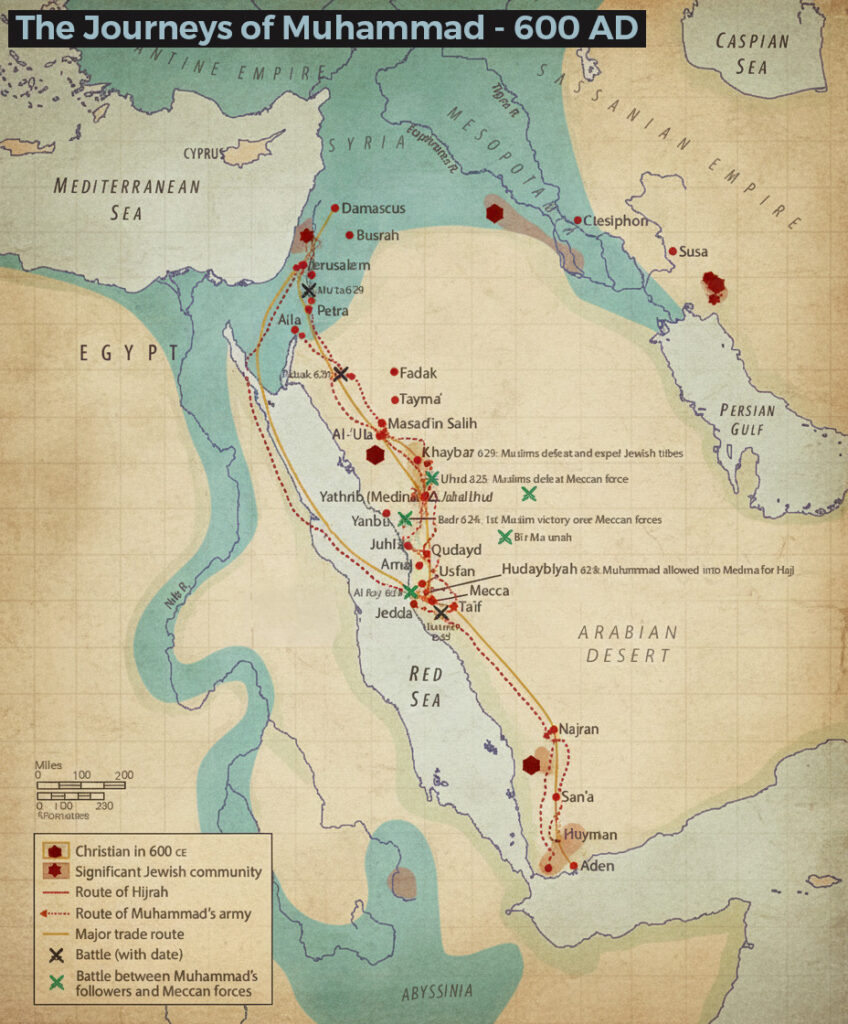
However, the Qur’anic verse itself only mentions a “Farthest Mosque” without naming a city. Some researchers have proposed alternative identifications, such as a site called al-Jiʿrāna near Mecca, arguing that Jerusalem’s role in Islam grew alongside the later Umayyad construction of the Dome of the Rock and al-Aqsa in the late 7th century. (Wikipedia)
From a strictly textual perspective we can say:
- The Qur’an gives a short reference to a night journey from Mecca to a blessed “Farthest Mosque”.
- Hadith and biographical sources, written generations later, firmly link this to Jerusalem.
- Archaeology shows that the monumental structures now associated with the story were built after Muhammad’s lifetime, which feeds ongoing debates about how the story developed historically.
Whatever the geography, the narrative itself places Muhammad in a liminal zone. The move from Mecca to the Farthest Mosque is the threshold, and the ascent that follows is where the interdimensional features intensify.
Physical journey or spiritual vision?
Inside the Islamic tradition there has never been a single agreed reading on “how” this travel occurred. Instead, we find a spectrum of interpretations that map surprisingly well onto modern questions about altered states, out-of-body journeys and non-ordinary dimensions.
Majority view: body and spirit together
Most pre-modern Sunni scholars held that Isra and Miʿraj involved the Prophet’s body and soul, not a dream or imagination. Contemporary scholars who adopt this view emphasise that if God can create the universe, transporting a human being across vast distances and through layered heavens in a night is not difficult. (About Islam)
This position has several theological functions. It:
- Confirms Muhammad as a uniquely favoured messenger.
- Reinforces belief in God’s ability to suspend ordinary physical constraints.
- Underlines the reality of heaven, hell and angelic beings as more than metaphors.
Some Sufi writings use bodily Miʿraj to argue for Muhammad’s incomparable status even in relation to the greatest saints, whose ascents are seen as purely spiritual. \
Visionary or spiritual-only interpretations
A minority of classical scholars, and a larger share of modern rationalist Muslims, have argued that the journey was spiritual or visionary. They often point to Qur’anic language stressing “signs” and dreams, and compare Miʿraj to powerful night visions experienced by prophets such as Abraham. (Dr Khalid Zaheer)
Modern essays from within the tradition sometimes frame Miʿraj as an advanced form of kashf, a lifting of the veil in consciousness that allows the Prophet to witness higher realities and receive the prescription of daily prayer, while his physical body remains in Mecca. (Ahmadiyya Movement)
From a UAP-research angle this looks similar to accounts of:
- Consciousness leaving the body while sensors register a sleeping or still subject.
- Journeys through structured “levels” populated by non-human intelligences.
- Time dilation where hours of experience map to minutes of clock time.
The difference is that in Miʿraj these phenomena are embedded inside a detailed theological framework rather than presented as anomalous science data.
External critics and textual historians
Non-Muslim historians generally approach Isra and Miʿraj as a religious narrative that crystallised over time.
Some secular critics treat Miʿraj as an imaginative composition or dream report that later gained canonical status. Muslim theologians respond that prophetic dreams and miracles are exactly how God communicates deeper realities, so the presence of shared motifs does not undercut authenticity.
UAPedia’s editorial stance is simple here: we acknowledge both the religious framing and the critical scholarship, and we do not try to adjudicate the truth of a foundational faith event. We can, however, map how the data lines up with patterns seen in other high-strangeness journeys.
Images, maps and artwork of the interdimensional journey
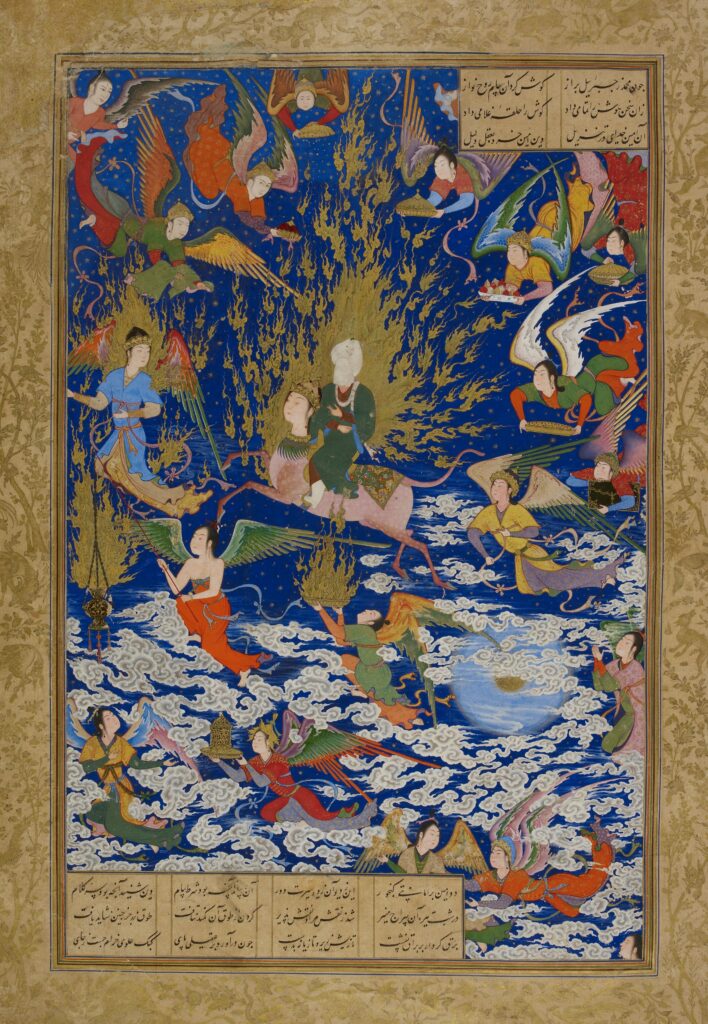
Although many Muslim communities avoid figural images of the Prophet altogether, other regions, especially Persianate cultures, produced a rich visual tradition of Miʿraj scenes.
Typical features include:
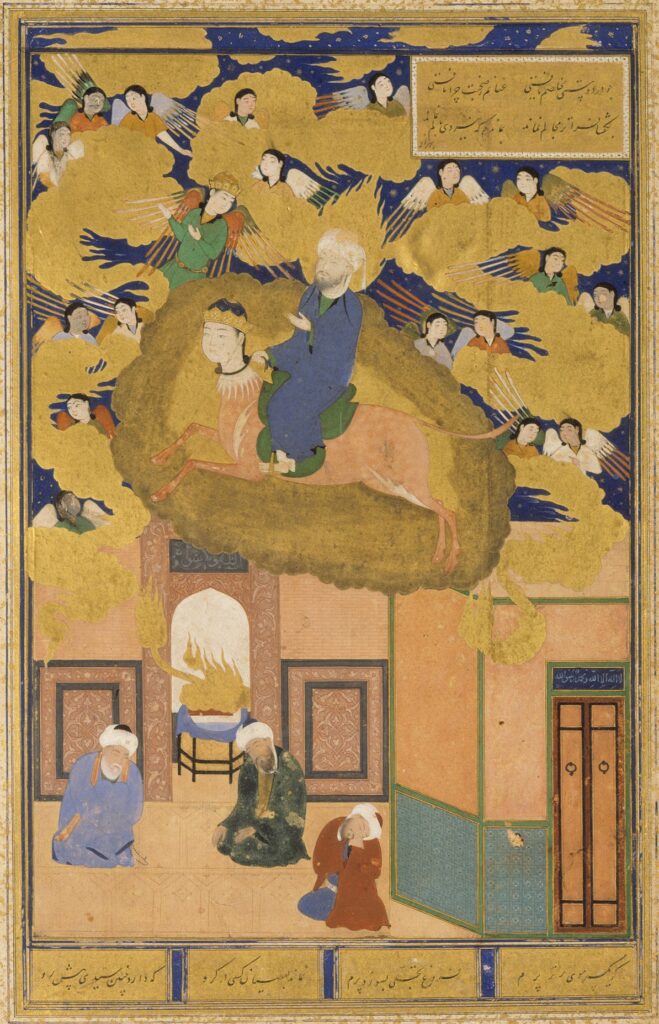
- Muhammad riding Buraq, often shown as a luminous, horse-like creature with wings and a human or angelic face – see illustration at the beginning of article. (The Metropolitan Museum of Art)
- Concentric rings or banks of clouds and stars indicating ascent through the heavens.
- Hosts of angels flanking the Prophet, sometimes offering trays and gifts. (Harvard Art Museums)
- A veil over Muhammad’s face in later works as an expression of reverence. (Seattle Art Museum)
Notable Miʿraj artworks that are now widely reproduced in textbooks and online include:
- A folio from Saʿdi’s Bustan with the Prophet on Buraq, attributed to Sultan Muhammad Nur, ca. 1525–35, now in the Metropolitan Museum of Art. (The Metropolitan Museum of Art)
- A Safavid painting of the ascent in a 16th-century Persian manuscript, analysed in depth by art historian Christiane Gruber. (University of Michigan LSA Sites)
- Timurid and Mughal Miʿraj manuscripts like the famous Mirajnama, whose details are showcased in Public Domain Review’s “Visual history of Buraq.” (The Public Domain Review)
In parallel, modern Muslim organisations use clean infographic maps to illustrate the journey’s Earthly leg, tracing stops such as Medina, Mount Sinai, Bethlehem and the vicinity of Moses’s grave, before a symbolic vertical line marks the ascent from Jerusalem into the skies. (Studio Arabiya)
For UAPedia readers, these visuals are more than devotional art. They are “data visualisations” of how generations of believers have imagined the topology of the journey: a hybrid of geographic travel and vertical, layered cosmos, traversed by an entity who is simultaneously human and uniquely attuned to higher dimensions.
Interdimensional travel and UAP frameworks
UAP researchers who adopt interdimensional or “ultraterrestrial” models pay close attention to ancient ascension narratives. Jacques Vallée and Chris Aubeck, in their historical survey “Wonders in the Sky,” explicitly place Muslim Miʿraj stories alongside other accounts of humans taken to other realms, noting the continuity across cultures of aerial journeys guided by luminous beings. (ia800500.us.archive.org)
From this perspective several features of Isra and Miʿraj stand out as data points.
The vehicle: Buraq as more than a horse
Buraq is described as an extraordinary, shining mount that can traverse enormous distances in an instant, yet is still framed as an animal created by God. (Studio Arabiya)
Interdimensional travel hypothesis (Speculation label: Hypothesis)
Some modern writers propose reading Buraq as a consciously “mythologised technology,” a way of describing a real but non-ordinary transport system in language accessible to 7th-century listeners. Within this framing Buraq might represent:
- A structured energy field that couples to the rider’s body.
- A conscious non-human entity that serves as a living craft.
- An induced shift of the Prophet’s awareness onto a higher-dimensional “carrier wave.”
This is not an Islamic doctrinal view. It is a research analogy that tries to make sense of a being that behaves like both animal and vehicle. It should therefore be tagged clearly as Hypothesis, not as a verified claim.
Layered heavens and parallel realities
The Miʿraj takes Muhammad through “seven heavens,” each populated by different prophetic figures and angelic hosts. (AbdurRahman.Org)
In a UAP context this maps to:
- Reports of “stacked” realities where experiencers pass through multiple zones, sometimes meeting different entities at each level.
- The idea of a structured multiverse or set of parallel branes, hinted at in theoretical physics but experienced subjectively in altered states.
Vallée and others argue that whether you call these zones “heavens,” “fairy realms” or “other dimensions,” the core structure is similar. (Everand)
Speculation label: Researcher Opinion
From a UAPedia vantage point, Miʿraj belongs to a family of accounts where human consciousness is escorted through a nested, inhabited cosmos, rather than simply flying upward into physical outer space. That pattern deserves serious comparative study, without reducing it to either “just myth” or “straightforward spaceflight.”
Time dilation and the “one night” motif
The entire journey is framed as occurring in a fraction of the night. Yet in that interval Muhammad traverses continents, passes through multiple heavens, speaks with numerous beings and negotiates religious law. (Studio Arabiya)
This joins a larger pattern in both religious literature and modern UAP narratives where:
- Long sequences of experience are later reported to have taken place in a small external time window.
- Participants insist on the reality and coherence of the experience despite its temporal impossibility by ordinary physics.
Within interdimensional models, one explanation is that the experiencer’s consciousness is “decoupled” from ordinary space-time and reinserted with minimal elapsed Earth time.
Non-human intelligences and teleology
Unlike many modern UAP encounters, Miʿraj has a very clear purpose: to confirm Muhammad’s status and to institute the five daily prayers. (Bloomsbury)
The beings encountered are not ambiguous “greys” or unknown entities. They are earlier prophets and angels within a well-defined Abrahamic cosmology. The journey’s content is intensely theological, not technological.
For that reason some UAP analysts see Miʿraj as evidence that whatever intelligence interacts with humanity may choose to speak in the symbols and structures of a given culture, rather than in “alien hardware” that would be incomprehensible to that audience.
Claims taxonomy
Verified
These are facts that multiple independent sources agree on and that do not depend on accepting the miracle itself.
- The Qur’an contains passages that classical and modern Muslim commentators associate with Muhammad’s Night Journey and Ascension, especially Surahs 17 and 53. (Quran.com)
- Early hadith collections and biographical works, including traditions in Sahih al-Bukhari and the sīra of Ibn Ishaq as transmitted by Ibn Hisham, preserve detailed narratives describing the journey, the role of Buraq and the meetings with earlier prophets.
- The Night Journey and Ascension quickly became central in Islamic devotion, legal theory and art, with a major modern scholarly monograph dedicated to their reception history. (Bloomsbury)
- The event is commemorated widely on the 27th night of the month of Rajab, with regional variations in practice from West Africa to South Asia and Indonesia. (Wikipedia)
Probable
These are positions strongly supported by historical scholarship but still open to refinement.
- The detailed Miʿraj narratives in hadith and sīra show clear signs of literary development over time, with early shorter versions expanding into more elaborate cosmological tours as the centuries progress. (Wikipedia)
- The identification of al-masjid al-aqsā with Jerusalem likely solidified in connection with the Umayyad building program on the Temple Mount and evolving Muslim claims about the city’s sanctity. (Wikipedia)
Disputed
These are points with credible scholars or communities on more than one side.
- Whether the journey occurred with Muhammad’s body and soul, or in a purely spiritual or visionary mode. Classical jurists and theologians have argued both ways, and modern Muslim authors continue the debate. (Answering Islam)
- Whether the Qur’anic phrase “the Farthest Mosque” must refer to Jerusalem or could have originally indicated another sanctuary nearer Mecca, later reinterpreted in light of political and devotional developments. (Wikipedia)
Legend
Within the taxonomy, “Legend” does not mean “false,” it means “a narrative preserved primarily in religious and cultural memory.” The following sit in that category.
- The full literalistic picture of Muhammad riding a winged steed into the skies, passing through physically layered heavens and conversing face to face with God in a single Earth night. For believers this is a miracle; for historians it is an article of faith that lies beyond empirical testing. (Wikipedia)
- Folk elaborations that add extra marvels, such as Buraq leaving sparks of light at every stride that become future shrines, or extremely detailed timetables of the journey’s stages. These rarely appear in the earliest strata of sources and vary regionally. (Quran Gallery App)
Misidentification and Hoax
- There is no serious evidence that the traditional Miʿraj accounts are deliberate hoaxes. They are transmitted as sacred narratives inside a large community of practice.
- Attempts to “debunk” Miʿraj by treating it as a misunderstood meteor, comet or mundane aerial event do not line up well with the actual content of the story, which is about structured realms and beings, not about a single light in the sky. Those efforts tell us more about modern anxieties than about 7th-century Mecca. (Wikipedia)
Speculation labels
Hypothesis
- Reading Buraq as a symbol for a non-ordinary transport mechanism (field, vehicle or conscious entity) that mediates interdimensional travel.
Researcher Opinion
- Vallée-style arguments that Miʿraj belongs to a recurring pattern of human encounters with other realms, where culture shapes the imagery but not the underlying structure. (ia800500.us.archive.org)
None of these speculative frames replaces the Islamic theological interpretation. They are analytical overlays intended for comparative UAP research.
References
Buckley, R. P. (2013). The night journey and ascension in Islam: The reception of religious narrative in Sunnī, Shīʿī and Western culture. Bloomsbury. (Bloomsbury)
Colby, F. S. (2008). Narrating Muḥammad’s night journey: Tracing the development of the Ibn ʿAbbās ascension discourse. SUNY Press. (Discussed in summary form in Isra and Miʿraj overviews.) (Dokumen)
Dar al-Ifta al-Misriyyah. (n.d.). The miracle of the night journey and heavenly ascension of Prophet Muhammad. (موقع دار الإفتاء المصرية)
Quran.com. (n.d.). Surah al-Isrāʾ (17); Surah al-Najm (53). (Quran.com)
Rubin, U. (2024). Muḥammad’s night journey (isrāʾ) to al-masjid al-aqṣā. In Aspects of the earliest origins of Islamic sanctity of Jerusalem. Routledge. (Taylor & Francis)
Vuckovic, B. O. (2004). Heavenly journeys, earthly concerns: The legacy of the miʿraj in the formation of Islam. Routledge. (Academia)
Vallee, J., & Aubeck, C. (2010). Wonders in the sky: Unexplained aerial objects from antiquity to modern times. Tarcher. (Miʿraj discussed among Mediterranean ascension narratives.) (ia800500.us.archive.org)
Metropolitan Museum of Art. (n.d.). “The Miʿraj or The Night Flight of Muhammad on his Steed Buraq”, folio 3v from a Bustan of Saʿdi. (The Metropolitan Museum of Art)
Brooklyn Museum. (n.d.). Miʿraj (Ascension) of the Prophet Muhammad, folio from an illustrated Khamsa. (Seattle Art Museum)
Public Domain Review. (2016). Out of their love they made it: A visual history of Buraq. (The Public Domain Review)
SEO keywords
Isra and Miraj, Islamic Prophet Muhammad night journey, Muhammad interdimensional travel, Buraq winged steed, Miʿraj seven heavens, al-Aqsa Mosque Night Journey, Islamic ascension narratives and UAP, Vallée Wonders in the Sky Miʿraj, interdimensional travel religious experiences, high strangeness in Islam, Near East heavenly journey parallels, UAP ultraterrestrial hypothesis Islam.