
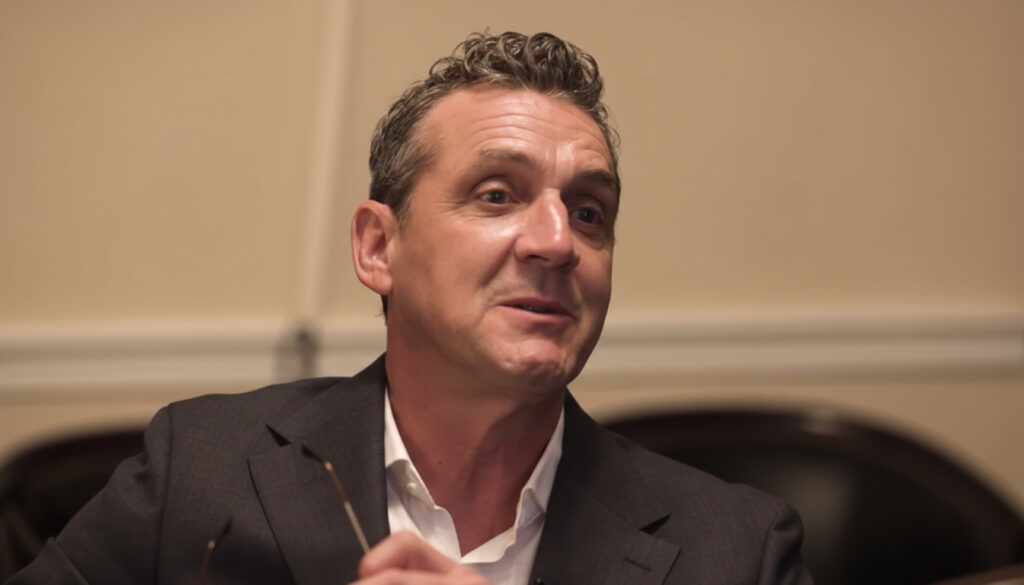
English-born American filmmaker James C. Fox has spent nearly three decades turning leaked memos, shaky cockpit recollections, and forgotten small-town incidents into a coherent story about a non-human presence in our skies.
Where many directors flirt with the UAP subject for a quick streaming bump, Fox has treated it as a life’s work. Across films like UFOs: 50 Years of Denial?, Out of the Blue, I Know What I Saw, The Phenomenon, Moment of Contact, and The Program, he has cultivated a particular lane: high-production documentaries built on military, intelligence, and civilian testimony that challenge official silence without collapsing into easy answers.
Today Fox sits at a crossroads of pop culture and policy. Lawmakers watch his cuts in private screening rooms. Debrief reporters, ex-CIA officers, and Senators endorse his work on the record. (The Debrief) And on long podcast appearances he talks without notes about radar tracks in the 1950s, whistleblower protections in 2023, and the existential shock that would follow open confirmation of non-human intelligence. (Ai Meeting Assistant)
We classify Fox simultaneously as a documentary filmmaker, a UAP investigator, and a disclosure advocate whose work now shapes how the public and parts of government talk about UAP.
Early life and first contact with the UAP subject
Publicly available biographical details on Fox are surprisingly sparse compared to his visibility. He was born James C. Fox on 25 April 1968 in England and later became a naturalized American. Almost everything we know about his formative years comes from interviews he has given once journalists turn the conversation away from cases and toward the person behind the camera.
In a 2023 profile for The Examiner News, Fox recalls his fascination beginning in the mid-1990s. Immersed in the usual pop-culture “little grey men” imagery, he noticed that buried under the noise were pilots, radar operators, police officers, and ordinary families reporting structured craft that resisted easy explanation. (Examiner News) Rather than treat those reports as a cultural curiosity, he decided to build what he called “the seminal feature-length documentary” on the topic, even if it took decades. (Examiner News)
That ambition pushed him out of the comfortable lane of television specials and into a long-form, multi-film project that would evolve along with the UAP story itself.
Building a filmography around UAP
Fox’s career is unusually coherent. With one major detour into environmental catastrophe, almost every film he has made circles the same question:
What happens if we take the best UAP witnesses and evidence at face value and follow the story wherever it leads?
UFOs: 50 Years of Denial? (1997–1999)
Fox’s first major work on the subject, UFOs: 50 Years of Denial?, was produced in the late 1990s and later re-released in expanded form. (IMDb) The documentary walks through Roswell, early Air Force investigations, and classic cases, featuring figures like Apollo astronaut Edgar Mitchell and former intelligence officers who discuss alleged crash retrievals and reverse-engineering attempts. (Tubi)
It already shows Fox’s core instincts: put decorated officials and scientists on camera, lock in on their testimony, and let them contradict the dismissive tone of many government and media treatments of the subject.
Out of the Blue (2003)
Out of the Blue is where Fox truly enters the modern UAP conversation. Co-directed with Tim Coleman and Boris Zubov and narrated by Peter Coyote, the film compiles high-credibility cases from around the world, from military intercepts to mass sightings. (Factual America Podcast)
To promote the film’s airing on the Sci Fi Channel (now Syfy), Fox worked with the network on a campaign urging more government transparency around UAP. In one famous moment reported by CBS News, he learned that former president Jimmy Carter had once filed a UAP report. After being repeatedly rebuffed, Fox approached Carter directly at a book signing and captured a brief on-camera acknowledgment that the sighting remained unexplained. (CBS News)
It was early evidence of Fox’s willingness to push past protocol when he believes historical testimony is at stake.
I Know What I Saw (2009)
With “I Know What I Saw”, Fox refined the “high witness” formula. The film grew out of a National Press Club event where pilots, air traffic controllers, and officials from several countries testified about close encounters with structured craft that performed beyond known aerospace capabilities.
Rather than simply recycling sensational footage, Fox anchored the narrative in these in-person testimonies. The film helped popularize cases like the 1997 Phoenix Lights and pushed them into a more serious, policy-relevant frame rather than the late-night talk radio niche. (The Debrief)
Pretty Slick (2016)
Fox’s one major non-UAP detour, Pretty Slick, examines the Deepwater Horizon oil spill. While not about anomalous phenomena, it showed that his investigative instincts translate beyond UAP: long-form interviews, archival digging, and a focus on how institutions manage (and sometimes obscure) disaster. Many in the UAP community see this as proof that Fox is not a single-issue director but someone interested more broadly in secrecy, accountability, and long-term risk.
The Phenomenon: a modern cornerstone of UAP media
Released in 2020, The Phenomenon is the film that propelled Fox from UAP niche figure to central voice in the broader disclosure era.
Structured as a sweeping history from the 1940s to the post-2017 Pentagon videos, the documentary weaves together:
- archival interviews with Kenneth Arnold, Jesse Marcel, and other early witnesses
- case studies like the Ariel School encounter, Westall, Socorro, and Rendlesham Forest
- the Nimitz case of the “Tic Tac” and related modern Navy encounters
- and on-camera interviews with Senator Harry Reid, former Deputy Assistant Secretary of Defense for Intelligence Christopher Mellon, John Podesta, former New Mexico governor Bill Richardson, and journalist Leslie Kean, among others.
The premise is simple: the volume and quality of UAP events, especially those involving multi-sensor data and nuclear sites, cannot be dismissed as misidentifications or atmospheric quirks. The film calls for serious scientific study and public transparency, echoing Kean’s book and later UAPedia’s own editorial approach that treats government sources as inputs rather than verdicts.
Reception and influence
The Phenomenon received broadly positive coverage across both UAP-friendly and mainstream outlets. A review for Film Festival Today described it as an “intelligent and thorough examination” that could sway skeptics, even while noting that its TV-style presentation and information density might overwhelm some viewers.
In a widely shared piece for The Cut, journalist Katie Heaney framed Fox as one of the rare UAP documentarians whose work is “well reported” rather than built on recycled footage, and highlighted his Ocean’s Eleven-style ensemble of serious witnesses and officials.
Inside the UAP world, the endorsements were even more explicit. As summarized by Cristina Gomez at The Debrief, former Senate Majority Leader Harry Reid said the film “makes the incredible credible”, while former CIA officer Jim Semivan, Jacques Vallée, and Lue Elizondo each praised it as a benchmark for disclosure-focused documentaries. (The Debrief)
Crucially, The Debrief piece also notes that The Phenomenon was screened for “many high ranking members of Congress” and members of a recent presidential administration, indicating that Fox’s work functions as unofficial briefing material in some policy circles. (The Debrief)
Moment of Contact and the Varginha case
If The Phenomenon is Fox’s bid for a definitive global overview, Moment of Contact (2022) is his deep dive into one of the most contested modern cases: the 1996 events in Varginha, Brazil.
The film assembles:
- testimony from local witnesses, including the young women who reported seeing a crouched, brown-skinned entity with large red eyes
- interviews with former Brazilian military and emergency personnel who suggest an unusual operation took place
- and archival material on the Brazilian Air Force’s handling of UAP, a subject already catalogued in UAPedia’s taxonomy of international investigations.
Fox positions the case as a possible non-human biological encounter linked to an earlier crash, with entities allegedly captured and transported by Brazilian authorities.
Controversies around Moment of Contact
The film has been polarizing. Within UAP circles, it reignited global interest in Varginha and prompted new witness outreach. To skeptics, it exemplifies the danger of over-relying on decades-old testimony and rumor-rich environments.
It is supported by multiple consistent witnesses and some suggestive documentary fragments, yet faces counter-arguments and lacks the multi-sensor or contemporaneous physical data that would move it into Verified or Probable.
Moment of Contact: New Revelations of Alien Encounters (2025)
In 2025, Fox followed up with Moment of Contact: New Revelations of Alien Encounters, a digital-first sequel that adds new interviews and explores additional claims tied to the Brazilian saga.
Early coverage from genre outlets frames it as a “deeper cut” for viewers already familiar with the original film rather than a standalone introductory piece.
The Program: documenting the politics of disclosure
Released in December 2024, The Program marks Fox’s pivot from case-based storytelling to legislation and whistleblowers. The documentary, produced through Lab 9 Films and CE3, “explores the unprecedented bipartisan congressional effort to uncover what intelligence agencies really know about UFOs, now referred to as UAP.” (Letterboxd)
The cast list alone reads like a snapshot of the post-2017 disclosure landscape:
- David Grusch, the former intelligence official whose sworn statements about crash retrieval and reverse-engineering programs triggered historic hearings
- Christopher Mellon, long a bridge between government insiders and journalists
- Representative Tim Burchett, one of the most outspoken members of Congress on UAP
- Physicist Hal Puthoff, associated with AAWSAP/AATIP and cutting-edge propulsion research. (Letterboxd)
On his December 2024 appearance on The Joe Rogan Experience (episode #2246), Fox used The Program as a springboard to talk through the politics of non-human intelligence, the constraints imposed by classification, and the potential societal shock of open confirmation.
The film effectively frames UAP disclosure as a struggle between:
- whistleblowers and sympathetic legislators
- legacy secrecy architectures like Special Access Programs
- and newer offices such as AARO, whose 2024 Historical Review concluded that it found no verified evidence of long-running crash retrieval efforts, a statement UAPedia treats as a Tier 2 government position rather than a final factual adjudication. (UAPedia – Standards)
Fox’s role in the UAP community: investigator, amplifier, activist
Boots on the ground
Cristina Gomez’s long-form interview at The Debrief describes Fox as having spent “27 years” conducting “boots on the ground” investigations into UAP cases across the world. (The Debrief) His repeated returns to locations like Phoenix, Socorro, Ariel, and Varginha show a pattern: he does not treat cases as closed simply because a formal investigation ended without resolution.
UAP ACT NOW and political pressure
In the same piece, Gomez notes that Fox helped spearhead a group of disclosure advocates under the banner “UAP ACT NOW”, aimed at pressuring Congress to release as much previously classified information as possible. (The Debrief) The original campaign site has since been repurposed for unrelated content, but contemporary coverage and interviews document its existence as a targeted call for legislative action rather than a generic petition. (The Phenomenon)
Public appearances and media footprint
Fox’s media presence is unusually broad for a niche documentary director:
- Three appearances on The Joe Rogan Experience: a joint episode with Jacques Vallée (2020) and two solo episodes in 2023 and 2024.
- Podcast and radio interviews ranging from The Lone Star Plate to Debriefed: Digging Deeper and other UAP-focused shows, where he often previews new footage and discusses behind-the-scenes interactions with officials.
- Appearances in UAP-oriented news coverage on outlets like NewsNation and regional TV when new films or major hearings hit.
On X his profile @jamescfox describes him as the director and producer of The Program, Moment of Contact, The Phenomenon, I Know What I Saw, and Out of the Blue, and he interacts regularly with figures such as Christopher Mellon, Ross Coulthart, Bryce Zabel, and UAP-focused podcasts. (TwStalker)
This network of journalists, ex-intelligence officials, and activists forms a loose disclosure coalition in which Fox is a key visual storyteller.
Known associates and recurring collaborators
Fox’s films and advocacy sit at the intersection of several UAPedia categories. Key recurring associates include:
- Jacques Vallée – featured in multiple films and joint Rogan appearance; represents the data-driven, high-strangeness wing of UAP research.
- Christopher Mellon – appears in The Phenomenon and The Program and often amplifies Fox’s work on social media; central figure in bringing Navy UAP encounters to public attention.
- Leslie Kean – interviewed in The Phenomenon; her journalism on AATIP and crash retrieval claims overlaps considerably with Fox’s narrative universe.
- Lue Elizondo – former AATIP head whose testimony and commentary feature in the marketing and fan discourse around The Phenomenon and The Program. (The Debrief)
- Jim Semivan, Garry Nolan, George Knapp – appear in or publicly endorse Fox’s work and recirculate his clips when new legislative developments occur. (The Debrief)
Together, these figures occupy overlapping slots in UAPedia’s “Investigators & researchers”, “Public figures & advocates”, and “Whistle-blowers & insiders” subcategories.
Government interaction and UAPedia’s editorial lens
Fox is not a government insider, but his career is defined by interviewing those who are or were. The Phenomenon alone captures testimony from Reid, Mellon, Podesta, Fife Symington, and others about incidents and programs they believe have been under-reported or misrepresented. (Wikipedia)
From UAPedia’s editorial perspective on government sources:
- These on-camera statements count as Tier 4: Cleared personnel testimony, which is high-value but still mapped into the Claims Taxonomy rather than treated as automatic confirmation.
- Official responses such as AARO’s historical report, which currently disputes the existence of long-running crash retrieval programs, sit in Tier 2: Official reports and policy documents and are weighed against multi-witness cases and whistleblower statements rather than overriding them.
Fox’s body of work arguably embodies this stance. His films rarely ask audiences to choose between “believe the Pentagon” and “believe the witnesses”. Instead, they highlight the gaps between them and invite viewers to consider that some information may sit behind waived or bigoted Special Access Programs that escape standard oversight. (UAPedia – Standards)
Controversies and criticisms
While widely respected in UAP circles, Fox’s approach raises recurring debates.
- Evidentiary balance
- Skeptical reviewers of Moment of Contact argue that Fox under-weights mundane explanations and does not always ask probing follow-up questions that could clarify memory distortions or local rumor. (Movie Nation)
- Some reviewers of The Phenomenon found its information density hard to parse and suggested that the documentary at times feels like a sophisticated TV special rather than fully cinematic work.
- Narrative framing toward non-human intelligence
- Fox openly rejects the idea that most well-documented UAP cases can be explained by misidentification, classified aircraft, or hoaxes. His films are constructed around the hypothesis that there is a genuine non-human component. This perspective resonates with much of the UAP community but is criticized by some scientists as starting from the conclusion rather than the data. (Factual America Podcast)
- Crash retrieval and “the program” claims
- By foregrounding testimony from figures like Grusch in The Program, Fox amplifies specific claims that the United States and other governments have run clandestine crash retrieval and reverse-engineering efforts for decades. AARO’s historical report explicitly disputes having found evidence of such legacy programs within its remit, though UAPedia’s editorial standard notes that such denials may be structurally limited by compartmentalization. (UAPedia – Standards)
In our Claims Taxonomy, these high-stakes assertions currently sit as Disputed, pending further corroboration, while many of the underlying sighting events themselves occupy Verified or Probable slots. For detailed information please visit the articles of each case.
Selected works and publications
Documentary films
- Fox, J. (Director). (1997). UFOs: 50 Years of Denial? [Documentary film]. Ufo Central Home Video. (Rotten Tomatoes)
- Fox, J. (Director). (2003). Out of the Blue [Documentary film]. UFO Films. (Factual America Podcast)
- Fox, J. (Director). (2009). I Know What I Saw [Documentary film]. UFO Films. (Wikipedia)
- Fox, J. (Director). (2016). Pretty Slick [Documentary film]. [Deepwater Horizon oil spill]. (Wikipedia)
- Fox, J. (Director). (2020). The Phenomenon [Documentary film]. CE3; 1091 Media. (Wikipedia)
- Fox, J. (Director). (2022). Moment of Contact [Documentary film]. CE3 Films. (Wikipedia)
- Fox, J. (Director). (2024). The Program [Documentary film]. Lab 9 Films; CE3 Films. (Letterboxd)
- Fox, J. (Director). (2025). Moment of Contact: New Revelations of Alien Encounters [Documentary film]. (Wikipedia)
References
Gomez, C. (2021, April 19). James Fox: Being close to the intelligence [Video + article]. The Debrief. (The Debrief)
Stone, A. (2023, July 17). My interview with acclaimed “Phenomenon” director James Fox. The Examiner News. (Examiner News)
Conroy, E. (2020, October 6). Director of “The Phenomenon” wants to bring discussion of UFOs into the mainstream. San Antonio Express-News. (Wikipedia)
Heaney, K. (2020, October 7). My favorite hot ufologist has a new documentary. (The Cut)
Tran, H. (2020, October 6). Film review: UFO documentary “The Phenomenon” is acutely convincing. (Film Festival Today)
SEO keywords
James Fox UAP biography, James Fox The Phenomenon documentary, James Fox Moment of Contact Varginha, James Fox The Program David Grusch, UAP disclosure filmmaker James Fox, James Fox Joe Rogan UAP, Out of the Blue James Fox, I Know What I Saw documentary, UAP ACT NOW James Fox, UAP crash retrieval programs documentary, Varginha Brazil 1996 Moment of Contact, The Phenomenon 2020 UAP film, UAP congressional hearings documentary, James Fox UAP investigator profile