
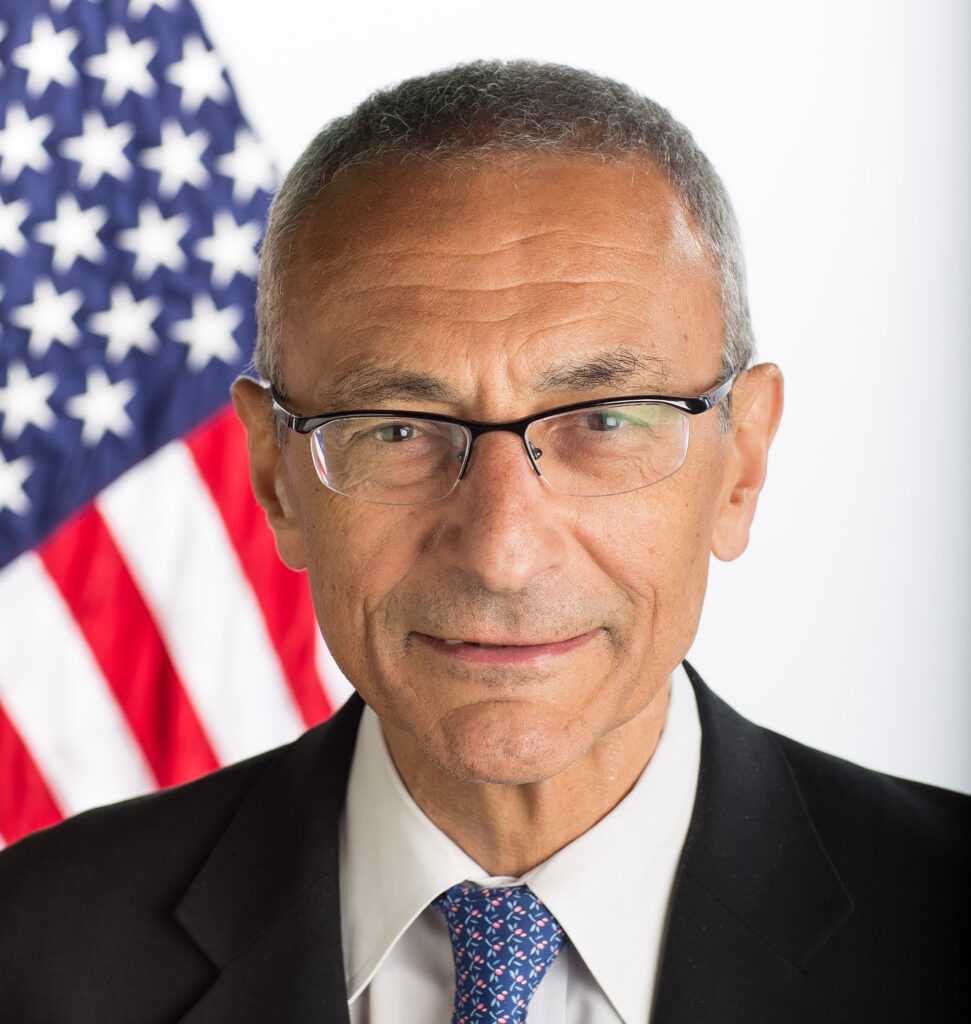
On his last day as counselor to President Barack Obama in February 2015, John Podesta sent a single, mischievous tweet that lit up the internet.
“Finally, my biggest failure of 2014: once again not securing the disclosure of the [UAP] files. #thetruthisstilloutthere.” (The Independent)
It sounded like a joke. Reporters ran light features about the “X-Files fan” in the West Wing. But if you look at Podesta’s record, that quip was not a throwaway. For more than two decades he has been one of Washington’s most persistent inside-players pushing for declassification of government records on what previous eras called “UFOs,” now formally labeled UAP.
Along the way he helped front a major Freedom of Information Act campaign, wrote the foreword to Leslie Kean’s influential book on UAP, appeared in a History Channel documentary, traded emails with Tom DeLonge and Apollo astronaut Edgar Mitchell about non-human intelligence, and became a minor folk hero to disclosure activists who dreamed of a Clinton-Podesta “open files” presidency.
This is the odd dual life of John Podesta. Inside the Beltway he is best known as a master strategist to three Democratic presidents. Inside the UAP world he is the rare political heavyweight who keeps publicly saying that it is time to open the books.
From Chicago to the Situation Room
John David Podesta Jr. was born in Chicago in 1949 to a Greek American mother and Italian American father. He grew up in a working-class neighborhood on the city’s Northwest Side, attended Lane Tech High School, then Knox College, where he volunteered for Eugene McCarthy’s 1968 presidential bid. He earned his law degree from Georgetown University in 1976.
By the late 1970s he was working as counsel on the Senate Judiciary Committee and its subcommittees on security, terrorism and regulatory reform. In 1988 he and his brother Tony launched Podesta Associates, a lobbying and public affairs firm that would eventually become a fixture in Washington.
Podesta’s long partnership with Bill Clinton began in 1970 on a Connecticut Senate campaign. When Clinton reached the White House in 1993, Podesta followed, serving first as staff secretary and senior policy adviser, then deputy chief of staff, and finally chief of staff from 1998 to 2001.
Inside Clinton-world he gained a reputation as a disciplined manager with a geeky streak. He pushed Executive Order 12958, which set tougher standards for classification and led to the declassification of hundreds of millions of pages of diplomatic and intelligence records. Podesta later called that program the administration’s “biggest accomplishment.”
That crusade against over-classification is the through-line that eventually merges his conventional career with his unconventional interest in UAP.
Center for American Progress, Obama and Biden
After leaving the Clinton White House, Podesta founded the Center for American Progress (CAP) in 2003, turning it into one of the most influential progressive think tanks in the United States.
He co-chaired Barack Obama’s 2008 transition team then returned to the White House in 2014 as counselor to President Obama, focusing on climate and energy policy.
Under President Joe Biden, Podesta came back yet again, this time as senior adviser for clean energy and then as the administration’s top international climate diplomat, overseeing hundreds of billions of dollars in clean energy incentives from the Inflation Reduction Act.
All of which makes his side identity as “that UAP guy” in Washington all the more striking. Very few people with this kind of resume are willing to publicly acknowledge that they care about anomalous craft at all.
First contact: the 2002 declassification push
Podesta’s UAP activism surfaced publicly in 2002 at a news conference organized by the Coalition for Freedom of Information, a campaign backed by the Sci Fi Channel and investigative journalist Leslie Kean. The coalition was trying to pry loose NASA records about the 1965 Kecksburg, Pennsylvania, incident, where witnesses reported a bell- or acorn-shaped object crashing into woods before being removed by the military. (Space)
Standing next to Kean, Podesta used the kind of language he usually reserved for declassifying Cold War dossiers:
“It is time for the government to declassify records that are more than 25 years old and to provide scientists with data that will assist in determining the real nature of this phenomenon.” (TIME)
Here a sitting or recent White House chief of staff was telling cameras that the government should help scientists figure out “the real nature” of UAP. For activists, this was a milestone affirmation that the issue had at least one powerful friend inside the establishment. For skeptics, it was an amusing footnote.
Kean’s FOIA campaign soon escalated into a lawsuit against NASA. Podesta lent his name and credibility to that effort, appearing in Sci Fi Channel programming and press material and serving as a kind of senior patron for Kean’s investigative work. (Space)
This early phase matters because it links Podesta to the modern transparency movement that treats government files as one evidence stream among many and tries to wrestle them out of secrecy through legal means rather than leaks. That posture aligns closely with UAPedia’s editorial standard on government sources as “reliable for what they say and unreliable for what they omit.”
Lending his name to the “generals, pilots and officials” book
In 2010 Leslie Kean published UAPs: Generals, Pilots, and Government Officials Go on the Record (still marketed under the older label in mainstream bookstores). Podesta wrote the foreword. Book sellers and reviewers highlighted his presence prominently; one promotional blurb boasted that “with the support of former White House chief of staff John Podesta, Kean lifts the veil on decades of U.S. government misinformation.” (Barnes & Noble)
In his foreword Podesta praised Kean’s focus on high-caliber witnesses and systematic documentation and reiterated his call for disclosure. Contemporary coverage in the Los Angeles Times and elsewhere framed this as “John Podesta writes probing foreword for new book on UAP,” underscoring just how unusual it was for a senior political operative to endorse such a project. (Los Angeles Times)
The effect inside the field was to legitimize Kean’s work and, by extension, a data-first approach to UAP that emphasizes radar tracks, pilot reports and official documents rather than sensational narratives.
“Biggest failure”: the 2015 tweet and the Obama era
By the time Podesta returned to the White House under Obama, his fascination with UAP had become something of an open secret in Washington. Colleagues at CAP joked about his alien interest. (Vox)
On February 13, 2015, as he prepared to leave the administration, he summarized his year in a White House blog “year-in-review” list. Number ten was the now famous line about his “biggest failure” being the lack of UAP file disclosure, repeated in the tweet that went viral. (FOX 5 DC)
The wording was playful, but the underlying regret was not. The Obama Presidential Library now maintains a dedicated FOIA finding aid titled “Records related to John Podesta’s responses about [UAP] and UAP disclosure,” confirming that citizens have actively sought his internal correspondence on the topic. (Obama Library)
That FOIA description notes that the records encompass emails and public communications responding to questions about UAP and disclosure during his time as counselor, another data point that UAP was more than a private hobby; it was something he engaged from within government, at least at the level of public messaging.
Hillary 2016, Tom DeLonge and the WikiLeaks window
Podesta’s next act put him at the center of a political storm.
In 2015 he became chair of Hillary Clinton’s 2016 presidential campaign. Media outlets from Mother Jones to MSNBC ran stories arguing that “ETs for Hillary” might finally see some action, pointing to the Clintons’ history with the Rockefeller Initiative and to Podesta’s long record of calling for declassification. (Openminds.tv)
In a 2016 interview highlighted by HuffPost, Podesta reportedly said he had “convinced” Hillary Clinton to declassify more UAP records if she reached the Oval Office. The comment, combined with his 2015 tweet, cemented his status as the unofficial disclosure envoy for the campaign. (Internet Archive)
Then came the WikiLeaks email dump.
Among thousands of messages from Podesta’s hacked account were exchanges with Blink-182 frontman and To The Stars Academy founder Tom DeLonge. The emails showed DeLonge enthusiastically describing meetings with generals and scientists, referencing “classified science,” “DOD topics” and historic crash stories, and pitching Podesta on a multimedia project about “non-linear science.” (The Wall Street Journal)
Other leaked messages showed Apollo 14 astronaut Edgar Mitchell trying to brief Podesta on “non-violent spacefaring ETI” and zero-point energy. (Reddit)
The content of these emails was speculative and at times eccentric, but their mere existence proved that high-level campaign staff were engaging directly with UAP enthusiasts and at least listening to arguments about advanced propulsion, secrecy and contact. For the disclosure community it was electrifying. For Podesta’s political opponents it was fodder to mock him as obsessed with little green men.
Ancient Aliens and the mainstreaming of the “open files” message
In April 2018 Podesta appeared on the History Channel series Ancient Aliens in an episode titled “The UAP Conspiracy.” Commentators noted how unusual it was to see a former White House chief of staff sitting for an on-camera interview in a show better known for meme-worthy haircuts than for careful analysis. (IMDb)
Asked about Clinton and disclosure, Podesta reiterated that she would have “ordered a review” of classified UAP material and that he hoped for greater openness from future administrations. Conservative outlets pounced, accusing him of promoting far-reaching suspicions, while UAP advocates treated the appearance as further evidence that the topic was drifting into the mainstream.
By 2021 the landscape had shifted. The New York Times had revealed the Pentagon’s AATIP program, Congress had mandated a UAP report from the Director of National Intelligence, and mainstream media outlets were openly debating military videos of anomalous craft. (Vanity Fair)
Vanity Fair ran a profile of Podesta titled “I Hope the Mindset Has Changed: John Podesta Is Thrilled That Congress Finally Cares About [UAP].” In it he described his “decades-long mission to get the real skinny” and expressed satisfaction that lawmakers were finally paying attention. (Vanity Fair)
For a man whose public brand is climate policy and political hardball, it was striking that a major magazine was now describing him as a long-time activist on anomalous aerial phenomena.
Podesta’s public claims about UAP
Across his speeches, op-eds and interviews, several recurring themes emerge.
- Excessive secrecy
Podesta argues that the United States classifies far too much material in general, and that UAP files older than 25 years should be systematically declassified. He ties this to democratic accountability and to the scientific need for data. (TIME) - Phenomenon worthy of study
He stops short of asserting that UAP are definitely non-human, but repeatedly says the subject deserves serious scientific investigation rather than ridicule. In his 2002 and 2010 comments he described them as a genuine phenomenon whose “real nature” is still unknown. (NFOIC) - Transparency as risk management
Podesta frames openness not as a threat to security but as a way to build trust and allow the public to handle potentially disruptive information like adults. This mirrors his broader declassification philosophy from the Clinton years. - Political will, not technical difficulty, is the obstacle
His famous “biggest failure” line implies that disclosure is mainly a matter of leadership choices inside the White House and agencies, not a lack of legal tools or archival capacity. (The Independent)
Controversies and criticisms
John Podesta lives in a political hurricane that extends well beyond UAP. He became a central character in various internet narratives that attempted to tie his leaked emails to sinister plots. Those topics sit outside UAPedia’s scope and are mentioned here only because they shaped the public perception that anything Podesta touches is ripe for imaginative reinterpretation.
Specific to UAP, critiques cluster in three areas:
- Association with sensationalist media
Skeptical commentators argue that appearing on shows like Ancient Aliens undermines the seriousness of disclosure work by mixing policy arguments with speculative ancient astronaut content. (InsideSources) - Perceived promotion of extreme claims
His willingness to engage with figures like DeLonge and Mitchell, who speak freely about crash retrievals and zero-point energy, leads some to suspect he is sympathetic to highly speculative ideas, even when he rarely endorses them outright. (Reddit) - Criticism from open-government purists
Advocates who focus on conventional transparency sometimes grumble that Podesta’s UAP advocacy makes broader declassification work easier to dismiss as fringe, though others counter that his high profile helps normalize both conversations at once.
Despite this, mainstream outlets such as Vanity Fair still treat him as a credible voice on both governance and anomalous phenomena, which speaks to the unique niche he occupies. (Vanity Fair)
Implications for the UAP landscape
Podesta’s role has less to do with technical analysis and more to do with narrative and access.
- Bridging elite politics and UAP activism
Before figures like Senator Kirsten Gillibrand or Representative Tim Burchett became vocal on the issue, Podesta was the most prominent Washington insider speaking the language of declassification and transparency around anomalous craft. This helped normalize the idea that caring about UAP is compatible with holding serious national security jobs. (Wikipedia) - Legitimizing data-first journalism
His collaboration with Leslie Kean connected a rigorous journalistic approach with the credibility of a former White House chief of staff, making it easier for major publishers and outlets to treat UAP material as legitimate. (Barnes & Noble) - Expanding FOIA battles into the anomalous domain
By backing Kean’s Kecksburg lawsuit and appearing with the Coalition for Freedom of Information, Podesta helped demonstrate that FOIA and the courts, not only leaks and rumor, can be used to pry open anomalous case files. (Space) - Tying UAP secrecy to broader transparency debates
Because his main career focus is climate policy, democracy and governance, Podesta tends to fold UAP into a general critique of excessive secrecy. For UAPedia this is important context; it reminds readers that declassification fights over anomalous phenomena are part of a larger struggle for open government.
Selected references
Biographical overview at Wikipedia (Wikipedia)
Center for American Progress biography (Center for American Progress)
Independent coverage of his “biggest failure” remark (The Independent)
Discussion of his 2002 declassification call (TIME)
Vanity Fair profile (Vanity Fair)
UAPs: Generals, Pilots, and Government Officials Go on the Record (Barnes & Noble)
Obama Presidential Library FOIA finding aid on “John Podesta’s responses about UAP and UAP disclosure” (Obama Library)
SEO keywords
John Podesta UAP, John Podesta UFO files tweet, John Podesta disclosure advocate, Coalition for Freedom of Information Kecksburg, Leslie Kean generals pilots officials foreword Podesta, Hillary Clinton UAP campaign emails, Tom DeLonge John Podesta leaked emails, Edgar Mitchell Podesta zero point energy, John Podesta Ancient Aliens interview, John Podesta Vanity Fair UFO report, Obama aide biggest failure disclosure of UFO files, UAP declassification politics, Rockefeller Initiative Clinton Podesta, Center for American Progress John Podesta UAP interest, UAPedia John Podesta biography