
By mid-March 2026, as 3I/ATLAS was passing Jupiter, Avi Loeb, Harvard Professor and Founder of Project Galileon, tried to put a bow on months of blog posts, talks and interviews. In a Medium essay titled “What If 3I/ATLAS Is AI/ATLAS?,” he assembled what he called 22 “anomalies” that, in his view, keep an artificial origin for the object on the table. (Medium)
He grouped them into three clusters: geometric coincidences in the orbit and jet geometry, strange chemistry, and unusual physical behavior. Below is a narrative summary of those 22 points, following his own numbering but translated into plain language and placing them in the broader scientific context.
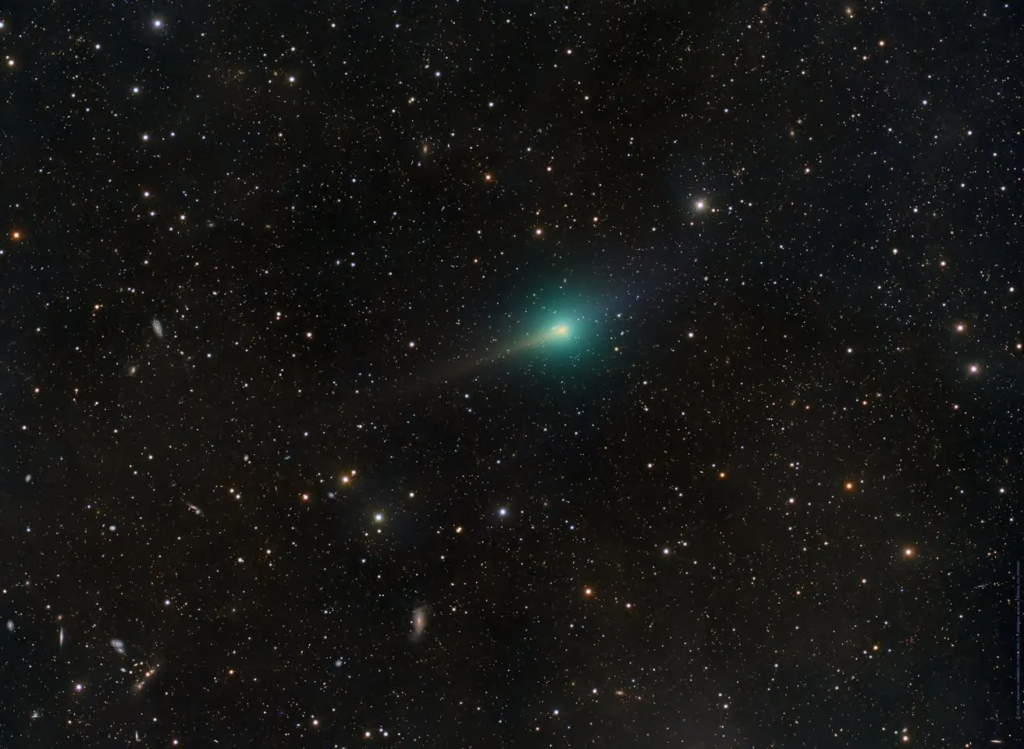
The “mysterious” 22 anomalies
- Mass budget discrepancy
Loeb’s updated list now begins with an argument that, if 3I/ATLAS is treated as a natural comet, the inferred nucleus size and the implied number density of similar objects require more solid material than low-metallicity protoplanetary disks are generally thought to supply. In his framing, this makes a purely natural origin harder to reconcile with current formation models. (Medium) - Retrograde orbit almost in the planetary plane
Most comets that visit the inner Solar System move in or near the ecliptic, which is the flat plane defined by the orbits of the planets. 3I/ATLAS is unusual because it is on a retrograde path, so it travels the “wrong way” relative to planetary motion, yet its orbital plane is still within about 5 degrees of the ecliptic. Loeb assigns this configuration a probability of roughly 0.2 percent and takes it as a hint that the trajectory might have been deliberately chosen rather than drawn randomly from interstellar space. (Medium)
Critics counter that this is an example of “after the fact” probability making. Many different orbital orientations would have looked “interesting” once noticed, and survey telescopes are naturally more sensitive to objects near the ecliptic, which boosts the chance that a new interstellar object we actually find will lie close to that plane. (Penn State Sites) - Close passes by Mars and Jupiter, but not Earth
The second anomaly is about timing and geometry. Loeb notes that the object’s path brings it tens of millions of kilometers from Mars and Jupiter while keeping it well away from Earth, and that at perihelion it was on the far side of the Sun and therefore essentially unobservable from terrestrial telescopes. He treats this pattern as “fine tuning” and suggests that a technological craft might wish to avoid flying close to a noisy, radar‑rich planet like Earth while still sampling other worlds. (Medium)
Mainstream orbital dynamicists see the same geometry as a natural outcome of a random hyperbolic orbit that happens to cut through the inner Solar System. Given the enormous volume of space and the long look‑back time to when the object entered the system, there are many ways to draw “suspicious” lines between its path and the planets after the fact. (NASA Science) - Perijove distance and Jupiter’s Hill sphere “match”
In March 2026, 3I/ATLAS will pass Jupiter at about 53.5 million kilometers, which is almost identical to Jupiter’s Hill radius, the zone where Jupiter’s gravity dominates over the Sun’s. Loeb notes that this distance matches to within observational uncertainties and builds a scenario where the object might be using the encounter to release smaller devices into quasi stable orbits near Jupiter’s Lagrange points, places where a probe can “park” with minimal fuel. (Medium)
Planetary scientists agree the match is numerically striking but remind readers that Hill radii exist for every planet. If one starts from the assumption “an alien probe would like to visit some dynamically special surface,” then almost any close pass can be reinterpreted as a hit. - A tightly collimated sunward anti‑tail
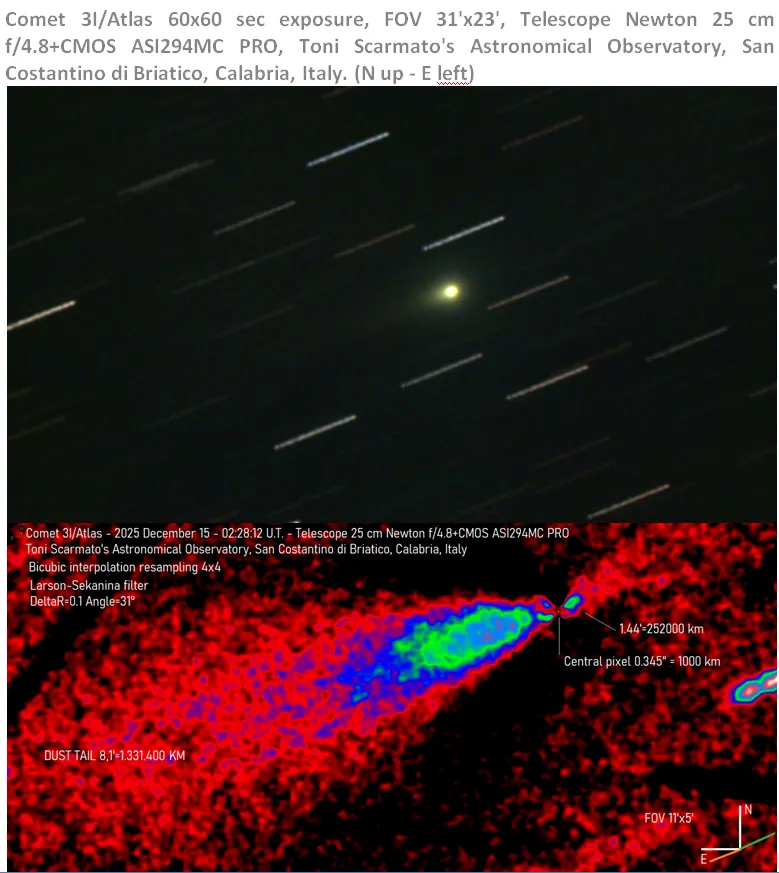
Comets sometimes show “anti‑tails,” dust structures that appear to point toward the Sun because of perspective. In 3I/ATLAS, analysis of a Hubble image from July 2025 and later ground based images suggests a very narrow sunward structure that Loeb describes as at least ten times longer than it is wide and extending roughly a million kilometers. He argues that sustaining such a straight, sunward jet is hard to reconcile with ordinary ice sublimation and instead imagines a beam of particles or plasma that could shield a technological craft from the solar wind. (Medium)
Polarimetric and imaging studies by independent teams instead interpret the feature as an unusual but natural dust jet in a low gravity environment whose particles are shaped and oriented by sunlight and the solar wind. (arXiv) - Rotation axis aligned with the Sun at entry
Loeb cites modeling that places the rotation axis of 3I/ATLAS within about 8 degrees of the direction to the Sun when the object entered the inner Solar System. He calculates that the odds of such an alignment for a random spin axis are about 0.5 percent. In his narrative, this can be read as the object “presenting its face” to the star as it arrives. (Medium) - Jet anchored close to the sun‑facing pole
Before perihelion, observers reported a wobbling jet that always stayed close to the sunward direction. Loeb interprets this as evidence that the base of the jet sits within roughly 8 degrees of the pole that faces the Sun. He assigns that configuration another 0.5 percent probability and treats the repeated alignment between jet, spin axis and Sun as additional geometric fine tuning. (Medium) - Mirror symmetry of the jet before and after perihelion
After the comet swung around the Sun, a similarly narrow jet again appeared to point almost directly at the Sun, now from the opposite side of the nucleus relative to the direction of motion. Loeb frames this as a kind of geometrical choreography: before perihelion the jet appears sunward ahead of the object’s motion, and after perihelion an equally collimated structure points sunward but now trails the motion. He multiplies his earlier 0.5 percent factors and gets what he calls a “tiny” probability for this pattern to occur by chance. (Medium)
In response, dynamical modelers like Jason Wright have pointed out that using several small a posteriori probabilities and multiplying them together is statistically suspect when the “anomalies” themselves were chosen after examining the data. (Penn State Sites) - Nightside activity and thermal insulation puzzle
Loeb adds a thermodynamic twist. In his reading of the geometry, the regions on the nucleus that host the anti‑tail jet are sometimes on the nightside for months at a time. For a natural icy body, heat would tend to conduct around the interior and gradually warm those regions anyway, which should make it hard to keep jet sources “off” when they are dark and “on” only when they face the Sun. He argues that this pattern would be easier to explain if the jets came from engineered thrusters controlled by an onboard system rather than by passive heating. (Medium) - Deflection angle equals twice the jet opening angle
As 3I/ATLAS rounded the Sun at perihelion, the Sun’s gravity bent its velocity vector by about 16 degrees. Loeb notes that this is almost exactly twice the measured opening angle of the narrow anti‑tail, about 8 degrees. For him, this symmetry is another coincidence: before perihelion one edge of the jet cone overlaps the sunward direction, and after perihelion the opposite edge can also align with the Sun, if the spin axis stays fixed in space. He treats the match between these angles as suggestive rather than definitive, but it still enters his “anomaly ledger”. (Medium) - Arrival direction near the “Wow!” signal
The final geometric coincidence is more psychological than dynamical. Loeb notes that the incoming direction of 3I/ATLAS lies within about 9 degrees of the patch of sky from which the famous 1977 “Wow!” radio signal was detected. He gives that angular coincidence a probability of about 0.6 percent and hints that repeated activity from one region could be meaningful. (Medium)
Radio astronomers point out that many other directions would also have seemed special: the galactic center, the anti‑center, bright nearby stars, or famous exoplanet systems. This is another classic example of what Josh Winn, in an email exchange that Loeb later published, calls the problem of “retrofitted” probability, where one only decides what counts as special after seeing the result. (Medium) - Gravitational deflection
The gravitational deflection of 3I/ATLAS by 16 degrees at perihelion (as discussed here), is exactly twice the opening angle of the anti-tail before perihelion. This coincidence allows the wobbling jet around the rotation axis to generate an anti-tail in the direction of the Sun before perihelion and a counter jet on the opposite pole after perihelion, with a jet opening angle of 8 degrees on both poles. (Medium) - Three symmetric mini-jets
In the March 2026 version of his argument, Loeb adds a new claim based on processed Hubble images from late 2025 into early 2026. Using Larson-Sekanina filtering, he says the data reveal three mini-jets roughly 120 degrees apart. He presents that symmetry as suggestive of controlled or engineered activity rather than irregular cometary venting. - Sideways non-gravitational acceleration
Loeb’s updated anomaly list adds a specific dynamical claim: that the non-gravitational acceleration of 3I/ATLAS was not directed simply away from the Sun but included a significant sideways component. In his view, that makes simple outgassing interpretations less straightforward. - Alignment with Sun-Earth angle
On January 22, 2026, 3I/ATLAS will align with the Sun-Earth axis to within an extraordinarily small angle of 0.69 degrees (as discussed here). At that time its anti-tail will be pointing at Earth. (Medium) - Nickel without much iron
Spectroscopic studies of 3I/ATLAS show emission lines from gaseous nickel and cyanide that are much stronger, relative to iron and to each other, than in thousands of previously catalogued comets, including the earlier interstellar visitor 2I/Borisov. (Medium) Loeb highlights this pattern and links it to an industrial “carbonyl” process used on Earth to produce nickel alloys, where nickel carbonyl gas is an intermediate. He argues that this chemical fingerprint has not been seen in natural comets and could hint at processing by technology, or at least at material that has passed through an engineered environment. (Medium)
Planetary chemists accept that the nickel signal is striking but suggest that unusual primordial environments or selective outgassing from a heterogeneous nucleus could also produce odd elemental ratios, especially in an object that formed around another star. (arXiv) - Anti-tail particle size
The anti-tail is capable of penetrating hundreds of thousands of kilometers through the solar wind and the solar radiation. In order not to be stopped, the dust particles must be much larger than common sub-micron particles of interstellar dust (as discussed here). However, if the particles are bigger than a millimeter, then they must carry an untenable amount of mass in order to account for 99% of the scattered sunlight around 3I/ATLAS, as observed in the Hubble images. (Medium) - Isotopic ratios suggesting a rare birth environment
Loeb now adds unusual hydrogen and carbon isotope ratios to his list of composition anomalies. He argues that the reported D/H and 12C/13C values differ markedly from Solar System comets and point to formation in an unusually cold, low-metallicity environment. - Methane as a layered-composition or biosignature puzzle
Loeb argues that methane was detected only after perihelion even though carbon dioxide and carbon monoxide were detected earlier, despite methane’s intermediate volatility. He treats this as evidence for a strange layered composition and notes that methane and related organic molecules can function as biomarkers in some contexts. (Medium) - Very massive, very fast, and allegedly too common
Based on Hubble and other data, mainstream analyses place the nucleus of 3I/ATLAS somewhere in the range of a few hundred meters to several kilometers in size, with a total mass tens of millions of tons or more. (NASA Science) Loeb notes that this makes it roughly a million times more massive than ʻOumuamua and a thousand times more massive than 2I/Borisov, while also moving faster through the inner Solar System than either of those earlier interstellar visitors. In his own probability calculations he argues that, given current estimates of how much rocky material gets ejected into interstellar space, it is hard to randomly receive such a massive natural object once per decade, which again nudges him toward a “targeted” arrival story. (Medium) - Extreme negative polarization
Polarimetry measures how light becomes polarized when it scatters off dust. A consortium led by Zuri Gray found that 3I/ATLAS shows an unusually deep and narrow negative polarization curve, with values that are outside the range previously seen in comets and asteroids. (arXiv) Loeb highlights this as one of his anomalies and notes that the effect could be connected to the strange anti‑tail geometry. In his framing it is another hint that the object may belong to a completely different category of material, potentially even a “Trojan horse” that hides engineered structures inside a natural shell. (Medium)
The authors of the polarimetric study, however, interpret their own result as evidence that 3I/ATLAS extends the diversity of natural cometary materials rather than as a sign of technology. (arXiv) - Fast brightening and a very blue color near perihelion
Near closest approach to the Sun, 3I/ATLAS brightened more steeply than most catalogued comets and showed a reflectance spectrum that is bluer than the Sun in visible light. (Medium) In earlier writing, has floated the idea that such behavior might signal that some sort of “engine” turned on at perihelion.
How to read these “anomalies”
From a strict scientific standpoint, each item on Loeb’s list is either:
- A real and interesting measurement, such as the extreme negative polarization or unusual nickel abundances. (arXiv)
- A geometric or probabilistic pattern that looks special once pointed out, but that can be framed as a “coincidence” in different ways depending on what you decide to measure. (Medium)
NASA, ESA and multiple independent groups continue to treat 3I/ATLAS as a natural interstellar comet whose quirks expand our understanding of how other planetary systems eject icy bodies. (NASA Science) Their interpretation is that outgassing, dust dynamics and survey selection effects are enough to explain the observed behavior, including the non gravitational acceleration and the odd polarization curve.
Loeb’s own December 2025 follow up essay, “The 18 Anomalies of 3I/ATLAS: Should We Pay Attention to Them if They Were Not Forecasted?”, documents an email exchange with Princeton astrophysicist Josh Winn, who pushes back hard on the way these probabilities are constructed. Winn’s central point is that low “p‑values” assigned after you have already inspected the data cannot be treated as strong evidence that something is artificial, because one could always have chosen a different set of “surprising” features. (Medium)
From a researcher perspective, the anomaly list is important less as a proof that 3I/ATLAS is a craft and more as a window into Loeb’s approach. He is deliberately scanning interstellar visitors for any hint of techno signatures and refusing to assume that non‑human technology is off the table by default. That stance aligns with our editorial view that government and agency pronouncements, including from NASA, are valuable but not definitive, and that high quality outliers deserve sustained attention rather than reflexive dismissal. (NASA Science)
Whether future data and mission‑class observations of other interstellar objects confirm or erase these specific anomalies, the 22 have already secured their place in the evolving story of how the astronomical community reacts when a truly strange visitor appears from the dark between the stars.
References
Gray, Z., Bagnulo, S., Borisov, G., Kwon, Y. G., Cellino, A., Kolokolova, L., … Muinonen, K. (2025). Extreme negative polarisation of new interstellar comet 3I/ATLAS (C/2025 N1). arXiv preprint arXiv:2509.05181. (arXiv)
Loeb, A. (2025, November 23). Anomalies of 3I/ATLAS, organized by likelihood. Medium. (Medium)
Loeb, A. (2026, January 18). What If 3I/ATLAS Is AI/ATLAS? Medium. (Medium)
Loeb, A. (2025, December 17). 3I/ATLAS maintained a sunward jet after its gravitational deflection by 16 degrees at perihelion. Medium. (Medium)
Loeb, A. (2026, March 12). 3I/ATLAS is Fading Away, Leaving Us to Ponder Over Its 22 Mysterious Anomalies Medium. (Medium)
NASA. (2025). Comet 3I/ATLAS: Overview. NASA Solar System Exploration. (NASA Science)
NASA. (2025). Comet 3I/ATLAS facts and FAQs. NASA Solar System Exploration. (NASA Science)
Wright, J. T. (2025, November 9). Loeb’s 3I/ATLAS “anomalies” explained. AstroWright blog, Penn State. (Penn State Sites)
SEO keywords
3I/ATLAS anomalies list, Avi Loeb 18 anomalies, 3I/ATLAS artificial probe hypothesis, interstellar comet nickel anomaly, 3I/ATLAS negative polarization, Loeb Wow signal alignment, sunward anti tail jet 3I/ATLAS, Loeb classification scale, technosignatures interstellar objects, UAPedia 3I/ATLAS analysis
Last updated March 16, 2026.