
If you’ve ever wondered how one small American town ends up permanently stapled to the modern UAP conversation, McMinnville is your cleanest case study. Not because the town is overflowing with documented incidents, and not because it can “prove” anything on its own, but because it sits at a rare intersection: a genuinely ordinary place with an extraordinary cultural artifact, plus a paper trail that never quite goes away.
McMinnville is the largest city in Yamhill County, in the foothills of the Oregon Coast Range, with roots that stretch back to the 1840s. William T. Newby, one of the early settlers, saw enough traffic crossing his claim to imagine a townsite. By 1854 he had a grid laid out, and by May 1856 the town was platted and named after his Tennessee hometown: McMinnville. (Oregon Encyclopedia) That kind of origin story is classic Oregon: trail-era movement, a mill, a few businesses clustering near a practical chokepoint, then a name that’s really a memory of somewhere else.
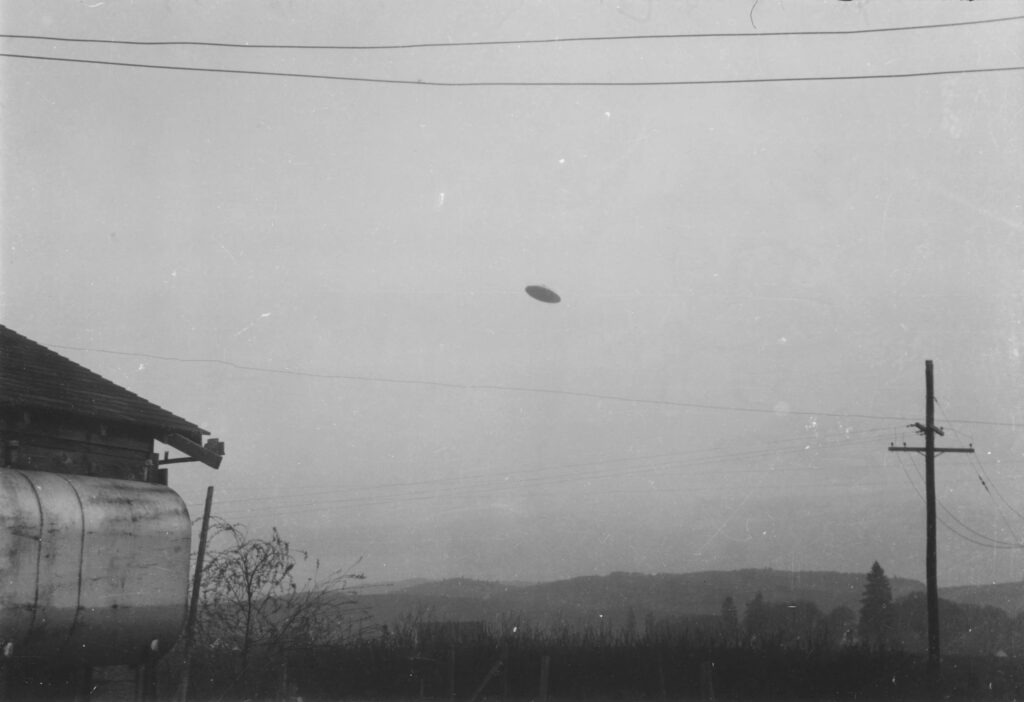
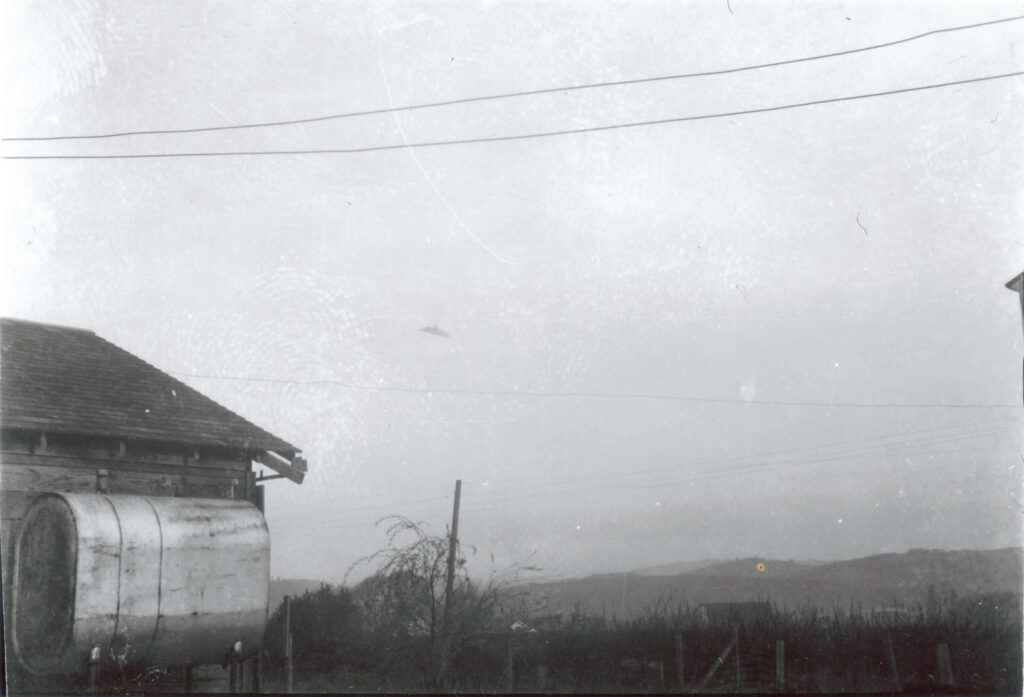
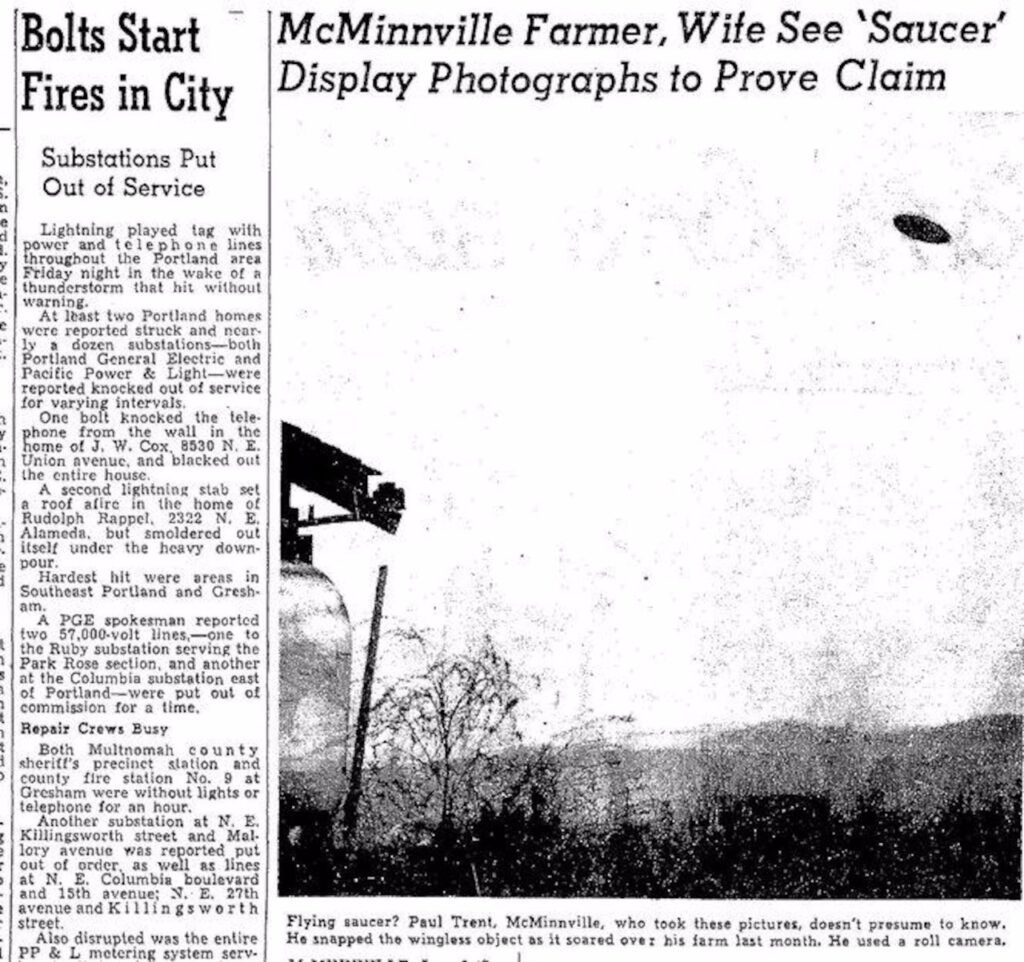
Fast-forward a century and change and you get a very different kind of memory, one that arrives from above. On 11 May 1950, a farm about 10 miles southwest of McMinnville became the setting for two photographs that still anchor arguments on both sides of the “prosaic vs. non-prosaic” divide. (NCAS Files)
The reason McMinnville matters to UAP research is that the Trent photographs became an unusually durable object for analysis, dispute, and reinvention, with enough documented handling by institutions and investigators that people can keep re-litigating it decades later. That durability, more than any single interpretation, is the real McMinnville effect.
The town itself, before the sky story
It helps to picture McMinnville the way locals do when they are not talking about the Trent case: a walkable downtown, vineyards nearby, and a civic identity built around a “main street” that actually functions as one. Third Street, in particular, has been treated as a planning success story. The American Planning Association highlighted it as a Great Place in America street, noting how early-2000s streetscaping and preservation helped create a pedestrian-focused destination with year-round activity. (American Planning Association)
The city has also documented its own long arc of downtown investment: it identified the need for a Third Street Improvement project as early as 2000, and frames later phases as part of multi-decade infrastructure and accessibility work. (mcminnvilleoregon.gov) In other words, the physical stage that later hosts the festival and the parade did not appear by accident. It is a deliberate civic project.
This matters for UAP culture because a town’s ability to “hold” an annual mythos is partly architectural and administrative. McMinnville has a downtown designed to host public life, so when a UAP-themed weekend arrives each year, it feels like something the town can absorb rather than something that overwhelms it.
That’s not a mystical claim, it’s basic urban form.
The Trent event as a witness story first
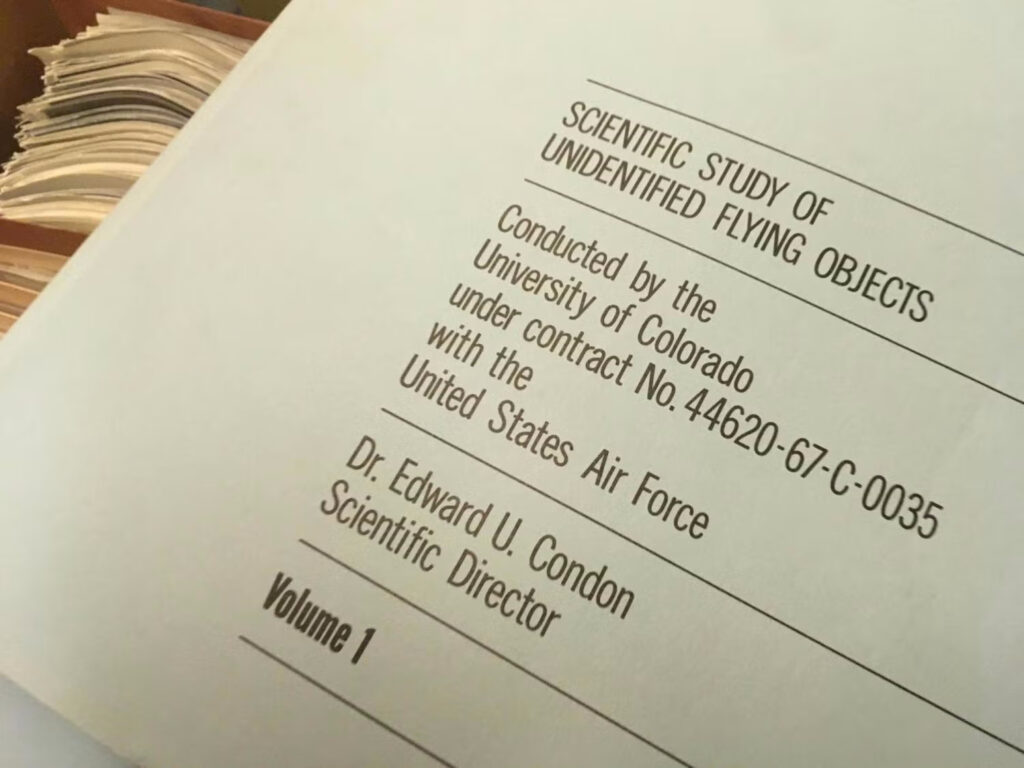
The Trent case is often discussed as two grainy images, but it begins as testimony. In the University of Colorado’s UAP study (the “Condon Report” project), the incident is cataloged as Photographic Case 46: McMinnville, Oregon, dated 11 May 1950, investigated by astronomer William K. Hartmann. (NCAS Files)
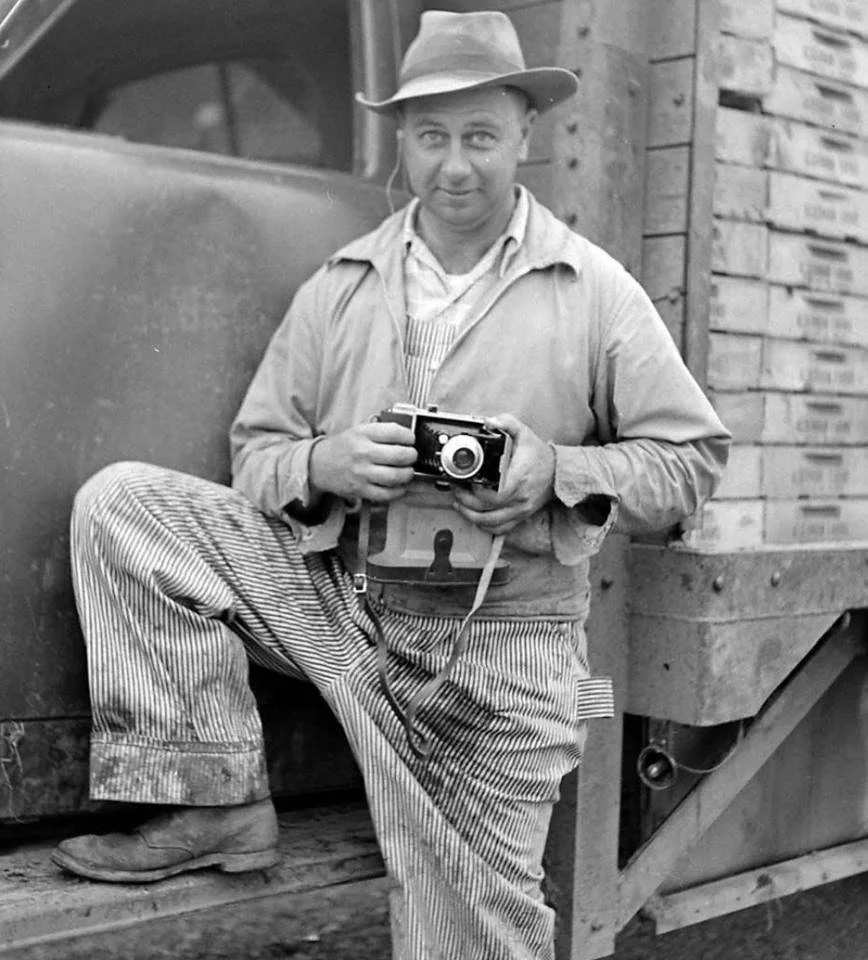
In the case narrative, Witness I is described as seeing a bright, metallic-looking, disk-shaped object while in the backyard. She calls for her husband. They retrieve a camera. He takes two photographs within roughly half a minute, rewinding quickly between shots. The object, as described in one account quoted in the case file, is “very bright,” “almost silvery,” with “no noise or smoke.” (NCAS Files)
That is the core structure: two people, a short window, a camera already loaded, two exposures, then the object departing toward the west. The report also notes something that becomes important later: the witnesses describe a wind or gust when the object “tipped,” though their later recollections differ in intensity. (NCAS Files)
Even if you never look at the photographs, you can already see why this became sticky. The story has the kind of small, human details that tend to persist: the rabbits, the camera’s location, the quick rewind, the argument about whether the wind was strong or slight. Those details can be read two ways. Believers read them as living texture. Skeptics read them as the sort of inconsistent recall you expect over time. Both readings can be made without inventing facts.
What the Colorado case file does that many retellings do not is treat the witnesses as people rather than symbols. Hartmann’s write-up describes them as friendly, industrious, and not obviously motivated toward elaborate pranks, while also noting they were not highly educated or trained observers. (NCAS Files) That’s sober and useful. It doesn’t canonize them, and it doesn’t dismiss them.
What “official study” actually did with McMinnville
Here’s where the fact-check feedback matters most. It is tempting to say the Condon project “couldn’t debunk” the case. That phrasing overreaches.
The Condon Report’s summary section says that for the McMinnville pair, the “UFO images turned out to be too fuzzy to allow worthwhile photogrammetric analysis.” (NCAS Files) That is a real limitation, and it has to be stated plainly. Photogrammetry, in this context, depends on being able to measure geometry precisely across two frames. If the object’s edges are indistinct, the measurement power collapses.
But the same summary also makes clear that the Colorado project did additional photographic work through Hartmann. (NCAS Files) And the deeper Case 46 text is not a single-line dismissal. It is lengthy, structured, and unusually attentive to both physical and psychological factors. (NCAS Files)
This is why the Trent case lives in an odd space. The report’s headline posture about “fuzzy photogrammetry” is deflating, but the case file itself preserves the reasons the incident remained interesting. That tension is not something we should smooth over. It is part of the historical record.
A contemporary mainstream summary of the report captured that duality well. TIME, covering the end-of-era moment when official interest was winding down, noted that scientists were impressed by the analysis “in which all factors investigated appear to be consistent” with an extraordinary object, while also emphasizing that the report does not rule out a hoax and specifically points out that the object’s position relative to overhead wire can be read as favoring a suspended model. (TIME)
So, a careful modern phrasing looks like this: the Colorado study preserved the case as analytically notable while simultaneously leaving room for prosaic fabrication scenarios, and the report’s own summary downgraded the usefulness of photogrammetric measurement because of image quality. (NCAS Files)
That is less punchy than “not dismissible,” but it is more faithful.
The long argument: object, model, or something in between?
When you read enough about McMinnville, you notice that most people are not actually arguing about a “flying saucer.” They’re arguing about methods, custody, and what counts as a decisive signal in messy data.
One modern skeptical line comes from IPACO, a group focused on image-analysis methods. Their report on McMinnville argues the photos are consistent with a small model suspended, and the authors claim their later tool integration detected a suspension thread in both pictures. (Ipaco) In a related technical presentation hosted by CNES/GEIPAN materials, the IPACO approach is described as producing “evidence, with a very high probability,” of a thread in both images, with an estimated angle for that line. (Geipan)
That is the strongest modern “this is a model” claim, because it is specific: it points to a physical mechanism, not just a vibe. It also has an obvious vulnerability: if the thread detection is algorithm-sensitive, dependent on scanned generations, or prone to false positives in film grain and scratches, the conclusion could be overstated. The correct stance is to report what they claim and how they claim it, then note what would be required to make it definitive, namely transparent replication on the best-available source material.
Skeptical Inquirer’s coverage of the Trent photos frames the case as repeatedly re-heated, highlighting narrative inconsistencies and emphasizing that “best of all time” claims are often marketing rather than measurement. (Skeptical Inquirer) That’s a useful cultural warning: UAP cases become brands, and brands encourage overconfidence.
On the other side, proponents like Bruce Maccabee have argued that photometric characteristics, atmospheric effects, and comparative brightness in the image are more consistent with a distant, larger object than a near small model, and he directly criticizes the way the Condon summary leaned on “too fuzzy” photogrammetry language without foregrounding Hartmann’s more favorable internal assessment. (NICAP) Maccabee’s longer technical write-up (archived by NICAP) lays out his view that the dismissal logic confuses photogrammetry with photometry and that the “too fuzzy” remark does not automatically nullify other forms of analysis. (NICAP)
It is important to label that correctly: Maccabee’s position is a researcher’s argument, not an institutional conclusion. It may be rigorous, but it is still advocacy in the courtroom sense: it argues a side. IPACO’s report is also a side, even when it’s technical. The existence of dueling technical documents is not “resolution.” It is the definition of an active controversy.
And then there’s a third dimension that rarely gets enough attention: custody of the physical materials.
The negatives problem: evidence that wanders
Even in cases where the “data” is literally two frames of film, those frames can drift through institutions and hands for decades. Case 46 notes that the Colorado project tracked down the original negatives and was permitted to examine them, describing how they were in the possession of International News Photo Service and later merged into United Press International holdings. (NCAS Files) That’s a real paper trail, and it matters.
But later custody becomes its own story. A local-news account describes a long dispute in which the Trent family sought return of the negatives, with claims that researcher Bruce Maccabee held them for many years and later sent them to the News-Register for transfer back, after which the family continued trying to retrieve them. (KVAL)
You do not have to take a position on who “should” own them to recognize the research implication: every custody shift multiplies the number of scans, crops, and contrast-adjusted versions that circulate. The public usually debates the copy of the copy, not the best-available source. That reality does not prove a hoax and it does not prove authenticity. It does, however, explain why the debate never dies. The evidence is never fully centralized for everyone to interrogate in the same way.
If you want one practical lesson from McMinnville for modern UAP work, it’s this: chain of custody is not a boring administrative detail. It is part of the dataset.
Is McMinnville a “hotspot”?
Evidence-first: the publicly documented, historically central UAP case in McMinnville’s orbit is the Trent photographs. Everything else most people associate with “McMinnville UAP” is downstream of that. (NCAS Files)
Analysis, clearly labeled: culturally, the town functions like a hotspot because it hosts a recurring ritual where UAP curiosity is given a calendar slot, a parade route, and an audience. That’s not the same thing as saying the skies above Yamhill County produce a higher incidence of anomalous events than other places. The historic record, as commonly cited in major case literature, does not establish that statistical claim on its own.
If you want to keep the word “hotspot” at all, it should be used in that cultural sense, not as an empirical frequency claim.
What McMinnville teaches UAP research in 2026
McMinnville is a reminder that UAP history is not only a story of objects and observers. It is a story of publications, institutions, archives, and towns deciding what to do with the weirdness they inherit.
The Colorado project shows how official or semi-official studies can simultaneously preserve a case for serious discussion and still minimize it in summary. (NCAS Files) The later IPACO and CNES/GEIPAN-adjacent material shows how new tooling can re-open old evidence, sometimes in ways that sound decisive, but still require replication and transparency to become persuasive across camps. (Ipaco) The custody disputes show how “the evidence” can become a family story, a newspaper story, and a civic heritage story all at once. (KVAL)
And the festival shows how communities metabolize ambiguity. Downtown McMinnville can host a parade that is playful, commercial, and sincere at the same time, precisely because the original case remains unresolved enough to support multiple identities: skeptic, believer, curious tourist, or local who just wants the street fair. (McMinnville Downtown Association)
That unresolved quality is not a flaw in the narrative. It is the mechanism by which the narrative persists.
Implications
In practical terms, the Trent case is a warning label for single-sensor evidence. Two frames of film without shared instrumentation, without modern metadata, and with decades of copying are fragile. They can be debated forever. If your goal is scientific closure, you want convergence: multiple witnesses, multiple independent sensors, well-preserved originals, and a documented chain of custody.
In cultural terms, McMinnville demonstrates how UAP history becomes local identity. A town with a well-loved main street and a strong downtown organization can turn unresolved history into recurring public life, and in doing so keep a 1950 event active in 2026. (McMinnville Downtown Association)
Neither implication requires exaggeration. McMinnville is not important because it is magical. It is important because it is legible: you can trace the paper trail.
Claims Taxonomy
Verified
The Trent incident is treated as Case 46 in the University of Colorado photographic case studies, with specific time and location details recorded. (NCAS Files)
Probable
That the Trent photographs’ enduring prominence is driven by a combination of early national publicity, later institutional study, and repeated re-publication across decades. This is consistent with how Case 46 is referenced and how the festival frames its origin. (NCAS Files)
Disputed
The central claim, whether the object photographed was a distant anomalous craft or a near suspended model, remains actively disputed, with published technical arguments on both sides and no universally accepted resolution. (NCAS Files)
Misidentification
Some interpretations argue for a mundane constructed object (model) as the photographed stimulus. That would place the “UAP” in the category of misattributed stimulus rather than aerial anomaly, but this remains contested rather than demonstrated beyond reasonable doubt. (Ipaco)
Hoax
None. Allegations of deliberate fabrication exist in the literature and in later commentary, but publicly accessible records do not provide a conclusive, universally accepted demonstration that the Trents intentionally staged the photographs. (TIME)
Speculation Labels
Hypothesis
A durable UAP case like McMinnville may function as a “social attractor,” drawing later reports, interpretations, and creative reenactments into its orbit. This would be a sociology-of-belief mechanism rather than evidence about the original object.
Witness Interpretation
In later retellings, witnesses and families often interpret the Trent event through whichever frame feels safest, such as “secret military craft,” “something not of this world,” or “a prank gone too far.” Those are interpretations layered onto a short, time-compressed experience.
Researcher Opinion
The strongest divergence in researcher opinion is methodological. Some argue the case is best approached as photometric inference under uncertainty, while others argue that thread detection and geometry dominate and imply a model. The controversy is as much about which analytical approach deserves priority as it is about what was in the sky. (NICAP)
References
Condon, E. U. (1969). Scientific study of unidentified flying objects (University of Colorado UAP study; NCAS text mirror). (NCAS Files)
Linscheid, D. (2025). McMinnville. The Oregon Encyclopedia. (Oregon Encyclopedia)
American Planning Association. (2015). Third Street: McMinnville, Oregon (Great Places in America). (American Planning Association)
Downtown McMinnville. (2026). UFO Festival (event overview and schedule). (McMinnville Downtown Association)
McMenamins. (2026). 26th Annual UFO Festival (event overview and schedule). (McMenamins)
McMenamins UFO Festival. (n.d.). Official festival site (ufofest.com). (McMenamins UFO Festival)
Cousyn, A., Louange, F., & Quick, G. (n.d.). UAP photo/video authentication and analysis (CNES/GEIPAN-hosted PDF). (Geipan)
IPACO. (n.d.). The McMinnville pictures (ReportMcMinnville.pdf). (Ipaco)
Sheaffer, R. (2015). The Trent UAP photos: “Best” of all time, finally busted? Skeptical Inquirer. (Skeptical Inquirer)
KVAL News. (2008). Fight over UAP photos pits family versus newspaper. (KVAL)
TIME. (1969). Investigations: Saucers’ end. (TIME)
Library of Congress. (2018). Memorable marchers in the annual McMenamins festival parade (photo record). (The Library of Congress)
SEO keywords
McMinnville Oregon UAP, Trent photographs 1950, McMinnville UAP photos, Condon Report Case 46, William K Hartmann photometric analysis, IPACO McMinnville report, CNES GEIPAN IPACO thread detection, UAP photographic evidence analysis, UAP case study Oregon, Yamhill County UAP history