
NASA now has an official UAP point of view.
In September 2023 the agency published the Unidentified Anomalous Phenomena Independent Study Team Final Report, stood up a permanent UAP portal, and named Mark McInerney as Director of UAP Research to coordinate methods and partnerships.
All of that is real and on the record.
It also positions NASA exactly where an interagency system would want its most trusted public brand to sit, as a funnel for unclassified messaging and a switchyard that can route sensitive detections into protected channels. (NASA Science)
NASA’s public line has been consistent. There is no evidence in NASA holdings that UAP are extraterrestrial, the core problem is poor data, and the remedy is better sensors, standardized metadata, and AI enabled analysis.
That is the surface story, and it tracks the report text.
It does not preclude deeper classified equities behind the curtain, particularly once data touch partners with national security missions. (NASA Science)
NASA is not a statutory member of the US Intelligence Community, which the Office of the Director of National Intelligence lists explicitly. That matters legally. However, an August 2025 executive order reclassified NASA as an organization that primarily performs intelligence, counterintelligence, and national security work, a change that excludes it from collective bargaining protections.
It does not prevent NASA from being the government’s most credible integrator and public explainer for UAP while sensitive material is handled in defense channels. AARO’s Senate testimony and filings place NASA among its whole of government partners. (National Intelligence Agency)
The May 31, 2023 public meeting was livestreamed and unusually candid about stigma and harassment. It was also a case study in optics control. NASA first declined to name its UAP director citing threats, then hours later identified McInerney.
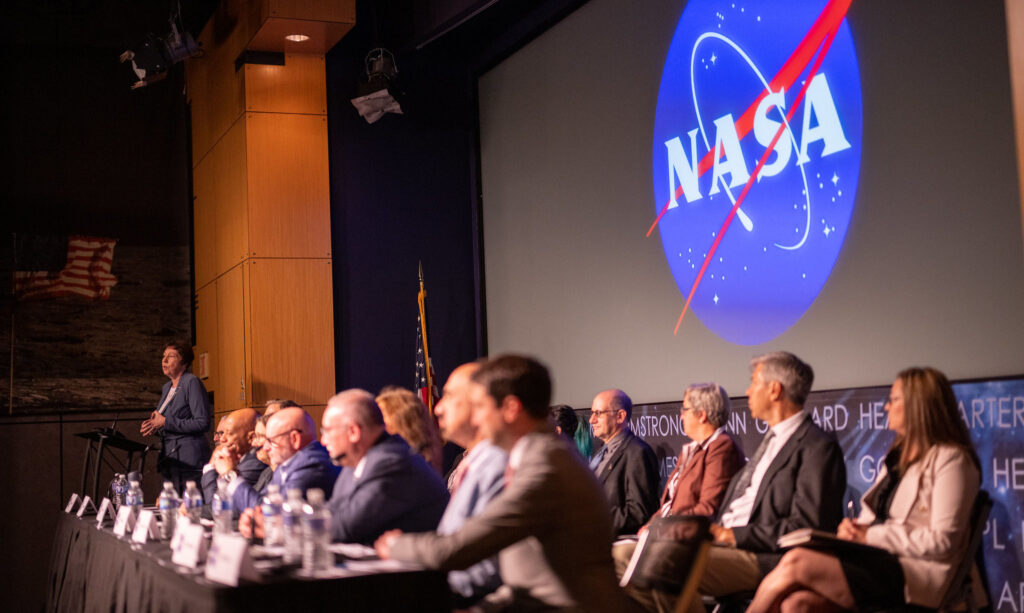
The sequence plays as risk management. It also reveals that privacy veils can be raised and dropped at will, which is instructive for how identities and data are handled when stakes rise. (Reuters)
How NASA entered, and what that really enabled
The modern US UAP cycle ramped with the June 2021 ODNI Preliminary Assessment. NASA announced an open study in 2022, held a public session on May 31, 2023, and delivered its final report on September 14, 2023 while naming a UAP research director.
Publicly, the aim is better, unclassified data and reproducible methods. Functionally, this architecture also creates a clean public lane that can normalize the topic while quietly triaging any needles that do not belong in the open haystack. (National Intelligence Agency)
What NASA has released is clear: the study report, the portal, and the briefing.
What is less discussed is what the agency has not centralized for the public. FOIA e-libraries and the National Archives UAP collection show that responsive material exists but is fragmented, which makes sense for a civil agency not chartered to run intelligence archives. The fragmentation also makes comprehensive public synthesis harder and keeps the center of gravity in interagency hands. (NASA)
There is evidence of internal NASA attention before the formal study.
Government Attic and Black Vault FOIA releases contain NASA email traffic on UAP related communications in 2021. That does not prove hidden conclusions. It does establish that NASA was actively managing UAP messaging well before the public blue-ribbon study began. (Government Attic)
Where the paper trail points when you look past the press event
Interagency authorities that can sequester data
NASA’s Space Act Agreement machinery gives the agency unusually broad power to craft bespoke agreements with government and industry.
These agreements explicitly allow data protection and delayed publication under suitable protective conditions. NASA also maintains formal memoranda with the Department of Defense and the US Space Force that institutionalize collaboration across operations, planetary defense, and space domain awareness.
Data can and do cross those seams. When they do, classification and partner restrictions can apply. This is not speculation, it is the text of the agreements and the agency’s own guidance. (NODIS 3)
Export control and CUI regimes that narrow public release
NASA policy directs strict compliance with export control law and Controlled Unclassified Information rules.
These policies are designed for national security and often bind contractors too. They are not written for UAP per se, but any UAP relevant capture that reveals sensor performance, system vulnerabilities, or partner capabilities can fall under these regimes and be withheld. That is a lawful path to withhold material without ever invoking a dramatic narrative. (NODIS 3)
AARO is the magnet for defense sensitive cases, NASA is the explainer
By law, AARO is the government’s focal point for UAP across all domains with authority to compel information from federal components.
NASA is named as a partner and has already synchronized public messaging with AARO on high visibility days. In practice, that means a plausible split. Defense relevant events flow to AARO. NASA’s public role sets the narrative frame and curates open science contributions. (Legal Information Institute)
The archives are now being pulled into one place, slowly
The National Archives launched a dedicated UAP holdings hub and photo index and has directed agencies to organize and prepare UAP records for disclosure.
That includes civil agencies like NASA. It is progress, and it also tells you those records exist and are being processed. Timing, scope, and redactions will decide how much of the interesting material ever lands in the public collection. (National Archives)
Why NASA likely knows more than it says
NASA’s study report itself says NASA’s fleet and data repositories should play a powerful supporting role, pairing environmental context with event data. This is the clue.
NASA sits across sensor rich space and Earth observing systems and has the legal instruments to share, restrict, and time the release of data. If an anomalous event of genuine interest is captured, NASA can funnel the contextual layers into open science while the target data, if sensitive, moves into protected channels through existing agreements. The public sees atmosphere and sea state. The signature moves elsewhere. (NASA Science)
At the same time, NASA elevates a message that stresses data quality and no extraterrestrial evidence, a line reinforced by AARO’s historical volume reports. Those statements are accurate within the scope of what they are willing and able to publish, and they buy time while the interagency sorts the small number of stubborn cases. The point is not that the public line is false. The point is that it is bounded. (WIRED)
Hypothesis: if any civil entity is the top echelon for UAP intelligence, it is NASA
This is a hypothesis offered for readers as a thought starter:
- Central node with public legitimacy
NASA is the rare federal brand that commands broad trust. That makes it an ideal front end for a topic that needs destigmatization in public while sensitive details remain gated. The 2023 public meeting was a near perfect example, complete with managed access, curated experts, and rapid identity control around the new director. (Federal Register) - Legal authorities that bridge open and closed worlds
Space Act Agreements, formal DoD and USSF memoranda, and export control and CUI rules give NASA tools to both disseminate and contain. That allows the same office to speak the language of open science and to honor restrictions that keep sources and methods out of view. (NODIS 3) - Data gravity and analytic capacity
NASA has unmatched experience organizing petabyte scale observational archives, fusing environmental context, and applying AI to imagery and telemetry. If the US government wanted a de facto head for UAP analytics who is not legally inside the IC but can steer the evidence commons and the public narrative, NASA is the logical choice. The study report itself sketches that role. (NASA Science) - Interagency handoffs that keep sensitive needles out of the open haystack
AARO’s mandate, the Archives requirements, and NASA’s own portal language all make room for a choreography in which the most interesting cases move fast to AARO while NASA advances a normalized research surface. That architecture can be both efficient and opaque. (Legal Information Institute)
What would falsify or support this hypothesis
- Publish a time synchronized ledger of NASA to AARO referrals, including anonymized triggers, modalities involved, and final disposition categories. If that ledger shows no meaningful handoffs, the hypothesis weakens. If it shows steady routing of high value captures, the hypothesis strengthens. (Legal Information Institute)
- Release Space Act Agreement indices and annexes that reference airborne anomaly collection, metadata retention rules, or AI triage terms. The SAA guide and active lists show what is possible. They do not yet show the full map for UAP. (NODIS 3)
- Compare NASA Earth observing context layers to the timing and location windows of well documented military incidents, then publish any correlations openly. The study report encourages this exact workflow. If nothing anomalous ever correlates, skepticism wins. If patterns emerge, the current public story is incomplete. (NASA Science)
Counterpoints that deserve to be heard
NASA’s formal stance is clear. The independent study found no evidence of extraterrestrial origin in current data and identified the lack of high quality, multimodal observations as the main obstacle.
Those facts are not in dispute here. The argument is that NASA’s authorities and partnerships make it both able to expand the public evidence base and able to keep the most sensitive edges out of sight. Both can be true. (WIRED)
Investigative sidebar: how to audit NASA’s UAP footprint like a pro
- Start with the primary. Read the NASA final report in full and keep NASA’s UAP portal open while you work. (NASA Science)
- Map the collaboration. Pair NASA’s site with AARO’s resources and the Senate hearing record to understand roles and lanes. (AARO)
- Pull the memos. Read NASA’s Space Act Agreement guide and the signed NASA DoD and NASA USSF memoranda. Note data protection clauses and how they could apply to anomalous collections. (NODIS 3)
- Follow the paperwork. Use NASA’s FOIA e-libraries and the National Archives UAP hub. FOIA releases from Government Attic and The Black Vault show there is useful paper in circulation. (NASA)
- Track export control and CUI gates. NASA’s own directives explain how sensitive data can be withheld or delayed legally. (NODIS 3)
References
NASA UAP portal and FAQs. (NASA Science)
NASA UAP Independent Study Team Final Report PDF. (NASA Science)
NASA press release naming Mark McInerney. (NASA)
ODNI list of Intelligence Community members. (National Intelligence Agency)
AARO statement for the record and Senate hearing transcript. (AARO)
Reuters reporting on harassment of NASA UAP panel. (Reuters)
Business Insider on the temporary anonymity and later naming of the UAP director. (Business Insider)
Federal Register notice for the May 31, 2023 UAP meeting. (Federal Register)
Government Attic and Black Vault NASA UAP related FOIA releases. (Government Attic)
NASA FOIA e-libraries hub. (NASA)
National Archives UAP holdings home and photo index. (National Archives)
Space Act Agreements guide and examples, plus NASA DoD and NASA USSF memoranda. (NODIS 3)
NASA export control and CUI policies. (NODIS 3)
WIRED and Axios coverage of the report’s top line. (WIRED)
Claims taxonomy
Verified
- NASA published the UAP Independent Study Team Final Report and maintains a public UAP portal. (NASA Science)
- NASA named Mark McInerney Director of UAP Research after first withholding the name, citing harassment concerns. (NASA)
- NASA is not listed among the 18 members of the US Intelligence Community by ODNI. (National Intelligence Agency)
- AARO lists NASA as a partner and testified to Congress on UAP activities. (AARO)
- FOIA releases show NASA internal communications regarding UAP in 2021. (Government Attic)
Probable
- NASA’s interagency agreements and export control or CUI policies routinely constrain public release of UAP relevant data that touch sensitive sensors, partner capabilities, or acquisition programs. The authorities and clauses exist and are used generally. (NODIS 3)
Disputed
- The community claims that NASA is minimizing compelling cases. NASA answers that it has no extraterrestrial evidence, that the barrier is data quality, and that defense sensitive incidents belong with AARO. The disagreement is over scope and transparency, not the text of the published report. (WIRED)
Legend
- Cultural stories linking NASA to the esoteric persist because of the JPL cofounder Jack Parsons chapter and popular media, not because NASA has a documented institutional occult mission. This belongs to culture more than to governance.
Misidentification
- Many historical UAP reports resolve to balloons, drones, aircraft, atmospheric and sensor artifacts when analyzed with proper context. Official summaries reiterate this even as a residual set remains ambiguous. (Reuters)
Speculation labels
Hypothesis
NASA functions as the unacknowledged headwaters for the US government’s unclassified UAP evidence commons, while its agreements, export control, and CUI authorities let it route high value detections into protected channels in coordination with AARO. The public narrative remains conservative while the sensitive work proceeds. (NODIS 3)
Witness interpretation
NASA officials described harassment around the panel and initially withheld the director’s identity. People inside the process interpreted this climate as a reason to constrain disclosures. That atmosphere plausibly shaped communications decisions, including name suppression and cautious language. (Reuters)
Researcher opinion
If NASA and AARO jointly publish calibrated, multimodal datasets with full provenance and standardized metadata, the field will move from arguments to tests. NASA’s report outlines how to build that pipeline. Until those datasets exist, expect the most interesting cases to remain inside partner channels. (NASA Science)
SEO keywords
NASA UAP report, NASA UAP director, Mark McInerney UAP, NASA AARO partnership, NASA Space Act Agreements UAP, NASA export control CUI UAP, National Archives UAP records, NASA FOIA UAP emails, NASA UAP public meeting, ODNI Intelligence Community NASA role, USSF NASA memorandum UAP, AARO Senate testimony NASA partner, NASA UAP open data AI, UAP study final report PDF.