
From its incorporation in Washington, D.C. in 1956 until its dissolution in 1980, the National Investigations Committee on Aerial Phenomena functioned as the best known civilian clearinghouse for what we now call UAP.
NICAP did two things that were revolutionary for its era. First, it treated sightings as data to be filtered, ranked and compared across categories such as witness class, corroborating sensors and physical effects.
Second, it lobbied relentlessly for transparent government handling of the problem and for open scientific review.
The public-facing effect was a national network that investigated thousands of incidents at a time when official channels emphasized dismissal. The lasting effect is a corpus of cases and analytical patterns that still frame how historians, scientists and policy analysts talk about legacy UAP reports. (NICAP)
A short timeline and the numbers that matter
1956. Incorporation in the District of Columbia. Early leadership included T. Townsend Brown and board members drawn from high-ranking military, scientific and media circles.
Within months the board removed Brown and appointed Marine Corps Major Donald E. Keyhoe as director.
Retired Rear Admiral Delmer S. Fahrney served as board chair. NICAP’s Washington location and elite letterhead made it the press corps’ default source whenever UAP reports spiked. (NICAP)
1957. Publication of The UFO Evidence, a 388-page synthesis edited by Richard H. Hall, which selected 746 cases from more than 5,000 signed reports and hundreds of additional press accounts. This volume codified patterns that would structure civilian UAP analysis for decades. At that time NICAP membership was about 5,000 across all 50 states and roughly 25 countries. (NICAP)
1965–1967. NICAP’s membership, publications output and staff all surged. By early 1967 the organization had nine full-time employees and approximately 14,000 members.
Subcommittees of technically trained volunteers operated globally, and the office became a must-call newsroom for investigative copy. (NICAP)
1968–1969. NICAP broke with the University of Colorado’s Condon study and publicly charged the project with bias. The break coincided with declining public interest after the Condon Report’s publication in early 1969 and the USAF’s closure of Project Blue Book that December. NICAP downsized and Keyhoe was pushed out at year’s end.
1980. Dissolution of NICAP.
1980–present. NICAP’s case files were transferred to the Center for UFO Studies and remain a core historical archive.
In recent years, the National UFO Historical Records Center in New Mexico began curating CUFOS and NICAP collections for public access. (Center for UFO Studies)
People behind the data
Board of Governors and advisers. NICAP’s governance is a data point in itself. The July 1, 1957 board roster included:
• Roscoe H. Hillenkoetter, former Director of Central Intelligence and U.S. Navy Vice Admiral.
• Herbert B. Knowles, U.S. Navy Rear Admiral, retired.
• Joseph B. Hartranft Jr., prominent aviation executive and safety advocate.
• Dewey J. Fournet Jr., former USAF major involved with early official UAP analysis.
• Gen. Pedro A. del Valle, USMC, retired.
• Broadcaster Frank Edwards.
• Physicist Charles A. Maney and other clergy, scientists and engineers.
These names were not decorative. They helped NICAP push its “data first” posture into mainstream newspapers and congressional offices.
Executive staff and investigators. Donald E. Keyhoe served as director from early 1957 to December 1969. Richard H. Hall joined in 1958 and became assistant director. His editorial and analytical labor produced The UFO Evidence in 1964 and, later, The UFO Evidence Volume II in 2001. Investigator Gordon Lore headed research on physiological and electromagnetic effects in the late 1960s. In 1970 professional administrator John L. Acuff took over as director to steady finances and operations. (NICAP)
Leadership statements. In January 1957, board chairman Rear Admiral Delmer S. Fahrney publicly stated that objects were entering the atmosphere at very high speeds and performing accelerations beyond then-known capabilities. This set NICAP’s tone and placed technical performance at the center of its message. (NICAP)
Hillenkoetter’s intervention. In 1960, former CIA Director and NICAP board member Roscoe Hillenkoetter called for congressional inquiry and criticized secrecy and ridicule around UAP. His statement, carried in the national press and preserved in CIA archives, remains one of the earliest high-level endorsements of serious study. (CIA)
What NICAP published and why it mattered
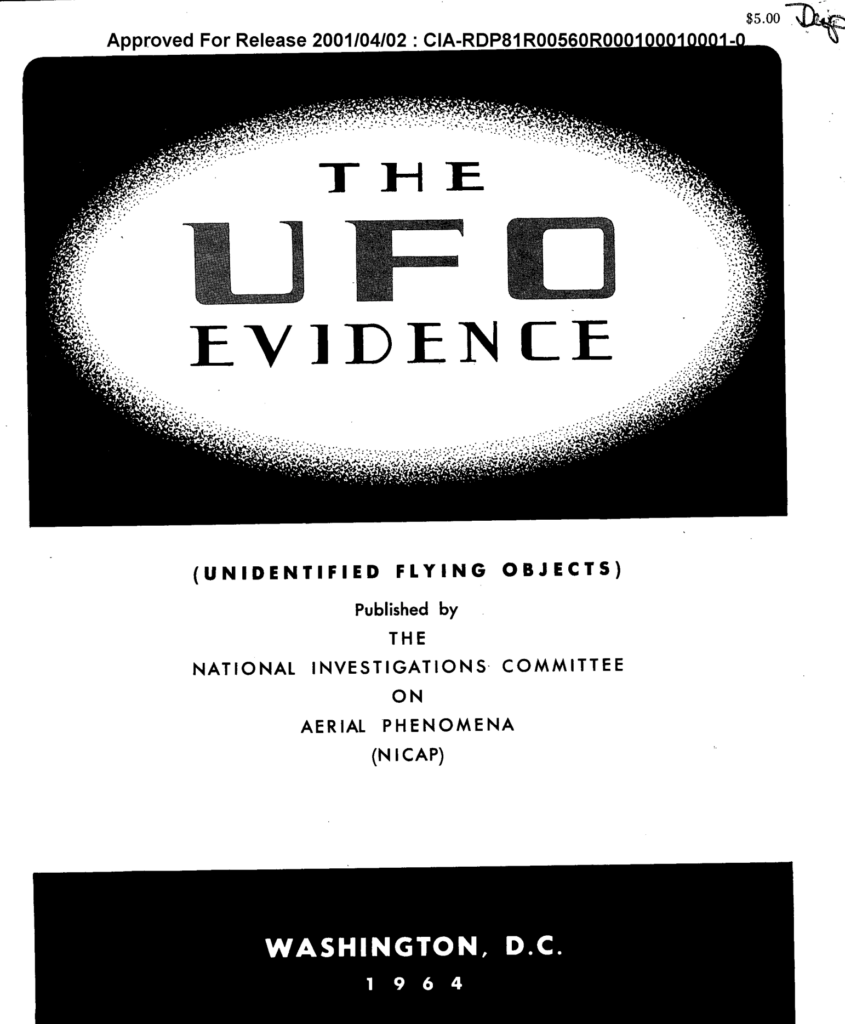
The UFO Evidence (1964).
Hall’s compendium is central to NICAP’s legacy. It selected 746 reports based on witness competence, multi-witness corroboration, instrumented data such as radar and camera records, and the presence of physical or physiological effects.
The opening abstract made two crucial methodological assertions. First, that screening by observer qualification and corroboration would produce a residual set of cases demanding scientific attention.
Second, that the residual set supports the hypothesis that UAP are under intelligent control and that extraterrestrial origin is plausible. (NICAP)
NICAP policy, as printed in the 1964 volume, formalized a two-track program: field investigations by trained subcommittees and panels of scientific advisers, coupled to an advocacy program urging open congressional review of the evidence and of official investigative methods.
This was not a posture against the government as such. It was an attempt to shift UAP from a secrecy-bound military channel to an open scientific one. (NICAP)
Newsletters and special reports. NICAP ran The UFO Investigator for members and, during its peak, produced special bulletins and topical monographs. Two 1969 publications stand out. UFOs: A New Look summarized the case for renewed scientific work. Strange Effects from UFOs compiled physiological and electromagnetic interference reports from vehicle and aircraft encounters.
Together they sharpened NICAP’s data taxonomy around “special evidence”. (Center for UFO Studies)
Symposium and congressional interface. NICAP lobbied for hearings and circulated The UFO Evidence widely on Capitol Hill in 1964.
Four years later, the House Committee on Science and Astronautics held a public symposium that placed technical testimony from multiple scientists on the record. While NICAP did not run the hearing, its model of case curation and open review was reflected in the format and content. (NICAP)
How NICAP handled data
NICAP’s method was simple but powerful for its time. It privileged trained observers and independent corroboration. It carved cases into families: pilot and aviation encounters, radar-visuals, actions suggesting control, multi-witness ground reports by police and civil defense, and “special evidence” that included electromagnetic effects, physiological impacts and photographic records.
By elevating this residual set, NICAP made a narrow claim. It did not assert that all reports proved a single hypothesis. It insisted that the curated remainder warranted serious inquiry. (NICAP)
A data-first stance also meant publishing what selection looked like. Hall’s abstract laid down the numbers. 746 selected reports after examination of more than 5,000 signed reports, plus hundreds more from publications.
Membership figures were disclosed. Even the price of an associate membership and newsletter periodicity were printed. That level of transparency built credibility across the press and among scientists who were otherwise wary of the subject’s cultural noise. (NICAP)
Conflict with the Condon Committee and the AIAA aftermath
NICAP initially cooperated with the University of Colorado project led by Edward Condon, transferring hundreds of files and conferring with project leaders in 1966 and early 1967. Within a year NICAP charged that the study was structurally biased. In April 1968 it publicly broke relations and issued a press packet outlining alleged deficiencies, including the now-famous “Low memo” controversy and neglect of submitted case material. (NICAP)
After the Condon Report concluded that further UAP study was not justified and the Air Force closed Blue Book in December 1969, NICAP’s membership and finances sharply declined. Yet the technical critique did not vanish.
In 1970, the American Institute of Aeronautics and Astronautics’ UFO Subcommittee reviewed the Condon work and, while agreeing that previous studies had not advanced knowledge very far, stated it did not find a basis for Condon’s prediction that nothing of scientific value would come from further studies. That dissent helped keep the door open for later, better-instrumented research programs. (Wikipedia)
Membership, staff and network by the numbers
• Members. About 5,000 in 1964 across all states and roughly 25 countries. Approximately 14,000 at the 1967 peak. (NICAP)
• Staff. Nine full-time employees at peak. Dozens of PhD-level consultants. Subcommittee investigators screened for technical competence. (NICAP)
• Case files. By the mid-1970s, NICAP staff described a repository of some 20,000 reports, with a structured push to compute on the corpus as funding allowed. (NICAP)
The NICAP archive and its afterlife
In the early 1980s, NICAP’s case files and publications moved to the Center for UFO Studies, where they remain an essential reference for scholars and investigators.
Today, the National UFO Historical Records Center in New Mexico is working with CUFOS to preserve and provide public access to the material at scale.
This includes private and official documents, audio and video, newsletters and original investigator notes. The continuity of custodianship matters. It means forward-looking research can test old patterns against new instrument data without reinventing the wheel. (Center for UFO Studies)
Critics of NICAP
Skeptical analysts such as Philip J. Klass and Robert Sheaffer were consistent and sometimes withering critics. Klass argued that NICAP’s celebrated cases dissolved under technical scrutiny and that anecdotal evidence, even by trained witnesses, is often unreliable.
Sheaffer, a long-time columnist and author, made similar arguments about methodological rigor and publication bias. Whether one agrees or not, their critiques forced clearer standards for classification, documentation and publication that improved later civilian research, including the work of CUFOS and other groups. (Amazon)
Inside the government, the Condon Report’s negative framing and the National Academy of Sciences’ review dampened official enthusiasm for study for a generation.
Yet the AIAA critique, Hillenkoetter’s call for hearings and the 1968 House symposium together show that NICAP did move the Overton window for technical and policy discussion. (Wikipedia)
Implications
Policy. NICAP pioneered the model of an independent, nonprofit evidence broker that treats citizen reports as data and interfaces with legislative oversight. Its method foreshadows more recent calls for multi-agency transparency and for data standards that let civilian and government information interoperate.
Science and engineering. The emphasis on radar-visual cases, electromagnetic interference and physiological effects created discrete research tracks. These are precisely the categories where modern sensors and forensic methods can either confirm or re-attribute legacy events. Hall’s patterns also lend themselves to modern statistical treatment, especially when cross-referenced with atmospheric, astronomical and aerospace telemetry.
Culture. NICAP consciously fenced off contactee narratives in favor of tightly sourced incident files. That stance, much like a court’s evidentiary threshold, shaped the “middle-class respectability” of the topic that historians such as Jerome Clark have observed. It also created a template later used by MUFON, CUFOS and other organizations.
NICAP Members and roles
Founders and early leadership
• T. Townsend Brown. Co-founder and initial director in 1956. Replaced by Keyhoe in January 1957. (NICAP)
• Rear Adm. Delmer S. Fahrney, USN, retired. Chair of the Board. Publicly framed the technical performance problem. (NICAP)
Executive staff
• Maj. Donald E. Keyhoe, USMC, retired. Director, 1957–1969. Led advocacy for hearings and oversaw the investigative network and publications. (Wikipedia)
• Richard H. Hall. Executive secretary and assistant director, architect of The UFO Evidence. (Wikipedia)
• Gordon I. R. Lore Jr. Assistant director and author of Strange Effects from UFOs. (Scribd)
• Stuart Nixon and John L. Acuff. Administrators during the 1970s restructuring period. (NICAP)
Board of Governors, 1957 snapshot
• VADM Roscoe H. Hillenkoetter, USN, retired.
• ADM Herbert B. Knowles, USN, retired.
• Gen. Pedro A. del Valle, USMC, retired.
• Maj. Dewey J. Fournet Jr., USAF, retired.
• Joseph B. Hartranft Jr., aviation leader.
• Frank Edwards, national broadcaster.
• Prof. Charles A. Maney, physicist.
• Clergy and scientists from multiple fields.
Key books and NICAP publications
Monographs and reports
• Hall, R. H. (Ed.). (1964). The UFO Evidence. Washington, DC: NICAP. The core 746-case compendium and policy statement. (NICAP)
• Hall, R. H. (2001). The UFO Evidence: A Thirty-Year Report, Vol. II. Lanham, MD: Scarecrow Press. Update with post-1964 data and categories. (AbeBooks)
• Bloecher, T., Hall, R., Davis, I., Keyhoe, D. E., & Lore, G. I. R. Jr. (1969). UFOs: A New Look. NICAP. (Biblio)
• Lore, G. I. R. Jr. (1969). Strange Effects from UFOs. NICAP. (Scribd)
Related books by NICAP principals
• Keyhoe, D. E. (1950). The Flying Saucers Are Real. New York: Fawcett.
• Keyhoe, D. E. (1953). Flying Saucers from Outer Space. New York: Holt.
• Keyhoe, D. E. (1955). The Flying Saucer Conspiracy. New York: Holt.
• Keyhoe, D. E. (1960). Flying Saucers: Top Secret. New York: Putnam.
• Keyhoe, D. E. (1973). Aliens from Space. Garden City, NY: Doubleday. (Google Books)
Independent histories that analyze NICAP’s role
• Jacobs, D. M. (1975). The UFO Controversy in America. Bloomington: Indiana University Press.
• Denzler, B. (2001). The Lure of the Edge. Berkeley: University of California Press.
• Swords, M. D., Powell, R., et al. (2012). UFOs and Government: A Historical Inquiry. San Antonio: Anomalist Books. (Google Books)
Critics and counterpoints
• Klass, P. J. (1983). UFOs: The Public Deceived. Amherst, NY: Prometheus.
• Sheaffer, R. (1998). UFO Sightings: The Evidence. Amherst, NY: Prometheus. (Amazon)
Claims taxonomy
Verified
- NICAP created and published the first large, methodical civilian UAP compendium with explicit selection criteria and a public policy program attached. The case counts, chapter structure, and board policy statements are documented in the 1964 volume and in NICAP’s newsletters. (NICAP)
Probable
- NICAP’s central empirical claim is that a residual set of multi-witness, multi-sensor UAP events remains unexplained after ordinary re-attribution and that the set is worth scientific time. The judgment that the residual set is real, coherent and not merely the artifact of selection remains plausible given the documented case structure, although modern re-analysis is warranted. (NICAP)
Disputed
- Assertions of deliberate infiltration or manipulation of NICAP by intelligence agencies have long circulated. Evidence in public sources shows board members and advisers with intelligence backgrounds, but scholars disagree over motive and impact. Some argue internal financial and managerial failures were sufficient to explain NICAP’s decline. (Wikipedia)
Legend
- NICAP consciously avoided publishing contactee and mythic narratives as evidence. The organization’s own publications draw a firm line between evidentiary reports and popular lore. (NICAP)
Misidentification
- As with any large corpus, later work has re-attributed some NICAP-circulated cases to astronomical, meteorological or human causes, which NICAP anticipated by elevating only the curated residue in its flagship report. (NICAP)
Hoax
- NICAP warned about fraudulent claims and “crackpotism” and excluded such material from its evidence base. This policy is explicit in the 1964 volume. (NICAP)
Speculation labels
Hypothesis
NICAP’s Board of Governors stated in 1964 that the residual, unexplained UAP subset is best modeled as real, artificial objects under control of living beings, and that extraterrestrial origin is a plausible notion. This is an organizational hypothesis supported by a curated case set and should be tested against instrumented data. (NICAP)
Witness interpretation
The 746 curated cases privilege pilots, scientists, engineers and police, often with radar or other instrument corroboration. These are witness interpretations anchored to technical context and logs, which is why they were selected. They remain subject to re-analysis as better physical models and atmospheric datasets become available. (NICAP)
Researcher opinion
Hillenkoetter’s 1960 insistence on hearings and open files calls out the corrosive effect of secrecy and ridicule on scientific progress. That is a policy opinion by a former DCI speaking as a NICAP board member, and it aligns with UAPedia’s editorial stance that government sources are exhibits to be weighed, not oracles. (CIA)
Where to read and cite NICAP, with links that work
• The UFO Evidence (1964). NICAP PDF. Washington, DC: NICAP.
https://www.nicap.org/ufoe/UFO%20Evidence%201964.pdf?utm_source=uapedia.ai (NICAP)
• The UFO Evidence, Volume II (2001). Hall, R. H. Lanham, MD: Scarecrow Press. Publisher page:
https://www.bloomsbury.com/au/ufo-evidence-9781461673767/?utm_source=uapedia.ai (Bloomsbury)
• UFOs: A New Look (1969). NICAP special report. Bibliographic listing:
https://www.biblio.com/book/ufos-new-look-special-report-national/d/136788213?utm_source=uapedia.ai (Biblio)
• Strange Effects from UFOs (1969). Lore, G. NICAP monograph. Example library copy:
https://www.scribd.com/document/482269089/Strange-Effects-from-UFOs-A-NICAP-Special-Report-1969?utm_source=uapedia.ai (Scribd)
• CIA reading room on Hillenkoetter’s 1960 press call: (CIA)
• CUFOS NICAP documents, including founding board lists and the 1968 Condon break press release:
https://cufos.org/resources/nicap-documents/?utm_source=uapedia.ai and sample document image:
Center for UFO Studies
• AIAA critique of the Condon Report summarized in Sturrock’s analysis:
https://sohp.us/jse_01_1_sturrock_2.pdf?utm_source=uapedia.ai (Sign Oral History Project)
• AP News on the National UFO Historical Records Center: AP News
References
Bloecher, T., Hall, R., Davis, I., Keyhoe, D. E., & Lore, G. I. R. Jr. (1969). UFOs: A New Look. NICAP. Biblio record: (Biblio)
Hall, R. H. (Ed.). (1964). The UFO Evidence. Washington, DC: National Investigations Committee on Aerial Phenomena. PDF: https://www.nicap.org/ufoe/UFO%20Evidence%201964.pdf?utm_source=uapedia.ai (NICAP)
Hall, R. H. (2001). The UFO Evidence: A Thirty-Year Report, Volume II. Lanham, MD: Scarecrow Press. Publisher page: https://www.bloomsbury.com/au/ufo-evidence-9781461673767/?utm_source=uapedia.ai (Bloomsbury)
Klass, P. J. (1983). UFOs: The Public Deceived. Amherst, NY: Prometheus Books. Catalog page: (Amazon)
Lore, G. I. R. Jr. (1969). Strange Effects from UFOs. Washington, DC: NICAP. Example copy: https://www.scribd.com/document/482269089/Strange-Effects-from-UFOs-A-NICAP-Special-Report-1969?utm_source=uapedia.ai (Scribd)
National Investigations Committee on Aerial Phenomena. (1968, April 30). NICAP Calls Colorado UFO Project Failure [press release]. CUFOS archive: https://cufos.org/resources/nicap-documents/?utm_source=uapedia.ai and sample image: Center for UFO Studies
NICAP. (n.d.). Official website. https://www.nicap.org/?utm_source=uapedia.ai (NICAP)
Sturrock, P. A. (1997). An analysis of the Condon Report on the Colorado UFO project. Journal of Scientific Exploration, 11(1), 93–123. Reprint: https://sohp.us/jse_01_1_sturrock_2.pdf?utm_source=uapedia.ai (Sign Oral History Project)
U.S. House of Representatives. (1968). Symposium on Unidentified Flying Objects, Committee on Science and Astronautics. Hearing transcript: https://nicap.org/books/1968Sym/1968_UFO_Symposium.pdf?utm_source=uapedia.ai (NICAP)
CUFOS. (n.d.). NICAP documents hub, including founding board rosters, 1956–1957. https://cufos.org/resources/nicap-documents/?utm_source=uapedia.ai and July 1, 1957 board list image: Center for UFO Studies
CIA Reading Room. (1960). Ex-C.I.A. chief wants UFO probe. https://www.cia.gov/readingroom/docs/CIA-RDP68-00046R000200090025-2.pdf?utm_source=uapedia.ai (CIA)
AP News. (2022, Nov. 24). National UFO Historical Records Center coming to Albuquerque. (AP News)
Modern researchers will also benefit from Don Berliner’s 1976 historical overview, which documents NICAP’s membership peak of 14,000, nine full-time staff and a plan for computer-assisted analysis on a corpus of about 20,000 reports. Although published as a magazine piece, it remains an important quantitative snapshot of NICAP in its middle years. (NICAP)
Relevant critics and responses
Klass, P. J. (1983). UFOs: The Public Deceived. Amherst, NY: Prometheus. Klass’s broader critique targets reliance on anecdote and witness error. NICAP’s answer, implicit in its methodology, is to filter for competence, instrument corroboration and multi-witness convergence. (Amazon)
Sheaffer, R. (1998). UFO Sightings: The Evidence. Amherst, NY: Prometheus. Sheaffer’s work presses for stronger standards in reporting and publication, which aligns with NICAP’s “residual set” concept and with UAPedia’s evidentiary rules. (Skeptical Inquirer)
SEO keywords
NICAP, National Investigations Committee on Aerial Phenomena, UAP history, UAP data, Richard H. Hall, Donald Keyhoe, Roscoe Hillenkoetter, Delmer S. Fahrney, The UFO Evidence, congressional hearings, Condon Committee, AIAA UFO Subcommittee, CUFOS, National UFO Historical Records Center, UAP electromagnetic effects, radar-visual cases, UAP Investigator newsletter, UAP policy and science