Before the industrial age gave us aircraft, satellites, and rocket launches, Europeans still wrote about strange things in the sky with a confidence that can feel uncomfortably modern.
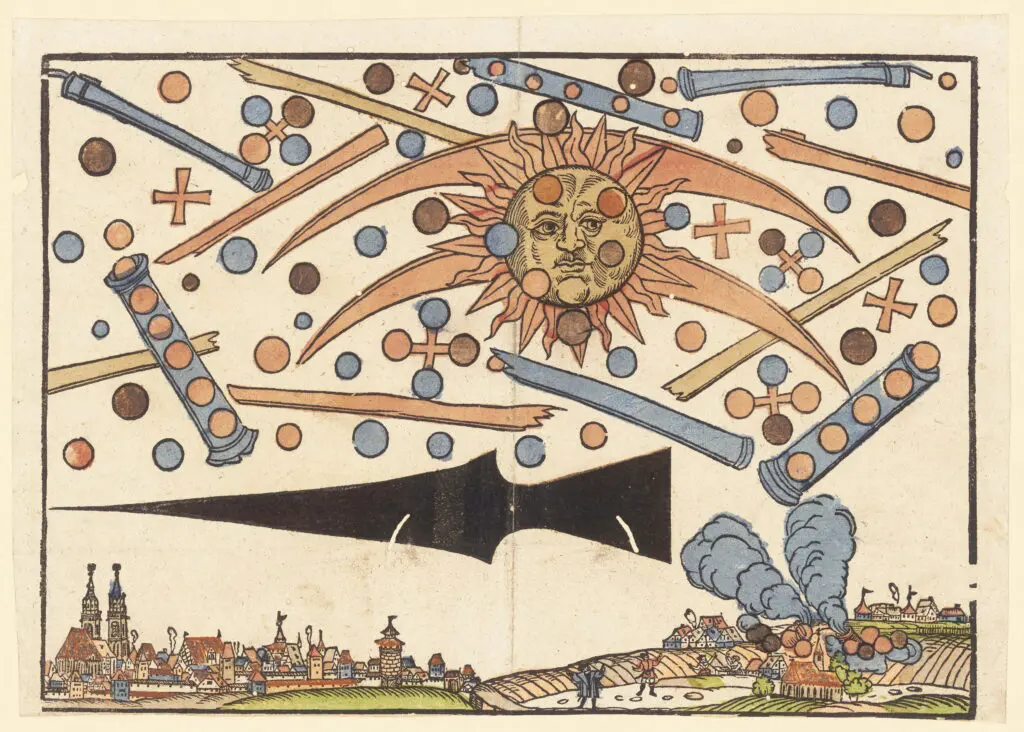
In the spring of 1561 in Nuremberg, a printed broadside claimed that townspeople watched a dawn spectacle of “balls,” “rods,” “crosses,” and crescent shapes apparently interacting in the sunlit sky. Five years later in Basel, another broadside described unusual sunrise and sunset conditions “accompanied by black spheres,” observed on multiple dates, and interpreted as a moral warning. (E-Manuscripta)
These two events are often bundled together in UAP discussions because they are visually unforgettable.
Woodcuts survive. Titles survive. Library shelf marks survive.
Even if we cannot reconstruct every detail of what happened, we can verify that the documents exist, when and where they were printed, and how later collectors preserved them. That is the archival core, and it is stronger here than in many older “wonders in the sky” reports.
The more delicate question is what we should do with them. A 16th-century broadsheet is not a modern incident report. It can contain witness descriptions, but it is also a product designed to persuade, warn, and sell.
A careful approach is to keep the main narrative anchored to what the sources securely establish, then clearly label everything else as hypothesis or interpretation.
What can be verified, right now, from the archives
The “Nuremberg 1561” source most often cited is a single-sheet print preserved by the Zentralbibliothek Zürich and digitized on e-manuscripta. The library catalog description is explicit that it is an Einblattdruck (single-leaf print) describing a sky phenomenon over Nuremberg on April 14, 1561, and that the large woodcut shows a complex interplay of forms, with the text relating the event to divine omnipotence. (E-Manuscripta)
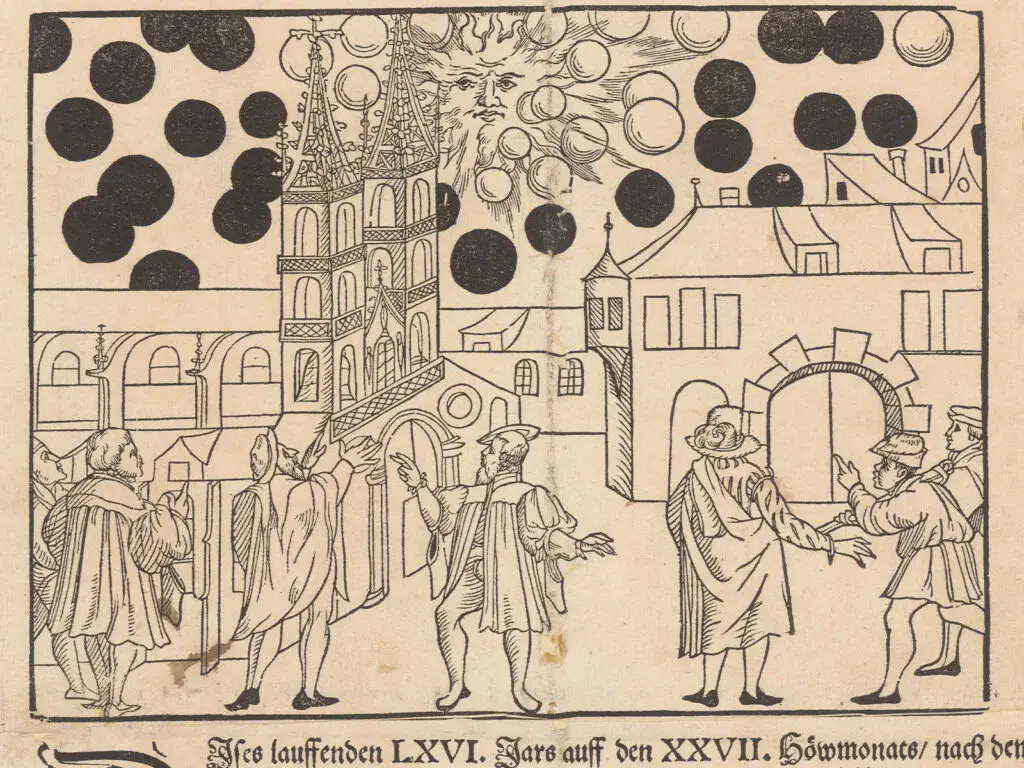
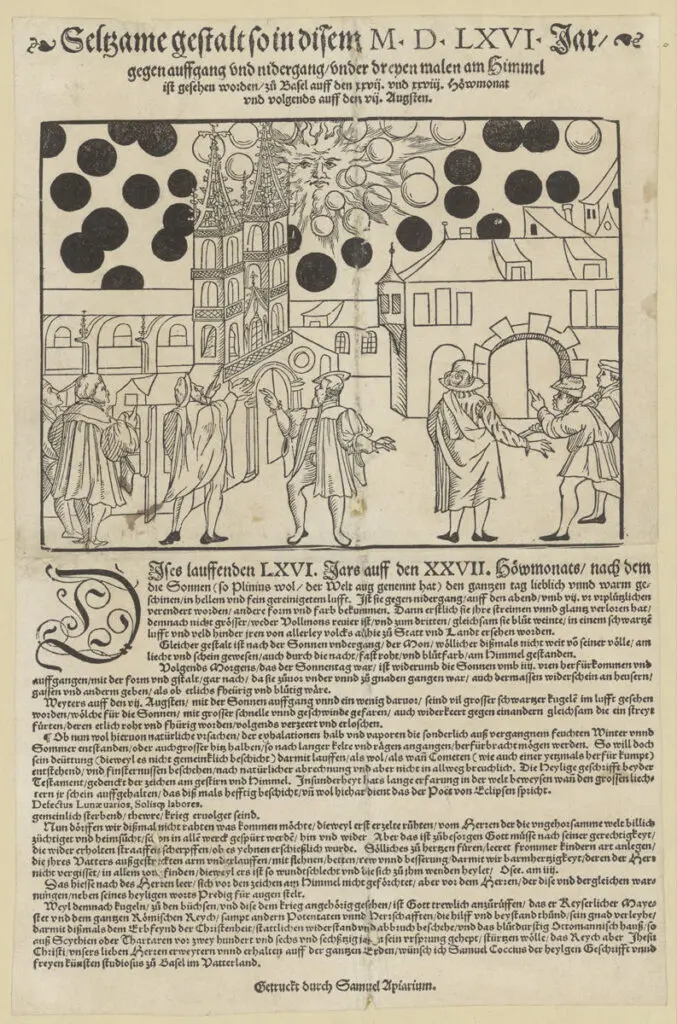
The “Basel 1566” source is also preserved by the Zentralbibliothek Zürich on e-manuscripta. Its catalog description summarizes the content as an unusual sunset and sunrise accompanied by “black spheres,” observed on July 27 and 28 and on August 7, 1566, and interpreted as a divine portent that prompts a call to repentance and prayer for help against the Turks. (E-Manuscripta)
Both are tied to the Wickiana collecting tradition.
The e-manuscripta description of the Wickiana explains that Johann Jakob Wick (1522–1588), a canon at Zürich’s Protestant Grossmünster, systematically collected news items from 1560 onward.
It also states that the Wickiana comprises 24 volumes, and that 429 single-leaf prints and illustrated broadsheets were removed from the volumes and archived separately. That collecting habit is a major reason we still have these broadsheets to analyze rather than secondhand retellings. (E-Manuscripta)
So if you want a clean baseline, it is this: these are real, catalogued, dateable artifacts that describe unusual sky phenomena, and they were preserved within a known archival pathway.
Nuremberg, April 14, 1561: what the source actually says
The Nuremberg broadsheet is famous for its woodcut, but the catalog summary makes it clear the text is integral to its meaning. (E-Manuscripta)
The broadside’s narrative is often accessed today through modern summaries and translations. One accessible treatment that points back to the original artifact is The Public Domain Review, which recounts the traditional reading of the text: a dawn event between roughly 4 and 5 a.m., a profusion of shapes “out of the sun,” and a prolonged spectacle that witnesses experienced as dynamic and conflict-like. (E-Manuscripta)
Even with translation caveats, what stands out is the report’s insistence on multiplicity and sequence. It does not center on a lone fireball. It does not read like a quick flash. It describes many elements and describes them as moving, grouping, and changing over time. That is one reason it persists as a UAP touchstone.
But it is equally important to note what we do not have. We do not have named eyewitness depositions. We do not have a municipal record saying “this happened.” We have a printed report, created within months or weeks of the claimed event, presented to a public audience, and framed in religious language. The broadsheet’s existence is firm. The precise correspondence between the woodcut’s shapes and what individual citizens saw is, by nature, less firm.
A historically grounded way to read Nuremberg 1561 is to treat it as a compiled mass-witness claim filtered through print culture. It may preserve genuine observational features. It may also emphasize or stylize features to communicate impact and moral meaning.
Basel, July 27–28 and August 7, 1566: multiple dates, a moral frame, and “black spheres”
Basel’s broadsheet begins with something we can anchor to the library description: it explicitly summarizes the event as an unusual sunset and sunrise “accompanied by black spheres,” across three dates in late July and early August 1566, and it explicitly says the phenomena are interpreted as a divine portent prompting repentance and prayer. (E-Manuscripta)
That moral framing is not incidental. In early modern Europe, unusual celestial displays were widely treated as “signs,” and broadsheets were one of the main ways those signs were circulated and interpreted in public. Alexandra Walsham’s work on early modern “sermons in the sky” captures the broader cultural habit: the sky was read as meaningful, and reports blended observation with providential interpretation. (blog.nationalmuseum.ch)
Basel also has a particularly useful modern commentary from the Swiss National Museum, which emphasizes something UAP researchers sometimes skip because it is inconvenient: the makers of the Basel leaflet were not eyewitnesses and relied on first- and second-hand sources. This does not make the report worthless, but it does affect how confidently we can treat the woodcut as an eyewitness diagram. (blog.nationalmuseum.ch)
So Basel, more than Nuremberg, pushes us toward a layered reading: some combination of witnessed sky conditions, subsequent retelling, editorial selection, and moral interpretation. The “black spheres” line remains the most arresting detail because it is explicitly present in the library catalog summary, not only in later retellings. (E-Manuscripta)
The medium matters: what a broadsheet is, and what it is not
It is tempting to treat these woodcuts like snapshots. They are not snapshots.
A 16th-century broadsheet is closer to a one-page newspaper crossed with an illustrated sermon. It uses an image because images travel faster than paragraphs. It uses moral language because moral language was a primary lens for public meaning. It uses simplified shapes because simplified shapes reproduce well and remain legible across copies.
This is also where Wick’s role matters. The Wickiana description makes clear that Wick was collecting “news items” on wars, crimes, deformities, and freak weather, basically whatever seemed socially significant and worth preserving. (E-Manuscripta) That collecting impulse helps explain why a dramatic sky report would be preserved, and why its form would match the media ecology of the time.
For UAP study, the consequence is straightforward: these sources are valuable, but they must be handled like mediated testimony. They are closer to a curated compilation than to raw observation notes.
Natural explanations: what they can explain, and where they may not map cleanly
Most sober discussions of Nuremberg and Basel bring up atmospheric optics, especially halo phenomena and sun dogs (parhelia). That is not a handwave. It is a real family of effects that can look spectacular when the sun is low and ice crystals are present.
Britannica defines a sun dog as luminous spots at the sun’s elevation, typically around 22 degrees on either side, produced by atmospheric ice crystals. (E-Manuscripta) Atmospheric optics references emphasize that sun dogs often appear alongside related halo features such as arcs, pillars, and circles. In practice, a strong halo display can be complex and can shift as cloud structure changes.
That said, it is also fair to acknowledge the limits of what any single prosaic explanation can do with these specific broadsheets. In Nuremberg’s case, many readers focus on the “object-like” vocabulary: multiple balls, rod-like forms, and a dark “spear” shape. In Basel’s case, the emphasis is on repeated observations across multiple dates and the “black spheres” motif. (E-Manuscripta)
A cautious way to phrase this is: halo and sun dog phenomena can plausibly account for some of the reported geometry and the setting (sunrise/sunset), and historians and science communicators often explore that route; however, the surviving sources are mediated enough that we cannot confidently map every depicted shape to a specific optical component, nor can we confidently say “therefore it was not atmospheric optics.” The honest answer is that the sources permit multiple readings, and the evidential constraints come from the genre as much as from the sky.
Why Vallée and Aubeck treat cases like this as data, not as trophies
Jacques Vallée and Chris Aubeck’s Wonders in the Sky is frequently invoked here because it treats pre-20th-century accounts as part of a longer timeline of reported aerial anomalies. The Smithsonian catalog entry describes the book as a historical compilation of unexplained aerial objects from antiquity to modern times, emphasizing cultural impact and the long record of reported anomalies. (E-Manuscripta)
UAPedia’s own biographical treatment of Vallée stresses the same methodological point: the intent is not to force the past into modern categories, but to show that structured anomaly reports long predate modern flight, and to treat those reports with linguistic and contextual scrutiny. (UAPedia – Unlocking New Realities)
This framing is useful because it discourages a common failure mode. The failure mode is to treat Nuremberg and Basel as “slam dunk orb cases” simply because the art looks like orbs. A better approach is to treat them as high-quality historical nodes: well-preserved, culturally informative, and suggestive, while still bound by the limitations of their medium.
Implications that stay inside the evidence
Even if we never settle what caused these reported events, the cases still carry implications that are valuable for UAP study.
First, they demonstrate that early modern Europeans sometimes described aerial phenomena using discrete “object” language. Whether that language reflects literal object perception, metaphor, or stylized print conventions varies case by case. But the vocabulary exists in the record.
Second, they show how interpretation travels with observation. Basel’s catalog summary explicitly includes repentance and prayer as part of the text’s purpose. (E-Manuscripta) That tells us something about how communities metabolized uncanny experiences.
Third, they highlight the importance of archives. The Wickiana’s structure, and the fact that these are catalogued items with stable identifiers, makes them usable for comparative work across centuries. (E-Manuscripta)
These are grounded implications. They do not require us to claim that 16th-century Europe experienced “craft” in the modern sense. They also do not require us to claim the events were “only weather.” They simply keep the record intact as reported, recorded, and debated.
Speculation labels
Witness interpretation
Both broadsheets interpret the sky events through a religious lens. The Nuremberg catalog summary notes the text relates the phenomenon to divine omnipotence. (E-Manuscripta) The Basel catalog summary explicitly describes the phenomena as a divine portent leading to a call for repentance and prayer for help against the Turks. (E-Manuscripta)
Hypothesis
One hypothesis is that witnesses experienced complex atmospheric optics under striking sunrise or sunset conditions, later rendered into simplified discrete forms by the broadsheet medium. This can be consistent with the known complexity of halo displays and with early modern print conventions.
A second hypothesis is that at least some witnesses perceived discrete “object-like” elements that felt distinct from common sky optics, and that this perception survived into the print narrative as “balls” and other forms. Under this hypothesis, the broadsheets preserve a residue of anomaly, but the medium prevents decisive attribution.
Researcher opinion
Modern institutional commentary, such as the Swiss National Museum’s discussion of Basel, places these pamphlets within a broadsheet ecosystem and stresses that the Basel creators relied on first- and second-hand reports rather than direct witnessing. (blog.nationalmuseum.ch) Vallée-style archival work treats such cases as part of a long comparative record, emphasizing continuities and cultural filtering rather than claiming certainty of cause. (UAPedia – Unlocking New Realities)
Claims taxonomy
Nuremberg 1561: Disputed. The artifact is real and well catalogued, but the surviving record is a mediated broadsheet rather than converging independent witness documents. (E-Manuscripta)
Basel 1566: Disputed. The artifact is real and well catalogued, and the library summary explicitly includes “black spheres” and a moralized interpretation, but modern institutional commentary notes the leaflet’s creators were not eyewitnesses. (E-Manuscripta)
Relevant links
Primary sources (Zentralbibliothek Zürich, e-manuscripta)
https://www.e-manuscripta.ch/zuzneb/content/titleinfo/2723858
https://www.e-manuscripta.ch/zuzneb/content/titleinfo/2725175
https://www.e-manuscripta.ch/wick/nav/classification/1726382
Institutional context
https://blog.nationalmuseum.ch/en/2024/07/the-celestial-event-over-basel-in-1566
Additional links
References
Apiarius, S., & Coccius, S. (1566). Seltzame gestalt so in disem M. D. LXVI. Jar/ gegen auffgang vnd nidergang/ vnder dreyen malen am Himmel ist gesehen worden… [Broadsheet]. Zentralbibliothek Zürich (e-manuscripta). https://www.e-manuscripta.ch/zuzneb/content/titleinfo/2725175 (E-Manuscripta)
Glaser, H. (1561). Himmelserscheinung über Nürnberg vom 14. April 1561 [Broadsheet]. Zentralbibliothek Zürich (e-manuscripta). https://www.e-manuscripta.ch/zuzneb/content/titleinfo/2723858 (E-Manuscripta)
Schweizerisches Nationalmuseum. (2024, July 30). The celestial event over Basel in 1566. Swiss National Museum Blog. https://blog.nationalmuseum.ch/en/2024/07/the-celestial-event-over-basel-in-1566/ (blog.nationalmuseum.ch)
UAPedia. (n.d.). Renaissance Europe and UAP: Prodigies, pamphlets, and problems of the sky. https://www.uapedia.ai/wiki/renaissance-europe-and-uap-prodigies-pamphlets-and-problems-of-the-sky/ (UAPedia – Unlocking New Realities)
UAPedia. (n.d.). Jacques Vallée: The father of modern UAP studies. https://www.uapedia.ai/wiki/jacques-vallee-the-father-of-modern-uap-studies/ (UAPedia – Unlocking New Realities)
UAPedia. (n.d.). UAPedia editorial standard: Navigating the mystery. https://uapedia.ai/wiki/uapedia-editorial-standard-navigating-the-mystery/ (UAPedia – Unlocking New Realities)
Vallée, J., & Aubeck, C. (2010). Wonders in the sky: Unexplained aerial objects from antiquity to modern times. Jeremy P. Tarcher/Penguin. (UAPedia – Unlocking New Realities)
Wickiana. (n.d.). Johann Jakob Wick collection description. Zentralbibliothek Zürich (e-manuscripta). https://www.e-manuscripta.ch/wick/nav/classification/1726382 (E-Manuscripta)
SEO keywords
Nuremberg 1561 UAP, Basel 1566 black spheres, Renaissance UAP broadsheet, Wickiana collection, Johann Jakob Wick, Hans Glaser Nuremberg sky phenomenon, Samuel Apiarius Samuel Coccius Basel broadsheet, wonders in the sky Vallée Aubeck, pre-20th-century UAP accounts, early modern celestial signs UAP