
Oak Ridge is more than a place on the Tennessee River. It is a test case for how the United States builds technology at speed, protects it behind fences, and then tries to understand anomalies that appear around it.
In the 1940s Oak Ridge helped split the atom.
In the 1950s it sat under the nation’s early warning radars as those same anomalies threaded across protected airspace.
In the 2020s the Pentagon’s All domain Anomaly Resolution Office asked Oak Ridge National Laboratory to break down a purported “off world” metal and tell the public what it really was. This is the arc of a single location across eight decades of science, secrecy, and UAP.
This feature examines primary documents, official laboratory reports, and named programs wherever possible. It combines the material record of the Manhattan Project with sensor verified encounters and the newest work from AARO.
The place and the program
In October 1942 the Army Corps of Engineers began buying land in East Tennessee for what would become the Clinton Engineer Works, later Oak Ridge. By March 1943 fifty-six thousand acres lay behind guarded gates.
Three industrial complexes did the core work of the Manhattan Project.
- Y-12 used electromagnetic “calutrons,”
- K-25 ran gaseous diffusion.
- X-10 was the pilot plant that hosted the Graphite Reactor.
Together they fed uranium 235 to Los Alamos and proved industrial scale plutonium production. (The Department of Energy’s Energy.gov)
Oak Ridge’s scientific footprint and workforce grew and then matured into a modern national laboratory system.
- K-25 became the East Tennessee Technology Park after diffusion ended.
- X-10 became Oak Ridge National Laboratory.
- Y-12 continued with missions that included lithium separation in the Cold War and now storage and processing of highly enriched uranium inside the National Nuclear Security Administration complex. (CDC)
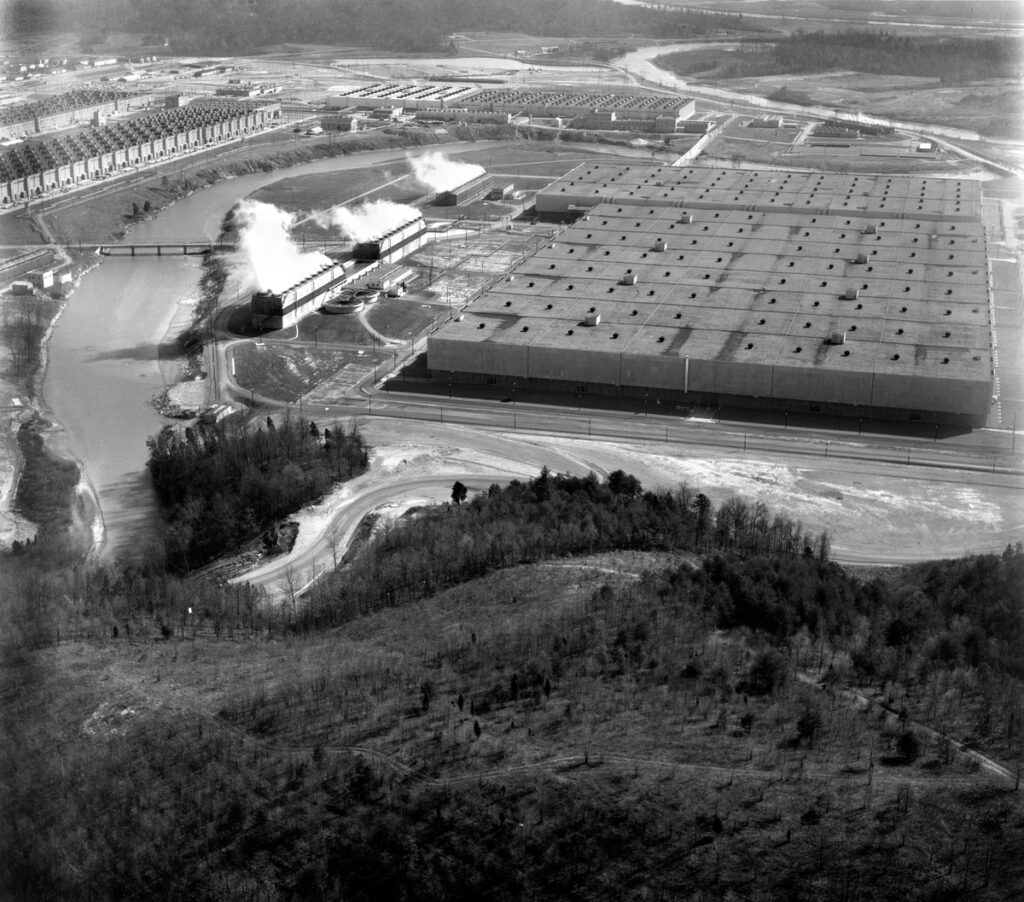
55-177 DOE photo Ed Westcott 3-9-1955 Oak Ridge Tennessee. Public Domain
Security at Oak Ridge was never an afterthought. From the Manhattan Project era through the AEC and into DOE, counterintelligence, guarded perimeters, and layered sensors were a way of life. That posture shows up in historical security studies and in the Army’s own institutional histories of counterintelligence during the project. (OSTI)
The first signal: sensor verified UAP at Oak Ridge in 1950
The earliest unambiguous, sensor backed UAP at Oak Ridge appears in an Air Force Office of Special Investigations “spot intelligence report” dated 4 December 1950.
The eight district OSI office summed up two evenings of radar events over the Controlled Area of Oak Ridge on 29 and 30 November. At 17:15 hours on 29 November, three unidentified “paints” appeared on the A 3 radar scopes that covered the reservation; over the next hours the targets maneuvered across the northwest boundary and then over the center of the reservation at altitudes between roughly 2,500 and 3,000 feet, changing directions and fading in and out.
An F-82 was scrambled to intercept but achieved no visual or airborne radar contact. The report includes local wind data and a classification cancellation stamp.
The technical language is matter of fact, not sensational. It also states the aircraft were not the conventional sense because of the way they moved.
The report is valuable for what it is and what it is not.
It documents multi hour radar tracks near a sensitive atomic complex, notes an attempted fighter intercept, and avoids leaps to conclusions. That is a good baseline for data driven UAP history.
A second document set produced by the Air Force the next week emphasized there were no known ECM systems in play to explain the radar returns. That wording matches the broader pattern of Atomic Energy Commission and Air Defense Command correspondence from the period when restricted airspace around atomic sites was under tight watch. (Noufors)
The 1952 wave crosses Oak Ridge
The summer of 1952 drove a national spike in UAP reporting.
The Air Force later assessed that the broader surge in sightings from 1952 to 1957 included many misidentifications of new technologies but it also logged a subset of uncorrelated targets with multiple sensors. Oak Ridge is present in these records. (U.S. Department of War)
Case one. Oak Ridge radar visual near the AEC laboratory, 21 June 1952
At 10:58 p.m. local a Ground Observer Corps spotter reported a slow moving object near the lab, inside prohibited airspace. Ground control intercept radar acquired a target, then lost it. An F 47 fighter on combat air patrol engaged, and the pilot reported aggressive turns by the target, including approaches that looked like ramming attempts, before the object sped away. The chain of events is preserved in a case reconstruction based on the Blue Book file. (NICAP)
Case two. “Bullet shaped object,” 23 June 1952
Two days later, at 3:30 a.m., a civilian witness, Martha Milligan, saw a bullet shaped object with a burnt orange exhaust fly straight and level for half a minute. Blue Book indexed this one as an unknown. As a single witness case without sensor data it is weaker, but it shows the context around the radar visual events. (The Black Vault)
A contemporaneous summary by Project Blue Book chief Edward Ruppelt gives a wider frame. Ruppelt later wrote that sightings clustered around “technologically interesting” places, including atomic facilities, and he discussed Oak Ridge alongside other heavily guarded sites. His book is not an official Air Force conclusion, but it is a first person account by the officer who ran the program in its most analytical phase. (Wikipedia)
For researchers cataloging UAP near nuclear infrastructure, Oak Ridge shares page space with Hanford and Savannah River. A National Investigations Committee on Aerial Phenomena chronology collates the Oak Ridge June 1952 radar visual with source documents; a separate NICAP compilation reproduces the 1950 document trail. These are secondary aggregations, but they are built from the declassified record. (NICAP)
What the Manhattan Project set in motion
The Manhattan Project and its successors built not only bombs but a nationwide network of labs, test ranges, and radars.
That network created a huge observation bias around sensitive sites. AARO’s Historical Record Report Volume 1 notes that national lab growth, secrecy, and constant testing most likely contributed to waves of UAP reporting.
It explicitly lists the Manhattan Project and its laboratory ecosystem, including Oak Ridge National Laboratory, as part of the historical backdrop for the 1952 spike. (U.S. Department of War)
For context on the ground at Oak Ridge, official histories from DOE and the National Park Service document the physical plant and mission of Y-12, K-25, and X-10. The K-25 and X-10 facilities are preserved in part within the Manhattan Project National Historical Park and through DOE history centers, which helps anchor subsequent UAP narratives to the real industrial and security landscape. (National Park Service)
Witness accounts you can check
A data first treatment privileges sources the public can inspect. Here are three Oak Ridge linked accounts and where to read them.
- 29 to 30 November 1950 radar tracks over the reservation
The OSI spot report is brief and careful. It records “unidentified paints” moving over the center of the controlled area, fanning out, and then fading after about two hours. An F 82 attempted intercept without contact. You can see the original OSI header, the timing, the wind table, and the declassification stamp. - 21 June 1952 radar visual near the AEC lab
A GOC observer called the filter center; GCI radar reported a target; an F 47 pilot described hard maneuvers by the object. The case reconstruction cites Blue Book forms and questionnaires by time. This is the classic atomic reservation incursion profile. (NICAP) - 23 June 1952 “bullet shaped” visual
Listed as an unknown in The Black Vault’s index to Project Blue Book unknowns, with the witness name and the essential details. Not a strong case by itself, but useful near the radar visual. (The Black Vault)
There is also a July 1947 Oak Ridge photo series in the Blue Book microfilm that shows a luminous object over a residential area.
The images exist, but the files do not tie the light to the reservation or provide strong technical data. Treat them as early context rather than proof. (Wikimedia Commons)
The books that shaped the nuclear UAP conversation
Several works gave Oak Ridge a recurring role in the literature.
- Edward J. Ruppelt, The Report on Unidentified Flying Objects (1956). The former Blue Book head wrote about the 1952 wave and the clustering of reports near atomic sites. It remains the best entry point to the Air Force’s middle period of study. (Internet Archive)
- Barry Greenwood and Lawrence Fawcett, Clear Intent (1984). A key early compendium of government documents, including Oak Ridge material. The NICAP page for “Clear Intent 171 to 175” summarizes the Oak Ridge chapter and links documents still in use today. (NICAP)
- Robert Hastings, UFOs and Nukes (2008; revised 2017). Hastings assembled testimony and declassified papers about nuclear related incidents across multiple bases. The International Atomic Energy Agency catalog and other listings show its continuing use. (INIS)
For the place itself, Denise Kiernan’s bestseller The Girls of Atomic City captures Oak Ridge culture during the war and early postwar era, and City Behind a Fence by Charles W. Johnson and Charles O. Jackson remains a foundational Oak Ridge history. These are not UAP books; they explain the human and physical environment where the sightings occurred. (Simon & Schuster)
Government involvement then and now
The chain of custody for Oak Ridge UAP reporting was classic Cold War. The AEC security patrols and FBI field office at Knoxville communicated with Air Defense Command and OSI when unknowns were detected. A declassified summary from a 1950 inquiry lists the AEC Security Division, NEPA division security, FBI, Air Force radar and fighter squadron, and the OSI as participants who could not find a satisfactory conventional explanation for a series of objects reported over Oak Ridge.
The memo states that routine natural causes had been ruled out by the quality and convergence of witnesses. (NICAP)
Project Blue Book took in and indexed the atomic site cases. That record is now online through archives and public repositories. (Wikimedia Commons)
In 2024 the Department of Defense released AARO’s Historical Record Report Volume 1, a document driven review of government files from 1945 through October 2023.
The report acknowledges persistent claims of UAP events near nuclear infrastructure and says AARO is continuing to investigate unresolved nuclear related cases because of their sensitivity for national readiness.
It also documents a number of instances where sightings were almost certainly misidentifications of new technology or natural phenomena. (U.S. Department of War)
Congress reinforced that review process with hearings and statutory mandates. The “Exposing the Truth” House hearing and subsequent oversight work kept public attention on the question of what the government actually holds. (Congress.gov)
Oak Ridge and AARO meet directly in the lab
The strongest modern link between Oak Ridge and the UAP portfolio is a test, not a sighting. In 2022 AARO contracted Oak Ridge National Laboratory to perform advanced materials characterization on a layered magnesium alloy sample that had been publicly alleged to be debris from a 1947 crash with extraordinary properties.
ORNL’s synopsis, published in April 2024, describes microscopy, spectroscopy, and isotope measurements. The laboratory found a terrestrial magnesium zinc matrix with lead and bismuth banding and concluded the structure did not meet theoretical requirements to function as a terahertz waveguide for antigravity as claimed. AARO’s July 2024 supplement concurs and adds historical context, assessing the sample as consistent with mid twentieth century magnesium alloy experiments.
Both documents are public on AARO’s site. (AARO)
That is an extraordinary step for transparency. It uses a DOE lab with deep materials expertise to address a long circulating claim and publishes the work. It is also an institutional hinge: the very lab system born from the Manhattan Project is now the place where extraordinary artifacts meet instruments and either hold up or fall apart.
AARO’s site also explains its declassification approach and hosts resolved case imagery and case resolution reports. The office defines UAP in a way that spans air, sea, space, and transmedium observations, which matters for nuclear sites that include both terrestrial and maritime domains. (AARO)

Data cards: what happened, when, and how we know
1947, Oak Ridge
Sensors: Photographs
Data: Seven stills of a luminous object over a residential area; poor probative value
Primary source: Blue Book microfilm images.
29–30 Nov 1950, Oak Ridge reservation
Sensors: Ground radar; attempted fighter intercept
Data: Multi hour radar paints over controlled airspace; plain language OSI report; winds logged; no ECM known; no visual confirmation from the fighter
Primary source: Declassified OSI spot intelligence report with timing and intercept note.
21 Jun 1952, near AEC Oak Ridge Laboratory
Sensors: GOC observer; GCI radar; fighter pilot report
Data: Target fades on radar; pilot reports aggressive maneuvers by the object; dogfight narrative without weapon employment
Primary source: Project Blue Book derived reconstruction and document packet. (NICAP)
23 Jun 1952, Oak Ridge
Sensors: Visual only
Data: One witness reports bullet shaped object with orange exhaust for under a minute
Primary source: Project Blue Book unknowns list. (The Black Vault)
2022–2024, ORNL materials analysis for AARO
Sensors: Optical and electron microscopy, CT, laser ablation ICP MS, multicollector ICP MS
Data: Layered Mg Zn alloy with Pb Bi banding; isotopic ratios squarely terrestrial; no THz waveguide conditions met
Primary source: ORNL synopsis and AARO supplement. (AARO)
How to interpret Oak Ridge across time
A prudent reading keeps two ideas in focus.
- Oak Ridge is a magnet for scrutiny. The reservation drew radars, guards, and quick reaction fighters. AARO argues that secrecy and the proliferation of advanced projects and labs likely boosted UAP reporting. That does not erase the best Oak Ridge cases but it raises the background noise floor. (U.S. Department of War)
- Some Oak Ridge cases are robust on their own terms. The 1950 OSI report is a clean example of government documentation of multi hour radar tracks over a nuclear reservation with an attempted intercept. It does not resolve the unknowns but it is solid as a data point.
The synthesis is not to wave away every anomalous report near atomic sites as misidentification, nor to leap to non human explanations. It is to insist on instrumented records and institutional memory, which Oak Ridge has in abundance.
Implications
- Policy. AARO’s willingness to route extraordinary claims through DOE labs is a workable model. It validates or falsifies with instruments and publishes the outcome. That can scale to other physical claims. (AARO)
- Operations. The 1950 OSI report reads like a textbook air defense problem set. Modern equivalents would take advantage of fused sensor networks, but the decision tree for restricted airspace remains familiar. Oak Ridge security is still a national priority, as later incidents unrelated to UAP have shown. (The New Yorker)
- History. The Manhattan Project did not end. It turned into a nationwide network that still produces discoveries and debates. If the atomic age created the conditions for modern UAP reporting, the same labs now supply the tools to test UAP claims. (The Department of Energy’s Energy.gov)
References
- U.S. Department of Energy, Oak Ridge history page. (The Department of Energy’s Energy.gov)
- National Park Service, Manhattan Project National Historical Park, Oak Ridge assets. (National Park Service)
- CDC and DOE historical materials on K 25 operations. (CDC)
- DOE OSTI, history of classified activities at ORNL. (OSTI)
- FAS, Security and the Manhattan Project. (Intelligence Resource Program)
- USAF OSI, 4 Dec 1950 “Spot Intelligence Report” on Oak Ridge radar targets.
- NICAP, Oak Ridge 21 June 1952 radar visual case file compilation. (NICAP)
- The Black Vault, Project Blue Book Unknowns list, entry for 23 June 1952 Oak Ridge. (The Black Vault)
- Blue Book microfilm, “File 26, July 1947, Oakridge, Tennessee, 7 photos.”
- Edward J. Ruppelt, The Report on Unidentified Flying Objects, online archive copy. (Internet Archive)
- NICAP, “Clear Intent 171–175, Oak Ridge.” (NICAP)
- IAEA record, Robert Hastings, UFOs and Nukes. (INIS)
- AARO, Historical Record Report Volume 1, sections on the Manhattan Project and nuclear cases. (U.S. Department of War)
- AARO UAP Records page, ORNL synopsis and AARO supplement on the magnesium alloy specimen. (AARO)
- House hearing record, “Unidentified Anomalous Phenomena: Exposing the Truth.” (Congress.gov)
- New Yorker, “Break In at Y 12,” for security context at the modern reservation. (The New Yorker)
Claims taxonomy
- 29–30 November 1950 Oak Ridge reservation radar tracks
Classification: Verified
Why: Multi sensor radar, attempted intercept, official OSI record; no routine cause identified in the documents. - 21 June 1952 radar visual near AEC Oak Ridge Laboratory
Classification: Verified
Why: Ground observer plus GCI radar plus fighter pilot narrative, documented in Blue Book material. (NICAP) - 23 June 1952 “bullet shaped” visual
Classification: Probable
Why: Single witness visual, short duration, no corroborating sensor data. (The Black Vault) - July 1947 photo sequence
Classification: Disputed
Why: Images exist, provenance and interpretation are weak; not tied to Oak Ridge sensor networks or security logs. - UAP nuclear interference narratives from the Cold War
Classification: Disputed
Why: AARO notes unresolved nuclear related cases are under review but has not validated claims of missile shut downs; in at least one cited case the office correlates witness timing with an antiballistic missile test. (U.S. Department of War) - Alleged “metamaterial” with antigravity properties tested by ORNL
Classification: Misidentification
Why: ORNL and AARO conclude the specimen is terrestrial magnesium alloy with Pb Bi banding and does not meet THz waveguide conditions. (AARO)
Speculation labels
Hypothesis. A portion of Oak Ridge era radar targets were likely anomalous propagation or biologicals under certain weather inversions. The 1950 report’s long duration tracks and altitude changes argue against a simple flock explanation, but without raw radar data we cannot model the propagation environment directly.
Witness interpretation. The 21 June 1952 fighter pilot’s description of “ramming” approaches may record the cognitive stress of night maneuvering against a small light source with poor range cues.
Researcher opinion. The persistence of Oak Ridge in the literature is partly a records effect. Atomic sites document more, so anomalies are preserved rather than lost. The 1950 OSI document is still a valuable unknown, and the ORNL analysis shows how to adjudicate physical claims without ambiguity.
SEO keywords
Oak Ridge UAP, Manhattan Project UAP, AARO Oak Ridge, Oak Ridge National Laboratory UAP analysis, 1950 Oak Ridge radar, 1952 Oak Ridge radar visual, Blue Book Oak Ridge, Y 12 UAP history, K 25 history, X 10 Graphite Reactor UAP, nuclear sites and UAP, DOE labs and AARO, magnesium bismuth alloy ORNL, UAP near atomic sites