
On the evening of October 11, 1973, two shipyard workers went fishing near the Pascagoula River in Mississippi and walked into one of the most unsettling contact cases in modern UAP history. Charles “Charlie” Hickson, then 42, and Calvin Parker Jr., then 19, said they saw a blue-lit, oblong craft descend near the riverbank, heard a strange buzzing sound, and were taken aboard by three short, pale, non-human-looking beings who moved as if they were floating. The men reported the event to local authorities that same night, and their story became famous almost instantly. Yet the more complicated story did not end at the river.
The classic Pascagoula case is usually told as a single night of terror. This article focuses on the part that came afterward: Hickson’s reported follow-up encounters in 1974. According to Hickson’s later account, as summarized in retrospective reporting and attributed to his book UFO Contact at Pascagoula, he claimed three additional contacts, once at a local tree farm, once at his home, and once on Mississippi Highway 67. The repeated message he attributed to the beings was simple, cosmic, and disturbing in its implications: they meant no harm, he had been chosen, and the human world needed help. Those later contacts are weaker evidentially than the same-night Pascagoula record, but they are essential to understanding what the case became.
The Parker–Hickson case is not only a story about alleged abduction. It is a story about documentation, ridicule, public memory, and the strange way a single encounter can divide two lives. Hickson became the more public voice, speaking, writing, and insisting that the contact was real. Parker withdrew for decades before later telling his version in books and interviews. Between them sits a remarkable evidence trail: a sheriff’s-office tape, investigator interviews, oral history, press coverage, skeptical critiques, later witness claims, and a commemorative marker at Lighthouse Park in Pascagoula.
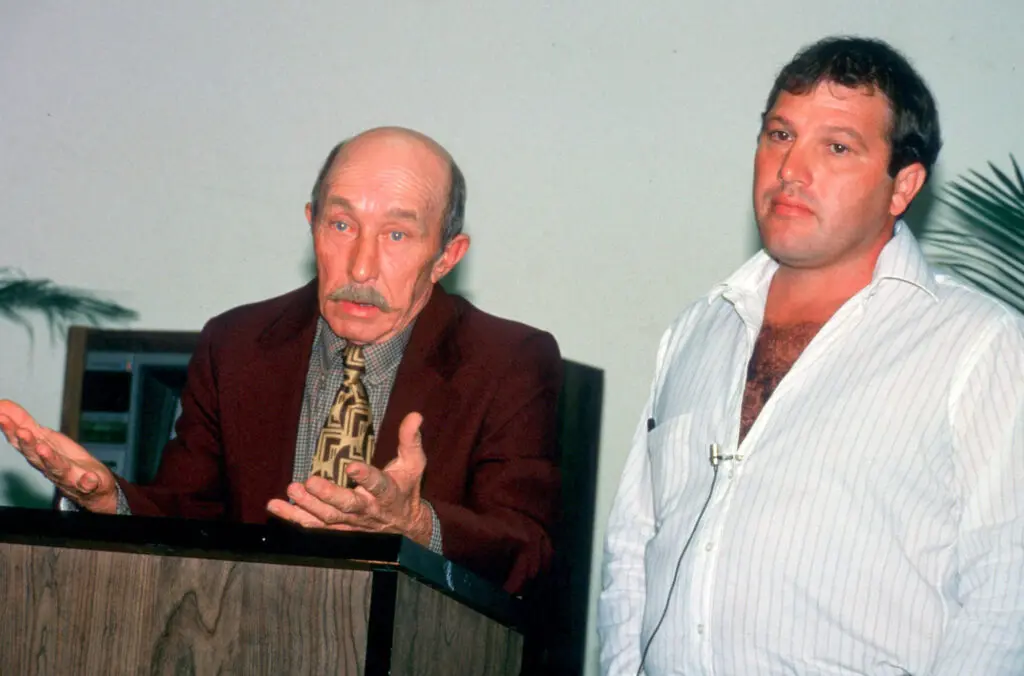
The night at the river
The strongest documentation in the case begins only hours after the alleged encounter. NICAP’s preserved transcript identifies the sheriff’s-office interview as taking place at approximately 11 p.m. on October 11, 1973, conducted by Sheriff Fred Diamond and Captain Glen Ryder. Hickson told them that he and Parker had been fishing along the river when a blue light came down near the bayou, hovering low above the ground. He described an oblong craft, a buzzing sound, and three beings that “floated” or “glided” toward them rather than walking normally. Source: NICAP, “The Hickson Tapes: The Pascagoula Incident,” https://www.nicap.org/reports/731011pascagoula_hicksontape.htm
Hickson’s first-night description was vivid but not polished. That matters. He struggled for ordinary language to describe extraordinary perception. The beings had pincer-like hands, a slit-like area where a mouth might be, ear-like projections, and no obvious eyes as he understood the word. He said they lifted him by the arms without hurting him, brought him inside the craft, and exposed him to a moving instrument that looked “like a big eye.” Parker, according to Hickson, was overwhelmed and either passed out or became nearly unable to function.
The men did not initially sound like people expecting fame. Hickson told the officers he expected to be laughed out of Jackson County. He also said he had tried to contact Keesler Air Force Base and was told to contact the sheriff. That detail fits the wider institutional context: Project Blue Book, the Air Force’s formal UAP-investigation program, had ended in 1969, four years before Pascagoula. The National Archives states that Blue Book closed in 1969 and that its records contain no information on sightings after that date. Source: National Archives, “Project BLUE BOOK,” https://www.archives.gov/research/military/air-force/ufos
This post-Blue Book gap is important. Pascagoula was not investigated through the old Air Force system because that system no longer existed in active form. The case entered public record through local law enforcement, media reporting, civilian investigators, and later witness testimony. That makes it both unusually well preserved for a close-contact report and frustratingly incomplete by modern investigative standards.
The hidden tape
The hidden sheriff’s-office tape remains the emotional center of the case. After the formal questioning, Diamond and Ryder left Hickson and Parker alone in the room while the recorder continued running. If the men had invented the story, this was the moment when they might have relaxed. Instead, the transcript captures continued panic, confusion, dread, and fear of disbelief. Parker said he needed nerve pills or a doctor. Hickson tried to calm him while also saying people would not believe them.
The tape does not prove the external cause of the event. It does not show a craft. It does not identify the beings. It does not solve the case. But it does document something meaningful: shortly after the reported encounter, when they apparently believed they were alone, the two men continued to behave as if something terrifying had happened. For testimony-based UAP research, that is not a minor detail.
A careful reader should separate two questions. The first is whether Hickson and Parker displayed acute distress that night. The answer is strongly supported by the recorded transcript and later law-enforcement recollections. The second is whether the cause of that distress was an objectively real non-human contact event. That remains disputed. The tape is powerful evidence of sincerity and acute shock, not conclusive proof of origin.
Polygraph claims are sometimes raised in discussions of Pascagoula, but they should be handled cautiously. At most, polygraphs can be discussed as limited and contested indicators related to perceived sincerity. They cannot establish the physical reality of a craft, the identity of beings, or the external cause of an experience.
Hickson’s public path
Charlie Hickson did not retreat from the case. Reuters later described him as never backing away from the story despite ridicule and noted that he appeared on national television in 1974 before later co-authoring a book with William Mendez. Hickson’s public stance was not casual. He framed the experience as life-altering and insisted on it until his death in 2011. Source: Reuters, “Mississippi man who said he was abducted by aliens dies,” https://www.reuters.com/article/world/uk/mississippi-man-who-said-he-was-abducted-by-aliens-dies-idUSTRE78C66R/
The University of Southern Mississippi preserves a 1979 oral history interview with Hickson. Its summary states that he gave his background, described the Pascagoula event in detail, and discussed the aftermath, including speaking engagements in churches, radio programs, and television appearances. That oral-history record is valuable because it shows the case had become part of Hickson’s life story, not just a sensational headline. Source: University of Southern Mississippi Libraries, “Hickson Oral History,” https://lib.usm.edu/spcol/exhibitions/item_of_the_month/iotm_june_2022.html
For Hickson, the original encounter appears to have become a mission. That is where the follow-up contacts enter the story. According to Hickson’s later account, as summarized in retrospective reporting and attributed to UFO Contact at Pascagoula, he claimed he was contacted three times after the Pascagoula incident in 1974. These encounters were reportedly not identical to the first event. They were framed more as communication than capture, more message than medical examination. A Mississippi retrospective places the alleged follow-ups in January 1974 at a local tree farm, February 1974 at his home, and Mother’s Day 1974 on Mississippi Highway 67. Source: Jesse Yancy, “A Close Encounter in Pascagoula: Fifty Years After,” https://jesseyancy.com/a-close-encounter-in-pascagoula-fifty-years-after/
This must be stated precisely: Hickson reported these follow-up contacts. They are not documented at the same level as the October 11 sheriff’s-office episode. No hidden tape, official same-night interview, or independently published contemporaneous official record carries the later encounters in the way the first event is carried. Their evidentiary category is testimonial and weakly documented unless directly supported by page-cited primary text or contemporaneous 1974 reporting. They remain historically important because they shaped how Hickson understood the entire experience.
The three follow-up contacts
The reported 1974 contacts are strange partly because they unfold in ordinary spaces. A tree farm. A home. A highway. These are not theatrical locations. They are places embedded in everyday Mississippi life. Hickson’s claim was not that he pursued the beings into some remote ceremonial landscape. It was that the phenomenon returned to him inside the geography of his normal world.
The message he attributed to the beings had three parts. First, they meant no harm. Second, he was chosen. Third, humanity needed help. That sequence is familiar in contact literature, but in the Parker–Hickson context it carries special weight because it follows a frightening, bodily, apparently coercive event. In other words, Hickson’s story moves from paralysis and examination to reassurance and warning. The tone changes, but the strangeness deepens.
There are at least three possible readings. The first is literal: Hickson experienced continuing contact with the same or related non-human intelligences. The second is psychological: the shock of the Pascagoula event generated later visionary or interpretive experiences that helped him make meaning from trauma. The third is mixed: an anomalous external event may have triggered both continuing experiences and human symbolic processing. None of these readings can be established conclusively from the available record.
Still, the follow-up claims should not be discarded merely because they are difficult. Many contact and abduction cases contain an “afterward,” and the afterward is often where the witness’s life changes most deeply. Hickson’s later claims show that, for him, Pascagoula was not a closed event. It was the beginning of a relationship, or at least the beginning of his belief that a relationship existed.
Calvin Parker, the reluctant witness
Calvin Parker’s life gives the case a different rhythm. When Hickson became the public witness, Parker often appeared as the wounded survivor. In a long interview with Country Roads Magazine, Parker said he kept the story from even his wife for decades. He described wanting an ordinary life, not a public identity built around the worst night he could not explain. He also spoke about job disruption, emotional distress, and the burden of public disbelief. Source: Country Roads Magazine, “An Interview with Calvin Parker,” https://countryroadsmagazine.com/art-and-culture/people-places/the-pascagoula-abduction/
Parker’s later accounts added details that were not as prominent in the first-night record. He described blue hazy lights reflected on the water, a hovering oval craft, beings approaching, an examination table, a clicking object, and a more humanlike figure connected to the onboard experience. Those additions are valuable as witness memory and later testimony, but they should be weighed carefully because they emerged after decades, after public retellings, and in a case where hypnosis became part of the investigation history.
Yet Parker’s reluctance matters. He did not spend the first decades eagerly building a public career out of the encounter. WLOX later reported that Parker’s later chronicle included accounts from people who said they witnessed related events. Parker died on August 24, 2023, after kidney cancer, according to WLOX reporting. Source: WLOX, “Calvin Parker, who claimed he was abducted by aliens in Pascagoula in 1973, has died,” https://www.wlox.com/2023/09/02/calvin-parker-who-claimed-he-was-abducted-by-aliens-pascagoula-1973-has-died/
Parker’s role also helps protect the case from an overly simple reading. If Hickson’s later contacts made him sound like a chosen messenger, Parker’s long silence reminds us that contact narratives can also leave people isolated, embarrassed, and injured by disbelief. One man stepped forward. The other tried for years to step away. Both responses belong to the same case.
Later witnesses and the Pascagoula corridor
The Pascagoula story has also grown through later witness claims. WLOX reported in 2019 that Maria Blair came forward after decades, saying that on the same October night she had seen a strange blue light moving near the river while waiting for her husband. Her account does not verify the abduction itself, but it adds a potentially relevant environmental observation near the same time and place. Source: WLOX, “Pascagoula UFO: A new witness comes forward,” https://www.wlox.com/2019/03/15/pascagoula-ufo-new-witness-comes-forward/
Country Roads Magazine also reported that additional people later described unusual events around the river corridor. Some accounts involved blue lights; others involved unusual objects near or over water. The article discusses a November 6, 1973 underwater-object episode and attributes a stronger documentary claim to researcher Philip Mantle. The most precise way to handle that point is to say that, according to Mantle as reported by Country Roads, Coast Guard documents exist for that episode. Without direct citation to the documents themselves, the documents should not be treated here as independently verified.
This witness ecology changes the atmosphere of the case without solving it. Pascagoula may have been an isolated two-witness encounter, or it may have occurred within a broader local flap during the already intense 1973 UAP wave. Later witness reports deserve case-by-case evaluation. They should not be automatically folded into the Hickson-Parker claim, but they do broaden the investigative horizon.
Publications and investigations
The case’s publication history is unusually layered. Hickson and Mendez’s 1983 book, published under the title UFO Contact at Pascagoula, became the primary vehicle for Hickson’s expanded story, including the alleged follow-up contacts. Publication listings vary. The University of Southern Mississippi lists a Gautier, Mississippi edition as “Charles Hickson, 1983,” while some bibliographic listings associate the title with Wendel or Wendelle C. Stevens Publishing. The title should therefore be cited with care, and where possible, with the exact edition consulted.
Parker’s later books, Pascagoula: The Closest Encounter, My Story and Pascagoula: The Story Continues: New Evidence & New Witnesses, gave the younger witness a delayed public voice. These works are essential primary or near-primary sources, though they must be read as witness-centered accounts rather than neutral case files.
Civilian investigators and researchers also shaped the case. J. Allen Hynek and James Harder interviewed the men soon after the event, and their involvement helped preserve Pascagoula as more than a local curiosity. NICAP’s archived transcript gave later researchers access to the first-night tone and content. USM’s oral-history preservation gave Hickson’s life story a documentary frame. Local media, especially WLOX, kept the case visible in Mississippi memory.
In June 2019, Pascagoula unveiled a historical marker at Lighthouse Park. WLOX reported that Parker attended, that members of both families were present, and that the marker was paid for by the historical society with placement and installation handled through local civic effort. Parker described the recognition as deeply meaningful after decades of ridicule and doubt. Source: WLOX, “Historical marker unveiled honoring possible alien abduction in Pascagoula,” https://www.wlox.com/2019/06/23/historical-marker-unveiled-honoring-possible-alien-abduction-pascagoula/
A marker does not adjudicate the ontological truth of the event. It marks public memory. And public memory matters because UAP witnesses often face a second ordeal after the encounter: being laughed at, doubted, simplified, or turned into folklore. Pascagoula’s marker says, at minimum, that the event became part of the civic history of the place where it happened.
The 1973 wave context
The Pascagoula event occurred during a broader period of heightened UAP reporting in the United States. Historian David M. Jacobs treated the 1973 to 1974 period as a major wave in The UFO Controversy in America, describing widespread reports across multiple states, including close-range sightings and occupant claims. This wave context does not prove the Pascagoula encounter, but it helps situate it historically. The case did not appear in a vacuum. It emerged during a national moment when local police, newspapers, civilian investigators, and ordinary witnesses were all wrestling with unusually frequent reports.
For citation transparency, Jacobs should be cited by book edition rather than by a vague web archive reference. The appropriate reference is David M. Jacobs, The UFO Controversy in America, Indiana University Press, 1975. Researchers using Jacobs for wave-specific claims should consult the physical or digital edition and add page numbers from the edition actually reviewed.
Controverting interpretations
The Parker–Hickson case has always drawn critics, and serious treatment requires engaging them. Joe Nickell revisited the case for Skeptical Inquirer and argued for a psychological interpretation involving hypnagogic experience, suggestibility, and memory effects. Philip J. Klass also challenged the case, emphasizing inconsistencies and a deception-oriented reading. Such critiques point to real issues: shifting details, the limits of polygraph claims, the complications introduced by hypnosis, and the absence of physical evidence from the riverbank. Source: Joe Nickell, “Famous Alien Abduction in Pascagoula: Reinvestigating a Cold Case,” https://skepticalinquirer.org/2012/05/famous-alien-abduction-in-pascagoula-reinvestigating-a-cold-case/
Those criticisms should be taken seriously, but they are not a final explanation. A hypnagogic interpretation struggles with the outdoor setting, the two-witness structure, the immediate law-enforcement report, and the hidden-tape distress. A purposeful-deception reading has to explain why Parker avoided the spotlight for so long and why the private tape sounds less like performance than panic. The strongest skeptical points expose evidentiary weakness. They do not fully dissolve the case.
The better conclusion is disciplined uncertainty. The first-night report is strongly documented as testimony and behavioral evidence. The external cause remains disputed. Hickson’s 1974 follow-up contacts are historically important but weakly documented. Parker’s later testimony is emotionally significant but later and more memory-dependent. Later witness reports are intriguing but uneven. That is not a dismissal. It is a map.
Why the follow-ups matter
Hickson’s follow-up encounters matter because they reveal what can happen after a classic abduction case enters the witness’s inner life. The initial Pascagoula event was bodily and frightening. The follow-ups, as Hickson described them, were communicative and purposive. This shift mirrors a recurring pattern in contact literature: terror becomes message, violation becomes mission, and the witness becomes a carrier of meaning.
That does not require readers to accept every claim literally. It asks them to notice structure. Hickson’s message contained reassurance, selection, and planetary concern. The beings, in his telling, were not simply visitors. They were observers of humanity’s condition. Whether this was external communication, witness interpretation, or post-event integration, it gave Hickson a role. He was no longer only someone to whom something had happened. He became someone who believed he had been told something on behalf of others.
The implications are unsettling. If the follow-ups were genuine, then Pascagoula was not merely a single abduction but a continuing contact case with moral or civilizational messaging. If they were psychological aftereffects, they show how anomalous trauma can generate profound symbolic content. If they were both, then UAP contact may not fit cleanly into categories of physical event versus inner experience. Some cases may move through both domains.
Implications for UAP research
The Parker–Hickson follow-up encounters highlight a central challenge in contact and abduction research: human testimony is evidence, but it is not all the same kind of evidence. Same-night testimony differs from memory recovered later. A hidden recording differs from a book written years afterward. A witness’s emotional state differs from proof of external technology. A later corroborating light sighting differs from direct confirmation of an onboard examination.
The case also shows why government absence should not be mistaken for absence of significance. Project Blue Book had closed before Pascagoula, so the lack of a Blue Book file is not evidence that the case was unworthy. It reflects the institutional gap of the era. After 1969, some of the most important UAP cases were preserved not by formal federal investigation but by local police, journalists, civilian researchers, libraries, and witnesses willing to endure public scrutiny.
For modern researchers, the lesson is methodological. Preserve first statements. Preserve emotional context. Distinguish official records from witness interpretation. Track later testimony without letting it overwrite earlier testimony. Treat skeptical readings as stress tests, not automatic verdicts. And above all, do not flatten the witness. Hickson and Parker were not merely “the two men from Pascagoula.” They were individuals who processed the same alleged event in radically different ways.
Claims taxonomy
Verified
Hickson and Parker made a same-night report to local law enforcement on October 11, 1973. Sheriff’s-office questioning occurred, and a transcript of the recorded interview and private conversation is publicly available through NICAP. Project Blue Book had closed in 1969 and did not maintain case records for post-1969 sightings. USM preserves a 1979 Hickson oral history. A historical marker was unveiled in Pascagoula in 2019.
Probable
Hickson and Parker displayed acute distress shortly after the reported event. Hickson appears to have sincerely believed contact continued. Parker’s avoidance of publicity, reported emotional burden, and later interviews are consistent with long-term distress, though these remain partly self-reported. Later witness ecology around Pascagoula is probable as a historical reporting phenomenon, but individual claims require separate evidentiary review.
Disputed
The external cause of the October 11 event remains unresolved. The literal onboard examination, the nature of the craft, the identity of the beings, and the external reality of Hickson’s 1974 follow-up contacts are disputed. Polygraph claims, where discussed, should be treated only as limited and contested evidence of possible sincerity, not proof of an external non-human event.
Legend
The local and cultural memory of Pascagoula, including its marker, retellings, commemorations, and simplified popular versions, has become part of Mississippi UAP lore. This legendary layer should be separated from the underlying testimony rather than used to dismiss it.
Misidentification
No demonstrated misidentification has been established for the core Hickson-Parker event. Some surrounding reports in the wider 1973 wave could have ordinary explanations, but the central case has not been definitively re-attributed.
Hoax
A purposeful-deception classification is not established. Critics have argued along those lines, but the same-night private recording, Parker’s long reluctance, and the lack of clear early benefit weigh against treating deception as the proven explanation.
Speculation labels
Evidence
Hickson and Parker reported a close encounter to Jackson County authorities on October 11, 1973. A same-night sheriff’s-office interview and private recorded conversation are preserved in transcript form. The National Archives confirms that Project Blue Book had ended before the case and that its files contain no later sighting records. USM holds Hickson’s 1979 oral-history record. WLOX documented the 2019 historical marker and later coverage of Parker’s death.
Witness Interpretation
Hickson interpreted the beings as non-human or machine-like and later reported telepathic communication with them. Parker later interpreted his memories as an onboard examination involving both the original beings and a more humanlike figure. These claims are important as witness interpretation, not independently verified biological identification.
Researcher Opinion
Hynek and Harder treated the case as worthy of serious attention. Mantle’s later work emphasized additional witness ecology, including reported river-area sightings. Nickell and Klass offered skeptical interpretations that foregrounded psychology, inconsistency, suggestibility, and possible deception. These interpretations frame the debate but do not independently settle the case.
Hypothesis
Hickson’s 1974 follow-up contacts may represent continuing contact, traumatic aftereffect, visionary interpretation, symbolic integration, or a blended event in which external anomaly and internal meaning-making became inseparable. The follow-ups should be described as testimonial and weakly documented unless supported by direct primary-source publication with page references or contemporaneous records.
References
Blum, R., & Blum, J. (1974). Beyond Earth: Man’s contact with UFOs. Bantam.
Country Roads Magazine. (2023). An interview with Calvin Parker: The Pascagoula abduction. https://countryroadsmagazine.com/art-and-culture/people-places/the-pascagoula-abduction/
Hickson, C., & Mendez, W. (1983). UFO Contact at Pascagoula. Publication listings vary; University of Southern Mississippi lists a Gautier, Mississippi edition as Charles Hickson, 1983, while other bibliographic listings associate the title with Wendel or Wendelle C. Stevens Publishing.
Jacobs, D. M. (1975). The UFO Controversy in America. Indiana University Press. Page references should be added from the edition consulted for claims about the 1973 to 1974 wave.
National Archives. (2024). Project BLUE BOOK: Unidentified flying objects. https://www.archives.gov/research/military/air-force/ufos
National Investigations Committee on Aerial Phenomena. (n.d.). The Hickson tapes: The Pascagoula incident. https://www.nicap.org/reports/731011pascagoula_hicksontape.htm
Nickell, J. (2012). Famous alien abduction in Pascagoula: Reinvestigating a cold case. Skeptical Inquirer, 36(3). https://skepticalinquirer.org/2012/05/famous-alien-abduction-in-pascagoula-reinvestigating-a-cold-case/
Parker, C. (2018). Pascagoula: The closest encounter, my story. Flying Disk Press.
Parker, C. (2019). Pascagoula: The story continues: New evidence and new witnesses. Flying Disk Press.
Reuters. (2011, September 13). Mississippi man who said he was abducted by aliens dies. https://www.reuters.com/article/world/uk/mississippi-man-who-said-he-was-abducted-by-aliens-dies-idUSTRE78C66R/
University of Southern Mississippi Libraries. (2014). Sermon about Pascagoula alien abduction. https://lib.usm.edu/spcol/exhibitions/item_of_the_month/march_2014
University of Southern Mississippi Libraries. (2022). Hickson Oral History, 1979. https://lib.usm.edu/spcol/exhibitions/item_of_the_month/iotm_june_2022.html
WLOX. (2019, March 15). Pascagoula UFO: A new witness comes forward. https://www.wlox.com/2019/03/15/pascagoula-ufo-new-witness-comes-forward/
WLOX. (2019, June 23). Historical marker unveiled honoring possible alien abduction in Pascagoula. https://www.wlox.com/2019/06/23/historical-marker-unveiled-honoring-possible-alien-abduction-pascagoula/
WLOX. (2023, September 2). Calvin Parker, who claimed he was abducted by aliens in Pascagoula in 1973, has died. https://www.wlox.com/2023/09/02/calvin-parker-who-claimed-he-was-abducted-by-aliens-pascagoula-1973-has-died/
Yancy, J. (2023). A close encounter in Pascagoula: Fifty years after. Mississippi Sideboard. https://jesseyancy.com/a-close-encounter-in-pascagoula-fifty-years-after/
SEO keywords
Parker–Hickson, Charlie Hickson follow-up encounters, Calvin Parker, Pascagoula abduction, Pascagoula UAP, Pascagoula River contact case, 1973 UAP wave, Classic Abduction Cases, Contact and Abduction Experiences, Hickson tapes, Pascagoula sheriff tape, Keesler Air Force Base UAP report, Project Blue Book closure, J. Allen Hynek Pascagoula, James Harder Pascagoula, Philip Mantle Pascagoula, Maria Blair witness, telepathic contact claims, non-human beings, UAP abduction testimony, Mississippi UAP history, post-abduction psychological effects, witness reliability in UAP cases