
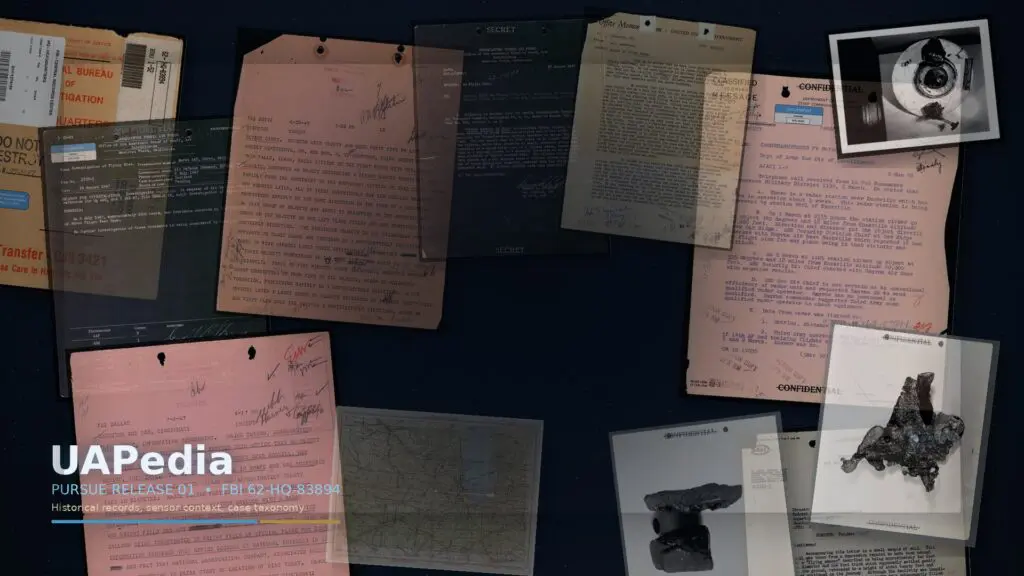
The first ten FBI PDFs released through PURSUE under file 62-HQ-83894 form one of the most useful public archival bridges between the first modern “flying disc” reports of 1947 and the civilian UAP movements of the 1960s. Taken together, these files show the FBI acting less as the lead technical investigator and more as a national intake, referral, record-preservation, rumor-control, and jurisdiction-boundary agency. The Bureau received UAP reports, forwarded some to Air Force or Army channels, preserved public correspondence, answered citizens, routed matters involving possible security concerns, and documented the growing civilian UAP research ecosystem.
This matters because the files do not present a single simple story. They preserve three overlapping histories: serious military and pilot reports, disputed crash or recovered-material narratives, and a fast-expanding public movement of clubs, newsletters, contact claims, and pressure campaigns. The result is not a final explanation of UAP. It is a documentary map of how the U.S. government, the Air Force, civilian witnesses, media organizations, and private researchers all shaped the modern UAP record.
Note: Our editorial standard treats government records as essential but incomplete. Government sources are “inputs, not verdicts,” and historical files may contain gaps, misclassification, context loss, or artifacts of earlier information-control practices. (UAPedia – Unlocking New Realities) This article therefore treats FBI 62-HQ-83894 as a verified archival source, while separating the existence of a record from the truth of every claim inside it. That approach is consistent with UAPedia’s broader editorial mission: to preserve historically significant UAP records, distinguish evidence from interpretation, and avoid premature certainty. (UAPedia – Unlocking New Realities)
Highest-priority findings
1. The FBI was a UAP archive and relay node, not the sole investigative owner
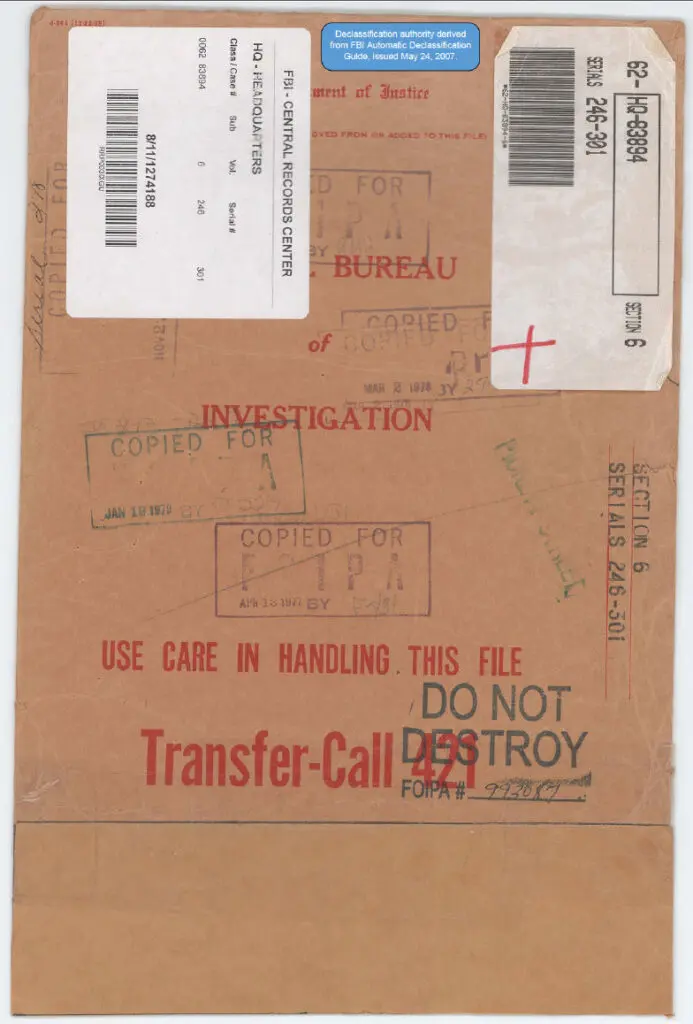
Across the ten files, the Bureau repeatedly receives reports, letters, photographs, alleged fragments, public inquiries, and security-sensitive leads. Yet many documents show that UAP investigation responsibility was usually referred to the Air Force, OSI, Air Technical Intelligence Center, or other military channels. This is especially clear in Section 7, where FBI field guidance says local offices were not supposed to conduct ordinary UAP investigations unless properly directed and that credible reports should be routed to Air Force or OSI channels.
The implication is important: the FBI files cannot be read as the full UAP record. They are a surviving window into intake, referral, correspondence, and interagency awareness.
2. The files preserve serious early cases that deserve standalone treatment
Several cases from Sections 1-5 are strong enough for dedicated investigations and updates: Muroc AAF, Maury Island, Roswell, Oak Ridge, Guam, Twin Falls, Myrtle Creek, Bethel, and early Project Sign/Grudge material. The most important newly reinforced case is the Muroc AAF sightings of July 8, 1947, which involved multiple military or technical witnesses at a major flight-test base.
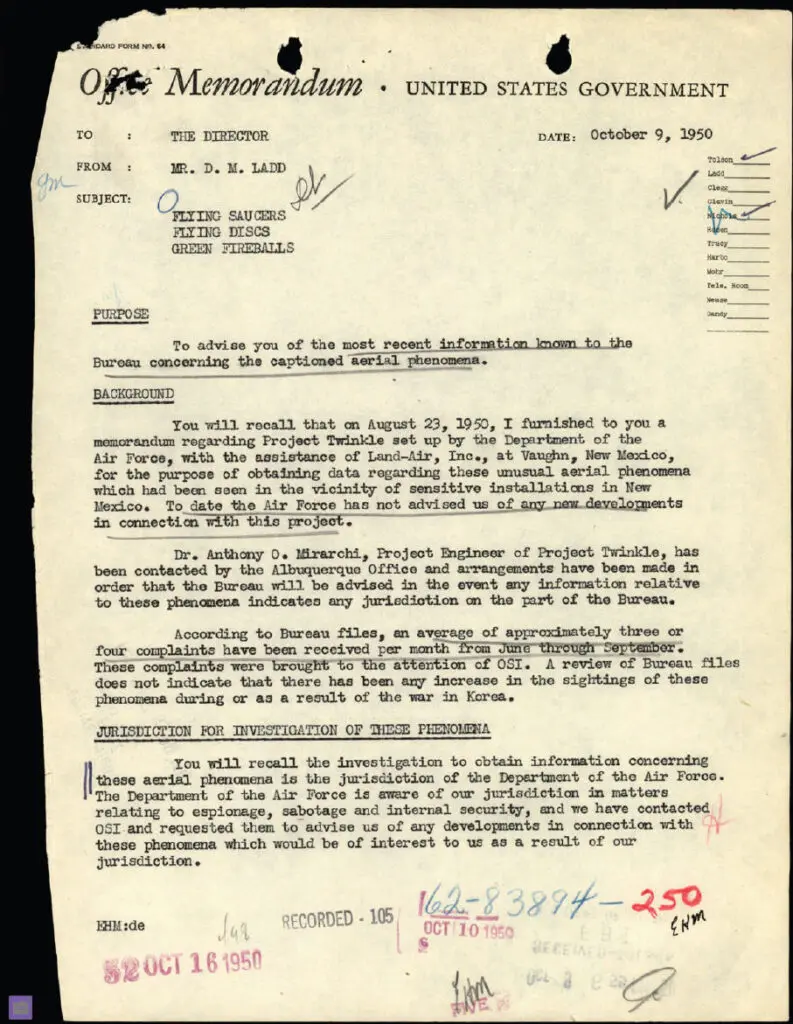
3. Project Twinkle and New Mexico green fireballs emerge as one of the strongest archival clusters
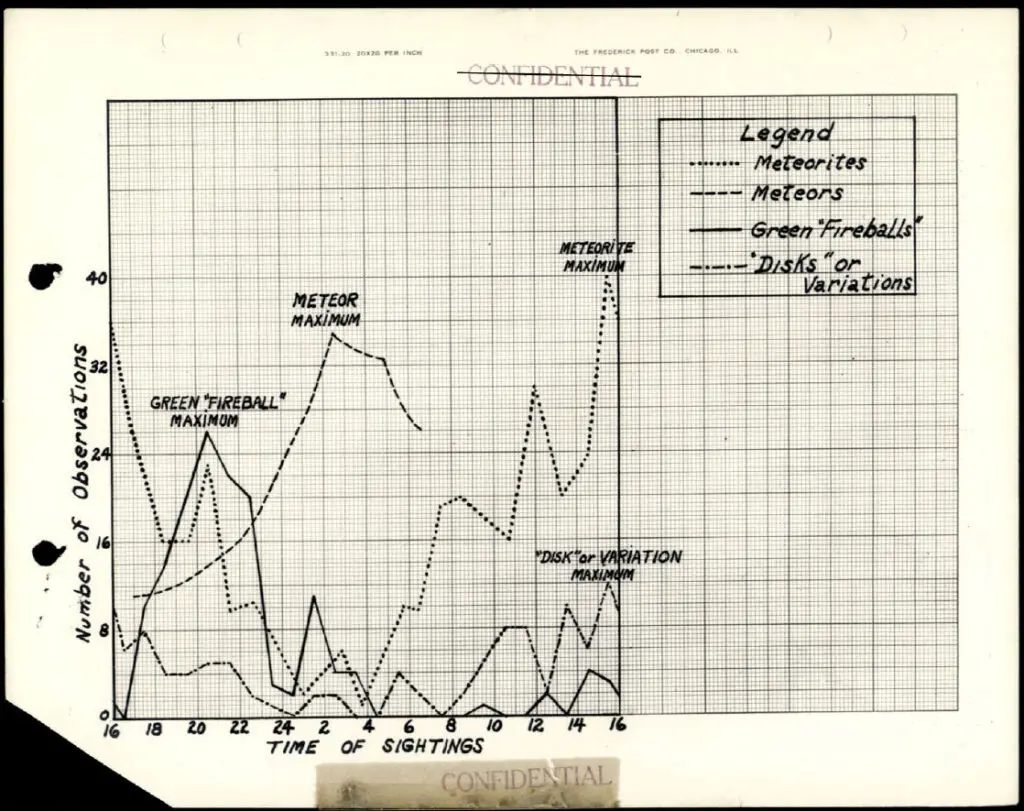
Section 6 is one of the most significant files in the set. Pages 2–5 summarize OSI concern over unexplained aerial phenomena in New Mexico, including green fireballs, disc variations, and meteor-like phenomena. Pages 24–33 include the Air Force summary, Lincoln LaPaz’s “Anomalous Luminous Phenomena” report, a graph comparing meteors, meteorites, green fireballs, and disc-like variations, plus a Holloman AFB photograph labeled “Photograph of Unknown Aerial Phenomena.”
These records show organized Air Force and scientific concern near Los Alamos, Sandia Base, Holloman AFB, and other sensitive New Mexico locations. They do not prove one origin, but they do establish that the green fireball problem was treated as more than ordinary public rumor.
4. Oak Ridge and Savannah River show early UAP sensitivity around atomic-era infrastructure
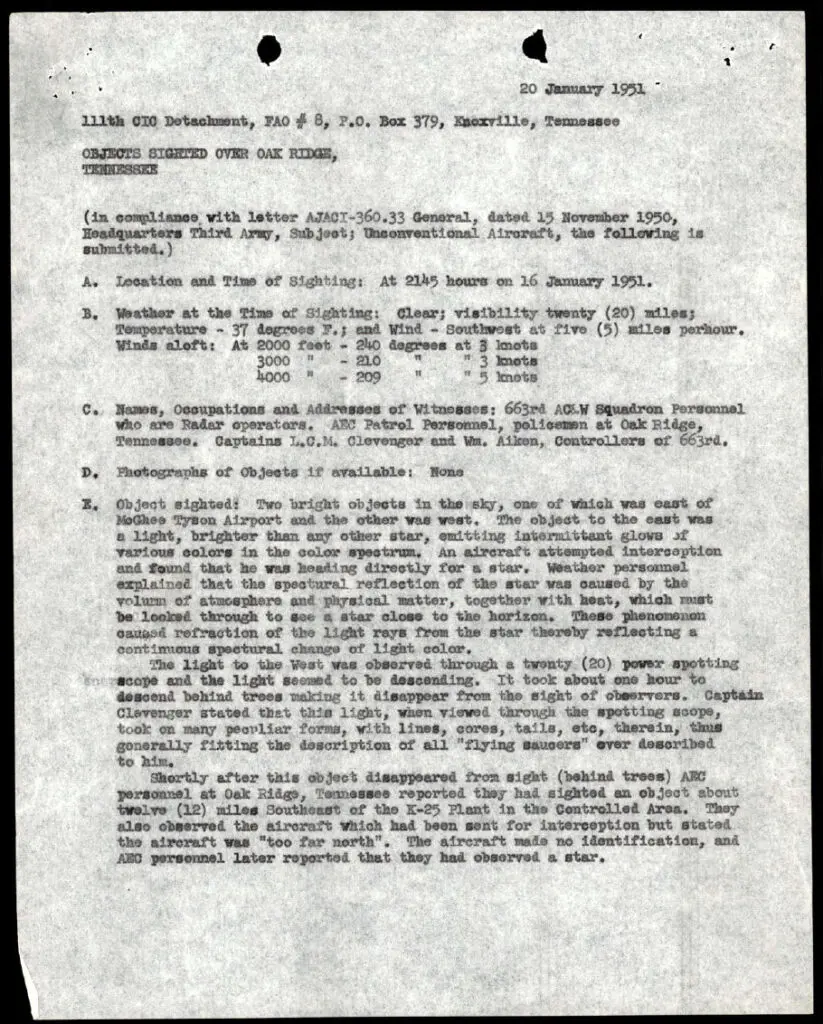
Section 5 and Section 6 contain Oak Ridge radar and vital-installation material, including radar returns, local and interagency concern, and a possible radar-jamming thread involving ionization of particles in the atmosphere. Section 6 pages 92–93 are especially important because they tie the Oak Ridge concern to protection of vital installations and possible radar interference.
Section 7 page 3 adds the Savannah River Plant case of August 8, 1952. Two E. I. du Pont employees reportedly saw a blue light with an orange fringe, shaped like a saucer, over the Four Hundred Area of the Savannah River Plant, an Atomic Energy Commission facility.
UAPedia should treat Oak Ridge and Savannah River as early nuclear-site UAP cases, while keeping object identity Disputed until radar logs, witness interviews, and technical data can be independently reconstructed.
5. The Air Force had formal “unconventional aircraft” reporting standards by 1950
Section 6 pages 10-12 contain a Department of the Air Force letter titled “Reporting of Information on Unconventional Aircraft.” It requests data on time, location, shape, color, formation, speed, altitude, maneuvers, witness reliability, weather, photographs, fragments, and physical evidence.
This is a key finding. The structure resembles modern UAP reporting protocols. It shows that by 1950, U.S. military authorities were not merely collecting anecdotes. They were trying to standardize evidence fields for unusual aerial reports.
6. Sections 8-10 document the growth of civilian UAP networks
The later files shift from early military and intelligence concern toward civilian UAP organizing. Section 8 contains Truman Bethurum, Frances Swan, the Detroit Flying Saucer Club, Desmond Leslie, John Otto, and Leonard Stringfield’s CRIFO network. Section 9 includes Donald Keyhoe, NICAP, Robert T. Stone’s Inter Continental Aerial Research Foundation, Albert K. Bender material, the Aerial Phenomena Research Group, and the William Albert Rhodes photographic chain-of-custody issue. Section 10 includes AFSCA, IGAP, the Condon Committee context, Socorro correspondence, Paul Peyerl’s German-disc claims, and contactee-era publications.
This confirms that the FBI archive is not only an official record. It is also a cultural record of how UAP research became organized, public, spiritual, scientific, political, and commercial.
Chronological synthesis
1947-1950: Flying-disc reports, official routing, and early physical-evidence claims
Sections 1-5 preserve the first phase of the modern UAP era. The file shows the FBI receiving citizen letters, military reports, newspaper clippings, field memoranda, alleged fragments, photographs of recovered objects, and Air Force referrals.
The Roswell FBI relay appears in Section 1 on page 70. It records that the Bureau was told of an object described as resembling a high-altitude weather balloon with a radar reflector, transported to Wright Field. For UAPedia, the value is precise: the document verifies what the FBI received as a relay. It does not establish that the FBI independently examined the material or had access to every military channel. In reading through the files, even though this incident has been proven not to be the same as the Roswell crash, its inclusion speaks by itself (why was this mundane occurrence classified for a start), and maybe that will help others speculate that disinformation agents appropriated this as cover story. The fact here is that some of the released material will fall into the disinformation or misidentification categories.
The Maury Island material, especially in Sections 2 and 3, substantially deepens the archive around Harold Dahl, Fred Crisman, Kenneth Arnold, Emil Smith, alleged fragments, photographs, press involvement, and the fatal B-25 crash involving Capt. William Davidson and Lt. Frank Brown. This material does not settle Maury Island. It does show that the case became an interagency matter involving witnesses, media, alleged physical evidence, and sabotage rumors.
The Muroc AAF case in Section 3 is one of the strongest early military cases. Multiple witnesses at a major flight-test base described round, silver, spherical, or disc-like objects without conventional wings, fins, propulsion, or vapor trails. Because the case involved aviation-adjacent personnel and an official Air Force record path, UAPedia should prioritize it for a dedicated article.
Sections 2-4 also preserve significant regional cases: Twin Falls, Idaho; Myrtle Creek/Canyonville, Oregon; Guam; Bethel, Alaska; and early Project Sign laboratory routing. Some physical-object cases appear to be pranks or ordinary objects, including saw-blade-style discs, handmade models, ordinary soil, and manufactured artifacts. Those cases should be retained in the archive because they help distinguish strong reports from the noise surrounding the 1947 wave.
1950-1953: Green fireballs, Project Twinkle, radar concerns, and formal intelligence workflows
Sections 6 and 7 show a significant change. The language shifts from “flying discs” as a broad public phenomenon to “unconventional aircraft,” structured reporting, military intelligence coordination, radar evaluation, and sensitive-site concern.
Project Twinkle is the strongest example. Section 6 pages 2-5 summarize OSI concern over green fireballs and related aerial phenomena in New Mexico. Section 6 pages 24-33 preserve an Air Force summary and Lincoln LaPaz’s analysis. The Holloman AFB photograph on page 33 and the chart on page 32 are important visual artifacts. They show that the file includes not only text but attempted graphical and photographic analysis.
The 17th District OSI catalogue in Section 6 pages 34-71 is a major structured dataset. It records sightings by date, location, direction, altitude, color, sound, shape, speed, duration, and disappearance. Locations include Los Alamos, Sandia Base, Holloman, Kirtland, Camp Hood, Alamogordo, Albuquerque, and other military-relevant or sensitive areas. This should become a UAPedia data-archive article because it is an early precursor to modern UAP reporting standards.
Oak Ridge becomes more important in Section 6. The radar and vital-installation material links UAP reports to the protection of atomic-era infrastructure. The possible radar-jamming language involving atmospheric ionization is especially notable because it shows the Bureau and related agencies were considering not just visual sightings, but technical effects on detection systems.
Section 7 page 3 adds the Savannah River Plant case, a strong candidate for a new UAPedia page. Section 7 page 44 contains the DesVergers scoutmaster case, including the Air Force’s request for FBI assistance and discussion of physical-effect claims involving a cap. Section 7 page 63 adds the George Stock photographic inquiry. Section 7 pages 90–96 contain one of the most historically striking internal memos: Air Intelligence still leaned toward optical or atmospheric explanations, but some responsible military officials were reportedly seriously considering the possibility of interplanetary ships.
That final point should be carefully framed. The file does not state that the Air Force concluded UAP were interplanetary craft. It documents an internal interpretive tension during 1952, when credible unexplained cases were accumulating and officials were weighing extraordinary possibilities.
1954-1967: Civilian organizations, contactee claims, public pressure, and boundary-setting
Sections 8–10 move the story into a different phase: civilian research and public UAP activism. These files are less about military sensor analysis and more about organizations, publications, letters, claims of government affiliation, contact experiences, and requests for official comment.
Section 8 pages 34–58 contain the Leonard Stringfield and CRIFO cluster. The material includes newsletters, clippings, public claims, and Bureau awareness of Stringfield’s Air Force-related statements. This is important because Stringfield later became a major figure in crash-retrieval research. These pages show his earlier role as a civilian organizer during the 1954 wave.
Section 8 also documents contactee-era figures and claims. Truman Bethurum appears in pages 3-10, while Frances Swan appears in pages 12-21, including Navy/ONI-adjacent routing and claims of thought communication with beings in outer space. These materials should be treated as verified FBI-held documentation, but the contact claims themselves remain Witness Interpretation or Legend unless independently corroborated.
Section 9 pages 44-50 clarify Donald Keyhoe, NICAP, and FBI policy. The Bureau stated that it did not investigate UAP sightings, did not issue instructions preventing civilians or military personnel from discussing sightings, and generally forwarded UAP-related information to the Air Force. That policy cluster should be used in UAPedia’s FBI UAP Records, NICAP, Donald Keyhoe, and reporting-protocol articles.
Section 9 pages 52-53 add a major old-case update to the William Albert Rhodes photographs. The memo discusses the handling of negatives and whether they had been accepted or returned through FBI/Air Force channels. This does not prove the photographs anomalous. It does show that their chain of custody remained a live issue in FBI records decades later.
Section 9 pages 69-83 preserve Albert K. Bender and Gray Barker material, including early “men in black” narrative development. This is not proof that Bender’s claims were true. It is proof that the narrative had entered FBI correspondence and field review by the late 1950s.
Section 10 reconnects the civilian movement to official study. Pages 25-30 and page 49 preserve Condon Committee context, public pressure, Frank Edwards material, Project Blue Book numbers, and the move toward a government-financed academic study. Pages 33-38 add a direct FBI-document trail to the Socorro case, noting FBI file awareness of the April 24, 1964 Socorro sighting and interview routing involving Lonnie Zamora.
Section 10 pages 62-71 preserve the Paul Peyerl German-disc claim, including technical statements and drawings or images of a disc-like object. UAPedia should not treat this as proof of wartime German disc technology. It should be used as a documented node in the genealogy of German-origin saucer narratives and advanced human technology claims.
What does this change?
The first ten FBI files change the framing of PURSUE in four ways.
First, PURSUE is not only a modern UAP release. It also reopens the earliest federal archive of the modern era. The FBI material reaches back to Roswell, Maury Island, Muroc, Project Sign, Project Grudge, Oak Ridge, and Project Twinkle.
Second, the files show that UAP reporting became more formal when the phenomenon intersected with military bases, atomic-energy sites, radar, and air-defense systems. Section 6’s Air Force reporting requirements and 17th District OSI catalogue are especially important.
Third, the archive shows that by the 1950s, civilian UAP organizations had become part of the information environment. CRIFO, NICAP, APG, ICARF, AFSCA, the Detroit Flying Saucer Club, and IGAP were not side notes. They helped shape public pressure, government correspondence, media framing, and the later disclosure movement.
Fourth, the files reinforce the need for layered classification. One FBI file may contain serious pilot testimony, a possible hoax, an ordinary object, a contactee claim, and an internal policy memo. The archive’s value comes from preserving all of those layers without collapsing them into one explanation.
Priority investigation queue
| Priority | Case or topic | Recommended action | Initial classification |
| 1 | Muroc AAF UAP Sightings, July 8, 1947 | Create standalone article | Probable |
| 1 | Project Twinkle and New Mexico Green Fireballs | Create or expand standalone article | Probable / Disputed |
| 1 | 17th District OSI UAP Catalogue | Create data-archive article | Verified archive |
| 1 | Oak Ridge Radar UAP Incident, 1950 | Expand with radar-jamming and vital-installation material | Disputed |
| 1 | Savannah River Plant UAP, August 8, 1952 | Create nuclear-site case page | Probable / Disputed |
| 1 | Maury Island Incident | Add FBI/Air Force packet, fragment photos, press network, and B-25 crash context | Disputed |
| 1 | William Albert Rhodes UAP Photographs | Add chain-of-custody section | Disputed |
| 1 | Socorro Landing Incident, 1964 | Add FBI interview-routing trail | Probable / Disputed |
| 2 | DesVergers Scoutmaster Case | Update with FBI/Air Force field memo | Disputed |
| 2 | George Stock Photographs | Create or update photographic case page | Disputed |
| 2 | Leonard Stringfield and CRIFO | Create or update researcher/organization page | Verified archive |
| 2 | Donald Keyhoe and NICAP | Update with FBI jurisdiction-policy correspondence | Verified archive |
| 2 | Albert K. Bender and Men in Black narrative | Create narrative-genealogy page | Legend / Disputed |
| 2 | Paul Peyerl German Disc Claim | Add to German-origin UAP narrative genealogy | Legend / Disputed |
| 2 | AFSCA and IGAP | Add to civilian UAP organization and contactee-movement coverage | Verified cultural archive |
Claims Taxonomy
Verified
FBI 62-HQ-83894 Sections 1–10 are official historical files preserving reports, field memoranda, Air Force correspondence, witness letters, photographs, clippings, referral notes, and interagency routing related to UAP and “flying disc” reports.
The FBI repeatedly acted as a receiver, correspondent, record-holder, and referral agency, while technical evaluation usually belonged to Air Force, OSI, Air Technical Intelligence Center, or related military channels.
The Air Force had formal reporting requirements for “unconventional aircraft” by 1950, including fields for witness reliability, photos, fragments, maneuvers, speed, altitude, and physical evidence.
Probable
Muroc AAF, Guam, Myrtle Creek, Bethel, Twin Falls, Project Twinkle, and Savannah River Plant merit serious UAPedia treatment because they include official records, military or technical context, and unresolved witness descriptions.
UAP reporting near atomic-energy and military infrastructure was a recurring official concern, especially in New Mexico, Oak Ridge, and Savannah River.
Disputed
Roswell, Maury Island, Oak Ridge radar, Savannah River Plant, DesVergers, George Stock, Rhodes photographs, Bender, and the Socorro interpretation remain disputed. Each has official documentation, but the identity or meaning of the reported object or event remains unresolved or contested.
Legend
Albert Bender’s “men in black” narrative, Paul Peyerl’s German-disc account, and IGAP contact material should be preserved as historically significant narrative evidence, not established fact.
Misidentification
Several physical-object cases and public-submitted materials appear likely to involve ordinary objects, models, saw blades, balloons, aircraft, soil, meteors, or other prosaic sources.
Hoax
Some reports include prank or staged-object indicators, especially handmade discs, publicity-linked artifacts, and some contactee or club-related claims. UAPedia should apply Hoax only where the specific file supports intentional deception.
Speculation labels
Evidence
Official FBI memoranda, Air Force correspondence, OSI records, field reports, photographs, witness letters, physical-evidence routing, newspaper clippings, UAP reporting forms, and structured sighting catalogues.
Witness Interpretation
Descriptions such as “saucer-shaped,” “interplanetary ships,” “green fireball,” “men in black,” “space people,” “German disc,” “instant disappearance,” or “not a balloon” should remain attributed to witnesses, officials, or authors unless independently corroborated.
Researcher Opinion
The strongest immediate UAPedia updates from the first ten FBI files are Muroc, Project Twinkle, Oak Ridge, Savannah River Plant, Rhodes, Socorro, Stringfield/CRIFO, Keyhoe/NICAP, Bender, and the 17th District OSI catalogue.
Hypothesis
The FBI archive suggests that early UAP history evolved through three interacting channels: official military-intelligence routing, civilian research networks, and high-strangeness or contactee narratives. These channels often overlapped, which explains why the archive contains strong evidence, weak evidence, public rumor, and culturally significant narratives in the same file stream.
These anchors align with UAPedia’s existing taxonomy for flying-saucer-era cases, Project Sign/Grudge/Blue Book, AARO and archives, civilian organizations, witness reliability, common misidentifications, and document declassification.
References
Federal Bureau of Investigation. (1947–1950). 62-HQ-83894, Section 1: Flying discs. PURSUE Release 01. (Department of War)
Federal Bureau of Investigation. (1947–1950). 62-HQ-83894, Section 2: Flying discs. PURSUE Release 01. (Department of War)
Federal Bureau of Investigation. (1947–1950). 62-HQ-83894, Section 3: Flying discs. PURSUE Release 01. (Department of War)
Federal Bureau of Investigation. (1947–1950). 62-HQ-83894, Section 4: Flying discs. PURSUE Release 01. (Department of War)
Federal Bureau of Investigation. (1949–1950). 62-HQ-83894, Section 5: Flying discs. PURSUE Release 01. (Department of War)
Federal Bureau of Investigation. (1950–1951). 62-HQ-83894, Section 6: Flying discs. PURSUE Release 01. (Department of War)
Federal Bureau of Investigation. (1952–1953). 62-HQ-83894, Section 7: Flying discs. PURSUE Release 01. (Department of War)
Federal Bureau of Investigation. (1954–1955). 62-HQ-83894, Section 8: Flying discs. PURSUE Release 01. (Department of War)
Federal Bureau of Investigation. (1957–1959). 62-HQ-83894, Section 9: Flying discs. PURSUE Release 01. (Department of War)
Federal Bureau of Investigation. (1966–1967). 62-HQ-83894, Section 10: Flying discs. PURSUE Release 01. (Department of War)
UAPedia. (2025, December 5). How UAPedia treats government sources. (UAPedia – Unlocking New Realities)
UAPedia. (2026). UAPedia editorial standards: Navigating the mystery. (UAPedia – Unlocking New Realities)
Additional internal crosslinks
Kenneth Arnold and the Modern UAP Era
Project Blue Book
UAP and Nuclear Sites
Donald Keyhoe
NICAP
Leonard Stringfield
Condon Committee
Socorro Landing Incident
SEO keywords
FBI 62-HQ-83894, PURSUE FBI files, FBI flying discs, UAP archives, Roswell FBI teletype, Maury Island FBI files, Muroc AAF UAP, Project Twinkle, New Mexico green fireballs, Oak Ridge UAP radar, Savannah River Plant UAP, Leonard Stringfield CRIFO, Donald Keyhoe NICAP, Albert Bender men in black, Socorro UAP FBI files, Condon Committee UAP, UAPedia.