
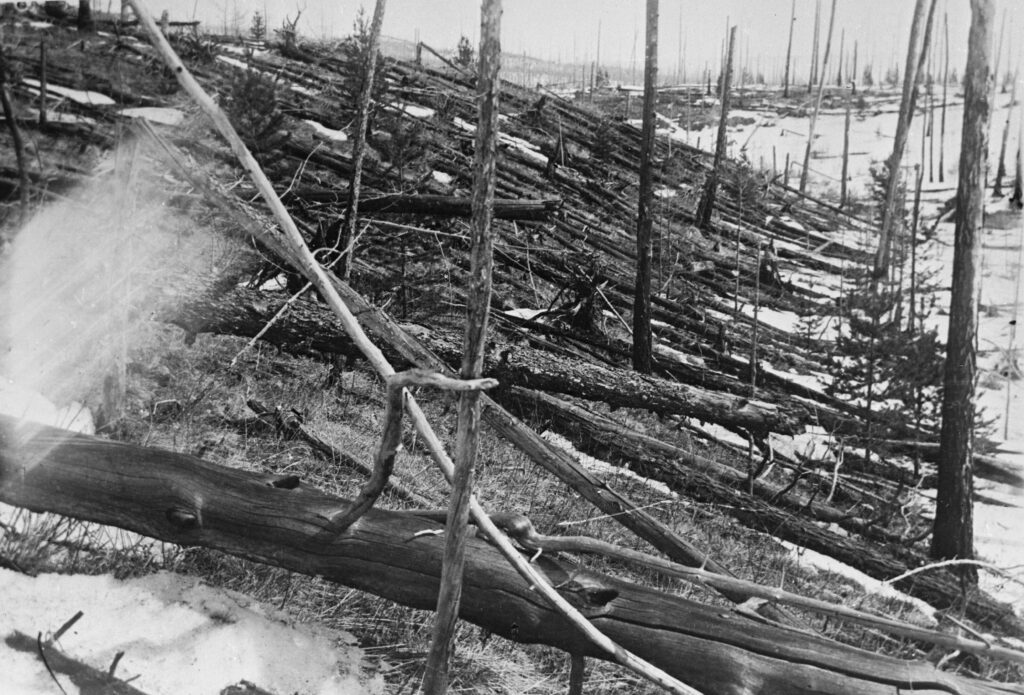
On April 7, 1928, a train pulled away from Moscow. Five days later the travelers step down at a station thousands of kilometers east, racing the thaw with sledges and hired horses. They are not chasing folklore. They are chasing an impact zone.
A 1929 Soviet popular science account, published in the magazine Znanie-Sila (“Knowledge is Power”), describes how Leonid A. Kulik, head of the Meteorite Department of the USSR Academy of Sciences, used a nationwide correspondence network to triangulate where the 1908 Tunguska catastrophe actually occurred, then launched a sequence of field expeditions into the taiga.
This matters for UAP history for one reason: early Soviet UAP data is not primarily “flying discs over Moscow.” It is a story about what a centralized scientific state did when it faced a sky event that shattered forests, traumatized witnesses, and refused to leave behind a neat fragment of metal.
The Soviet 1920s–1930s UAP record is sparse, uneven, and distorted by distance, ideology, and archival loss.
But the fragments we do have form a recognizable pattern: hard-to-reach locations, multi-witness testimony, recurring “cylinder/oval” descriptions, trans-medium rumors (air to water), and a persistent institutional urge to domesticate the unknown under the label of “meteorite,” even when the physical evidence is elusive.
Dossier at a glance: What the surviving data actually contains
What we can count (with honesty about the gaps)
Across open sources used here, the 1920s–1930s Soviet-era file breaks into three “data types”:
- Institutional actions (commissions, expeditions, correspondence networks)
- First-person observation records (diaries, local testimony)
- Later retellings (regional press, secondary compilations)
The downloadable CSV linked above captures the core entries as structured rows (date, location, evidence type, and a claim-grade). It is intentionally conservative: when a primary document is not accessible in open sources, the row is labeled as such rather than laundered into certainty.
A quick, readable mini-table
| Year | Node type | Location | One-line description | Evidence type |
|---|---|---|---|---|
| 1921 | Institutional | USSR Academy of Sciences | Kulik builds a correspondent network to relocate Tunguska | Archival/periodical account |
| 1927 | Investigation | Tunguska region | Recon expedition identifies devastated zone | Archival/periodical account |
| 1928 | Investigation | Tunguska region | Larger expedition supported by Sovnarkom | Archival/periodical account |
| 1927 | Observation | Kukunor district (Qinghai) | Roerich party sees fast “shiny oval,” course change | Primary diary text |
| 1928 | Reported observation | Karelia, Lake Vedlozero | Local tradition: fiery cylinder into lake ice | Local history / regional retellings |
If you are used to modern UAP datasets (radar tracks, FLIR, time-synced logs), this will feel painfully thin. That is the point. The early Soviet UAP file is not “low signal.” It is “low surviving instrumentation.”
So we do what historians do: we weigh testimony, proximity to the event, number of independent observers, and the incentives embedded in the reporting channel.
How to weigh sources in the early Soviet context
A Soviet-era “government source” is not a magic stamp of truth. It is a human institution with incentives: security paranoia, ideological messaging, and bureaucratic self-protection. The Soviet press also had incentives: wonder sells, but so does scientific triumph.
For this article, evidence is treated like a courtroom:
- Contemporaneous primary texts (diaries, period publications) get the highest weight.
- Institutional records and state-adjacent documents are valuable, but not treated as complete.
- Later retellings are treated as leads, not verdicts, unless they converge with older documentation.
That is why the Tunguska expeditions and the Roerich diary are the backbone here, and why Karelia’s Vedlozero story is treated as a serious but unresolved folklore-to-testimony pipeline, not as a solved case.
Case File 1: Tunguska as the USSR’s first “UAP-shaped problem”
The “meteorite” label, and why it did not end the mystery
In the 1929 Znanie-Sila narrative, the Tunguska event is framed in orthodox terms: a “giant meteorite” that fell in 1908, sought unsuccessfully before the Revolution, then re-localized by Kulik’s 1921 information campaign.
But the same source also preserves something more revealing: the Soviet state’s operational problem. The devastated region was remote, the logistics were brutal, and the “object” left no simple crater and no recoverable mass on command.
The expedition story includes travel race conditions, river crossings timed to ice breakup, and a field camp deep in uninhabited taiga.
In modern UAP language, Tunguska forced three uncomfortable questions:
- How do you investigate a sky event when the environment destroys your evidence chain?
- What do you do when witness memory exists, but the physical object does not?
- How do institutions behave when the simplest explanation cannot be physically demonstrated?
Those questions still define UAP research today.
Witness accounts as “instrumentation”
Evenki and local Siberian accounts of the 1908 event were collected and recycled through later decades, and they sit at the foundation of the Soviet-era file because they were actively gathered, filtered, and archived in the 1920s–1930s ecosystem that Kulik helped create. (The important point for this article is not the date of the explosion, but the date the testimony became “data” inside Soviet systems.)
What makes these accounts UAP-relevant is not that they prove a non-human craft. It is that many describe characteristics that do not map cleanly onto a simple “rock fell down” story: moving light, directional travel, immense aerial shock, and a sense of agency in trajectory descriptions. In historical UAP work, that combination is exactly what keeps cases alive across generations.
Government involvement, without over-reading it
The Soviet state’s material support is explicit in the 1929 publication: the 1928 expedition proceeds “with the help of Sovnarkom.”
This is not proof of a cover-up. It is proof of priority. In a young industrial state obsessed with electrification and aviation, a massive aerial event inside its territory mattered. It could be a natural hazard. It could be a strategic threat. It could be an opportunity for scientific prestige. Those motivations alone are enough to explain why the state funded fieldwork.
But funding also creates a UAP pattern we see repeatedly worldwide: when a state funds an investigation, records are produced, and some portion of those records becomes inaccessible later, whether by classification, loss, or institutional decay.
Implication: Tunguska seeded an “anomaly workflow”
The Kulik model, as visible in 1929, looks surprisingly modern:
- Build a reporting network (correspondents).
- Triangulate the location through converging testimony.
- Conduct a reconnaissance mission.
- Return with better logistics and official backing.
That is the skeleton of modern UAP pipelines. The USSR did not need radar to invent the workflow. It needed a mystery big enough to justify the bureaucracy.
Case File 2: The Roerich “shiny oval” and the problem of fast, high objects
If Tunguska is the USSR’s “anomalous event without a recoverable object,” Nicholas Roerich’s diary gives us the complementary problem: “an object without a crash.”
The primary text (and why it matters)
In Altai-Himalaya (published 1929, recording a 1927 field diary), Roerich describes a morning observation near the Kukunor district. Seven observers watch what begins as a bird reference point, then notice something higher: “something big and shiny,” reflecting the sun, “like a huge oval,” moving at great speed, crossing the camp, then changing direction and disappearing into the blue sky.
This is a clean historical data point because:
- It is contemporaneous (recorded in a diary-style text, later published).
- It is multi-witness (not a solitary visionary).
- It includes behavior (speed, trajectory, course change) not just “a light.”
Data features: what we can extract without exaggeration
From the Roerich entry alone:
- Shape descriptor: oval
- Surface descriptor: shiny / sun-reflective
- Motion descriptor: very fast
- Kinematics: course change (north-to-south, then southwest)
- Observational detail: binocular confirmation
Even if you try to force this into conventional categories, the course change and the “oval with reflective surface” description keep it interesting. Weather balloons can be reflective and can drift, but “great speed” and an apparent direction change over short observation windows can also indicate a misread of distance and wind layers. This is why we label speculation separately (see below) and keep the evidence statement tight.
Why this belongs in an “Early Soviet” article at all
Roerich’s observation occurs outside Soviet borders, but it sits inside the Soviet-era Russian intellectual sphere and becomes part of the broader Eurasian UAP narrative that later Soviet and post-Soviet researchers cite. It is also a classic example of a thing early 20th-century witnesses could describe, but could not measure.
No radar. No film. No time-stamped instrumentation. Just people, binoculars, and a striking shape.
Implication: the “high, shiny, fast” motif is older than the jet age
Roerich’s 1927 description reads like a template for later UAP reports: reflective body, unusual geometry, high altitude, and behavior that witnesses interpret as controlled motion. The report’s value is not that it solves anything. It is that it anchors a motif in time, before the postwar UAP vocabulary was culturally standardized.
Case File 3: Karelia’s Vedlozero, a trans-medium rumor that refuses to die
The Karelia file is where “Early Soviet UAPs” starts to look like “UAP plus USO.”
The core narrative (as preserved in local and regional sources)
A local-history style account from vedlozero.ru frames a late autumn 1928 night in the village of Shuknavolok, where a child witness (named in the narrative as Fedya Egorov) notices unusual activity near the lake.
Regional and popular sources expand the story into a recurring template:
- A cylindrical object, described as large and emitting flame/sparks, flies over the village and impacts the lake, sometimes described as breaking ice and sinking.
- Afterward, locals report sightings of a strange “water being” along the shore, described with an oversized head and thin limbs, retreating into the water when seen.
The specifics vary by retelling. Some versions inflate witness counts or add later “military interest.” In a data-first approach, those are treated as separate claims, not as one blended story.
What is credible here, and what is not yet
Credible elements (as “credible” is used in historical reconstruction):
- The location is stable (Vedlozero, Shuknavolok).
- The year anchor is stable (1928).
- The object description is stable (cylindrical, fiery, impacts water/ice).
- The post-event motif is stable (reports of a shoreline entity).
Not yet credible as “verified”:
- Exact dimensions (often stated as “ten-meter cylinder” in some retellings).
- Exact witness counts.
- Specific claims of security services cordoning the area (these appear in some secondary sources but are not demonstrated in the open primary record used here).
Why Vedlozero matters anyway
Even when treated conservatively, Vedlozero is one of the earliest Eurasian stories that combines:
- Aerial transit
- Water impact
- Persistent local follow-on phenomena
That “air-to-water” arc is exactly the pattern that modern trans-medium UAP discussions revolve around. Karelia’s story is historically valuable because it suggests that the trans-medium motif is not a late Cold War invention. It appears, at minimum, as local tradition, in the early Soviet period.
Implication: the early Soviet environment is a perfect incubator for USO-style narratives
Karelia is a lake country. It is dark in winter. It has long shorelines and limited historical instrumentation. In such environments, a single unusual event can seed decades of follow-on interpretations. That is not an argument against the event. It is a warning about how narratives evolve in data-poor zones.
So UAPedia’s stance here is simple: take the earliest attested narrative seriously, label later expansions, and do not pretend the case is solved.
Case File 4: The “Ural corridor” and the Karpinsk report problem
A number of later compilations claim that in 1927, locals near Karpinsk in the Urals witnessed an explosion of a cigar-shaped object.
Here is the problem, stated plainly:
- The claim exists in accessible secondary compilations.
- A directly citable primary document (local newspaper scan, police log, academy memo) is not present in the open materials used for this article.
So, we treat Karpinsk as a lead, not a settled historical entry.
Why include it at all?
Because it sits in a geographic corridor where Soviet industrialization, mining, and rail networks expanded rapidly. If anomalous aerial events occurred, they would have intersected with workers, guards, and transport infrastructure. That is exactly the kind of environment where “unidentified” reports can appear, even if later archives are incomplete.
For UAP researchers, Karpinsk is an invitation: go find the primary record.
Pattern analysis: what “Early Soviet UAPs” looks like as a dataset
Even with a small file, patterns can be extracted cautiously. The geometry repeats: oval and cylinder:
- Roerich: oval, reflective, fast, course change.
- Vedlozero: cylinder, fiery exhaust-like description, water impact.
This matters because the “cylinder/oval” vocabulary predates the postwar “disc” fixation.
Remote landscapes dominate
- Tunguska: taiga, river systems, uninhabited zones.
- Vedlozero: lake country, small villages, shoreline sightings.
Remote geography creates two opposing effects:
- It reduces mundane explanations tied to dense infrastructure.
- It reduces the probability of collecting high-quality documentation.
That combination is why early Soviet UAP research remains “unfinished.”
Institutional behavior is consistent: label first, investigate second
In the Tunguska case, the label “meteorite” is applied, but investigation persists because the object cannot be produced physically on demand.
In UAP research, this pattern is common: institutions choose a socially acceptable category (meteorite, balloon, aircraft), then quietly continue investigating when the category does not fully resolve the evidence.
This is not an accusation. It is an observed workflow.
Implications: what the early Soviet file teaches modern UAP research
The “first mile” problem is everything
Modern UAP debates often start at the “last mile”: what is it, where did it come from?
The early Soviet dossier shows the “first mile” is harder: getting the report, preserving the record, and building a chain of custody before politics, distance, or time erases it.
Kulik’s 1921 correspondent network is an early example of solving the first mile by building a distributed intake system.
Trans-medium narratives are not new, they are under-instrumented
Vedlozero’s persistence in local memory, whether ultimately validated or not, shows that “air-to-water” stories can be culturally stable across generations.
Modern sensor networks (radar, sonar, satellite) are the first true test of trans-medium claims. The early Soviet period could not test them. It could only preserve them.
Archival work is a form of UAP fieldwork
If your only tool is a telescope, you will miss submarines. If your only tool is a radar, you will miss the cultural layer.
Early Soviet UAPs sit in archives, local periodicals, and oral histories. The next big breakthroughs here are likely not new sightings. They are old documents.
Claims taxonomy
Applied to the major nodes discussed above.
- Tunguska investigations (1921–1928 as documented in period Soviet sources): Verified (that the investigations occurred and were institutionally backed)
- Tunguska as a non-prosaic UAP event: Disputed (multiple competing explanations; physical object remains unrecovered in the narrative record used here)
- Roerich “shiny oval” (Aug 5, 1927): Probable (multi-witness, contemporaneous diary, behavioral detail; no instrumentation)
- Vedlozero / Shuknavolok (1928): Disputed moving into Legend (core story stable, but documentation is mostly local narrative and later retellings; institutional records not demonstrated in open sources used here)
- Karpinsk (reported 1927 cigar-shaped explosion): Disputed (present in later compilations; primary record not surfaced here)
Speculation labels
These are deliberately separated from evidence statements.
Hypothesis
A small fraction of early Soviet-era UAP reports may represent structured, intelligently controlled craft operating above remote regions, with occasional trans-medium behavior. This hypothesis is consistent with the repeating “oval/cylinder” geometry motif and with course-change narratives, but it is not provable from the surviving 1920s–1930s instrumentation record alone.
Witness Interpretation
Witnesses frequently interpret speed, shine, and direction change as indications of control or intent. In Roerich’s account, the “changed direction” detail is presented as an observed fact; the interpretation of control is implicit, not measured.
Researcher Opinion
The early Soviet UAP file is best approached as a “thin but high-value” dataset: few entries, but with unusually strong contextual documentation for its era (a state-supported expedition narrative and a multi-witness diary entry). Its main value is historical anchoring, not resolution.
References
Roerich, N. (1929). Altai-Himalaya: A travel diary. Internet Archive (full text transcription). archive.org/stream/altaihimalayatra00roer/altaihimalayatra00roer_djvu.txt?utm_source=uapedia.ai
Sytin, V. (1929, February). V poiskakh meteorita [In search of the meteorite]. Znanie-Sila, 2(38). Tunguska Phenomenon archival documents. tunguska.tsc.ru/ru/archive/suslov/189/syt/?utm_source=uapedia.ai
Vedlozero.ru. (2012, February 4). Krushenie za ostrovom Chiirakko? [Crash beyond Chiirakko Island?]. vedlozero.ru/poselenie/locality/vedlozero/krushenie-za-ostrovom-chijrakko?utm_source=uapedia.ai
Pravda.ru. (2004, May 7). Entsiklopediya chudes: Vedlozerskiy fenomen [Encyclopedia of wonders: The Vedlozero phenomenon]. www.pravda.ru/mysterious/47179-anomalia/?utm_source=uapedia.ai
SEO keywords
Early Soviet UAPs, Soviet UAP history, 1920s UAP, 1930s UAP, USSR UAP sightings, Tunguska UAP, Leonid Kulik expedition, Nicholas Roerich UAP, Altai-Himalaya UAP, Vedlozero UAP, Karelia USO, trans-medium UAP history, archival UAP research, historical UAP dossier