
Lieutenant General Robert Miller Montague (1899–1958) is a pivotal figure at the intersection of America’s nuclear weapons enterprise and the postwar story of Unidentified Anomalous Phenomena (UAP).
As commanding general of Sandia Base starting in July 1947, in the same summer that the Roswell events entered public memory, Montague sat at the hub of atomic stockpile training, assembly, and logistics.
Four decades later his name appeared on the roster of the “Majestic 12” committee, instantly placing him in the center of a long running debate about secrecy, nuclear stewardship, and the earliest government responses to UAP.
The authentic historical record confirms his senior role at Sandia and later at U.S. Caribbean Command, along with the stature and clearances that made him a plausible insider to any compartment dealing with extraordinary aerospace questions.
The record also shows that the specific Majestic 12 documents that name him have not been validated by official repositories. Understanding Montague therefore requires careful separation of documentary fact from contested paper trails, and an appreciation of why nuclear leadership and UAP have remained intertwined in public imagination. (Defense Threat Reduction Agency)
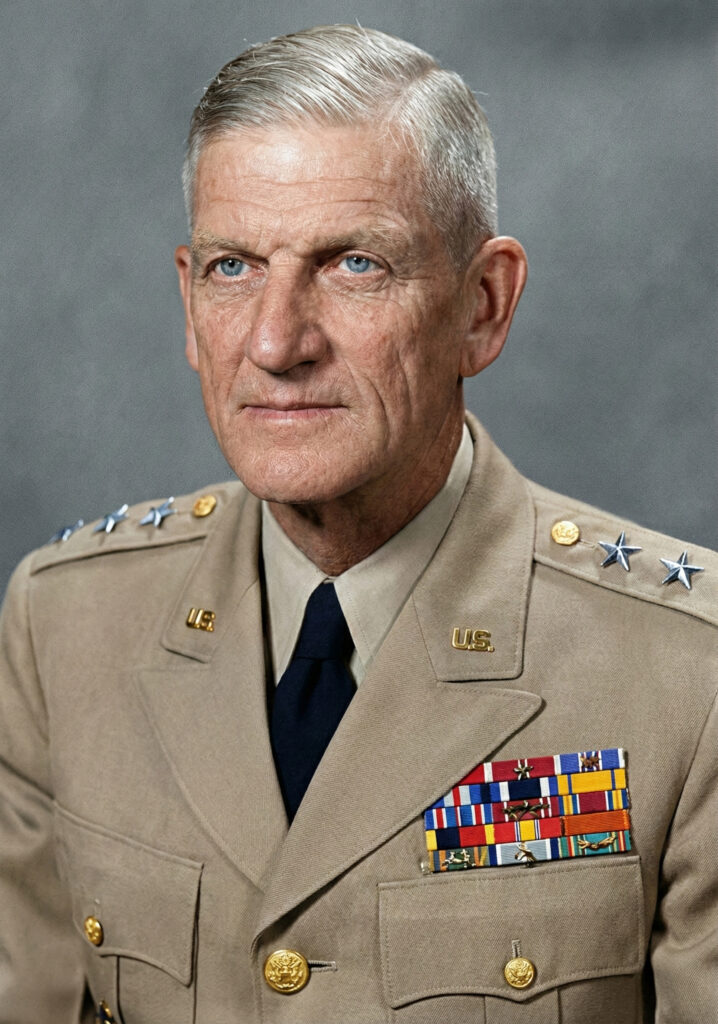
(U.S. Army | UAPedia)
Early life and professional formation
Robert M. Montague was born in Portland, Oregon, on 7 August 1899. He attended the University of Oregon, then transferred to the United States Military Academy at West Point, graduating in 1918 as a second lieutenant in artillery.
His early career followed a classic interwar pattern of schools and staff assignments, including the Field Artillery Advanced Course and the Command and General Staff College in the 1930s, along with a stint as an instructor at West Point.
These foundational years established Montague as a technically competent officer in the Army’s rapidly professionalizing artillery branch.
During World War II he served with distinction. From 1944 to 1945 he commanded the 83rd Infantry Division Artillery in the European Theater and acted as division commander on several occasions.
The Army’s Center of Military History and period divisional records place Montague in the thick of late war operations where coordination of fires, logistics, and maneuver rewarded the kind of disciplined staff training he had received before the war.
From Fort Bliss to Sandia Base in the atomic age
With the war over and the atomic era underway, Montague was posted to Fort Bliss as deputy commander of the Army’s air defense artillery center, then moved to Albuquerque in mid 1947.
The chronology preserved in the Defense Threat Reduction Agency’s official history marks the moment clearly. In July 1947 Brigadier General R. W. Montague became commanding general of Sandia Base, an installation that by then housed the military side of America’s nuclear mission.
Two weeks later Washington publicly acknowledged Sandia’s formal connection to the Armed Forces Special Weapons Project, the joint agency that succeeded the Manhattan Engineer District for training, assembly, and weapons stockpile functions. (Defense Threat Reduction Agency)
Sandia was the operational complement to Los Alamos and, later, to Livermore. Z Division, the ordnance engineering unit spun out of Los Alamos to harden laboratory designs into fieldable weapons, had been relocated to Sandia’s complex of test and assembly facilities.
In this environment the Field Command of AFSWP grew into a large operational organization that trained bomb assembly teams, coordinated storage sites, managed base construction and logistics, and worked alongside Sandia Corporation to integrate new warheads with aircraft and delivery systems. Montague’s base provided the ground truth for a weapons enterprise that was scaling from a handful of components toward a real stockpile. (Defense Threat Reduction Agency)
The official history of the nuclear agency captures the spirit of the period. It describes Field Command’s close interaction with laboratory scientists, the training of assembly teams, and the management of schedules for drop tests and component verification as the stockpile expanded in the early 1950s.
This was the work of building a reliable nuclear force, and Sandia Base under Montague was one of its command centers. (Defense Threat Reduction Agency)
Incidents and pressures during the Sandia years
Atomic work was hazardous in ways both obvious and hidden.
Contemporary press accounts and later summaries recall a tragic fire at Sandia’s stockade in March 1950 that killed fourteen prisoners and injured responders. The context underscores the strain of rapid growth and stringent security inside a base that sat at the edge of America’s most sensitive technical enterprise.
While Montague’s command signature was on Sandia’s daily life during such events, the record emphasizes the broader state of the base rather than personal culpability. (Trove)
The period also saw intense debate in Washington over custody of the nuclear stockpile, the division of responsibilities between the Atomic Energy Commission and the Department of Defense, and how much authority AFSWP should exercise.
Archival entries from 1947 and 1948 show Montague’s Sandia command mentioned in Joint Chiefs discussions about roles, responsibilities, and security exercises.
The Sandia commandant’s perspective was inevitably shaped by the requirement to train forces, protect sites, and prepare for field operations under tight timelines and evolving policy. (Defense Threat Reduction Agency)
After Sandia: European Command, I Corps, and Caribbean Command
Montague left Sandia in 1951 for a tour as head of plans, operations, and training for United States European Command, then served as deputy commander of Army Field Forces. In 1955 he took command of I Corps in Korea in the tense post armistice period when U.S. forces maintained a forward deterrent along the Demilitarized Zone.
By 1957 he had been selected to command the U.S. Caribbean Command, the predecessor to today’s U.S. Southern Command, based in the Panama Canal Zone. The appointment capped a trajectory that moved from artillery and wartime leadership to the nuclear enterprise and onward to a geographic unified command. (generals.dk)
A surviving U.S. Southern Command photo caption preserves a telling detail. The headquarters building at Quarry Heights would come to be known as Robert M. Montague Hall.
The official description notes that Montague oversaw construction of the facility and that he died in Panama in February 1958, approximately four weeks before the dedication. The naming honored a commander who had only just begun to put his stamp on the theater. (U.S. Southern Command)
Montague’s death at Gorgas Hospital in the Canal Zone on 20 February 1958 was attributed to a cerebral hemorrhage following an intestinal illness. Veterans Affairs records and grave listings confirm his burial at Arlington National Cemetery. The arc of his career, from West Point to the European campaign, to Sandia Base and then to senior joint command, ended while he was still on active duty.
The UAP connection: what the record shows
1) Sandia in July 1947
Because Sandia Base was the military center of the nuclear weapons program, Montague’s arrival there in July 1947 has long attracted attention from UAP historians.
The Roswell events occurred earlier that month, and whether or not one accepts any crash narrative, it is beyond dispute that Sandia’s mission, location, and clearances made it a natural focal point for any highly compartmented response to anomalies touching national security.
The official chronology marks his assumption of command and places Sandia squarely within AFSWP’s remit at precisely this critical time. (Defense Threat Reduction Agency)
2) Montague’s inclusion in the Majestic 12 story
In the mid 1980s a set of documents began circulating that purported to describe a secret interagency group known as “Majestic 12,” allegedly formed in 1947 to manage crash retrievals, exploitation, and policy. The so called Eisenhower Briefing Document lists twelve “designated members,” and among the military and scientific leaders named is General Robert M. Montague. Copies of these materials are widely available in archival reproductions. (Archive.org)
Official repositories have not validated these documents. The FBI’s public Vault summarizes the Air Force determination that the circulated Majestic 12 briefing was a fake.
The National Archives maintains a detailed reference note that highlights anomalies in the associated “Cutler to Twining” memo, including the absence of required Top Secret register numbers and timing problems that place the purported author out of the country on the date in question.
The U.S. Government Accountability Office, responding to congressional inquiry, reported that agencies’ knowledge of “Majestic 12” was limited to the disputed papers themselves.
That said, Montague was exactly the kind of officer who would have been consulted if any small interagency group had existed to manage sensitive aerospace events.
He commanded Sandia Base at the dawn of the stockpile, worked at the center of AFSWP’s Field Command operations, and later held a unified command billet.
These are the bona fides that make his name a plausible inclusion in any real or fabricated roster. This is a key reason why the MJ 12 story has remained attached to him in public discourse despite the documentary provenance problems. (Defense Threat Reduction Agency)
3) What Montague himself claimed about UAP
There is no public record of Montague making personal claims about UAP in speeches, interviews, or sworn testimony.
Contemporary Army sources and later biographies do not show him as a public participant in the debate. The linkage is therefore documentary rather than testimonial.
Where claims exist, they appear inside the Majestic 12 materials rather than in verifiable statements by Montague. That distinction matters for any serious history of the subject.
Influence and impact on ufology
Montague’s importance for UAP history flows from two converging currents.
First, he embodied the nuclear nexus. Sandia Base was the bridge between laboratory design and fielded capability. Within months of his arrival Field Command was training assembly teams, developing procedures, and coordinating with laboratories on the engineering of deliverable systems. UAP narratives that foreground the nuclear weapons complex often return to Sandia, Manzano, Kirtland, and Los Alamos. Montague’s tenure gave those narratives a real historical anchor in the person of the base commander who managed the military side of the enterprise in 1947. (Defense Threat Reduction Agency)
Second, his appearance on the Majestic 12 roster, shaped public expectation about who would sit at a secret table if one existed. The list is stacked with people whose portfolios touched atomic weapons, air defense, and scientific leadership. Including the Sandia commander offered a tidy organizational logic that helped MJ 12 feel plausible to many readers.
Media and publishing in the late twentieth century amplified that effect, and Montague’s name has continued to circulate in both critical and supportive accounts as a result. (Archive.or
Controversies linked to Montague
The MJ 12 authenticity dispute. The most sustained controversy is the contested status of the documents that name him.
As noted, the FBI summarized an Air Force determination that the materials are bogus, and the National Archives has documented specific anomalies in related memoranda. Supporters argue that forgeries can coexist with authentic secrets and that the profiles of the named individuals are too apt to be accidental.
Skeptics counter that the documentary flaws are decisive.
Montague’s case is emblematic of this stalemate. His real career makes him plausible, and the paper trail that would validate the claim is flawed. (FBI)
Sandia Base safety and security incidents. The 1950 stockade fire, along with separate aviation and weapons handling mishaps in the wider Albuquerque complex during the decade, highlights the operational risks of the nuclear infrastructure that Sandia supported.
Contemporary and retrospective accounts discuss these incidents in institutional terms and rarely ascribe individual blame to base commanders, yet they form part of the environment in which Montague led.
The shadow of such events explains why public discussion of Sandia often blends real operational hazards with speculation about extraordinary programs. (Trove)
Death in command and the timing of honors. Montague’s sudden death in Panama in early 1958, on the eve of the dedication of the headquarters building that would bear his name, has occasionally been folded into speculative narratives about intrigue.
Official sources are straightforward. The cause was a cerebral hemorrhage after illness, and the building naming is explained in ordinary terms of honoring a commander who oversaw its construction. The episode is best understood as an example of how ordinary events become raw material for later storytelling once a figure is attached to UAP lore.
Assessing Montague’s legacy for UAP studies
From the perspective of UAP history, Montague is significant for what his verified positions reveal about the structure of U.S. secrecy in the early atomic age.
- He occupied a ring of trust nearest to the stockpile. Sandia Base was not a public laboratory. It was the joint military arena for training, assembly, and storage operations that linked scientific invention to operational readiness.
The base commander had to coordinate with the Atomic Energy Commission and with top Air Force and Navy commands while managing the security culture that nuclear work demands. That level of trust is rare and explains why his name carries weight in any discussion of compartmented programs. (Defense Threat Reduction Agency)
- He exemplified the blend of technical and joint command experience that UAP researchers often seek in historical witnesses. After Sandia, Montague served in European Command, commanded I Corps in Korea, and led a unified command in the Caribbean.
These billets indicate that he would have been exposed to the full range of Cold War concerns, including air defense, intelligence, and the integration of new technologies with strategy. This is precisely the profile people imagine for a high level participant in any hidden effort to understand anomalous aerospace events. (generals.dk)
- He left no public claims about UAP, which in itself is instructive. Despite his proximity to the nuclear heart of the national defense enterprise and the later emergence of his name in MJ 12 documents, Montague did not publicly take a position on UAP.
For historians, that silence narrows the evidentiary base. What remains are official organizational histories, personnel chronologies, and the contested documents that invoked him posthumously.
Chronological snapshot
- 1899–1918
Born in Portland, Oregon, educated at the University of Oregon and West Point, commissioned into artillery. - 1930s
Professional schooling and teaching assignments, including the Command and General Staff College and a tour as an instructor at West Point. - 1944–1945
Command of 83rd Infantry Division Artillery in Europe, with periods as acting division commander. - 1945–1947
Deputy commander, Fort Bliss air defense artillery center. - July 1947–1951
Commanding general, Sandia Base. The DTRA chronology records his assumption of command in July 1947 and outlines Field Command’s expanding responsibilities for training, assembly, testing support, and logistics. - 1951–1952
Head of plans, operations, and training, U.S. European Command. - 1952–1955
Deputy commander, Army Field Forces. - 1955–1956
Commanding general, I Corps, Korea. - 1957–1958
Commander, U.S. Caribbean Command. Montague Hall at Quarry Heights was named in his honor. - 1958
Dies in Panama while in command, buried at Arlington National Cemetery.
References
All domain Anomaly Resolution Office. (2024, March 8). Report on the historical record of U.S. government involvement with UAP, Vol. 1. Department of Defense. https://media.defense.gov/2024/Mar/08/2003409233/-1/-1/0/DOPSR-CLEARED-508-COMPLIANT-HRRV1-08-MAR-2024-FINAL.PDF
Defense Threat Reduction Agency. (2002). Defense’s Nuclear Agency, 1947–1997. U.S. Department of Defense. Chronology entries noting Brig. Gen. R. W. Montague as commanding general of Sandia Base, July 1947, and Sandia’s AFSWP role. https://www.dtra.mil/Portals/125/Documents/History/Defenses-Nuclear-Agency-1947-1997.pdf
National Archives and Records Administration. (2024, June 25). Project BLUE BOOK, including the MJ 12 reference note. https://www.archives.gov/research/military/air-force/ufos
Federal Bureau of Investigation. (n.d.). Majestic 12. The Vault. https://vault.fbi.gov/Majestic%2012
U.S. Government Accountability Office. (1995, July 28). Comments on Majestic 12 material [B 260087]. https://www.gao.gov/assets/154832.pdf
U.S. Air Force. (n.d.). Unidentified Flying Objects and Air Force Project Blue Book [USAF Fact Sheet 95 03]. https://www.af.mil/About-Us/Fact-Sheets/Display/Article/104590/unidentified-flying-objects-and-air-force-project-blue-book/
Sandia National Laboratories. (n.d.). About Sandia, 1940s timeline. https://www.sandia.gov/about/history/1940s/
Sandia National Laboratories. (n.d.). About Sandia, 1950s timeline. https://www.sandia.gov/about/history/1950s/
U.S. Southern Command. (n.d.). Robert M. Montague Hall, Quarry Heights, Panama. Photo and official caption. https://www.southcom.mil/MEDIA/IMAGERY/igphoto/2003231922/
U.S. Department of Veterans Affairs. (n.d.). Veterans Legacy Memorial: Robert M. Montague. https://www.vlm.cem.va.gov/ROBERTMMONTAGUE/19E11
Generals.dk. (n.d.). Biography of Lieutenant General Robert Miller Montague. https://generals.dk/general/Montague/Robert_Miller/USA.html
Archive reproduction. (n.d.). Operation Majestic 12, Eisenhower Briefing Document [disputed]. https://ia800500.us.archive.org/35/items/majestic-12-documents-for-majic-eyes-only/Eisenhower%20Briefing%20Document_text.pdf
Sandia Base historical note. (n.d.). Sandia Base. Selected incidents including the 1950 stockade fire. https://en.wikipedia.org/wiki/Sandia_Base
National Library of Australia. (1950, March 10). 14 die in disastrous New Mexico fire. Contemporary news report. https://trove.nla.gov.au/newspaper/article/124640141
Wikipedia. (n.d.). Robert Miller Montague. Summary of career and postings. https://en.wikipedia.org/wiki/Robert_Miller_Montague
Notes: Where a government or institutional source provides the core fact pattern, non governmental summaries are used only to supplement dates or context. The “Majestic 12” materials are cited as archival reproductions for reference while acknowledging the official assessments listed above.
SEO keywords
Robert M. Montague biography, Sandia Base commander 1947, Montague Majestic 12 roster, AFSWP Field Command history, Sandia and UAP, Roswell 1947 Sandia connection, Montague Caribbean Command Panama, MJ 12 authenticity National Archives FBI, Project Blue Book 701 unidentified, AARO 2024 UAP report, nuclear weapons and UAP, UAPedia profile