
Sidney William Souers occupies a pivotal yet often under-told position at the moment the modern U.S. national security system took shape and the modern UAP story began.
A St. Louis business executive turned naval intelligence officer, Souers became the first Director of Central Intelligence in early 1946, then the first Executive Secretary of the National Security Council in 1947.
In those roles, he stood next to President Harry S. Truman as the United States designed the architecture that still handles intelligence, secrecy, and science policy.
The same résumé later placed Souers’s name on the membership lists circulated in the Majestic 12 papers that appeared in the 1980s, which claimed the existence of a secret group overseeing crash recoveries and analysis. Federal custodians later concluded those MJ-12 documents were not authentic government records.
The combination of Souers’s real importance and his appearance in those later claims keeps him at the center of ufology’s debates about early U.S. government knowledge of UAP. (Truman Library)
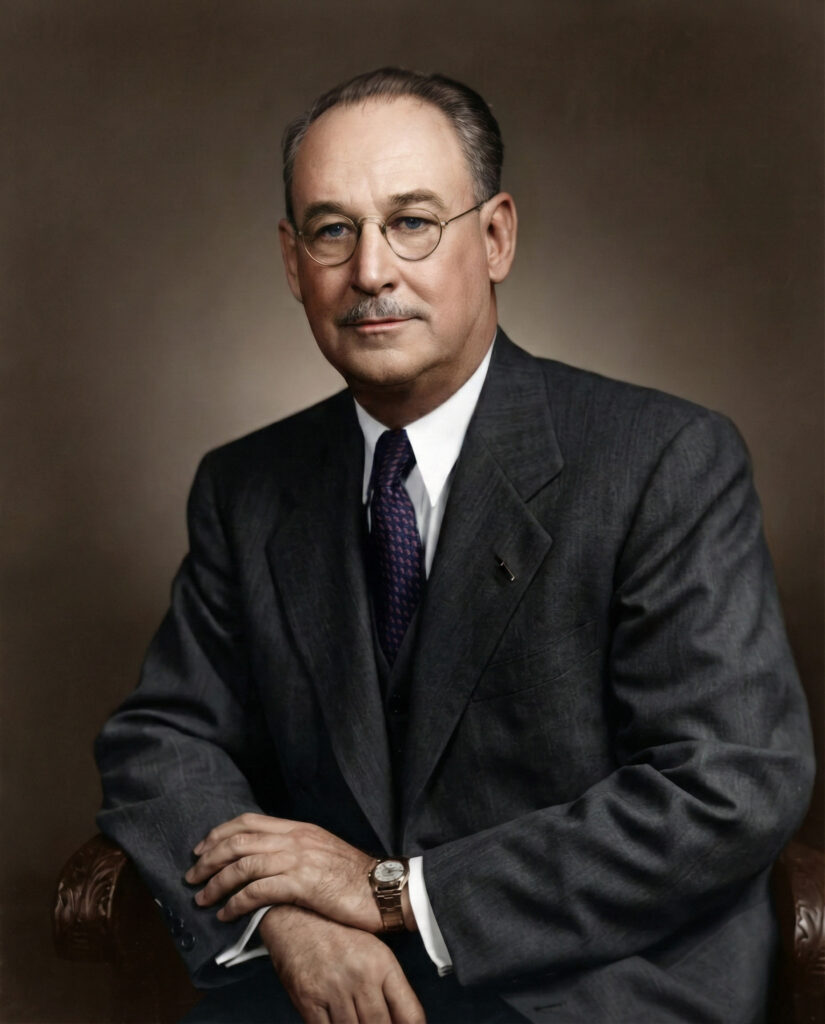
Early life and entry into public service
Sidney W. Souers was born in Dayton, Ohio, on March 30, 1892. He studied at Purdue University and graduated from Miami University in 1914, then built a successful business career that included banking and executive positions in retail and insurance before World War II drew him into full-time service.
These formative decades matter for understanding his later style in Washington. Souers brought to government the habits of a private-sector organizer who prized discretion, budgets, and crisp lines of responsibility.
The Truman Library’s summary of his papers and the CIA’s historical profiles confirm this trajectory, placing him at the junction of business acumen and wartime intelligence. (Truman Library)
Souers joined the Naval Reserve as an intelligence officer in 1929 and was called to active duty in 1940.
His wartime record included service in the Tenth Naval District at San Juan, Puerto Rico, command roles linked to district intelligence and security, and senior positions inside the Office of Naval Intelligence.
He was appointed assistant director of ONI in July 1944 and promoted to rear admiral as deputy chief of Naval Intelligence in late 1945. Those assignments established him as a trusted intelligence professional with unusual fluency in both operations and policy. (CIA)
First Director of Central Intelligence
On January 22, 1946, Truman designated Souers as the first Director of Central Intelligence, inaugurating the short-lived Central Intelligence Group and the National Intelligence Authority. He served as an interim director for several months, setting in motion daily intelligence briefings for the President and helping knit together the disparate wartime intelligence components into a postwar framework. As one CIA retrospective puts it, Truman even teased Souers by presenting him with a black hat and cloak the day he took the job, a gesture that acknowledged both the novelty and the ambiguity of the new role. Souers himself signaled that the position needed clear authorities, which would only arrive with the National Security Act the following year.
The State Department’s “Foreign Relations of the United States” (FRUS) volumes anchor Souers’s early role in the documentary record. They show him navigating the transitional months between ad hoc wartime arrangements and statutory authorities, then handing the CIG to Lt. Gen. Hoyt Vandenberg in June 1946 when a longer-term director was ready. (CIA)
Executive Secretary of the National Security Council
With the National Security Act of 1947, Souers returned to the center of power as the first Executive Secretary of the National Security Council. In that post he became Truman’s daily coordinator for the new national security machinery, working across State, Defense, and the intelligence elements to prepare agendas, track decisions, and turn presidential guidance into formal policy.
FRUS documents highlight how his office shaped the policy instruments of the early Cold War, and how Souers himself sometimes wrote the memoranda that carried the Council’s collective judgments to the President.
A July 1949 memorandum to Truman on the importance of continuity and independence for the director of central intelligence captures both his tone and his institutional concerns. (Office of the Historian)
Souers’s name also appears on the paperwork that built the early covert action framework. A June 15, 1948 “Note by the Executive Secretary” transmitted NSC 10/1 to establish the Office of Special Projects under the DCI.
This document sits at the birth of organized covert operations as a presidential tool. The CIA’s analytic history later stressed how Souers’s quiet brokerage among senior officials helped translate Truman’s intent into practice.
That episode defines one of the controversies of his career, since it married the NSC’s new process with covert capabilities that, by design, operated behind classification walls. (Office of the Historian)
Truman valued Souers’s judgment and discretion. In December 1952 the President awarded him the Distinguished Service Medal for “keen foresight and tireless efforts toward fulfillment of a strong and effective security program.”
The Truman Library and the Presidency Project preserve the citation and a photograph of the ceremony. Souers continued to advise Truman as a special consultant until January 1953. (Truman Library)
The official UAP landscape during Souers’s service
Understanding Souers’s link to UAP requires a timeline.
The modern UAP era began with the 1947 wave of “flying disc” reports. In September of that year, Air Materiel Command chief Gen. Nathan Twining wrote that the phenomenon reported was “something real,” a finding that pushed the Army Air Forces toward a formal program. In 1948 the newly independent U.S. Air Force created Project Sign, followed by Project Grudge in 1949 and Project Blue Book from 1952 to 1969.
When Blue Book closed, the Air Force tallied 12,618 cases, with 701 categorized as “unidentified” by the program’s standards. These program histories and numbers are summarized in official U.S. government sources, including the National Archives and the Air Force fact sheet. (National Archives)
This unfolded while Souers was either Executive Secretary of the NSC or a close presidential adviser.
There is no surviving, authenticated United States record that shows him authoring a UAP-specific policy directive. Yet his office managed the very interagency processes that coordinated defense and intelligence priorities, and he was present when UAP reporting became formalized inside the Air Force and when public communications about the topic became a policy concern after the 1952 Washington incidents.
The institutional proximity is undisputed. The question is how much can be said about Souers and UAP beyond that. (Office of the Historian)
What Sidney Souers actually said about UAP
The simplest answer is also the most important. There is no verified public statement by Sidney Souers on UAP in his speeches, published memoranda, or the accessible portions of his papers.
The Truman Library’s holdings and FRUS compilations show him writing on organization, intelligence authorities, and national security staffing rather than on anomalous aerial phenomena.
CIA histories of the early years echo that focus.
UAP researchers sometimes infer that Souers must have been aware of reports that ascended the chain during 1947 to 1952, and that is reasonable given his roles, but inference is not evidence. In the authenticated record, Souers is silent on UAP. (Truman Library)
Majestic 12 and the Souers question
What the MJ-12 papers claim
In the mid-1980s, a set of anonymously sourced documents surfaced that became famous as the “Majestic 12” papers.
The centerpiece was the “Eisenhower Briefing Document,” dated November 1952, which presented a roster of twelve men said to form “Operation Majestic-12,” a secret group created by President Truman in 1947 to manage crash recoveries and analysis.
That roster includes “Sidney W. Souers.”
Copies of the briefing circulate widely online. In addition, lists of alleged members quoted in overviews of MJ-12 consistently name Souers alongside scientists and senior military leaders. (Archive.org)
Influence on the evolution of U.S. secrecy and how that shaped UAP handling
Souers’s lasting impact on UAP history is indirect but profound.
He helped design the mechanisms by which the U.S. government handles sensitive scientific and intelligence questions.
As Executive Secretary of the NSC, he transformed the Council from a statutory idea into a working process.
That process featured agenda preparation, carefully minuted decisions, and follow-up through staff notes and presidential directives. When anomalous aerial reports began to challenge air defense and intelligence, they encountered a system of interagency coordination that Souers had helped refine. FRUS and National Archives guides to NSC records illustrate the emergence of that system in the late 1940s. (Office of the Historian)
Another aspect of his influence lies in the early covert action framework. NSC 10/1, transmitted by Souers in June 1948, formalized an Office of Special Projects to conduct discrete operations authorized at the highest level.
The CIA’s own scholarship credits Souers with enabling the compromises that made covert action a presidential instrument.
For UAP researchers, this is relevant not because it proves an anomalous program existed, but because it shows how White House-level compartments were structured in this era. If an extraordinary program had taken shape, it would have been nested inside policy and covert action mechanisms that Souers helped legitimize. (Office of the Historian)
Impact on ufology’s narratives
Even if Souers never wrote a sentence about UAP, he has become an enduring figure in ufology for three reasons.
- He stood at the creation of the modern intelligence community. His five-month interim as DCI in 1946 and later role as NSC Executive Secretary put him at the table when the United States designed its postwar secrecy and intelligence regimes.
Ufology often reads the late 1940s as a hinge when government attitudes toward anomalies hardened. Souers’s presence in that very moment is part of why his name endures. - He fits the plausible-casting test for a crash-retrieval overseer. The Eisenhower Briefing Document lists names that make intuitive sense to anyone who knows the period. Scientists such as Vannevar Bush and Detlev Bronk made real contributions to wartime research policy.
Military leaders such as Twining and Vandenberg ran the relevant commands. An NSC insider like Souers is exactly who an author or a hoaxer would include to give the roster credibility. This is a narrative effect worth acknowledging even as one accepts the custodians’ view that the documents are not authentic. - He symbolizes the tension between open science and protected compartments. The same era saw advisory panels managing sensitive technical questions, from nuclear issues to reconnaissance.
Blue Book’s public posture after 1952, the CIA-sponsored Robertson Panel in 1953, and the emergence of covert capabilities all formed a climate in which ambiguous data could be triaged and communications tightly managed. Souers embodied that balancing act. (CIA)
Controversies associated with Souers
The MJ-12 corpus with Souers on the roster. The controversy is not whether his name appears on the alleged list, since the circulated scans show it. The controversy is whether the papers are genuine. The FBI, the National Archives, and the GAO provide the official baseline that they are not authentic government records. Because Souers is a plausible member either way, the debate seldom fades. (Archive.org)
Covert action authority and democratic oversight. NSC 10/1 is a landmark in the history of covert action. Scholars of intelligence policy often argue about the long-term implications of that decision. The CIA’s “Silent Warrior” study credits Souers with implementing Truman’s vision through quiet compromise, which makes him a central figure in the birth of a powerful instrument that operated with minimal public awareness.
The controversy here is constitutional rather than UAP-specific, but it sets the context for how secret programs could be managed. Public communications in the early UAP years. During Souers’s tenure at the NSC and as Truman’s consultant, the Air Force moved from Sign and Grudge into Blue Book and the CIA convened the Robertson Panel. The official summaries that emerged over the following decade emphasized the absence of a demonstrated threat and the likelihood that most reports had conventional explanations. (Office of the Historian)
Reading of Souers’s role
Our approach is intentionally heterodox about the phenomenon. We do not accept the reflex that “most” cases can be waved away, because the historical dataset contains known gaps and because official reviews themselves concede a residual category that resisted explanation.
Within that frame, Souers’s biography offers two lessons.
First, he reminds us that the story of UAP inside the government is inseparable from the story of organization. Souers’s genius was process. He helped make the NSC a working engine. He helped translate presidential intent into institutional habit. If there were ever to be an honest and exceptionally rigorous government investigation of truly anomalous incidents, it would require exactly the kind of disciplined interagency machinery that Souers spent his life building.
Second, his disputed place in MJ-12 lore demonstrates why personnel lists can have such magnetic power.
The roster in the “Eisenhower Briefing Document” aligns with what any close reader of 1947 to 1952 would expect.
Scientists, service chiefs, and the NSC’s inside man.
It is good casting because it matches real roles. The federal record, however, requires us to stop where the authenticated evidence stops.
The FBI Vault and National Archives position carry weight. There is no verified government record that shows Souers in a crash-retrieval committee. Researchers should keep the plausibility in mind without substituting it for proof. (FBI)
Selected timeline
- 1892. Born in Dayton, Ohio. (Wikipedia)
- 1914. Graduates from Miami University and begins a business career. (Wikipedia)
- 1929. Commissioned as a Naval Reserve intelligence officer. (CIA)
- 1940–1945. Active duty in naval intelligence; service in the Tenth Naval District and at the Office of Naval Intelligence; promoted to rear admiral and deputy chief of Naval Intelligence. (CIA)
- Jan–Jun 1946. First Director of Central Intelligence, heading the new Central Intelligence Group. (CIA)
- Jul 1947. Becomes first Executive Secretary of the National Security Council under the National Security Act. (Office of the Historian)
- Jun 1948. Transmits NSC 10/1, creating the Office of Special Projects and establishing the covert action framework. (Office of the Historian)
- 1948–1949. Air Force Projects Sign and Grudge operate as the first formal UAP programs. (U.S. Department of War)
- 1952. Project Blue Book begins; Washington, D.C. radar-visual incidents drive a press-policy inflection. (Air Force)
- Dec 1952. Receives the Distinguished Service Medal from President Truman for national security service. (Truman Library)
- 1953. Continues as Truman’s special consultant until the end of the administration. (Truman Library)
- 1984–1987. MJ-12 papers surface with rosters that include “Sidney W. Souers”; federal custodians later conclude the papers are not authentic government records. (FBI)
- 1973. Souers dies in St. Louis after a long private-sector career and public service at the highest levels. (Wikipedia)
Balanced conclusions
Sidney W. Souers shaped the way the United States organizes secrecy, intelligence, and high-level deliberation. That is his undisputed legacy.
He also served at the precise moment when UAP reporting became a formal military concern. That proximity, combined with his inclusion in the MJ-12 rosters that federal custodians deem inauthentic, has kept his name alive inside ufology.
What can be said with confidence is that Souers built processes that would have been necessary for any rigorous, compartmented scientific investigation of anomalous technology.
What cannot be said, based on verified public records, is that he personally ran or even belonged to such a program.
The federal position on MJ-12 is clear. The FBI judged the key document set to be fake, and the National Archives found no corroborating records.
At the same time, government histories acknowledge that hundreds of cases in the early decades resisted prosaic explanation, and AARO’s synthesis admits data shortcomings that complicate verdicts.
From a UAPedia perspective that keeps an open mind without abandoning standards of evidence, Souers is best read as a builder whose work explains how mysteries could be managed. If the United States ever reveals an authenticated, historical program of extraordinary recovery or analysis, it would be no surprise to find that the paperwork moved through mechanisms he championed.
Until such records are produced, the fairest biography ties Souers to UAP through the structures he created and through the later narratives that borrowed his credibility, while keeping our footnotes anchored to what the archives actually show. (U.S. Department of War)
References
All-domain Anomaly Resolution Office. (2024, March 8). Report on the historical record of U.S. government involvement with unidentified anomalous phenomena (UAP), Volume 1. U.S. Department of Defense. https://media.defense.gov/2024/Mar/08/2003409233/-1/-1/0/DOPSR-CLEARED-508-COMPLIANT-HRRV1-08-MAR-2024-FINAL.PDF (U.S. Department of War)
Central Intelligence Agency. (1953). Report of meetings of Scientific Advisory Panel on Unidentified Flying Objects [Robertson Panel; Durant report]. https://www.cia.gov/readingroom/docs/CIA-RDP79B00752A000300100010-4.pdf (CIA)
Central Intelligence Agency. (2005). Directors of Central Intelligence, 1946–2005: A long look back [PDF]. https://www.cia.gov/resources/csi/static/directors-of-central-intel.pdf
Central Intelligence Agency. (2021). Adair, B. The Silent Warrior: Rear Admiral Sidney Souers and the emergence of CIA’s covert action authority [Studies in Intelligence extract]. https://www.cia.gov/resources/csi/static/0d93c336f342773507612f629bb652cc/Article-Rear-Admiral-Sidney-Souers-and-the-Emergence-of-CIAs-Covert-Action-Authority.pdf (CIA)
Federal Bureau of Investigation. (n.d.). Majestic 12 [FBI Vault]. https://vault.fbi.gov/Majestic%2012 (FBI)
National Archives and Records Administration. (2024, June 25). Project BLUE BOOK – Unidentified Flying Objects [includes MJ-12 reference page]. https://www.archives.gov/research/military/air-force/ufos (National Archives)
Truman Library. (n.d.). Souers, Sidney W. Papers. https://www.trumanlibrary.gov/library/personal-papers/sidney-w-souers-papers (Truman Library)
Truman Library. (1952, December 1). Citation accompanying Distinguished Service Medal presented to Admiral Souers. https://www.trumanlibrary.gov/library/public-papers/340/citation-accompanying-distinguished-service-medal-presented-admiral (Truman Library)
U.S. Air Force. (n.d.). Unidentified Flying Objects and Air Force Project Blue Book [Fact Sheet 95-03]. https://www.af.mil/About-Us/Fact-Sheets/Display/Article/104590/unidentified-flying-objects-and-air-force-project-blue-book/ (Air Force)
U.S. Department of State, Office of the Historian. (1948). Note by the Executive Secretary (Souers) to the National Security Council, NSC 10/1 [FRUS 1948, Vol. 1, Part 2, Doc. 288]. https://history.state.gov/historicaldocuments/frus1948v01p2/d11 (index page) and https://history.state.gov/historicaldocuments/frus1945-50Intel/d288 (document context). (Office of the Historian)
U.S. Department of State, Office of the Historian. (1949). Memorandum from the Executive Secretary of the NSC (Souers) to President Truman [FRUS 1945–50, Intelligence, Doc. 386]. https://history.state.gov/historicaldocuments/frus1945-50Intel/d386 (Office of the Historian)
Wolfbane.com. (n.d.). Eisenhower Briefing Document [scan of purported MJ-12 roster]. https://www.wolfbane.com/articles/eisenhower_briefing.pdf (Wolfbane)
Internet Archive. (n.d.). Eisenhower Briefing Document: Operation Majestic-12 [image copy of purported document]. https://ia800500.us.archive.org/35/items/majestic-12-documents-for-majic-eyes-only/Eisenhower%20Briefing%20Document_text.pdf (Archive.org)
National Archives. (n.d.). Record Group 273: Records of the National Security Council [research guide]. https://www.archives.gov/research/guide-fed-records/groups/273.html (National Archives)
Truman Library. (n.d.). Portrait of Admiral Sidney W. Souers [photo record]. https://www.trumanlibrary.gov/photograph-records/70-5111
Truman Library. (n.d.). Portrait of Sidney Souers [photo record]. https://www.trumanlibrary.gov/photograph-records/96-986
Truman Library. (n.d.). President Truman awards the Distinguished Service Medal to Admiral Sidney Souers [photo record]. https://www.trumanlibrary.gov/photograph-records/96-985
Naval History and Heritage Command. (n.d.). USN 702043 Rear Admiral Sidney W. Souers [photo listing]. https://www.history.navy.mil/our-collections/photography/numerical-list-of-images/nara-series/usn/usn-705000/usn-702043-rear-admiral-sidney-w–souers.html
Note on contested sources. The two “Eisenhower Briefing Document” links reproduce the MJ-12 material to document what those papers claim about Souers. Official judgments from the FBI and the National Archives, cited above, conclude that those papers are not authentic government records.
SEO keywords
Sidney Souers biography; Sidney W. Souers UAP; Majestic 12 roster Souers; MJ-12 authenticity; Executive Secretary NSC 1947; first Director of Central Intelligence; NSC 10/1 covert action; Project Sign and Blue Book timeline; AARO historical report; Truman Souers Distinguished Service Medal; Souers and UAP history.