
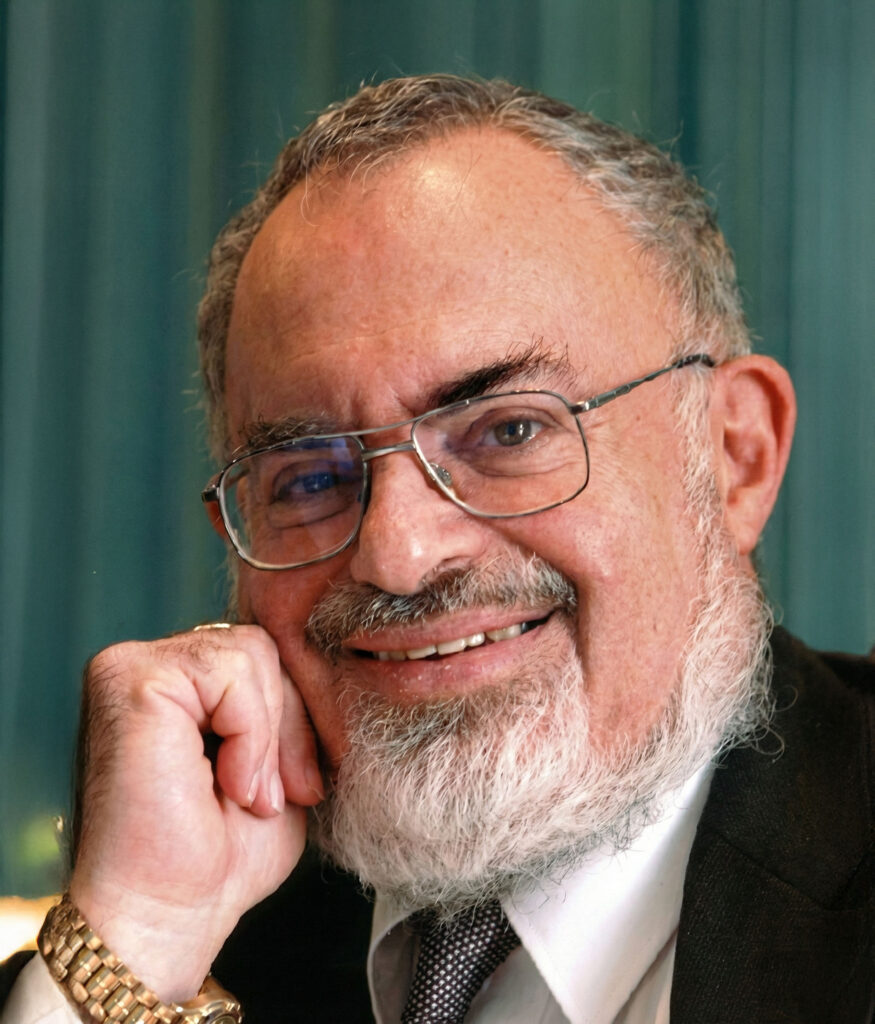
Stanton Terry Friedman was the rare scientist who made a life’s work out of saying the quiet part out loud.
Trained as a nuclear physicist and employed on advanced aerospace and reactor programs, he walked away from industry in 1970 and spent the next half century arguing that the preponderance of evidence shows that nonhuman intelligences have visited Earth and that officialdom has withheld that fact.
He did not arrive at this view casually. He hunted archives, filed requests, built witness networks, and he put numbers in front of audiences from college auditoriums to cable news studios.
Whether one agrees or not, his impact on the modern UAP story is measurable in data points: the reactivation of Roswell in the late 1970s, the publicization of Project Blue Book Special Report 14, the debate over the MJ-12 papers, the narrative structure of abduction research through the Hill case, and a durable set of arguments about interstellar travel grounded in nuclear engineering.
This dossier takes a data-first approach to Friedman’s career. It traces his industry work, documents his public footprint, details his associates, catalogs his publications, maps his claims into a transparent taxonomy, and situates his legacy amid government records and skeptical rebuttals. Wherever possible we link to primary or official sources so readers can check the receipts.
Timeline and Work History
1934–1956: Formation and training.
Born in Elizabeth, New Jersey, Friedman studied at Rutgers and then the University of Chicago, earning a BSc in 1955 and an MS in nuclear physics in 1956. (Wikipedia)
1956–1970: Nuclear programs.
Over 14 years he worked on advanced, often classified projects for General Electric, Aerojet General Nucleonics, General Motors, Westinghouse, TRW Systems, and McDonnell Douglas. Assignments involved nuclear aircraft concepts, fission and fusion rockets, and compact space power systems. These details matter because his later arguments about interstellar travel rest on engineering intuitions about high-energy propulsion. (Wikipedia)
Late 1950s–1960s.
The archive habit forms. While working in industry he found Captain Edward Ruppelt’s book and then discovered Project Blue Book Special Report No. 14, a large statistical analysis of 3,201 Air Force cases produced under Project BEAR in the 1950s. Friedman emphasized that the report categorized roughly one in five cases as “unknown” and argued that the “unknown” rate rose with sighting quality. That claim, rightly or wrongly, became a cornerstone of his lectures. (The University of Chicago Magazine)
1970: Full-time UAP work.
Friedman left industry to investigate UAP. Over the next four decades he delivered lectures at more than 600 colleges and to over 100 professional groups, appeared on network television and radio, and repeatedly sparred with skeptics and SETI advocates. The University of Chicago Magazine’s 2011 profile documents the scope of that activity and captures his research style in the archives. (The University of Chicago Magazine)
1978–1980: Roswell reignites.
In 1978 Friedman interviewed retired intelligence officer Jesse Marcel Sr., who had handled the debris in 1947 and now believed it was not of earthly origin. That contact catalyzed a new wave of witness interviews and publications and is widely credited with reviving global interest in Roswell.
1984–1990s: The MJ-12 controversy.
Beginning in 1984, purported “Majestic 12” documents surfaced via Jaime Shandera and William Moore. Friedman investigated and defended the authenticity of some core items while rejecting others.
2000s–2010s: Books, awards, debates.
Friedman coauthored and authored a series of widely read books, including Captured! with Kathleen Marden, Top Secret/MAJIC, Crash at Corona with Don Berliner, and Flying Saucers and Science. He debated SETI’s Seth Shostak on Coast to Coast AM in 2004 and appeared multiple times on CNN’s Larry King Live. MUFON gave him its top honor in 2007. (Barnes & Noble)
2019: Passing and archival legacy.
Friedman died on May 13, 2019, returning home from a lecture. Canadian outlets and the Fredericton Region Museum marked his passing, and his papers and artifacts became the basis for regional exhibits. (Yahoo News)
Involvement with UAP: The Dossier
1) Blue Book Special Report 14 and the “unknowns” argument
Friedman treated Special Report 14 as the neglected core data product of the Air Force era. He highlighted that the Battelle-led analysis categorized about 22 percent of cases as “unknown,” and he often used a correlation point that better quality reports more often landed as “unknown.”
The CIA reading room hosts a copy of the report with the formal title Analysis of Reports of Unidentified Aerial Objects (Project 10073), dated May 1955. The National Archives confirms Blue Book’s declassification and access status. (CIA)
2) The Roswell revival
The public had largely moved on from Roswell until the late 1970s. Friedman’s 1978 contact with Jesse Marcel and his subsequent witness-driven approach seeded new reporting, interviews, and books.
TIME’s historical explainer credits Friedman’s interview as the hinge event that “got Roswell started” again. The Air Force’s official 1994 report and the 1997 follow-up, Case Closed, cite GAO’s audit and present Project Mogul balloon operations as the prosaic source of debris. AARO’s 2024 report restates those conclusions and adds that there is no documentary basis for claims of recovered aliens. (TIME)
3) MJ-12 and the typographic duel
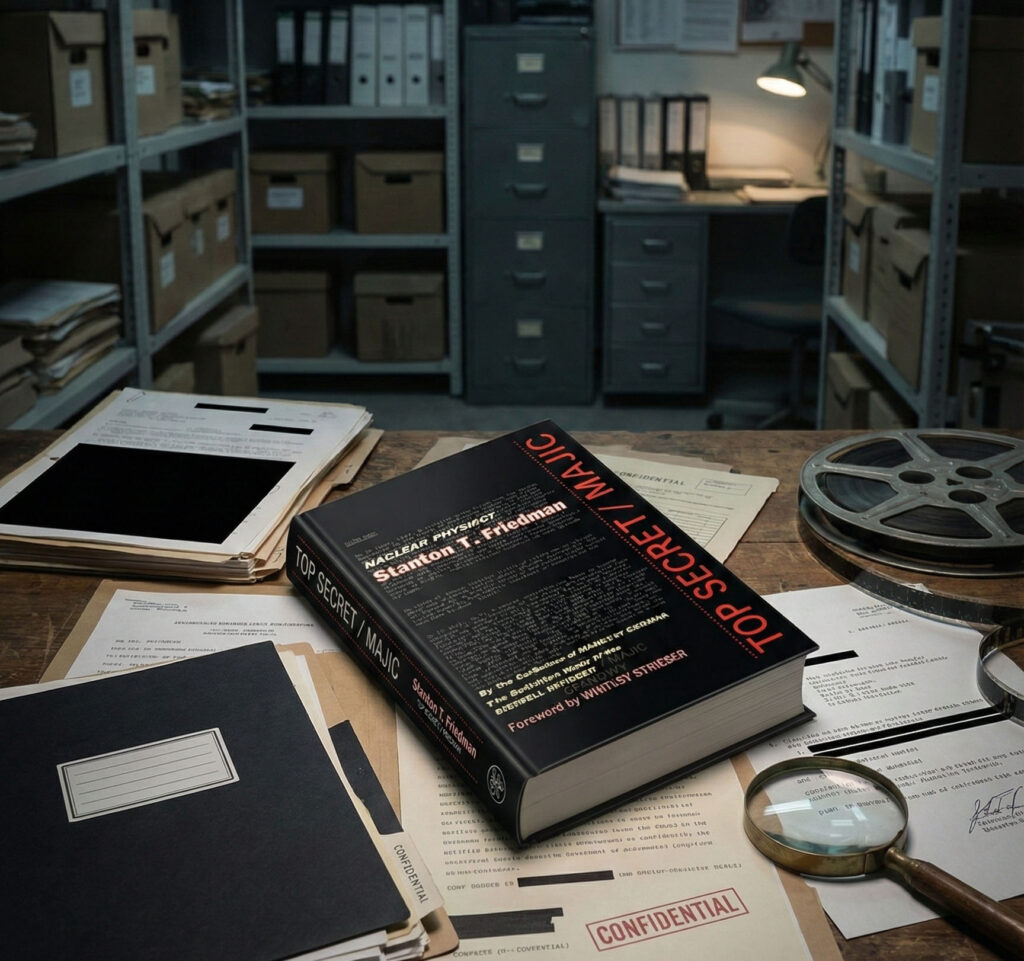
Friedman’s book Top Secret/MAJIC defended a subset of the MJ-12 papers. The FBI’s FOIA Vault records that an Air Force investigation determined the document set to be fake. Yet the controversy is not remembered only for authenticity claims. It is remembered for method.
When skeptic Philip J. Klass argued that a 1950s memo’s typeface was wrong for the era, Friedman found contemporaneous examples in that face and made Klass pay the challenge’s one thousand dollar cap. Klass later insisted it was a “challenge” rather than a bet, but he did pay. The episode shows Friedman’s forensic instinct at the scale of staples and fonts. (FBI)
4) Betty and Barney Hill and the abduction literature
With researcher Kathleen Marden, Betty Hill’s niece, Friedman coauthored Captured! and put archival structure around the 1961 New Hampshire case and Marjorie Fish’s “Zeta Reticuli” map hypothesis. Whether one accepts the interpretation, Captured! is a gateway to documents, hypnosis transcripts, and context. (Internet Archive)
5) On propulsion and feasibility
Friedman’s talks leaned on nuclear engineering to rebut the claim that interstellar travel is impractical.
He referenced fission and fusion rocket studies and argued that flight profiles to nearby stars are within the envelope of foreseeable physics.
The University of Chicago profile captures his “fusion” emphasis and the way he used aerospace history to frame possibility. (The University of Chicago Magazine)
Public Appearances: Where the Arguments Landed
- Network and cable news: Multiple CNN Larry King Live UAP specials in 2007 and 2008 featured Friedman sparring with Michael Shermer, Seth Shostak, Buzz Aldrin, and others. Transcripts remain available in CNN’s archives. (CNN Transcripts)
- Talk radio: The 2004 Friedman–Shostak debate on Coast to Coast AM surveyed evidence, SETI priorities, and audience sentiment. The show summary even recorded a listener vote. (Coast to Coast AM)
- Academic and public lectures: The University of Chicago Magazine documents more than 600 campus talks and professional audiences across 50 states, 10 provinces, and 19 other countries. (The University of Chicago Magazine)
- Museums and exhibits: The Fredericton Region Museum preserves an exhibit from his collections, signaling local institutionalization of his legacy.
Known Public Connections and Network
- Kathleen Marden, researcher and author. Coauthor on Captured!, Science Was Wrong, and Fact, Fiction, and Flying Saucers. Marden’s biographical page details her longstanding role in the Hill case corpus. (Kathleen Marden)
- Don Berliner, aviation historian. Coauthor on Crash at Corona. Penguin Random House’s author page confirms his aviation and UAP bibliography. (PenguinRandomhouse.com)
- William Moore and Jaime Shandera. Early custodians of the MJ-12 documents and coauthors of The Roswell Incident in 1980. Moore’s biography and mainstream summaries place Friedman in the small circle that circulated the material and argued about it. (Wikipedia)
- Jesse Marcel Sr. The retired intelligence officer whose 1978 interview with Friedman reopened the Roswell narrative. (Wikipedia)
Government Involvement and Official Records
- National Archives: Blue Book holdings. Project Blue Book’s records are open to the public. (National Archives)
- GAO audit of Roswell records (1995). At the request of Congressman Steven Schiff, GAO searched for contemporaneous records and found many routine RAAF records destroyed and no accident report requirement for a balloon crash. The audit cites Air Force conclusions. (Government Accountability Office)
- USAF’s Roswell Report series (1994, 1997). The Air Force linked debris to Project Mogul operations and explained “bodies” claims as test dummies and conflations. AARO’s 2024 history recaps those findings in plain language. (DAF History)
- AARO Historical Record Report (2024). Concludes that official programs have not confirmed extraterrestrial technology, and that many incidents relate to misidentification or classified projects. It explicitly notes that no official record substantiates recovery of aliens near Roswell. (U.S. Department of War)
- FBI Vault on MJ-12. The Bureau’s file summarizes the Air Force determination of inauthenticity for the MJ-12 “Eisenhower briefing.” (FBI)
Publications with Relevance to UAP
- Friedman, S. T. (1996). Top Secret/MAJIC. A defense of the core MJ-12 documents with Friedman’s rebuttals to critiques. Publisher records and reissues confirm bibliographic details. (Open Library)
- Berliner, D., & Friedman, S. T. (2004). Crash at Corona. The authors argue for a crash and recovery scenario near Roswell. See catalog entries and publisher listings. (Google Books)
- Friedman, S. T. (2008). Flying Saucers and Science. A synthesis of his evidence-driven case that interstellar travel and visitation are feasible. Retail listings and library catalogs confirm details. (Barnes & Noble)
- **Marden, K., & Friedman, S. T. (2007/updates). Captured! ** The Hill case revisited with original materials. Multiple editions exist. (Internet Archive)
- Marden, K., & Friedman, S. T. (2016). Fact, Fiction, and Flying Saucers. A study of misinformation and debunking narratives. Publisher page provides summary and metadata. (Red Wheel/Weiser)
The Controverters: Who Pushed Back and on What Basis
- Philip J. Klass, journalist and skeptic. Klass pressed documentary and typographic arguments against MJ-12 and other claims. He publicized his payment to Friedman over the Pica type challenge as a narrow concession on typography rather than on authenticity. (Gary P. Posner)
- Karl T. Pflock, author of Roswell: Inconvenient Facts and the Will to Believe. This Prometheus title is a thoroughgoing argument that no alien craft or bodies were found at Roswell and that claims rise and fall on a few unreliable testimonies. (Simon & Schuster)
- Kendrick Frazier and Skeptical Inquirer. Frazier’s 2017 retelling of Roswell emphasizes the ordinary origins of events and the sedimentation of myth over decades. (Skeptical Inquirer)
- Robert Sheaffer. Decades of skeptical columns critique the Hill “star map” reasoning and the MJ-12 corpus, representing a consistent methodological critique of ufology. (Skeptical Inquirer)
What Friedman Claimed, What He Cited, What Others Found
To keep the analysis crisp, we score each claim on three axes: Evidence Type (documentary, testimonial, physical, inferential), Official Counterposition, and Current Status.
- “A significant fraction of UAP reports in Air Force data remain ‘unknown,’ and better quality reports are more often ‘unknown’.”
Evidence Type: documentary statistics from Project Blue Book Special Report 14.
Friedman’s sources: Battelle’s analysis; Friedman’s slide correlations. (CIA)
Official Counterposition: AARO’s 2024 report states official investigations have not confirmed extraterrestrial technology and judges that cases often resolve with better data. (U.S. Department of War)
Current Status: Contested. The numbers in SR-14 are real, but their interpretation remains debated. - “Roswell was a crash and recovery of nonhuman technology.”
Evidence Type: testimonial from personnel and civilians, inferential reconstruction, and document hunts.
Friedman’s sources: interviews starting with Jesse Marcel; Crash at Corona and related research. (Wikipedia)
Official Counterposition: USAF 1994–1997 reports and GAO 1995 audit; AARO 2024 reiteration. (DAF History)
Current Status: Rejected by official inquiries; sustained by a community of researchers who challenge those inquiries. - “A small subset of MJ-12 documents are authentic.”
Evidence Type: documentary and forensic claims, including typographic and formatting arguments.
Friedman’s sources: Top Secret/MAJIC; archival searches; the Klass typeface challenge. (Open Library)
Official Counterposition: FBI Vault summary of Air Force finding of inauthenticity; subsequent analyses. (FBI)
Current Status: Rejected by official reviews and most historians; partially defended by Friedman to the end. - “The Betty and Barney Hill case is evidential.”
Evidence Type: testimonial under hypnosis, physical and documentary corollaries, the Fish star map.
Friedman’s sources: Captured! and Hill estate archives via Marden. (Internet Archive)
Official Counterposition: None definitive; skepticism targets hypnosis reliability and pattern matching in the star map.
Current Status: Contested within both UAP research and psychology. - “Interstellar travel by advanced civilizations is feasible using nuclear energy.”
Evidence Type: engineering extrapolation and historical propulsion studies.
Friedman’s sources: his nuclear industry background and public technical literature. (The University of Chicago Magazine)
Official Counterposition: Not an official adjudication; skeptics emphasize engineering constraints but do not treat feasibility as falsified fact.
Current Status: Plausibility claim. Not testable by current public programs, but consistent with known physics under generous assumptions.
Implications
- If Friedman is right: Then governance failed at transparency at a scale he called a “cosmic Watergate.” The implications for aerospace, defense, and the philosophy of science would be sweeping. The data stewardship lessons are immediate: preserve original records, declassify with context, and modernize how UAP observables are captured so that debates do not turn on typographic inference.
- If official reviews are right: Then Friedman’s legacy is still consequential. He made agencies spell out their positions, forced public literacy about archives, and catalyzed the very institutional responses that now dominate the discussion. AARO’s 2024 report is formulated for a public trained by decades of arguments that he and his peers advanced. (U.S. Department of War)
- For present research: His emphasis on propulsion plausibility, multiple data streams, and specific case histories remains instructive. Where his conclusions are contested, his methods offer a scaffold: go to the archives, ask for the documents, interview the principals, and quantify the claims.
Claims Taxonomy
- Crash retrieval at Roswell
Claim: Nonhuman vehicle recovered; cover up followed.
Core exhibits: Marcel testimony, early press releases, later witness accounts, alleged MJ-12 records.
Confounders: Mogul program documentation, destroyed routine base records from 1947, lack of chain-of-custody physical artifacts.
Status: Disputed. Rejected by USAF and GAO; defended by Friedman and other government whistleblowers. (DAF History) - MJ-12 authenticity
Claim: Some documents genuine indicators of a policy group.
Core exhibits: “Eisenhower Briefing,” “Cutler-Twining memo,” typewriter and format analyses.
Confounders: FBI and Air Force assessments of inauthenticity, provenance anomalies, later known hoaxes bundled with early papers.
Status: Disputed. Officially rejected; partially defended by Friedman. (FBI) - Abduction evidentiality
Claim: Betty and Barney Hill case exhibits consistent patterns and a credible star map fit.
Core exhibits: Hypnosis transcripts, Fish 3-D star mapping.
Confounders: Reliability of hypnosis, confirmation bias in spatial matching.
Status: Contested; central to abduction literature. (Internet Archive) - SR-14 unknowns are meaningful
Claim: Statistical unknowns are not noise but signal.
Core exhibits: Tables and quality-unknown correlation.
Confounders: Methodology limitations, case definitions, omitted classified data.
Status: Contested; foundational to Friedman’s case. (CIA) - Feasible interstellar propulsion
Claim: Nuclear technologies enable practical interstellar travel for advanced civilizations.
Core exhibits: History of fission and fusion rocket studies.
Confounders: Energy budgets, materials, shielding, programmatic scale.
Status: Probable but not proven, used to rebut impossibility claims. (The University of Chicago Magazine)
Publications Checklist (with context)
- Top Secret/MAJIC (1996; Marlowe/Da Capo; later Grand Central). Friedman’s detailed MJ-12 brief, including typographic counterarguments. (Open Library)
- Crash at Corona (with Don Berliner, 1992; updated 1997; Paraview 2004). Argues a two site recovery near Roswell and San Agustin. (Google Books)
- Flying Saucers and Science (2008, New Page). Presents SR-14, propulsion feasibility, and case syntheses for general readers. (Barnes & Noble)
- Captured! (with Kathleen Marden, 2007 and later anniversary editions). Assembles the Hill case and Fish star map work. (Internet Archive)
- Science Was Wrong (with Marden, 2010). A meta-book on resistance to disruptive ideas, used to frame UAP acceptance debates. (Amazon)
- Fact, Fiction, and Flying Saucers (with Marden, 2016). Treats patterns of misinformation and ridicule ecosystems around UAP. (Red Wheel/Weiser)
Bottom Line
Stanton T. Friedman is the most consequential bridge figure between Cold War data and the streaming era of disclosures and debunkings.
He did not just say that UAP are real. He constructed a body of work designed to make that statement evidence-based in the sense he judged most meaningful: numbers from official reports, paper trails from archives, on-the-record witness testimony, and engineering plausibility arguments.
References
AARO. (2024). Report on the historical record of U.S. Government involvement with UAP. Volume I. Department of Defense. https://media.defense.gov/2024/Mar/08/2003409233/-1/-1/0/DOPSR-CLEARED-508-COMPLIANT-HRRV1-08-MAR-2024-FINAL.PDF (U.S. Department of War)
Air Force History. (1994). The Roswell Report: Fact and fiction in the New Mexico desert. Department of the Air Force. https://www.dafhistory.af.mil/Portals/16/documents/AFD-101201-038.pdf (DAF History)
Air Force. (1997). The Roswell Report: Case closed. Office of the Secretary of the Air Force. https://www.esd.whs.mil/Portals/54/Documents/FOID/Reading%20Room/UFOsandUAPs/RoswellReportCaseClosed.pdf (Defense Logistics Agency)
Berliner, D., & Friedman, S. T. (2004). Crash at Corona: The U.S. military retrieval and cover-up of a UFO. Cosimo/Paraview. https://books.google.com/books/about/Crash_at_Corona.html?id=ii7BBAAAQBAJ (Google Books)
CNN. (2007, July 13). Larry King Live transcript. https://transcripts.cnn.com/show/lkl/date/2007-07-13/segment/02 (CNN Transcripts)
CNN. (2008, July 18). Larry King Live transcript. https://transcripts.cnn.com/show/lkl/date/2008-07-18/segment/01 (CNN Transcripts)
Coast to Coast AM. (2004, July 21). The Great UFO Debate (Shostak vs. Friedman). https://www.coasttocoastam.com/show/2004-07-21-show/ (Coast to Coast AM)
FBI. (1988). Majestic 12 [FOIA Vault]. https://vault.fbi.gov/Majestic%2012 (FBI)
Friedman, S. T. (1996). Top Secret/MAJIC. Marlowe & Company. Catalog entry: https://openlibrary.org/books/OL810834M/Top_secret_MAJIC and updated listing: https://www.grandcentralpublishing.com/titles/stanton-t-friedman/top-secretmajic/9780306835551/ (Open Library)
Friedman, S. T. (2008). Flying Saucers and Science. New Page Books. https://www.barnesandnoble.com/w/flying-saucers-and-science-stanton-t-friedman/1136630863 (Barnes & Noble)
Kendrick, F. (2017). The Roswell incident at 70: Facts, not myths. Skeptical Inquirer, 41(6). https://skepticalinquirer.org/2017/12/the-roswell-incident-at-70-facts-not-myths/ (Skeptical Inquirer)
Marden, K., & Friedman, S. T. (2007). Captured! The Betty and Barney Hill UFO experience. New Page Books. Library entry: https://archive.org/details/capturedbettybar0000mard and updated publisher listing: https://redwheelweiser.com/book/fact-fiction-and-flying-saucers-9781632650658/ (author bio cites coauthored titles). (Internet Archive)
Marden, K., & Friedman, S. T. (2010). Science was wrong. New Page Books. https://bookshop.org/p/books/science-was-wrong-startling-truths-about-cures-theories-and-inventions-they-declared-impossible-stanton-t-friedman/f98282a0bc5b446b (Bookshop.org)
National Archives. (2018, February 9). Do records show proof of UFOs? https://www.archives.gov/news/articles/do-records-show-proof-of-ufos (National Archives)
National Archives. (2024). Project Blue Book—Unidentified Flying Objects. https://www.archives.gov/research/military/air-force/ufos (National Archives)
Pflock, K. T. (2001). Roswell: Inconvenient facts and the will to believe. Prometheus. https://www.simonandschuster.com/books/Roswell/Karl-T-Pflock/9781573928946 (Simon & Schuster)
Rothman, L. (2015, July 7). How the Roswell theory got started. TIME. https://time.com/3916193/roswell-history/ (TIME)
UChicago Magazine. (2011, Sept–Oct). Gibson, L. “Science? Fiction?” https://mag.uchicago.edu/science-medicine/science-fiction (The University of Chicago Magazine)
U.S. GAO. (1995, July 28). Government Records: Results of a search for records concerning the 1947 crash near Roswell, New Mexico (NSIAD-95-187). https://www.gao.gov/assets/nsiad-95-187.pdf (Government Accountability Office)
Yahoo News/CBC. (2019, May 14). Stanton Friedman, famed UFO researcher, dead at 84. https://ca.news.yahoo.com/stanton-friedman-famed-ufo-researcher-191616648.html (Yahoo News)
Wikipedia community entries used for quick factual cross-checks (with citations within pages to primary sources): Stanton T. Friedman, Jesse Marcel, Majestic 12. https://en.wikipedia.org/wiki/Stanton_T._Friedman ; https://en.wikipedia.org/wiki/Jesse_Marcel ; https://en.wikipedia.org/wiki/Majestic_12 (Wikipedia)
SEO Keywords
Stanton T. Friedman, UAP history, Roswell crash, Project Blue Book Special Report 14, MJ-12 documents, Jesse Marcel interview, AARO 2024 report, GAO Roswell audit, nuclear propulsion UAP, Kathleen Marden, Don Berliner, Larry King Live UAP, Coast to Coast AM debate, UAP cover up arguments, UAP archives, UAP investigations, UAPedia biography