
In September 1966, two American astronauts looked out of their Gemini capsule and saw something they were not expecting: a large, bright object pacing their spacecraft high above Madagascar.
They described it as a kind of “wingman”, tumbling about once per second. They tried to photograph it. The resulting images are fuzzy, overexposed blobs, yet they have become some of the most fought-over frames in NASA history.
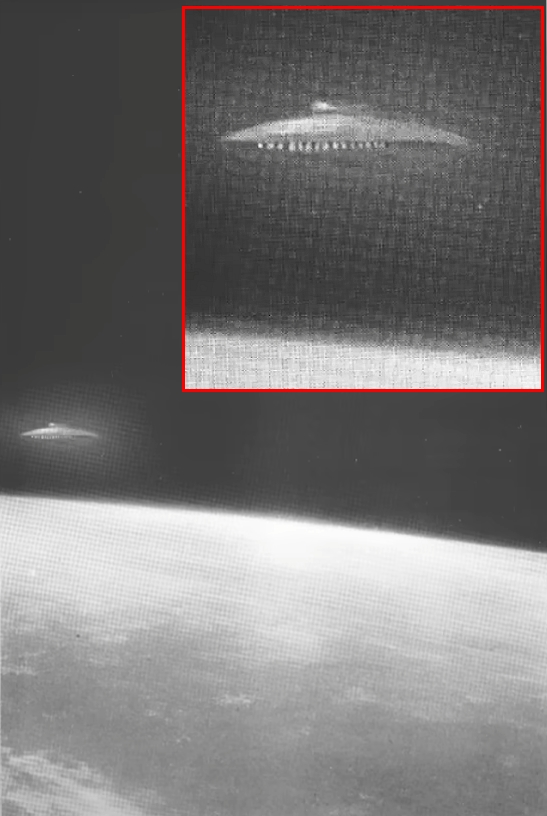
Half a century later, those original Hasselblad frames have been joined by something even stranger: a lost NASA lithograph from the personal archive of engineer Scott Simkinson, titled “Strange object as seen during the Gemini XI flight.” That lithograph appears to show a classic disc-shaped craft above Earth. Its re-emergence has triggered a full-on data war over what is real, what is altered, and what the Gemini 11 crew actually encountered. (Amazon)
This explainer walks through the case as a data problem first: photos, radar, orbital mechanics, testimony, and chain-of-custody. Then we flag speculation clearly.
Mission context: Gemini 11 on top of the world
Gemini 11 (often written Gemini XI) launched on 12 September 1966 with astronauts Charles “Pete” Conrad Jr. and Richard F. Gordon Jr. Its goals were ambitious: multiple rendezvous with an Agena target vehicle, a tether experiment, and a record-setting high orbit. The crew ultimately reached about 850 miles (1,368 km), the highest Earth orbit of any crewed mission before Apollo. (NASA)
The mission carried multiple cameras, including a 70 mm Hasselblad system that produced the now-controversial still images. It was tracked by NASA ground stations and, for orbital objects, by the U.S. space-tracking network run through NORAD, relying heavily on radar and optical sensors to maintain a catalog of satellites. (Scribd)
On 13 September 1966, during a pass over the Indian Ocean near Madagascar, the routine mission narrative picked up an anomaly.
The “wingman” sighting over Madagascar
The basic sequence is consistent across NASA transcripts, later debriefings, and independent summaries:
- Time: roughly orbit 16, near sunset over Madagascar.
- Crew: Conrad and Gordon inside Gemini 11, with the Agena target vehicle already attached earlier in the mission.
- Event: They observe a bright, elongated object apparently keeping pace with the spacecraft, then dropping down in front of them.
In the air-to-ground voice transcript, Conrad famously describes it as a “wingman” flying alongside them. One commonly quoted line, drawn from the debriefing, has him saying:
“We had a wingman flying wing on us going into sunset here off to my left.”
That is under 25 words; the full passage includes additional technical description of a large tumbling object. Conrad and Gordon estimated it was several miles away and moving ballistically, not maneuvering like a powered craft. (Yarchive)
Critically for our purposes, this was not a lone “lights in the sky” report:
- Two trained, space-qualified witnesses.
- Real-time voice transcripts.
- Photographs taken immediately afterward.
- Later ground-based tracking data from NORAD.
By UAP standards, this is a relatively well-instrumented case, even if the instrumentation was limited by 1960s technology.
What the cameras actually saw
The crew attempted to photograph the object with the onboard Hasselblad camera. NASA archive work by optical physicist Bruce Maccabee identifies three key frames from magazine G11-S, usually catalogued around frame S66-54685 (numbering varies slightly by source).
On the raw film, the object appears as:
- A bright, slightly elongated patch against the darkness of space.
- With multiple lobes or a “cloverleaf” structure when heavily enlarged.
- Lacking sharp edges, as if overexposed.
Maccabee’s analysis, based on NASA photo labs and official density step wedges, modelled the camera as follows:
- Lens f-number about 4.5.
- Exposure tuned for sunlit Earth limb, not for a bright point source in deep space.
- Expected diffraction disk for a point source around 5.5×10⁻³ mm on the negative. (The Black Vault)
He then compared:
- Expected image size of a distant satellite if it were a small, bright point.
- Observed image size and structure of the object in the Gemini 11 frames.
His conclusion: the anomalous image was far larger and more structured than expected for the Soviet Proton 3 satellite at the distance NORAD initially reported. In other words, the photos did not match the Proton 3 hypothesis under simple optical assumptions. (The Black Vault)
Skeptical investigators counter that overexposure and film halation can easily enlarge bright point sources, and that the heavy enlargements used in books and TV shows exaggerate irregularities. However, even James Oberg, a prominent skeptic, notes that the photos ended up fuzzier than what the astronauts saw visually, which complicates any purely photographic solution. (Yarchive)
NORAD radar, Proton 3 and the tracking puzzle
Soon after the sighting, the U.S. tracking network stepped in. According to mission summaries and later analyses:
- NORAD initially identified the object as the Soviet Proton 3 satellite, an upper stage and payload in a decaying orbit.
- NASA mission chronologies and multiple reference works repeat that identification. (Dreamland Fantasy Studios)
Proton 3 itself is uncontroversial: launched in July 1966, it was being tracked by radar as it slowly lost altitude. NORAD’s global radar network was designed to maintain such orbital elements to protect against surprise attacks and monitor Soviet space activity. (Scribd)
However, when Maccabee and others obtained tracking data and performed independent orbital calculations, they reached a different conclusion:
- Using NORAD TLE-like data for Proton 3 and mission data for Gemini 11, they found that Proton 3 would have been hundreds of miles away from Gemini 11 at the time of the sighting, not six miles.
- A widely quoted summary (derived from Maccabee) notes that Proton 3 would have been more than 350 miles away when the “long object” was seen over Madagascar. (Dreamland Fantasy Studios)
Maccabee therefore considered Proton 3 an incorrect match, and he emphasizes that the object is presently listed by NASA as “unidentified” in some internal cataloging.
James Oberg, who had early access to similar tracking data, offers a different angle. In a long technical note, he explains that:
- He obtained NORAD tracking data and Gemini 11 equator-crossing data in the 1970s.
- Early attempts to match the orbits could not get closer than a few minutes of timing, which he regarded as inconclusive because the computational method itself had not been validated.
- Revisiting the case with modern satellite prediction tools, he became more confident that Proton 3 remained a plausible culprit, although he acknowledges he cannot prove it definitively. (Yarchive)
Oberg even gives his own probability breakdown for the sighting, strongly favoring a man-made satellite and assigning a probability of less than 1 percent to a truly unexplained stimulus. (Yarchive)
What about direct radar returns on the “wingman”?
Here the record is murkier:
- Some spaceflight anomalies, such as objects during Gemini 10, occurred when the spacecraft was out of range of NASA radar, which limited real-time sensor cross-checks.
- For the Gemini 11 UAP, there is no published evidence of an independent radar track of an unknown object matching the astronauts’ visual. The Proton 3 identification is entirely based on catalogued orbital data, not on a distinct “unknown target” showing up on radar screens. (Center for Inquiry)
From a data standpoint, that means radar plays a negative role here: it provided the basis for a proposed identification (Proton 3) rather than an independent detection of an anomalous track. When Maccabee’s and Oberg’s orbital reconstructions diverge, they are really arguing about how to interpret the tracking data, not about what radar “saw” at the exact moment of the sighting.
NASA archives, Condon, and the skeptic reading
The Gemini 11 incident appears in multiple skeptical and semi-skeptical treatments of astronaut UAP sightings.
- A 1978 article in The Skeptical Inquirer by Oberg lists Gemini 11 as a case where astronauts reported a “yellow-orange [UAP] about six miles from them,” later associated with Proton 3. The article notes that the photos are fuzzy, but that the crew’s visual description matches a satellite on a ballistic path.
- Works like The Mammoth Encyclopedia of Extraterrestrial Encounters also mirror Maccabee’s criticism of the Proton 3 identification while still framing the event as a close pass of another satellite, not a non-human craft. (Internet Archive)
NASA’s own public-facing mission summaries tend to omit the anomaly entirely, or mention it briefly as a sighting of another satellite, reflecting the agency’s long habit of backgrounding UAP-related material in official storytelling. (NASA)
In line with UAPedia’s editorial policy on government sources, we treat NASA’s position and the Condon-era culture as one line of evidence, not as a final arbiter. Strong institutional incentives existed in the 1960s to minimize UAP significance, especially high-prestige programs like Gemini and Apollo.
Enter Scott Simkinson and the “Strange object as seen during the Gemini XI flight” lithograph
Decades after Gemini 11, a new piece of evidence surfaced from outside NASA’s official archives.
Who was Scott Simkinson?
News archives and NASA-related documents place Scott Simkinson as:
- An engineer and flight safety official associated with Apollo and launch operations.
- Described in contemporaneous newspapers as a member of an Apollo safety committee and later as an assistant program manager for flight safety. (Newspapers)
In other words, he was not a late-night radio caller. He was part of the engineering ecosystem around the very missions in question.
The Simkinson lithograph
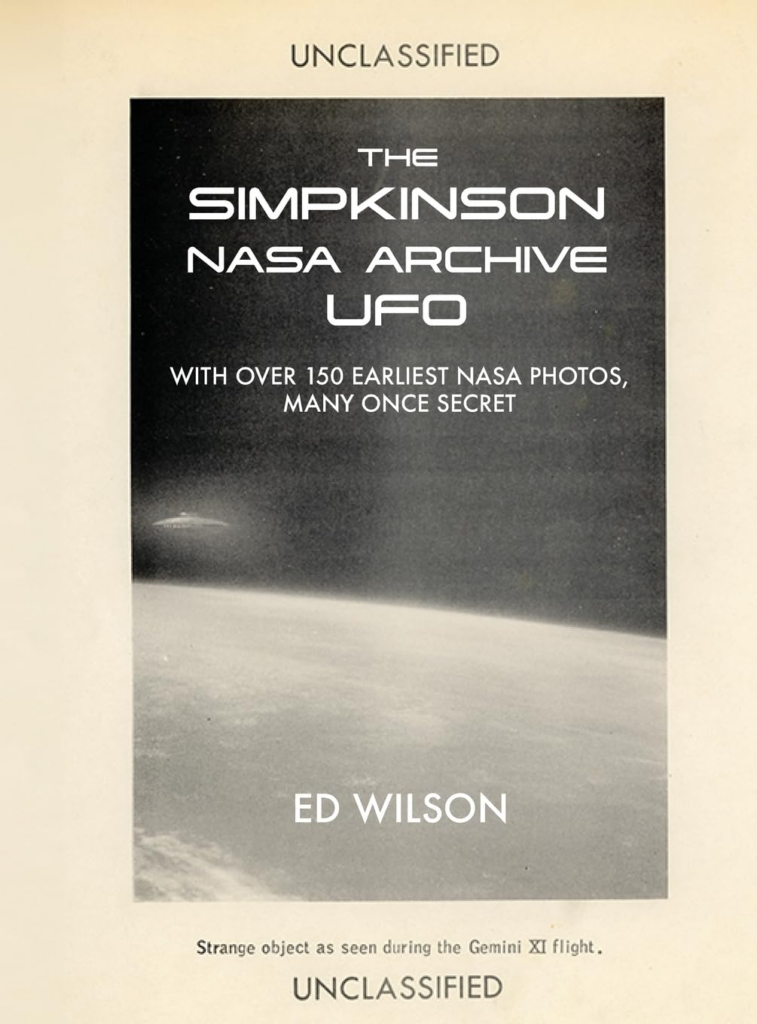
Author Ed Wilson reports that Simkinson preserved a set of NASA lithographs in his personal collection. Among them was one titled:
“Strange object as seen during the Gemini XI flight” (Podcast Guests)
This lithograph shows:
- Earth’s limb and cloud tops in black-and-white.
- A bright, lenticular, classic “flying saucer” shaped object above the horizon.
According to Wilson’s promotional materials and interviews:
- The lithograph survived only because Simkinson kept it when other internal prints were discarded.
- The image is not found in public NASA catalogs for Gemini 11.
- The team matched its cloud patterns to a specific Gemini 11 frame (often given as S66-54585) or to a narrow time window around that frame. (Podcast Guests)
Wilson’s book, The Simpkinson NASA Archive UAP (co-credited with contributions from Leslie Kean and Travis S. Taylor), claims:
- Over 150 historic NASA UAP-related photos, many originally withheld or poorly circulated.
- A deep dive into the Gemini 11 lithograph using voice transcripts, technical debriefings, and battery-failure reports.
- Forensic analyses by independent experts in physics, astronomy, chemistry, mathematics, and imaging. (Podcast Guests)
Podcast appearances and interviews expand on this:
- Zero Signal Podcast and Vancrux Podcast episodes focus on how the Simkinson lithograph appears to tie directly into official Gemini 11 photos, hidden RCA film, and anomalies in mission documentation. (NASA)
These sources present the lithograph as a missing link between the fuzzy “wingman” photos and a much clearer, apparently structured craft.
The S66-54585 controversy: cloud matches, missing saucers, and hoax claims
Once the Simkinson lithograph and Wilson’s book became widely known, independent researchers, including skeptics, began their own comparisons.
Metabunk and the “fake” verdict
In 2025, a thread on Metabunk examined an image said to be from Gemini 11 and published in Wilson’s book. The opening poster wrote that it “looks more like a retouched photo” and noted they could not find it in standard Gemini 11 image sets. (Metabunk)
Administrator Mick West quickly tracked down a NASA-hosted image on Flickr whose cloud patterns perfectly matched the Simkinson lithograph, down to a distinctive formation near the limb. The NASA image is identified as Gemini 11 frame S66-54585. (Metabunk)
Key points from that analysis:
- The clouds and limb geometry match, indicating the lithograph is derived from the same scene as S66-54585.
- The NASA scan does not show any saucer-like object.
- The widely circulated “Gemini 11 saucer” image appears distorted and cropped compared to the NASA original.
- The simplest explanation, in West’s view, is that someone added the saucer to a NASA photo, making the lithograph or at least the online version a hoax. (Metabunk)
Other forum participants noted suspicious image features:
- A glare halo around the saucer that does not follow normal reflection patterns.
- A lack of the image’s overall grid-like scan pattern within the saucer region.
- Fine details on the saucer sharper than the rest of the image. (Metabunk)
Ed Wilson’s counterargument
Wilson himself joined the Metabunk discussion and argued that:
- S66-54585 matches the lithograph’s clouds, but he sees it as disqualifying that the NASA frame lacks certain “orbital debris” specks visible in the lithograph.
- Drawing on analysis attributed to Travis Taylor, he claims the lithograph must originate from a missing NASA photograph taken within about 90 seconds of S66-54585, rather than from S66-54585 itself. (Metabunk)
Critics replied that this does not address the simplest hypothesis: that the saucer and debris were added to a known NASA frame. Metabunk’s consensus remains that the circulating saucer image is very likely fake, while Wilson maintains that it is based on a real but currently missing NASA photograph. (Metabunk)
From a UAPedia perspective, this is a classic chain-of-evidence problem:
- We have a named NASA engineer (Simkinson) with documented involvement in the space program.
- We have a lithograph with a NASA-style caption referencing Gemini 11.
- We have at least one public NASA frame with a matching cloud pattern but no saucer.
- We have an author claiming additional internal analyses and experts, but the raw provenance of the lithograph master and intermediate scans is not publicly documented to forensic standards yet.
Until higher-resolution scans of the original lithograph and any associated negatives are independently examined, the photo-forgery question cannot be considered fully closed.
Data first: what is actually solid here?
Let us separate evidence from interpretation.
Evidence with high reliability
- Astronaut visual testimony
- Conrad and Gordon reported a bright, tumbling object pacing their spacecraft near Madagascar, with clear separation from stars or debris, recorded in real time on NASA voice loops and in debriefings.
- Hasselblad photographs of an anomalous bright patch
- Multiple frames show a structured luminous region inconsistent with a simple point source under naive optical models, though overexposure complicates interpretation.
- NORAD tracking and the Proton 3 hypothesis
- Proton 3 was in orbit and was initially credited by NORAD with being the object.
- Independent analyses suggest significant distance mismatch, though Oberg disputes the robustness of those early calculations. (Yarchive)
- Simkinson’s role and the existence of the lithograph
- Simkinson is historically real and connected to NASA’s flight safety structure.
- A lithograph titled “Strange object as seen during the Gemini XI flight” exists and has been reproduced in Wilson’s book and media appearances. (Newspapers)
- Cloud pattern match to S66-54585
- The lithograph’s cloud pattern matches a known Gemini 11 frame, S66-54585, which in NASA’s public scan shows no saucer. (Metabunk)
Evidence with unresolved ambiguity
- Exact range and size of the “wingman” object
- Distance estimates in space are notoriously difficult without parallax or reference scales. Geminian eyeballing can be off by significant factors.
- Photometric and diffraction modelling
- Maccabee’s models suggest Proton 3 is a poor fit, but skeptical critiques argue that overexposure and unmodelled optical effects could still reconcile a satellite with the images. (The Black Vault)
- Chain of custody of the Simkinson lithograph
- We do not yet have a complete, public forensic chain from original negative to lithograph to modern scans.
- Radar coverage at the moment of the sighting
- Sources disagree on whether NASA ground radar could have tracked a close object at that orbital geometry. NORAD’s catalog is robust for satellites but may not capture every transient object or non-cooperative craft. (Scribd)
Implications for spaceborne UAP research
Even if we bracket the Simkinson lithograph entirely, the Gemini 11 “wingman” case remains important for modern UAP work:
- Multi-sensor standards
The case shows how easy it is to slide from “NORAD has data” to “the case is solved,” even when the underlying orbital maths are contested. Modern UAP investigations that lean heavily on radar or catalog matches should publish their methods, uncertainties, and assumptions clearly. (The Black Vault) - The value and limits of eyewitness expertise
Astronauts are superb witnesses, but even they struggle with distance and size in space. Yet their qualitative observations (ballistic motion, tumbling, apparent solidity) provide constraints that pure radar plots do not. - Archival fragility
The Simkinson episode reminds us that NASA’s photographic history is messy. Internal lithographs, unscanned negatives, and contractor-held films can surface decades later and disrupt tidy narratives. That is why UAPedia treats government archives as one stream among many, not as the final word. (UAPedia) - Need for open forensics
Whether you lean toward “unknown orbital hardware” or a genuinely non-human craft, the only way out of this stalemate is open publication of high-resolution originals and full forensic workflows. Citizen-science image analysis, already central in UAP work, should be part of that pipeline.
Claims taxonomy
- Claim: Gemini 11 crew observed a structured object pacing their spacecraft near Madagascar and attempted to photograph it.
- Status: Verified
- Basis: NASA voice transcripts, technical debriefing, multiple independent summaries and historical overviews.
- Claim: The object was the Soviet Proton 3 satellite.
- Status: Disputed
- Basis: NORAD and NASA initially identified Proton 3 based on tracking data, but independent orbital reconstructions argue for a significant distance mismatch. Oberg regards Proton 3 as still plausible but not proven. (Dreamland Fantasy Studios)
- Claim: The object was some other man-made satellite or debris in a catalog gap.
- Status: Probable
- Basis: The crew’s description of a tumbling, solid object on a ballistic track is consistent with space hardware, and satellite mis-cataloging is historically documented. At the same time, lack of a specific match and Maccabee’s photometric objections leave room for a non-prosaic possibility.
- Claim: The object was a non-human UAP interacting with Gemini 11.
- Status: Disputed
- Basis: No maneuvering beyond ballistic motion is documented, and there is no independent radar or multi-sensor confirmation. However, incomplete satellite catalogs and contested radar interpretations mean we cannot safely dismiss a non-prosaic explanation either.
- Claim: The widely circulated Simkinson saucer image is an authentic, unaltered NASA photograph of a structured craft from Gemini 11.
- Status: Disputed
- Basis: Cloud patterns match known NASA frame S66-54585, but the saucer is absent from that public image. Independent image analysts see strong signs of retouching. Wilson counters with arguments about debris patterns and missing frames. Evidence currently supports a disputed status rather than clear verification or hoax classification. (Metabunk)
- Claim: The online “Gemini 11 saucer” image (with disc and halo) is a deliberate modern fabrication built on a NASA photo.
- Status: Disputed
- Basis: A Metabunk analysis points to very likely digital alteration. Researchers including historian Ed Wilson disagree. Unless and until the original Simkinson lithograph is scanned and shown to contain precisely the same features at appropriate resolution and film grain, the safest assessment of the online version is that it is a hoax, regardless of what may or may not be present in Simkinson’s original print. (Metabunk, MUFON)
- Claim: NASA has intentionally removed a saucer-like object from the publicly available version of S66-54585.
- Status: Disputed
- Basis: Popular on social media but currently unsupported by hard evidence. How can the Simpkinson photograph and the NASA official digital picture differ? The existing digitized NASA frame shows no trace of such an edit. Absent original negatives and verified intermediate generations, this remains an unproven narrative. (Metabunk, MUFON)
Speculation labels
To keep things clean, here are the main interpretive strands, each tagged.
Hypothesis
- Unknown orbital object (UOO)
A still-undocumented piece of space hardware, such as a spent stage or classified satellite, passed near Gemini 11 and produced the observed sighting and photos. Maccabee and others note that catalogued satellites do not fit comfortably, which raises the possibility of incomplete or mis-reported tracking data, especially for foreign or classified payloads. (The Black Vault) - Non-prosaic UAP in low Earth orbit
A craft of non-human origin (or advanced undisclosed human tech) briefly paralleled Gemini 11. Its apparent ballistic motion and tumbling could be deceptive if the encounter geometry or our assumptions about control systems are wrong. This view is broadly compatible with the Simkinson lithograph if that image is authentic.
Witness Interpretation
- Conrad and Gordon’s description of the object as satellite-like and ballistic can be taken as a skilled guess rather than proof of human origin. Astronauts were steeped in man-made space hardware and might intuitively map any structured object in orbit to that mental category, even if its origin was not human. (Yarchive)
Researcher Opinion
- Oberg’s weighting
Oberg assigns high probability to a human satellite (Proton 3 or another) and very low probability to a genuinely unexplained stimulus. His reasoning relies heavily on his experience with satellite tracking and on his confidence that the computational mismatches reflect early modelling errors. (Yarchive) - Wilson and Taylor’s position
Wilson and Travis Taylor assert that the Simkinson lithograph reflects a real Gemini 11 photo that has not yet surfaced in NASA archives. Their argument hinges on forensic nuances such as orbital debris specks and cloud-pattern timing windows, which have not yet convinced independent skeptics. (MatchMaker.fm)
Selected references and further viewing
NASA mission context and imagery. (NASA)
Technical and historical analyses:
Maccabee, B. (c. 2000s). The Gemini 11 UAP Sighting. The Black Vault PDF re-host.
Oberg, J. (1996). The Gemini 11 UFO. (Yarchive)
Oberg, J. (1978). Astronaut “UFO” Sightings. The Skeptical Inquirer. (original PDF host as referenced)
Simpkinson archive and Ed Wilson:
Wilson, E. (2024). The Simpkinson NASA Archive UAP. Publisher listings. (Podcast Guests)
Zero Signal Podcast – The Simpkinson NASA UFO Incident. (NASA)
Vancrux Podcast episode on the missing Gemini XI lithograph. (Apple Podcasts)
Skeptical image-forensics debate:
Metabunk thread: Gemini 11-UFO – S66-54585 (12-15 Sept. 1966) [Fake] (Metabunk)
Astronaut UAP sighting compilations:
UFO Sightings by Astronauts and related summaries of Gemini-era anomalies, including the Gemini XI case. (Tarr Daniel)
SEO keywords
Gemini 11 photo UAP; Gemini XI wingman; Gemini 11 unidentified object; Scott Simkinson NASA; Simpkinson NASA Archive UAP; S66-54585 analysis; Gemini 11 radar tracking; Proton 3 satellite Gemini XI; Gemini 11 Hasselblad anomaly; astronaut UAP sightings; NASA UAP archives; NORAD UAP tracking; Metabunk Gemini 11 case; Bruce Maccabee Gemini 11; Ed Wilson Gemini XI lithograph.