
You are walking down a familiar street or through a forest you know well. The air goes suddenly still. Traffic that should be there is not. Birds stop. Time feels thick and syrupy, as if someone turned the universe’s frame rate down. You have the unmistakable sense that something is about to happen, and that whatever it is, it has already noticed you.
In UAP research, that eerie, liminal “not in Kansas anymore” state has a name: the Oz Factor.
This article unpacks the Oz Factor as a data object, not just a spooky vibe. We will track where the term came from, what symptom cluster witnesses actually report, how it shows up in historical and modern UAP cases, and how researchers are now trying to quantify it using formal datasets and psychological models. Along the way we will clearly flag what is evidence and what is speculation.
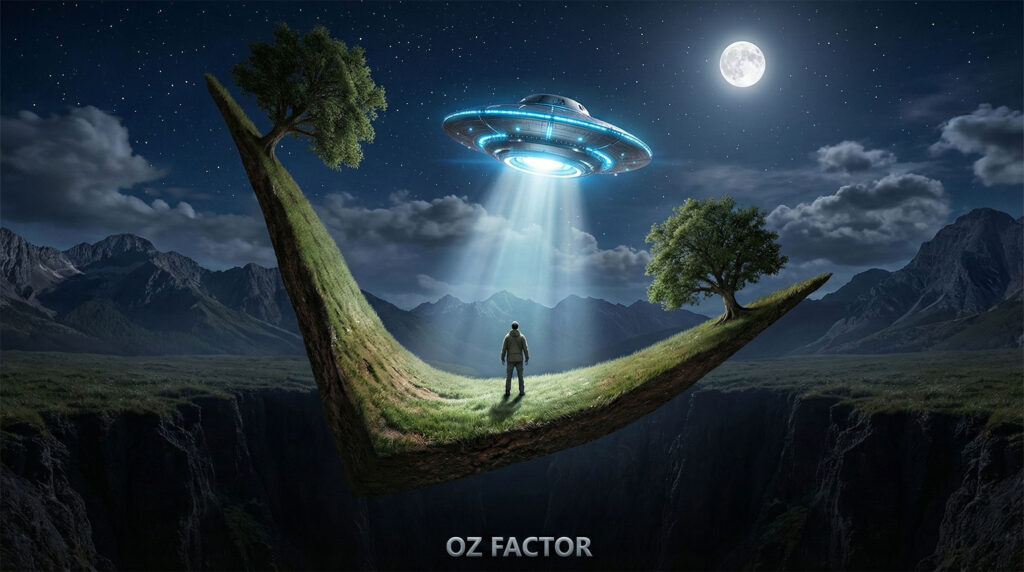
What exactly is the Oz Factor?
The term was coined in the early 1980s by British ufologist and investigator Jenny Randles. Writing in her book UFO Reality and in a 1987 BUFORA Bulletin article titled “In Search of the Oz Factor,” she noticed a recurring pattern in close UAP encounters. Witnesses often described a sensation of being cut off from ordinary reality and placed inside a slightly altered version of their surroundings. (HowStuffWorks)
The Oz Factor refers to the experience of being isolated or transported from the real world of everyday life into another environment that is quite similar to the real world but changed enough to be noticeable and disturbing. (Encyclopedia.com)
In her own essay “Understanding the Oz Factor in UFOs,” Randles lists characteristic features drawn from many cases:
- A sense of isolation or being wrapped in a “cocoon” that only the witness occupies.
- Ambient sounds fading or stopping altogether, including wind, traffic and birds.
- Time distortion, with minutes feeling like seconds or the other way around.
- A subtle “tingling” or mental foreboding just before the event.
- Strong feelings that one “had to look up” or was silently called. (Scribd)
She noticed that these episodes clustered around close encounters rather than distant lights. In a small statistical comparison she did on her case files, she found that medium definition sightings of structured objects at a distance averaged about 2.6 witnesses per case, while close encounters with physical or physiological effects averaged about 1.2 witnesses. (Scribd)
In other words, the closer and stranger the encounter, the more likely it was that only one person experienced it fully. Randles proposed that a “zone of influence” around some UAP interacts with consciousness, focusing the event on a single recipient while leaving others nearby apparently untouched. (Scribd)
Consciousness at the center
Crucially, Randles did not interpret this as proof that close encounters are “just imagination”. She argued the opposite: that the consistency of Oz Factor symptoms across unrelated witnesses is evidence that something real is happening, but that part of it operates through altered states of consciousness.
In a widely quoted summary, she writes that the Oz Factor implies a close encounter has a “visionary component” and that there is effectively a “direct feed from the source of the encounter to the consciousness of the witness.” (Scribd)
The symptom cluster: what witnesses actually report
A 2024 paper on UAP research in Germany, for example, defines the Oz Factor as:
A subjectively experienced loss of sensory or environmental activity, plus time distortions, memory lapses, strange emotions, buzzing sounds or strange smells, especially during close encounters with UAP. (ResearchGate).
Isolation and the “zone of influence”
Witnesses often feel that reality has “thinned out” around them.
- Familiar places suddenly feel emptied or depopulated, even at busy times.
- People or animals who should be present are absent, or appear frozen or oblivious.
- Follow-up canvassing often fails to locate other witnesses, even when many should have been in a position to see the anomaly. (HowStuffWorks)
Randles’ “zone of influence” concept attempts to capture this. If you are inside the zone, you get the full uncanny performance. If you are outside it, nothing unusual seems to be happening at all. (Scribd)
Altered soundscape: the great hush
A remarkably consistent feature is sudden silence.
- Background traffic noise, wind, rain, insects and birds become muted or vanish.
- Witnesses sometimes report a loud hum or buzzing that seems to replace normal ambient sound.
- The silence is often described as “dead”, “thick” or “like someone pressed mute on the world”. (Scribd)
The phenomenon is so distinctive that many non-UAP experiencers now use “Oz Factor” as informal shorthand for eerie silences in woods, mountains and alleged cryptid encounters. (Reddit)
Time distortion and missing time
Time behaves strangely inside Oz Factor episodes.
- Seconds feel like minutes or vice versa.
- Clocks and objective timings do not match subjective experience.
- In abduction narratives, there is often a hard gap of one to several hours that cannot be accounted for, commonly labelled “missing time”. (Scribd)
Randles’ own abduction monograph notes that witnesses frequently “lost all sense of time” in the early stages of an encounter, and she explicitly links this to the Oz Factor in her analysis. (Deadnet)
Emotional and cognitive shift
Witnesses describe a sharp change in mood or consciousness.
- Heightened foreboding or certainty that “something is about to happen”.
- A sudden switch into unnatural calmness or detachment in situations that should be terrifying.
- A feeling of observing a “magical void” or “dream-like place with different rules”. (Scribd)
Bodily sensations and sensory oddities
Less universal but still noted:
- Tingling in the skin, hair standing on end, sense of an electrical charge in the air.
- Strange smells, often metallic or ozone-like.
- Unusual lighting conditions, mists or hazes, sometimes described as if the world has been slightly color-graded. (ResearchGate)
Many of these elements match clinical descriptions of derealisation and depersonalisation episodes, which will become important when we look at competing explanations.
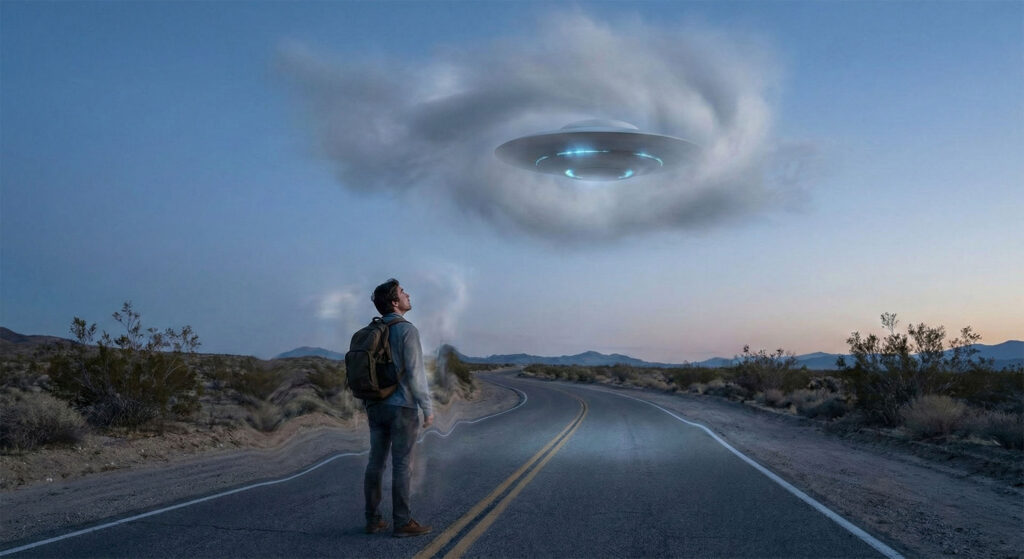
Historical and modern examples
The Oz Factor is not tied to a single famous sighting. It is a pattern that recurs across many small and medium-profile cases, often as the “atmospheric” part of a larger narrative. Here are some representative examples.
The factory worker and the silent mill
Randles’ first major Oz Factor case involved a night-shift factory security guard who reported seeing a domed, windowed object with an icy blue glow hovering next to an old mill. He watched it tilt on edge and maneuver, fully convinced he was seeing a non-human craft. (Scribd)
Yet:
- Another guard on duty, close enough that he should have seen the same thing, reported nothing at all.
- Houses with clear sightlines to the mill produced no additional witnesses despite publicity.
This pattern repeated in other close encounters in her files, including daytime events. Randles came to believe that single-witness high strangeness was a feature, not a bug, and that the Oz Factor explained why solid cases so often lacked corroboration even in populated settings. (Scribd)
Manchester, 1978 and Novato, 1989
Explanations on the Oz Factor cites two typical late-20th century cases. In one, a couple in Manchester watched a UAP hovering above a normally busy street on a late summer evening. Traffic and pedestrians, which should have been abundant, were almost completely absent. (HowStuffWorks)
In another, a father and son in Novato, California, watched a metallic, gold-colored, dumbbell shaped object accompanied by four small discs maneuver low in the sky near their home. Again, what struck them was not just the object, but the total lack of other observers at a time when neighbors would usually be out and about. (HowStuffWorks)
These are classic Oz Factor snapshots: the world subtly emptied, a focus on one family, and a lingering “this should have been seen by lots of people” frustration.
The library that emptied itself: the Rojcewicz encounter
Folklorist Peter M. Rojcewicz provided a famous non-craft example. While working on his PhD dissertation about UAP in a university library around 1980, he was approached by a strange man who grilled him about his research and then suddenly shouted that “flying saucers are the most important fact of the century” before leaving. (Encyclopedia.com)
As Rojcewicz tried to settle back to work, he realized something was badly off. The library seemed empty. No staff at the desks, no other patrons visible. He walked around in growing panic, found no one, and eventually returned to his chair. An hour later, as he left, the building appeared completely normal again. (Encyclopedia.com)
This “emptied world” and altered atmosphere are treated in Encyclopedia.com’s entry as a textbook Oz Factor vignette, attached here to what many would call a classic “men in black” style encounter.
Abduction narratives: the capture phase
The Betty and Barney Hill case in 1961 set the template for many later abduction claims. While the term Oz Factor was not yet coined, later analyses of abduction narratives identify a consistent “capture” phase that matches Randles’ description.
The article “Narrative of the abduction phenomenon” notes that abductees often report:
- Foreboding in the days or hours before the event.
- A sudden shift into altered consciousness.
- External sounds dropping out of awareness.
- Calm introspection replacing ordinary reactions.
British abduction researchers use the term Oz Factor for this stage, which marks the transition from normal activity into a state of “limited self-willed mobility” that precedes lights, mists and entity encounters.
Later high-profile abduction cases, such as the Allagash abductions in 1976 or the Travis Walton incident in 1975, feature similar reports of sudden silence, distorted time and an unreal atmosphere before and during the critical moments. Contemporary commentators frequently connect these to the Oz Factor when discussing “high strangeness” aspects of such cases. (That Would be Rad – Podcast)
Speculation label: Witness Interpretation for the non-human component of these specific abduction claims.
Beyond UAP: Bigfoot, angels, gnomes and the Oz Factor
Oz-like effects are not unique to UAP. A 2021 paper in the Journal for the Study of Religious Experience by Jack Hunter notes that the same kind of “dreamy and weirdly silent state of mind” appears in reports of:
- A UAP in the sky.
- Bigfoot in the woods.
- Gnome-like entities in gardens.
- Angels appearing in bedrooms. (RERC Journal)
Hunter quotes Randles’ later definition of the Oz Factor as a set of symptoms that creates the impression of having left the material world and entered a “dream-like place with magical rules,” and he treats it as a cross-phenomenon marker of high strangeness. (RERC Journal)
Speculation label: Hypothesis, in the sense that this cross-domain unification is a theoretical move, not an experimentally verified fact.
Data first: how modern researchers are quantifying the Oz Factor
GEP and the German “strangeness model”
One of the most concrete attempts to operationalize the Oz Factor is coming from the Gesellschaft zur Erforschung des UFO-Phänomens (GEP) in Germany. A 2024 paper on their case database describes how they are building a “strangeness model” that uses structured fields to capture qualitative oddities. (ResearchGate)
In that context, they treat the Oz Factor as a coded variable that can be evaluated statistically. Their preliminary study defines it as:
- Loss of sensory or environmental activity.
- Time distortions.
- Memory lapses.
- Strange emotions.
- Buzzing sounds or odd smells.
These are specifically logged during unexplained UAP cases, and the authors suggest, as a hypothesis, that the pattern might be explained by psychological processes such as derealisation and depersonalisation. They emphasize the need to compare unexplained cases to a large control group of identified objects (IFOs) to see whether Oz-like symptoms truly distinguish anomalous incidents. (ResearchGate)
Academic treatments in religious and cultural studies
Jack Hunter’s 2021 paper on “High Strangeness, Boggle Thresholds and Damned Data” uses the Oz Factor as part of a framework for dealing with extreme cases that challenge both beliefs and methods. He treats the stillness and silence as a prelude to the climactic encounter, and he leans on Randles’ 1988 definition that emphasizes a change of consciousness rather than simple sensory distortion. (RERC Journal)
Similarly, media and film studies work, such as Jake Edwards’ 2021 Warwick thesis, references Randles’ essay “In Search of the Oz Factor” when discussing how cinematic representations of UAP manipulate audience perception to create comparable altered-reality feeling states. (WRAP: Warwick Research Archive Portal)
These are not UAP case files, but they demonstrate that Oz Factor is now a recognized concept in scholarship on anomalous experience, not just in popular UAP lore.
Abduction research and the MIT conference legacy
By the early 1990s, abduction researchers such as Jenny Randles and Australian investigator Keith Basterfield were explicitly linking this shift in consciousness to what they saw in large samples of abduction reports, and the term was discussed in the context of the 1992 MIT conference on abductions. (Facebook)
Later overviews of abduction narratives reference the Oz Factor as standard terminology for the altered consciousness phase that precedes “capture”.
How do we explain the Oz Factor?
No single explanation commands consensus. Different communities lean in different directions, and some may all be partly true at once. Here we separate a few major lines of thought and clearly label their status.
Consciousness-centric UAP interaction
Randles herself takes the Oz Factor as strong evidence that consciousness is the focal point of certain UAP encounters. She argues that close encounters are “witness-focused incidents” in which something selectively tunes the witness’ sensory channels, which both explains the lack of independent observers and fits with modern physics’ hints that reality and observation are entangled at deep levels. (Scribd)
In this view:
- A UAP or non-human intelligence creates a bubble of altered perception for pragmatic reasons, perhaps to limit collateral exposure.
- The experience has a visionary component, but is still anchored in an external stimulus.
- Oz Factor cases are not weaker evidence than “clean” multi-witness sightings. They may instead be pointing at the core of the phenomenon. (Scribd)
This line of thinking dovetails with broader ideas in UAP studies about mind–matter interaction and the possibility that at least some UAP are deeply entangled with human consciousness.

Psychological and neurological models
The German GEP study explicitly floats the idea that Oz Factor episodes may be explained by psychological effects, especially derealisation and depersonalisation. These are well documented clinical states where reality feels “unreal”, colors or sounds seem changed, and the sense of self detaches from the body, often in response to stress or trauma. (ResearchGate)
Abduction skeptics and some clinicians have argued that:
- The build-up of anxiety before an encounter, combined with a strange stimulus such as an unusual light or noise, may trigger altered states that distort memory and time perception.
- Sleep paralysis, hypnagogic hallucinations and trauma can mix with existing UAP beliefs to produce compelling Oz-like narratives.
This does not necessarily mean “nothing happened”, but it does propose that part of what is reported in Oz Factor cases might be internally generated experience shaped by expectation and stress.
Our stance here is to treat this as a serious alternative model that must be tested against data, not a default dismissal. It is notable that Randles herself has often been critical of regression hypnosis and uncritical belief, even while defending the reality of many anomalous cases.
Electromagnetic and geophysical hypotheses
A small body of work explores whether electromagnetic fields and geomagnetic disturbances could trigger Oz-like states in witnesses.
A 2020 paper on UAP and global catastrophic risks notes that Randles’ Oz Factor could, in principle, be tied to strong geomagnetic storms or localized electric currents that affect human neurology, possibly producing paralysis, lights similar to St Elmo’s fire and other unusual perceptual effects in multiple people at once. (ResearchGate)
Other writers have suggested that fields around certain UAP could disrupt brain function, or that the “bubble” of Oz is a side effect of exotic propulsion manipulating spacetime and local EM conditions. (Reddit)
These ideas are intriguing, especially because laboratory studies show that targeted EM stimulation of specific brain regions can induce sensed presence, fear and altered perception. However, the current UAP Oz Factor data are not yet detailed enough to strongly confirm or refute such models.
High strangeness as a “control system”
Within the broader high-strangeness discourse, researchers like Jacques Vallée and later thinkers see Oz-like states as part of a “control system” that modulates how humans perceive anomalous stimuli. Hunter’s 2021 paper, along with various Fortean essays, notes that Oz Factor symptoms show up across UAP, cryptids, fairy lore and religious apparitions. (RERC Journal)
From this angle, Oz Factor is not a bug, not a malfunction, and not purely a side effect. It is part of how the phenomenon introduces novelty, shocks belief systems and perhaps gently steers cultural evolution.
This is highly speculative but has the advantage of respecting witness testimony across traditions, rather than isolating UAP as a unique modern category.
How investigators use the Oz Factor in practice
Whatever its ultimate cause, the Oz Factor has become a useful diagnostic tool in serious UAP case work.
As a marker of high-strangeness close encounters
Patterns emerging from Randles’ files and later databases suggest:
- Oz Factor symptoms correlate most strongly with close encounters that involve physical or physiological effects, rather than distant lights. (Scribd)
- These cases are disproportionately single-witness, even in populated settings.
- Witnesses often hesitate to report the “weird feelings” unless specifically asked, because they worry it will undermine their credibility. (Scribd)
For investigators, this means:
- If someone reports highly structured craft at close range but no alteration in sound, time or mood, that may be a different class of event from one with a full Oz symptom cluster.
- Adding structured questions about silence, time drift, emotional state and bodily sensations can improve the data quality of close encounter reports.
As a variable in strangeness and reliability models
GEP’s work shows how Oz Factor can be encoded as one variable among many in modern UAP databases. Combined with other observables, it may help separate:
- Misidentifications of aircraft, satellites or natural phenomena (which usually lack full Oz symptoms).
- Edge cases where witnesses describe both anomalous craft behavior and full altered reality states. (ResearchGate)
Even skeptical analysis benefits from tagging Oz-like reports, because it allows comparison between unexplained UAP and control samples of known objects, testing whether derealisation explanations are sufficient.
As a lens on witness wellbeing
Because Oz Factor experiences are often emotionally intense and disorienting, they can have lasting psychological impact. Some experiencers develop anxiety about being outdoors, intrusive memories or a sense that reality is not stable. This overlaps with other categories in UAPedia’s taxonomy such as Psychic trauma and UAP and Post-abduction psychological effects.
For therapists and researchers, acknowledging the Oz Factor as a genuine subjective experience, rather than simply “hallucination”, can be important for witness care, even if the practitioner personally favors a psychological or geophysical explanation.
Why the Oz Factor matters in UAP research
From a data-first perspective, the Oz Factor is important because it sits right at the junction of sensorless experiences, human consciousness and anomalous stimuli.
- It explains, in a structured way, why many of the best close encounter narratives are single-witness despite occurring in populated areas.
- It gives investigators a checklist of experiential variables to record, which can be compared across many cases and cultures.
- It provides a bridge between classic ufology and emerging studies of altered states, religious experience and anomalistics, where similar “dream-like, rule-shifting” episodes are documented. (RERC Journal)
For an UAP field that is finally building better data standards and sensor networks, the Oz Factor is a reminder that what happens inside the witness is an essential part of the phenomenon, not just an annoying source of noise.
Even if some portions of Oz Factor episodes ultimately prove to be psychological or geophysical in origin, the pattern itself is robust. It deserves a place alongside shapes, flight characteristics and radar returns in any full-spectrum theory of UAP.
Claims taxonomy
Verified
- The term “Oz Factor” was coined by Jenny Randles in the early 1980s and defined in UFO Reality and a 1987 BUFORA Bulletin article as a syndrome of altered reality, including isolation, stillness and time distortion, reported in some close UAP encounters. (HowStuffWorks)
- Multiple independent sources, including Encyclopedia.com, HowStuffWorks and reproduced essays, agree on the core definition and on Randles’ authorship. (Encyclopedia.com)
- Contemporary academic work in religious studies and UAP research in Germany uses the term Oz Factor with broadly consistent meaning, treating it as a recurring experiential pattern around anomalous events. (RERC Journal)
Probable
- Oz Factor-style experiences (silence, isolation, time distortion and emotional shifts) are common in close encounter and abduction narratives, and also appear in other anomalous contexts such as cryptid encounters and religious apparitions. (RERC Journal)
- These symptoms are more frequently reported in high-strangeness and close-proximity cases than in distant light sightings, based on Randles’ sample statistics and later qualitative reviews. (Scribd)
Disputed
- Interpretation of the Oz Factor as evidence that another intelligence is directly “feeding” imagery into human consciousness and selectively gating perception. (Scribd)
- Models that attribute the Oz Factor entirely to psychological processes such as derealisation, depersonalisation or sleep disturbances, without any anomalous external trigger. (ResearchGate)
- Hypotheses that connect Oz Factor episodes directly to geomagnetic storms or exotic electromagnetic fields generated by UAP, which are currently suggestive but not strongly evidenced. (ResearchGate)
Legend
- Informal use of “Oz Factor” in internet folklore for any creepy silence or “glitch in the Matrix” moment in forests or cities, even when no UAP or other anomaly is reported. These retellings often borrow the label without the structured content of Randles’ original concept. (Reddit)
Misidentification
- Individual cases that include Oz-like sensations may still be misidentified aircraft, satellites or atmospheric phenomena, especially when only a single fleeting light is reported. The Oz Factor description does not automatically guarantee that a case involves a non-prosaic UAP.
Hoax
- There is currently no evidence that the Oz Factor concept itself was created as a deliberate hoax. As with any experiential category, specific stories that invoke it can be fabricated, but the broader pattern appears across too many independent testimonies to be easily dismissed as a single invention.
References
Randles, J. (1983). UFO Reality. London: Robert Hale.
Randles, J. (1987). In search of the Oz Factor. BUFORA Bulletin, 26, 17–18. (Internet Archive)
Randles, J. (1988). Abduction: Over 200 documented UFO kidnappings exhaustively investigated. London: Robert Hale. (Amazon)
Randles, J. (2004). An essay on the Oz Factor and the strange sensations of altered reality reported by UFO witnesses. MUFON UFO Journal, 434, 18–19. (Scribd)
Ammon, D., Günter, T. A., Kramer, A., & Peiniger, H. W. (2024). UAP research in Germany: Single case studies, data management, understanding of “strangeness”. Journal for UFO Studies / GEP, preprint via ResearchGate. (ResearchGate)
Hunter, J. (2021). High strangeness, boggle thresholds and damned data in extraordinary experiences. Journal for the Study of Religious Experience, 7(1), 5–18. (RERC Journal)
Encyclopedia.com. (2025). Oz Factor. In Encyclopedia of Occultism and Parapsychology. (Encyclopedia.com)
Editors of Publications International, Ltd. (2024). The Oz Factor. HowStuffWorks. (HowStuffWorks)
Wikipedia contributors. (2025). Narrative of the abduction phenomenon. Wikipedia. (Wikipedia)
Wikipedia contributors. (2025). Jenny Randles. Wikipedia. (Wikipedia)
Alien Jigsaw. (n.d.). Essay on the Oz Factor and the strange sensations of altered reality reported by UFO witnesses (hosted article). (Reddit)
SEO keywords
Oz Factor and UAP, Jenny Randles Oz Factor, UAP close encounter consciousness, high strangeness silence effect, missing time Oz Factor, UAP altered reality bubble, derealisation depersonalisation UAP, German UAP research strangeness model, Jack Hunter high strangeness, BUFORA Oz Factor Randles, alien abduction consciousness shift, UAP witness psychological effects