Before Roswell became a festival, a museum, a police-patch motif, or a permanent shorthand for UAP secrecy, it was a family memory. In Alan Steinfeld‘s interview with Jesse Marcel Jr., he recalls being awakened as a boy while his father, Major Jesse Marcel, spread strange debris across the kitchen floor. Marcel Jr. described foil-like material, small I-beams, dark plastic-like fragments, and purple-violet geometric symbols. Those recollections closely track the 1991 affidavit later quoted in the Air Force’s own Roswell report, which means the Marcel family memory is not merely folklore floating outside the record. It is inside the argument itself. (UAPedia)
That is the best place to begin an authoritative account of Roswell, because the case has always been several different things at once. It is, first, a documented 1947 recovery of debris from a ranch near Roswell. It is, second, a public-information disaster in which the Army Air Forces briefly said it had a “flying saucer,” then reversed itself within a day. It is, third, a later witness-driven expansion of the story into multiple debris fields, bodies, transport routes, hospital scenes, and long-term secrecy. And it is, finally, a civic and cultural engine that turned one week in July 1947 into an enduring American mythscape. The evidence for these layers is not equal. Some of it is contemporaneous and hard. Some is late, vivid, and sincere, but much harder to verify. Any serious treatment has to separate those layers instead of blending them into one seamless tale. (GAO)
Roswell also mattered because of where it happened. Roswell Army Air Field housed the 509th Bomb Group, which the Air Force later acknowledged was the only military unit in the world at the time with access to nuclear weapons. In the summer of 1947, that made Roswell more than a remote New Mexico posting. It sat at the edge of the Cold War, in a moment when “flying disc” reports were already multiplying and when the United States had every reason to be sensitive about anything strange in the skies. Roswell’s importance was therefore never just local geography. It was strategic geography. (ESD)
Timeline at a glance
June 14, 1947: W. W. “Mac” Brazel later said he found a wide scatter of bright wreckage on the Foster ranch he managed, while out with his son Vernon. The Foster Ranch, where Mac Brazel discovered the debris in 1947, is located roughly 75 miles northwest of Roswell, New Mexico, in Lincoln County. It is much closer to the small town of Corona than to Roswell itself.
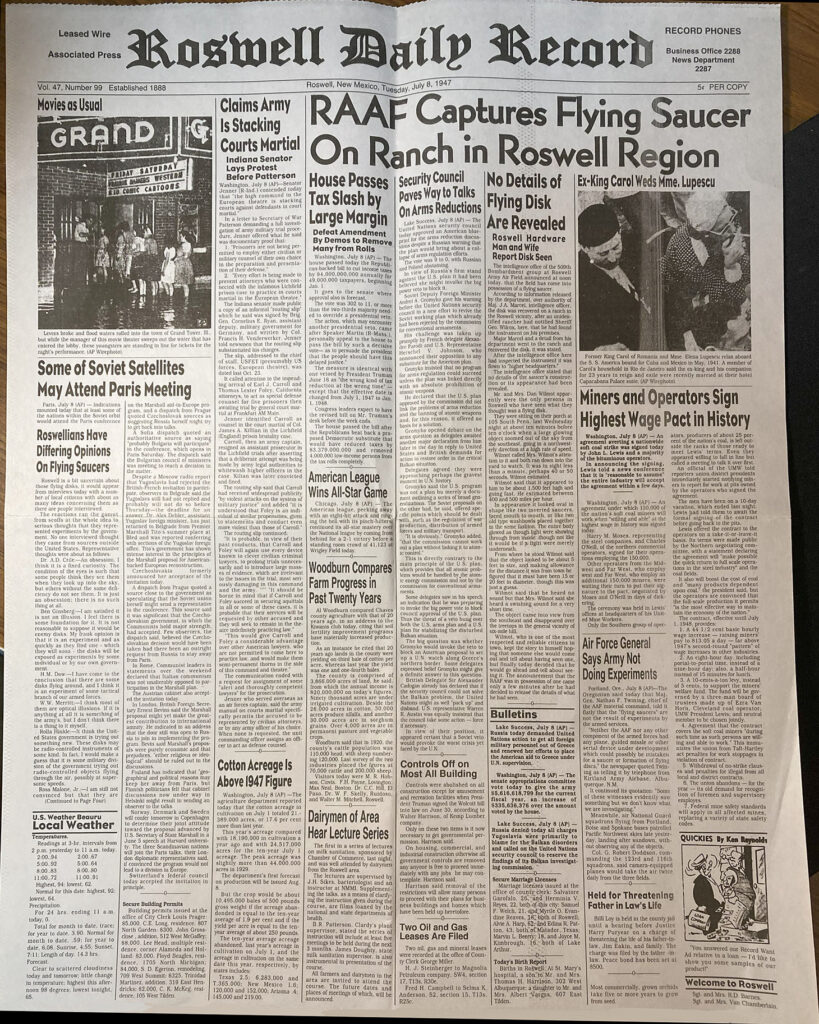
July 2, 1947: Dan and Inez Wilmot of Roswell reported seeing a glowing, oval object moving fast over town, a sighting published in the July 8 Roswell Daily Record.
July 4, 1947: Brazel returned to the site with family members and collected some of the debris.
July 7, 1947: Brazel quietly informed Sheriff George Wilcox. Major Jesse Marcel and a man in plain clothes, later identified in witness accounts as CIC officer Sheridan Cavitt, went with him to recover material.
July 8, 1947: The Roswell Army Air Field public information office announced that the field had come into possession of a “flying saucer.” That same day, an FBI Dallas teletype relayed an Eighth Air Force description of an object hung from a balloon and being sent to Wright Field for examination.
July 9, 1947: Brig. Gen. Roger Ramey’s office in Fort Worth announced the material was a balloon and radar target, not a disc. Brazel then gave the now-famous “Harassed Rancher” interview describing foil, paper, sticks, tape, and eyelets, while also insisting it did not resemble the weather balloons he already knew.
1978 to 1980: Stanton Friedman interviewed Jesse Marcel Sr., Roswell reentered public debate, and The Roswell Incident helped transform the case from a forgotten newspaper oddity into the central UAP crash narrative in American culture.
1994 and 1997: The Air Force issued its Roswell reports, first tying the debris to Project Mogul and later arguing that body stories were largely conflations with dummy drops and later accidents.
2024: AARO’s historical report again endorsed the Project Mogul explanation, and on the same day AP reported that Roswell police unveiled alien-themed patches, an almost perfect symbol of how unresolved history and local identity now coexist.
Key Locations
The Debris Field: This is the primary site where Brazel found the scattered wreckage. It is situated on what was the J.B. Foster Ranch (Daily Roswell Record).
The “Skip” Site: Some researchers point to a second location, often called the “skip site,” where the craft supposedly touched down before the final crash. The Bureau of Land Management (BLM) provides directions to this area on public land. (see map below)
The incident story
The Roswell event did not begin with a press release. It began as ranch debris. In his July 9 interview, Brazel said he first encountered the material on June 14, while making rounds on the J. B. Foster ranch. He described a large area of bright wreckage made up of rubber strips, tinfoil, tough paper, and sticks. At first he paid little attention. Only after hearing public talk of flying discs did he wonder whether what he had seen might matter. On July 4 he went back with family members and gathered up part of the material, then on July 7 he finally went to Sheriff Wilcox. That slow progression is one of the most important features of the case. The first actor in Roswell was not an intelligence officer, a politician, or a sensationalist. It was a working rancher trying to decide whether odd debris on the range was worth the trouble. (US Air Force Report)
From there the story accelerated. The July 8 Roswell Daily Record article is still explosive to read because of its plainness. The intelligence office at the 509th, the paper said, had announced that the field had come into possession of a flying saucer. The article said the material had been recovered from a ranch after a local rancher alerted Sheriff Wilcox, that Marcel and a detail recovered it, and that it was sent to “higher headquarters.” The article did not present a theory. It presented an Army claim. That distinction is one reason Roswell never really died. The case did not originate with a civilian insisting he saw something impossible. It originated with the U.S. military publicly saying it had possession of something extraordinary.
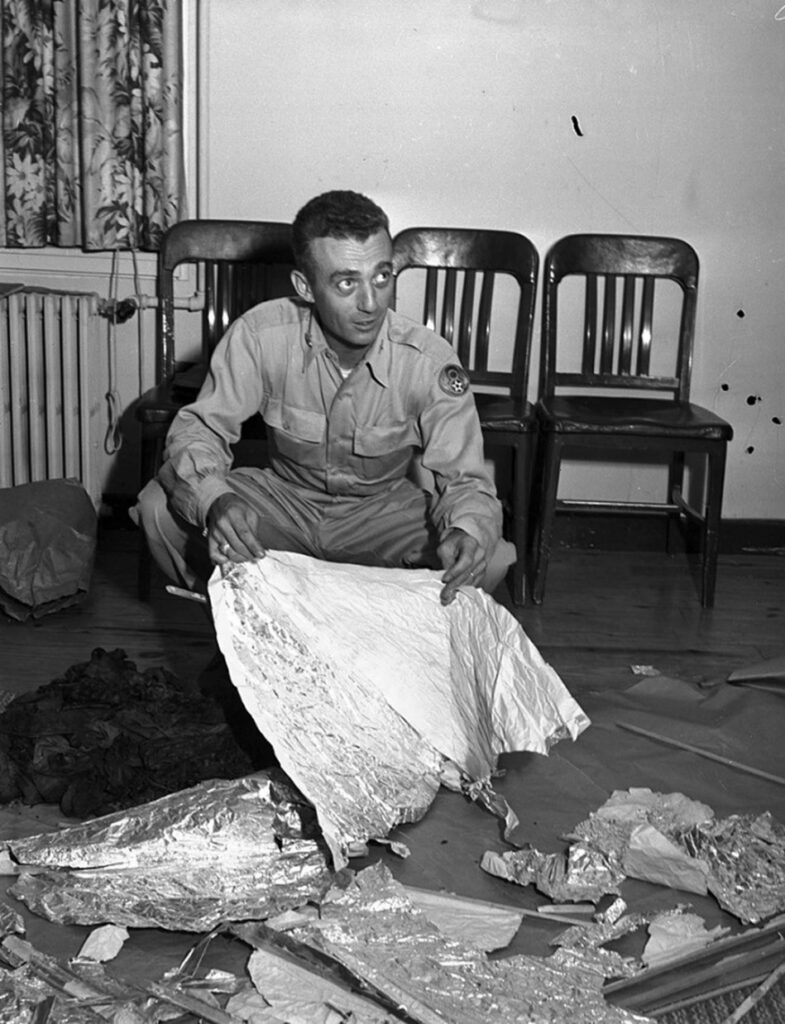
(Photo By Erin Thompson | Fort Worth Star-Telegram)
The same newspaper issue also carried the Wilmot sighting. Dan and Inez Wilmot told the Record that they had watched a glowing, fast-moving object – which they estimated travelled at 500 miles per hour – on the night of July 2. Dan Wilmot described it as like two inverted saucers faced mouth-to-mouth, glowing from within, silent except for a brief swishing sound his wife thought she heard. This does not prove the object Brazel found was the same thing. It does matter, however, because it shows that Roswell’s own local sky story existed alongside the debris story from the start. Roswell was not only about scraps on the ground. It was also about something seen over town before the press release went out.
Then comes the FBI teletype, one of the most important documents in the entire case. The July 8 memo, found later by GAO and authenticated by the FBI, stated that the military reported recovery near Roswell of a hexagonal-shaped object suspended from a balloon by cable, resembling a high-altitude weather balloon with a radar reflector, and that it was being sent to Wright Field for examination. That memo is significant for two reasons. First, it confirms that federal authorities took the recovery seriously enough to relay it immediately. Second, it already frames the object in balloon terms while also preserving enough odd detail to keep people arguing about what, exactly, was recovered and how it was described in the first frantic hours. (FBI)
By July 9 the public story had shifted. General Ramey’s Fort Worth office said the material was not a disc at all, but debris from a balloon and radar target. Photographs taken in Fort Worth showed Marcel crouched beside balloon-like wreckage. To some observers that should have settled the case. In practice it did the opposite, because Roswell’s defining pattern was now set: a dramatic military acknowledgment, followed by rapid deflation, followed by lasting suspicion about which statement had been true. Even if one accepts the balloon explanation, the communication sequence itself is historically astonishing. Governments are not supposed to authenticate wonders at noon and normalize them by breakfast the next day. (GAO)
Strategic Corridor Between Atomic Power and Rocket Power
Roswell’s location was not merely nuclear. It was corridor strategic.
The Foster Ranch debris field lies roughly between two of the most sensitive military installations in the world in 1947: the 509th Bomb Group at Roswell Army Air Field and White Sands Proving Ground, where captured V-2 rockets were being tested and where the United States was actively developing guided missile capability.
This geographic fact reframes the event.
The 509th represented atomic delivery.
White Sands represented ballistic evolution.
In the summer of 1947, the United States stood at the convergence of nuclear weaponization and long-range missile experimentation. If one were mapping the emergence of planetary-scale military capability, this corridor would glow.
Across later decades, UAP incidents repeatedly cluster near nuclear storage facilities, missile ranges, and strategic weapons systems. Roswell may represent the earliest alleged crash retrieval within that pattern.
The debris field did not lie in an empty desert. It lay between the atomic bomb and the rocket.
What the locals actually said
Brazel remains the most important civilian witness because he spoke closest to the event. His interview is often cited selectively, but read straight through it cuts both ways. On one side, his description sounds prosaic: tinfoil, paper, sticks, rubber, tape, and eyelets. On the other, he told the Record that he had found two weather observation balloons before and that this material did not resemble either of them. He also said Marcel and the plainclothes man tried and failed to reconstruct the thing. That combination is the heart of Roswell. It looks ordinary until it doesn’t. It sounds explainable until the witness reminds you that he was not new to ranch-country debris. (US Air Force Report)
Loretta Proctor, a neighbor of Brazel, is another valuable local voice because her recollections echo part of the Marcel family description without depending on the Marcels themselves. In affidavits quoted by the Air Force report, Proctor said Brazel showed her and her husband a brown, plastic-like piece and described other material as flexible, foil-like, and marked with purple printing. Bessie Brazel Schreiber, Brazel’s daughter, likewise remembered foil-rubber material, stick-like pieces, and faint floral or pastel markings on tape. None of this proves a nonhuman craft. It does show that more than one local memory retained the combination of foil-like material, unusual toughness, and purple or decorative markings. (ESD)
The Marcel family testimony is more consequential still because it comes from the intelligence officer sent to the ranch. In the interview, Jesse Marcel Jr. says his father stopped at the family home on the way back from the field, woke his wife and son, and laid out representative pieces of debris on the kitchen floor. He remembered no electronics, no wires, and no ordinary machinery. Instead, he recalled foil-like material, black plastic-like fragments, and small I-beams carrying violet geometric symbols. He also said his father returned from Fort Worth and instructed the family never to discuss the matter again. Crucially, Marcel Jr. flatly says the famous debris on Ramey’s floor was not what he saw that night at home. (UAPedia)
The Materials Question
The Roswell debate often collapses into a binary choice: flying disc or balloon. That framing obscures a more technical question that deserves isolation.
What were the material properties described?
Across Brazel, the Proctors, Bessie Schreiber, and the Marcel family affidavits, several consistent characteristics emerge:
-
- Extremely lightweight metallic foil,
- Resistance to tearing,
- Memory-retentive deformation with no visible creases,
- Thin I-beam structures,
- Violet geometric markings, and
- Absence of visible fasteners or conventional structural joins.
Project Mogul radar targets used balsa wood, foil-backed paper, rubber balloon material, and adhesive tape. Those materials existed in 1947. What remains debated is whether they account for the described elasticity and structural integrity.
Shape-memory alloys were not formally identified until over a decade later. No publicly documented 1947 radar target materials exhibit persistent deformation recovery after creasing.
If the Roswell debris was Mogul equipment, then the materials were either:
-
- Misperceived under stress,
- Later misremembered, or
- More advanced than typical radar reflectors.
An authoritative analysis requires not dismissal, but side-by-side material comparison grounded in 1947 manufacturing capability.
That testimony matters even more because the Air Force’s own 1994 report reproduces Marcel Jr.’s 1991 affidavit almost point for point. The report quotes him describing three categories of debris: thick foil-like metallic material, brittle brownish-black plastic-like material “like Bakelite,” and I-beam fragments with purple-violet writing resembling hieroglyphic-style geometric symbols. In other words, the official Roswell report did not make the Marcel family memory disappear. It had to incorporate it, then argue that the same descriptive cluster could fit specialized balloon and radar-target equipment. Roswell’s persistence lies partly in that exact tension. (ESD)
This is also where one of Roswell’s deepest contradictions appears. The 1994 Air Force photo review concluded that the same debris appeared in the Fort Worth photographs of Marcel and Ramey, which undercuts later substitution claims. Yet Marcel Jr. continued to insist that the material on Ramey’s floor was not what his father had brought into the house. An authoritative account has to resist the temptation to flatten that conflict. The official photo analysis exists. So does the Marcel family rejection of it. Roswell is not authoritative because one side vanishes. It is authoritative because the dispute can be stated clearly with named sources on both sides. (ESD)
The body story, and why it must be handled carefully
The most famous Roswell claim today is not about debris. It is about bodies. But that is not where the strongest record lies. The 1947 documentation is a debris story. The body narrative enters forcefully much later, and chiefly through the recollections of mortician W. Glenn Dennis. In interviews later preserved in National Archives holdings, Dennis said the base called him about child-sized caskets and preservation procedures for bodies exposed to the elements. He said he later saw strange wreckage in military ambulances at the Roswell hospital, encountered a disturbed nurse, and was told of three small badly damaged bodies being examined. Those claims transformed Roswell from an ambiguous recovery into a full crash-retrieval narrative.
But this part of the case is also the most fragile. Dennis first surfaced publicly decades after 1947. Parts of his story were secondhand even in his own telling, especially the nurse’s alleged account. The 1997 Air Force report examined his claims in depth and argued that the dates, personnel, and hospital circumstances did not line up with July 1947. It said no nurse or other person was reassigned on July 8 or 9, that the Roswell nurse corps that month consisted of only five nurses, and that no nurse by the name Dennis gave, Naomi Maria Selff, could be verified. The same report proposed that some details Dennis recalled fit later events, especially the 1956 KC-97 crash and later high-altitude dummy and balloon operations, better than they fit July 1947.
That does not mean Dennis invented his account. It means the evidentiary status of his account is disputed and unstable. Even the 1997 report’s own language is worth noticing here. It did not claim to have proven deliberate deceit. It argued that the witness made serious errors and likely conflated events by as much as 12 years. That is a very different judgment, and it matters because Roswell has too often been narrated as a battlefield between saints and frauds. Serious historical work is harder than that. A witness can be important, sincere, wrong in part, right in part, and still central to understanding how a case evolved. (US Air Force Report)
It is also important that Jesse Marcel Jr., whose testimony is often used by advocates of an expanded Roswell narrative, explicitly said he had no firsthand knowledge of bodies. In the UAPedia interview, he said his father was associated with the debris field, not with any alleged second site, and that if bodies existed his father did not tell him so from personal knowledge. That narrows the strongest Marcel-family testimony to debris, symbols, unusual materials, and the family order to remain silent. It does not extend cleanly to bodies. An authoritative article should say that plainly. (UAPedia)
Public repercussions, then and now
Roswell’s first public repercussion was immediate disorientation. Brazel became “the harassed rancher.” The Army’s acknowledgment created a sensation; the reversal created distrust. In that sense Roswell prefigured decades of UAP controversy in miniature. A local event became national not because evidence was abundant, but because official messaging became contradictory almost instantly. The public was left with a choice that felt impossible even in 1947: believe the original announcement or believe the correction that followed it with suspicious speed. (US Air Force Report)
Then Roswell largely went quiet. The Air Force’s 1994 report notes that the incident was not treated as one of the great 1947 disc cases in the modern sense until the 1978 to 1980 period. Jesse Marcel Jr. told UAPedia much the same thing from the family side: Stanton Friedman found his father in 1978, interviewed him, and effectively reopened the whole matter. That delayed ignition is one of the strangest things about Roswell. The event is famous for its endurance, but its endurance is really split in two. There was the 1947 shock, then a long trough, then the late twentieth-century Roswell boom that turned the case into a publishing phenomenon, a television staple, and the benchmark crash-retrieval story in UAP history. (ESD)
The city itself eventually adapted, then embraced. AP reported in 2024 that Roswell had become a magnet for people fascinated by extraterrestrial phenomena, with thousands visiting the International UFO Museum and Research Center and attending the annual festival. The official festival site says the event has attracted thousands since 1996 and continues to market Roswell as a destination, with the 2026 festival already being promoted. That modern civic afterlife does not prove anything about 1947. It does prove something about Roswell’s public repercussions. The case is no longer just an unresolved archive. It is infrastructure, iconography, retail, performance, and local identity. (AP News)
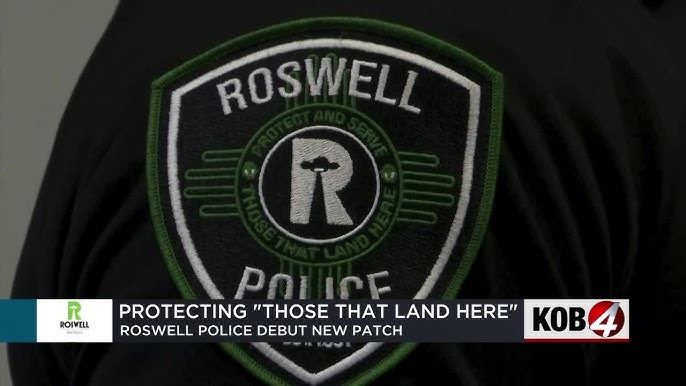
The police patch story captures this better than almost anything else. In March 2024, Roswell police unveiled new uniform patches featuring a flying saucer and alien faces, with the motto “Protect and Serve Those That Land Here.” AP noted that the patch appeared the same day AARO released its historical report dismissing extraterrestrial conclusions. That juxtaposition is almost perfect Roswell. Federal review says one thing. Local memory economy says another. The two now coexist without canceling each other. Roswell has become a place where official closure and cultural openness occupy the same block. (AP News)
The official explanations, and why they do not end the argument
The most serious official explanation is not the simple “weather balloon” line repeated in popular shorthand. It is Project Mogul. In the mid-1990s the Air Force argued that the debris near Roswell was most likely from a then-classified balloon train designed to help detect Soviet nuclear tests. According to the report, some early radar targets used with those balloon trains were made of foil or foil-backed paper, balsa wood beams, glue, tape, eyelets, twine, and, crucially, purplish-pink tape with symbols from novelty-manufactured components. Neoprene balloon material, exposed to sun, could degrade into dark, ash-like fragments. On paper, this is a powerful explanation because it speaks directly to several witness details that otherwise seem exotic: foil-like material, brown or blackened fragments, wooden beam-like pieces, and purple symbols or floral markings. (ESD)
The report went further. It argued that there was no preplanned public cover story, and that the public identification as a weather balloon likely reflected the fact that classified Mogul balloon trains were not physically different, in their basic components, from more ordinary balloon devices familiar to weather personnel. It also noted that members of the 509th, despite their elite status, were not read into Mogul. That is a crucial point. If one accepts the Mogul theory, then it is entirely possible that people at Roswell handled unfamiliar classified debris sincerely, reacted too quickly, and then watched a mundane public explanation replace their confusion. Roswell under that interpretation is still dramatic. It is just dramatic in Cold War terms rather than off-world terms. (ESD)
And yet the official explanation does not erase the case. It explains a great deal, but not the entire psychological structure of Roswell. The GAO report found that some Roswell Army Air Field administrative records and outgoing messages had been destroyed, and that the disposition paperwork did not indicate who destroyed them, when, or under what authority. GAO also found only two surviving 1947 records directly tied to the event: the July unit history and the July 8 FBI teletype. That is not proof of something extraordinary. It is, however, enough archival damage to keep suspicion alive, especially in a case built on rapid contradiction and later testimony. Roswell feels unresolved partly because the documentary record is both real and thin. (GAO)
AARO’s 2024 historical report did not materially change the official position. It reaffirmed that Air Force research found no indication Roswell was a UAP event or that the government recovered aliens or extraterrestrial material, and it restated the body explanation in terms of test dummies and later accident conflation. That continuity matters. It shows that the official line has stabilized rather than drifted. The government is not wandering among explanations now. It is repeating, with modern institutional branding, the same broad conclusion reached in the 1990s. For critics of the official account, that looks like repetition without resolution. For defenders of the official account, it looks like consistency. Either way, Roswell remains a live dispute because consistent official answers do not automatically dissolve contradictory witness memory, especially when some of that memory is tied to people directly involved in the first recovery. (U.S. Department of War)
The fairest conclusion is that Roswell contains one strong documentary spine and several weaker but consequential narrative branches. The spine is this: debris was recovered; the Army briefly called it a flying saucer; the explanation shifted to balloon/radar-target material; federal paperwork confirms the seriousness of the immediate response; and later government reviews linked the debris to Project Mogul. The branches include claims of substituted debris, second sites, bodies, hospital autopsies, and long-term secrecy. Some of those branches are supported by named witnesses. Some are late and partly secondhand. Some are contradicted by surviving records. The mistake is to pretend Roswell is either a solved footnote or a single perfectly coherent crash narrative. It is neither. (GAO)
Recent mentions and why Roswell still matters
Roswell persists because it keeps being reactivated by institutions that do not agree with one another. AARO revisited it in 2024. The National Archives continues to surface Roswell report materials and witness interviews, including Glenn Dennis, in accessible archival collections.
Since 2024, Roswell has been reintroduced into the modern disclosure debate by a new generation of insiders and whistleblowers. Luis Elizondo has publicly linked government possession of non-human technology and biological remains to the long historical arc that begins with Roswell. Eric W. Davis has gone further, calling Roswell real and describing it as the recovery of a craft of unknown, non-human origin. David Grusch did not publicly name Roswell in his July 2023 congressional opening statement, but his sworn testimony describing a hidden, multi-decade crash-retrieval and reverse-engineering program unmistakably revived interest in Roswell as the foundational U.S. recovery case. These interventions did not resolve the historical dispute, but they did restore Roswell to the foreground of contemporary UAP debate. (The Times)
Each of those is a different kind of “recent mention”: whistleblower’s testimony, bureaucratic, archival, and civic. Together they show that Roswell is not merely remembered. It is continuously reprocessed. (U.S. Department of War)
This is why Roswell remains the central UAP crash case in modern American history. Not because every claim made about it is equally strong. Not because the body stories are documented like the debris stories. And not because official denials automatically prove the opposite. Roswell endures because the case began with something undeniably real: an actual recovery, an actual Army statement, an actual reversal, and an actual trail of records, however incomplete. Around that hard core, memory, secrecy, misunderstanding, classification, local identity, and postwar anxiety built a much larger structure. The result is not a solved puzzle. It is a layered historical object. (GAO)
If one strips Roswell down to its essentials, the case says less than enthusiasts sometimes want and more than skeptics sometimes allow. It does not give us a clean, proven chain from ranch debris to nonhuman craft. But it does give us something rare and durable: a moment when official language, witness memory, and missing records collided in public, and never fully disentangled. That is why Roswell still deserves long-form investigation. The case is not powerful because it is simple. It is powerful because it is messy in exactly the way real history is messy. (GAO)
Claims taxonomy
Verified
- A debris recovery occurred on the Brazel/Foster ranch;
- Roswell Army Air Field publicly announced possession of a “flying saucer” on July 8, 1947; the explanation was reversed within a day;
- an FBI teletype documented the recovery in balloon-related terms and transfer for examination;
- Multiple local witnesses described unusual debris with foil-like, lightweight, and resilient properties;
- The case continues to be referenced in official reviews, including All-domain Anomaly Resolution Office (2024).
Probable
- The debris recovered is consistent with components described in Project Mogul (foil, balsa-like beams, tape with markings).
- Some witness descriptions (especially Brazel and Proctor family) align with classified balloon-radar target materials.
Disputed
- Whether all recovered debris shown publicly (Fort Worth photos) matches the original ranch material.
- Whether there were additional debris fields or recovery sites beyond Brazel’s ranch.
- Whether non-human bodies were recovered.
- Whether Roswell represents the first instance of a long-running U.S. crash-retrieval program.
- Modern insider testimony (Elizondo, Davis, Grusch) asserting non-human origin of Roswell-related materials, without publicly released primary evidence.
Legend
- Later fully elaborated Roswell narratives that present every witness thread as part of one seamless crash-retrieval operation go beyond what the contemporary 1947 record can sustain. They remain culturally important, but not equally evidentiary.
Misidentification
- The 1997 Air Force report and the 2024 AARO review argue that some body-recovery accounts likely reflect conflation with anthropomorphic dummy programs and later military accidents, especially the 1956 KC-97 crash and 1950s balloon operations.
Speculation labels
Hypothesis
The Brazel debris field was only one part of a larger event, with a second impact or recovery site elsewhere. This idea appears in later witness and researcher literature and is echoed cautiously by Jesse Marcel Jr. as a possibility, but it is not established by contemporary documentation. (UAPedia)
Witness Interpretation
Brazel interpreted the debris as unlike the weather balloons he already knew. Dan and Inez Wilmot interpreted what they saw as a disc-like object. Jesse Marcel Sr., through his son’s account, appears to have interpreted the debris as parts of a craft not made by conventional means. These are witness interpretations, not self-proving conclusions. (US Air Force Report)
Researcher Opinion
The Project Mogul explanation best fits the strongest surviving documentation, but it does not erase why Roswell still feels unresolved: destroyed records, an early Army misstatement, and tens of persistent firsthand and secondhand testimony from named participants and locals. That is an inference from the total record, not a single-source fact. (GAO, NARA)
Roswell remains unresolved due to a structural gap:
- Strong early event evidence;
- Weak or missing chain-of-custody documentation;
- Conflicting official explanations;
- Government insistence in several new reports (1994, 1995, 1997 and 2024); and
- Reinforcing but non-verifiable insider testimony.
Despite its later prominence, the Roswell incident was not formally catalogued or investigated as a case within Project Sign, Project Grudge, or Project Blue Book. This absence is notable given Blue Book’s extensive database of over 12,000 UAP reports. The omission suggests that Roswell was either administratively resolved early, handled outside standard UAP investigative channels, or classified within a different compartment of military intelligence.
References
Associated Press. (2024, March 8). Roswell police have new patches that are out of this world, with flying saucers and alien faces. (AP News)
Federal Bureau of Investigation. (1947, July 8). Dallas teletype regarding recovered disc near Roswell. (FBI)
McAndrew, J. (1997). The Roswell Report: Case Closed. U.S. Air Force. (US Air Force Report)
National Archives and Records Administration. (2014, July 7). The Roswell Reports: What crashed in the desert? (The Unwritten Record)
Roswell Daily Record. (1947, July 8). RAAF Captures Flying Saucer On Ranch in Roswell Region. (Wikimedia)
Roswell Daily Record. (1947, July 9). Harassed Rancher who Located “Saucer” Sorry He Told About It. (US Air Force Report)
U.S. Department of Defense, All-domain Anomaly Resolution Office. (2024). AARO historical record report, Volume 1. (U.S. Department of War)
Grusch, D. C. (2023, July 26). Opening statement before the House Committee on Oversight and Accountability hearing on unidentified anomalous phenomena. U.S. House of Representatives. (Oversight Committee)
Ensor, J. (2024, August 20). Pentagon UAP expert says secret group has “non-human material.” The Times. (The Times)
Daily Star. (2025, February 3). UFO whistleblower insists Roswell is “100 per cent” real. (Daily Star)
National Archives. (2025, April 24). Records related to unidentified flying objects (UFOs) and unidentified anomalous phenomena (UAPs) at the National Archives. (NARA)
The Unwritten Record. (2014, July 7). The Roswell Reports: What crashed in the desert? National Archives. (NARA)
(The Unwritten Record)U.S. Department of the Air Force. (1994). Report of Air Force Research Regarding the “Roswell Incident”. (ESD)
U.S. General Accounting Office. (1995). Government records: Results of a search for records concerning the 1947 crash near Roswell, New Mexico (GAO/NSIAD-95-187). (GAO)
UAPedia. (2008/2025). Jesse Marcel Jr: the Child with the Roswell Secrets. (UAPedia)
SEO keywords
Roswell Incident, Roswell UAP, Roswell UFO, Jesse Marcel Jr, Jesse Marcel Sr, Mac Brazel, Project Mogul, Roswell timeline, Roswell witness testimony, Roswell Daily Record, Glenn Dennis, Wright Field, Roswell Army Air Field, 509th Bomb Group, Roswell debris, Roswell crash investigation