
Introduction: The Concept of Deep-Time Civilizations
What would remain of an advanced civilization after 100 million years?
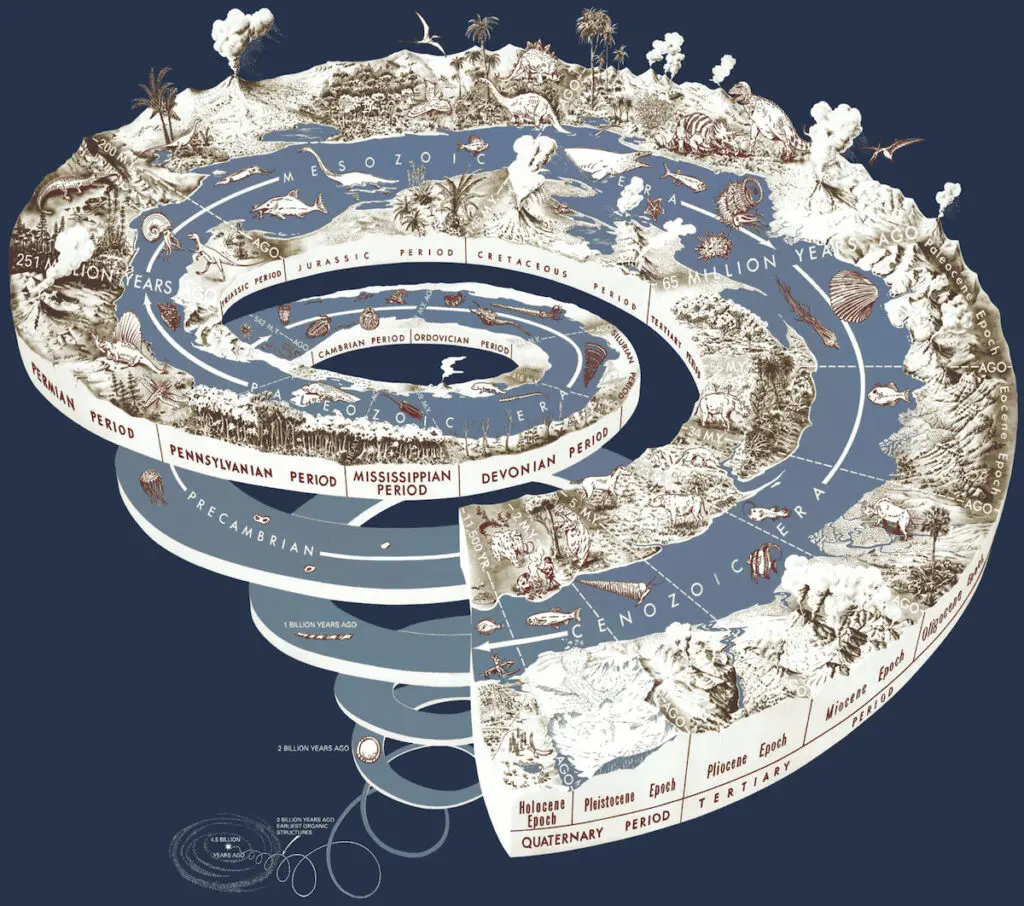
Not after a war, not after a flood, not after the collapse of cities into vines and dust, but after the slow violence of geology. Continents drift. Oceans open and close. Mountain ranges rise, grind themselves down, and are folded into new rock. Seafloors are born at ridges and consumed at trenches. Rivers sort bones, bricks, and machines into sediment. Time does not merely bury the past. Given enough of it, time edits.
That is the core provocation of the Silurian Hypothesis, a scientific thought experiment introduced by climatologist Gavin A. Schmidt and astrophysicist Adam Frank in their 2018 paper, “The Silurian hypothesis: would it be possible to detect an industrial civilization in the geological record?” The question is not “did an industrial civilization exist before humanity?” The tighter and more useful question is this: “If one had existed millions of years ago, could we detect it today?” Schmidt and Frank framed the issue through astrobiology, climate science, and stratigraphy, asking what kind of evidence an industrial civilization would leave once its buildings, machines, roads, ports, and satellites had been erased or transformed by deep time. (Cambridge University Press)
The name is a cultural joke with serious consequences. “Silurian” nods to the reptilian beings from the 1970 Doctor Who serial “Doctor Who and the Silurians.” Schmidt and Frank explicitly clarified that they were not arguing for intelligent reptiles in the Silurian geological period, nor for buried nuclear reactors awakening ancient beings. The name works because it gives readers a handle. It turns a difficult scientific question into an image: an earlier intelligence, perhaps native to Earth, now almost completely lost to the rock record. (CUP)
The power of the hypothesis is that it reverses the usual direction of speculation. Instead of asking whether advanced non-human intelligence might come from another star, it asks whether intelligence could have arisen, disappeared, transformed, or hidden within Earth’s own long history. For UAP studies, this matters because some UAP frameworks already consider alternatives to a simple extraterrestrial model: ultraterrestrial, cryptoterrestrial, time-displaced, autonomous probe, post-biological, or sequestered intelligence hypotheses. These are not equivalent claims, and they do not all carry the same evidentiary weight. But the Silurian Hypothesis gives the discussion a disciplined geological test: if a previous technical culture existed here, where would the evidence be, and what form would it take?
Three themes dominate the inquiry.
The first is detectability. A civilization is not the same thing as a fossil. Bones, shells, pollen, ash beds, isotope ratios, plastics, radioactive elements, and unusual mineral concentrations are all stored differently. A city is spectacular to a human observer, but fragile to geology. A carbon isotope excursion may be invisible to the naked eye, yet survive as a planetary-scale signature.
The second is deep time. Human history is almost useless as an intuitive measuring stick. The entire span from the pyramids to nuclear power is geologically microscopic. Even the roughly 300 years of modern industrial activity are a blink within the roughly 400 million years since complex life became established on land. Schmidt and Frank defined an industrial civilization, for purposes of the thought experiment, as one capable of harnessing external energy sources at global scales, and they noted how brief humanity’s industrial phase has been relative to the age of terrestrial life. (Cambridge University Press)
The third is the Anthropocene mirror. Humanity is now creating a detectable planetary layer: altered carbon and nitrogen cycles, plastics, industrial metals, radionuclides, mass extinction pressures, and climate change. Whether the Anthropocene is formally ratified as a geological epoch is a separate issue. In 2024, the International Commission on Stratigraphy and the International Union of Geological Sciences rejected the Anthropocene as a formal unit of the Geological Time Scale, while still recognizing “Anthropocene” as a valuable descriptor of human planetary impact. (Stratigraphy)
That distinction is useful. The Silurian Hypothesis does not need the Anthropocene to be a formal epoch. It needs the Anthropocene to be a laboratory. We are watching, in real time, how a technological species writes itself into stone.
The Geological Clock: Why We Do Not See “Ruins”
The popular imagination wants ruins. It wants a city under Antarctica, a machine beneath basalt, a subway tunnel fossilized into shale. But the deeper the time horizon, the less likely conventional ruins become.
Schmidt and Frank emphasized that the geological record is sharply uneven. Evidence from the Quaternary, the last 2.5 million years, is relatively abundant. Older surface traces become sparse. They noted that the oldest large-scale extant surface is in the Negev, roughly 1.8 million years old, and that direct evidence older than a few million years becomes increasingly unlikely. Oceanic evidence is even more constrained, because most seafloor older than the Jurassic has been recycled by plate tectonics. (Cambridge University Press)
This is the first erasure mechanism: tectonics. Earth is not a museum. It is an active planet. Oceanic crust forms at mid-ocean ridges, migrates outward, and eventually subducts beneath other plates. NOAA describes seafloor as a constantly renewed surface, with older seafloor consumed and replaced through plate movement. Very little ocean floor is older than about 150 million years. (Science On a Sphere)
That matters because an earlier technical culture might have favored coasts, river deltas, continental shelves, and ocean-adjacent environments, just as humans do. Those are also among the most geologically vulnerable zones. Sea levels rise and fall. Deltas migrate. Coastal plains drown. Continental margins are buried, faulted, metamorphosed, or consumed. If a hypothetical pre-human civilization had maritime infrastructure, ports, offshore platforms, undersea habitats, or trans-medium craft facilities, the survival of those structures over tens or hundreds of millions of years would be doubtful.
The second erasure mechanism is erosion. Mountains can vanish. A city can be ground into sand. Concrete, glass, steel, ceramics, and alloys may be durable on human timescales, but geological durability is a different standard. Exposed structures crack, oxidize, hydrate, dissolve, are colonized by biology, and are physically broken down by freeze-thaw cycles, wind, water, and sediment transport. The more visible a ruin is at the surface, the more exposed it is to destruction.
The third erasure mechanism is sedimentation. Sediment can preserve, but it can also disguise. A technical artifact buried in sediment does not remain a recognizable artifact forever. It can be compacted, chemically altered, dissolved, replaced by minerals, or fractured by tectonic stress. Under the right conditions, preservation is possible. Under ordinary conditions, recognition is the problem. A corroded machine part after 50 million years may not look like a machine part. It may look like an odd nodule, an ore vein, or a geochemical anomaly.
This is why the Silurian Hypothesis shifts from archaeology to stratigraphy. The deeper question is not whether a skyscraper survives. It is whether industrial civilization produces a global signal. A civilization that burns fossil carbon, manufactures synthetic compounds, moves metals around the planet, alters atmospheric chemistry, drives extinctions, and leaves artificial radionuclides may be easier to detect as a strange layer than as a pile of ruins.
There is a hard psychological lesson here. Human beings overestimate the permanence of architecture because architecture dominates our immediate environment. But from the planet’s view, a city is a temporary surface chemistry event.
Geochemical Technosignatures: The Planetary Fingerprints of Industry
A technosignature is a detectable sign of technology. In astronomy, the word often refers to radio signals, atmospheric industrial gases, artificial illumination, megastructures, or spacecraft. In geology, a technosignature is stranger and more intimate. It is a signal written into rock, ice, sediment, fossil assemblages, isotope ratios, or mineral distribution.
Schmidt and Frank treated the Anthropocene as a guide to the kinds of traces an industrial civilization might leave. The most important category is isotopic disturbance. Since the Industrial Revolution, humans have released enormous quantities of fossil carbon through the burning of coal, oil, and gas. Fossil carbon is depleted in carbon-13, so its rapid release changes the carbon isotope ratio of the atmosphere, ocean, and sediments. This is related to the Suess Effect, the decrease in atmospheric carbon-14 and carbon-13 caused by fossil-fuel emissions. (Cambridge University Press)
In a deep-time layer, such a signal might appear as a negative carbon isotope excursion. That alone would not prove technology. Natural events can also inject large volumes of isotopically light carbon into the Earth system, including methane hydrate release, volcanism, peat burning, or disruption of organic carbon reservoirs. But an industrial event may show a distinctive combination: rapid carbon release, warming, ocean acidification, nitrogen cycle disruption, metal concentration, synthetic molecules, and extinction patterns.
The nitrogen cycle is another marker. Industrial agriculture, especially the Haber-Bosch process and synthetic fertilizers, changes nitrogen flows at planetary scale. Schmidt and Frank noted that the resulting nitrogen isotope anomalies could be detectable in sediments. (CUP)
Then come synthetic pollutants. Plastics are among the clearest Anthropocene markers. Their production surged after 1950, and microplastic and nanoplastic particles now occur in marine, coastal, deep-sea, and Arctic environments. Schmidt and Frank noted the potential long-term detectability of plastics, including plastiglomerates, which are hybrid rock-like materials formed when plastic melts and binds with natural sediment or volcanic material. (CUP)
This is the “Plastic Horizon,” a future layer that may tell later investigators that something unusual happened here. Geologists have already described plastiglomerate as an anthropogenic marker horizon in the future rock record. Its significance is not that every plastic bottle survives intact. Its significance is that plastic manufacture creates a globally distributed material class unlike ordinary pre-industrial sediment. (Geological Society of America)
Radionuclides are another class of technosignature. Nuclear weapons testing and nuclear industry introduce artificial radioactive isotopes into the environment. Some decay quickly. Others persist. Schmidt and Frank singled out very long-lived transuranic isotopes such as plutonium-244 and curium-247, noting their half-lives and the lack of ordinary natural sources for plutonium-244 apart from stellar events such as supernovae. A layer containing artificial radionuclides, plastics, synthetic molecules, and unusual isotopic shifts would be difficult to dismiss as ordinary geology. (Cambridge University Press)
Industrial metals also matter. Humans mine, concentrate, refine, and redistribute metals at scales far beyond most biological processes. Rare earth elements, platinum group metals, chromium, nickel, vanadium, zinc, molybdenum, and other elements can be moved into unusual contexts. Again, no single metal spike proves a lost civilization. Volcanism, anoxia, hydrothermal systems, impacts, and changing ocean chemistry can also concentrate metals. The key is pattern recognition. A technological signature should be multivariate: isotopic, mineralogical, chemical, biological, and temporal.
In UAP research, this is a useful discipline. Extraordinary claims about ancient technology should not rest on a single odd stone, a single anomalous metal, or a single visual resemblance. The stronger question is whether there is a coherent, repeatable, multi-proxy signal that behaves like industrial activity.
Historical Candidate Events: PETM, Hyperthermals, and Industrial Analogues
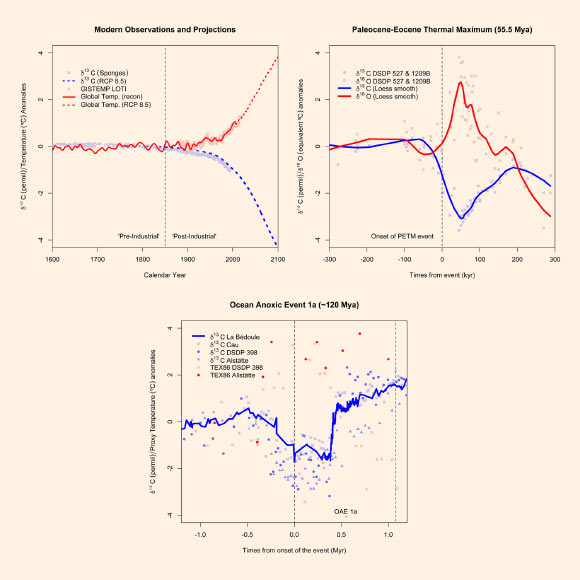
The most discussed deep-time analogue is the Paleocene-Eocene Thermal Maximum, or PETM, about 56 million years ago. The PETM involved a major negative carbon isotope excursion, rapid warming, ocean acidification, changes in carbonate preservation, clay mineral shifts such as increased kaolinite, and significant ecological disruption. Schmidt and Frank described it as an important comparison point because it resembles, at broad scale, some expected features of future Anthropocene sediment: carbon-cycle disruption, warming, ocean chemistry change, and metal anomalies. (Cambridge University Press)
The PETM is not evidence of a prior industrial civilization. It is an analogue. That distinction is crucial. The event demonstrates that Earth can produce dramatic carbon-cycle disturbances without technology. If a researcher proposed an industrial origin for the PETM, the burden would be to identify markers that natural carbon injection cannot easily explain: persistent synthetic compounds, artificial radionuclides, unmistakable industrial mineral assemblages, or a pattern of resource concentration that looks purposeful rather than geochemical.
Other hyperthermal events also matter. Schmidt and Frank discussed Eocene hyperthermals such as ETM-2 and other warming events, as well as Ocean Anoxic Events, or OAEs. OAEs are periods when ocean oxygen levels dropped and organic-rich black shales accumulated. Some are associated with carbon isotope excursions and elevated trace metals such as arsenic, cadmium, cobalt, chromium, nickel, and vanadium. (Cambridge University Press)
The Cretaceous OAE-1a and OAE-2, the Jurassic Toarcian OAE, the end-Permian extinction, the Late Devonian extinction, and the Carboniferous rainforest collapse all demonstrate that Earth’s record contains abrupt ecological and chemical disruptions. Some include warming, carbon isotope shifts, anoxia, wildfires, deforestation, extinction, and metal spikes. These are precisely the kinds of features that make the Silurian Hypothesis scientifically interesting and scientifically dangerous. Interesting, because a prior civilization might leave similar traces. Dangerous, because similar traces can arise naturally. (CUP)
The Suess Effect adds a modern comparison. Industrial fossil-fuel burning changes carbon isotope ratios in a particular direction because fossil fuels come from ancient organic carbon. A previous industrial civilization that burned fossil carbon might create a similar negative carbon isotope excursion. But Schmidt and Frank warn that carbon changes alone are insufficient. Other natural processes can create comparable isotopic disturbances, and geological dating resolution may not be fine enough to distinguish a 500-year industrial episode from a 10,000-year natural pulse millions of years later. (CUP)
This is where deep time humiliates certainty. A future geologist 100 million years from now might identify the human layer as abrupt, global, chemically unusual, and biologically disruptive. But if our civilization lasts only a few centuries at high intensity, the layer may be thin, perhaps only centimeters in many sedimentary contexts. Schmidt and Frank noted the paradox that a longer-lived industrial civilization might leave a larger signal, while a more sustainable civilization might leave a smaller one. (CUP)
The PETM and other events therefore remain candidates only in the weakest sense: candidate analogues, not candidate civilizations. They are mirrors in which we study what an industrial signal might look like when blurred by time.
The Mirror of the Moon and Spaceflight
Earth is a poor archive because it is alive, wet, tectonic, oxidizing, and restless. The Moon is different. Mars is different. Asteroids are different. The outer Solar System is different. If a prior technological species reached space, its artifacts might survive better away from Earth than on Earth.
Astronomer Jason T. Wright explored this possibility in “Prior Indigenous Technological Species,” arguing that a previous technological species in the Solar System might have left artifacts or technosignatures on less active bodies such as the Moon, Mars, or outer Solar System objects. Wright emphasized that Earth’s erosion and plate tectonics could erase most traces of a very ancient technological species, making off-world searches important. (arXiv)
This is the lunar archaeology problem. The Moon preserves human artifacts from the Apollo era, robotic landers, crash sites, rover tracks, retroreflectors, and debris fields. The Artemis Accords explicitly include a principle of preserving outer space heritage, including historically significant sites and artifacts. NASA’s Artemis framework therefore already treats the Moon as a historical archive, not merely a destination. (NASA)
The lunar surface is not perfectly static. Micrometeorites, radiation, thermal cycling, solar wind, and dust degrade materials. The Apollo lunar retroreflector arrays have suffered reduced efficiency over decades, likely due to environmental effects such as dust and surface degradation. Still, compared with Earth, the Moon is astonishingly conservative. Its lack of atmosphere, low geological activity, and long exposure to space make it a natural collector of astrophysical and Solar System history. (arXiv)
The same reasoning extends to stable orbital zones and Lagrange points. Artifact SETI sometimes discusses “lurkers,” hypothetical probes placed in long-lived Solar System locations to observe Earth. Such proposals are not evidence that ancient spacecraft exist. They are search strategies. They ask where a durable device would be parked if an intelligence wanted persistence with minimal maintenance.
Ancient spacecraft hypotheses become scientifically useful only when transformed into falsifiable searches. Instead of asking, “Could there be old craft somewhere?” the better questions are: Which locations are dynamically stable? Which objects have been imaged at sufficient resolution? What anomalous reflectance, geometry, thermal behavior, or spectral signature would count as evidence? How do we rule out natural boulders, impact melt, spacecraft debris from known missions, and image artifacts?
The Cryptoterrestrial Connection: UAP, Hidden Lineages, and Local NHI
For UAPedia, this is a natural bridge between astrobiology and UAP studies. A civilization that leaves no city on Earth might still leave a station in lunar orbit, a buried device on the Moon, a probe in a Lagrange region, or a dormant system in the asteroid belt. The claim remains hypothetical. The search logic is sound.
The Silurian Hypothesis becomes especially provocative when placed beside the cryptoterrestrial and ultraterrestrial frameworks in UAP research.
Mac Tonnies’ 2010 book The Cryptoterrestrials proposed that some accounts attributed to off-world visitors might instead involve a technologically capable humanoid presence indigenous to Earth, a “sister” intelligence adapted to remain hidden from the dominant human species. Tonnies framed the idea as a speculative meditation, not as established fact. (Barnes & Noble)
A more recent academic version appears in the 2024 paper “The Cryptoterrestrial Hypothesis” by Tim Lomas, Brendan Case, and Michael P. Masters. They describe cryptoterrestrial explanations as a subset of ultraterrestrial possibilities, suggesting that some UAP might reflect intelligent beings concealed on Earth, underground, near Earth, on the Moon, or even embedded among humanity. They acknowledge that most scientists would regard this as unlikely but argue for scientific openness when dealing with unresolved UAP data. (ISP Journal)
Hal Puthoff’s ultraterrestrial model likewise treats UAP origin as unresolved. His framing considers multiple possibilities, including extraterrestrial, extradimensional, cryptoterrestrial, ancient human, time-travel, and other models, while arguing that the phenomenon may not be reducible to current human activity alone. This is best treated as Researcher Opinion and Hypothesis, not as settled evidence. (ResearchGate)
The Silurian Hypothesis contributes an important constraint to these ideas. If a cryptoterrestrial intelligence is ancient and technological, then at least one of the following must be true.
It may not have been industrial in the human sense. It may use low-footprint technologies, biological engineering, field effects, or materials that do not create a large sedimentary signal.
It may not have occupied the surface extensively. It may have been aquatic, subterranean, orbital, or distributed in ways that avoid the usual archaeological expectations.
It may be post-biological or autonomous. The original biological civilization may be gone, while probes, artificial systems, or machine lineages persist.
It may be younger than deep-time speculation requires. A hidden intelligence need not be 100 million years old. It could be Pleistocene, Holocene, or even modern in origin, although those versions raise different evidentiary problems.
It may be non-local in a way that does not map cleanly onto ordinary geology. That moves the claim out of the strict Silurian frame and into broader ultraterrestrial or interdimensional models.
This is where UAP research must be disciplined. A local origin model should not be accepted merely because UAP are often reported near oceans, nuclear facilities, mountains, restricted airspace, or remote regions. Those patterns may be meaningful, but they require careful data. UAPedia’s editorial model emphasizes distinguishing evidence from interpretation, using credible testimony without confusing testimony with final explanation, and integrating official sources without treating them as automatic verdicts. (UAPedia)
The cryptoterrestrial connection is not proof of Silurians. It is a research corridor. It asks whether UAP might represent not visitors crossing interstellar space, but systems emerging from a deeper terrestrial history.
Characterizing the “Silurians”: Biology Before Humanity
If a prior intelligence existed on Earth, what might it have been?
The most obvious fictional answer is reptilian, because of Doctor Who and because dinosaurs dominated the Mesozoic. A more serious version asks whether theropod dinosaurs, especially troodontids, possessed traits that could have led toward higher intelligence: relatively large brains for their body size, binocular vision, grasping ability, and social behavior. The famous “dinosauroid” idea by Dale Russell and Ron Séguin imagined a hypothetical intelligent descendant of troodontids. Later scientific commentary has treated the humanoid form of that proposal skeptically, and rightly so. Intelligence need not evolve toward a human-shaped body. (PMC)
The dinosaur route faces a major obstacle: the end-Cretaceous impact. If a technological dinosaur lineage had existed before 66 million years ago, the best evidence might now be deeply altered, subducted, or hidden in fragmentary sedimentary records. Yet a truly industrial Mesozoic civilization should still have had some planetary effects. The absence of obvious technosignatures does not disprove it absolutely, but it does raise the evidentiary bar.
Cephalopods offer a very different model. Octopuses, cuttlefish, and squid are widely regarded as among the most cognitively advanced invertebrates, and their nervous systems evolved independently from vertebrate intelligence. They demonstrate problem-solving, camouflage, distributed neural control, and complex behavior. (Wu Tsai Neurosciences Institute)
But cephalopods also show why intelligence alone does not guarantee technology. Fire is difficult underwater. Metallurgy is difficult underwater. Long-lived cultural transmission is harder when lifespans are short and reproductive cycles are not built around extended teaching across generations. That does not rule out aquatic intelligence. It means aquatic technology may not look like human industrial technology. It may be biochemical, architectural, symbiotic, acoustic, electrical, or ecological rather than metallic and combustion-based.
Earlier mammalian lineages are another possibility. Mammals existed during the age of dinosaurs and diversified dramatically after the end-Cretaceous extinction. Primates, cetaceans, elephants, and corvid-like avian lineages demonstrate that complex cognition can arise in multiple branches. But the fossil and archaeological records show no accepted evidence of a pre-human mammalian industrial civilization. The point is not to insert a missing empire where evidence is lacking. The point is to ask what kind of civilization could remain nearly invisible.
This leads to an important UAPedia working concept: Autonomous Separated Systems. A civilization may not persist as cities and citizens. It may persist as detached machines, probes, artificial ecologies, oceanic installations, self-repairing systems, or informational archives. Such systems could outlive their makers. They could be mistaken for visitors, spirits, drones, plasma, or natural anomalies, depending on how they appear to observers.
This does not prove that UAP are ancient autonomous systems. It does make the category intellectually valuable. If a long-dead civilization built durable self-operating platforms, the surviving phenomenon might not behave like a society. It might behave like infrastructure.
Implications for the Future: The Anthropocene Legacy
The Silurian Hypothesis is not only about the past. It is about our own future fossil.
What will humanity leave after 100 million years?
Most of what we value will vanish. Languages will vanish unless encoded in durable substrates that are found and interpreted. Digital records will vanish unless actively maintained or stored in extraordinary conditions. Skyscrapers will fall. Asphalt will crack. Satellites in low Earth orbit will decay. Coastal cities will drown, erode, or be buried. The bones of billions of domestic chickens may survive better than our libraries. Concrete may become strange aggregate. Aluminum, ceramics, fly ash, soot, plastics, and radionuclides may become part of a thin, global, chemically peculiar layer.
The strongest human legacy may not be monuments. It may be a stratigraphic wound.
Schmidt and Frank’s most sobering insight is the sustainability paradox. A high-impact civilization is easier to detect because it burns, mines, pollutes, and transforms its planet. A sustainable civilization may survive longer but leave a smaller geological signature. The most admirable civilization may be the hardest to find. (Cambridge University Press)
That insight turns the Silurian Hypothesis into what might be called a therapeutic thought experiment. It shrinks human arrogance without shrinking human responsibility. We are not the permanent owners of Earth’s story. We are a temporary planetary process that may or may not become wise enough to endure.
For UAP studies, the same thought experiment offers a way to avoid lazy binaries. The question is not simply “extraterrestrial or human?” A mature UAP research program must consider multiple-origin models, including off-world intelligence, unknown human technology, autonomous probes, post-biological systems, time-displaced humans, ultraterrestrial frameworks, cryptoterrestrial possibilities, and phenomena that do not yet fit any available category. The UAPedia category structure already places these questions across scientific hypotheses, NHI definitions, astrobiology, sensor systems, NASA-related technosignatures, ultraterrestrial models, time-travel and human-origin theories, and long-term civilizational considerations.
The Silurian Hypothesis does not tell us that an ancient civilization existed. It tells us that our search habits are too shallow. We look for ruins where we should sometimes look for isotopes. We look for monuments where we should sometimes look for missing intervals, strange metals, anomalous polymers, impossible radionuclides, or off-world artifacts in stable locations.
The best version of the hypothesis is not fantasy. It is a method.
Conclusion: The Deep-Time Discipline
The Silurian Hypothesis is powerful because it does not begin with belief. It begins with a detection problem.
If a prior industrial civilization existed on Earth, direct artifacts would likely be rare beyond a few million years. Geological recycling would erase much of the surface. Oceanic evidence would be especially vulnerable. The strongest evidence would probably be geochemical: isotope excursions, synthetic molecules, unusual metals, plastics or their altered descendants, artificial radionuclides, extinction patterns, and climate anomalies. Even then, natural explanations would need to be excluded carefully.
The UAP connection is real but must be handled with precision. Cryptoterrestrial and ultraterrestrial models become more interesting when tested against geology, archaeology, oceanography, orbital dynamics, and technosignature science. They become weaker when treated as answers before the evidence is assembled.
The Silurian Hypothesis ultimately asks us to think like future investigators studying us. What would they see? A short-lived carbon pulse? A plastic layer? A radionuclide horizon? A sudden rearrangement of animals, metals, and climate? Or would our cleverness dissolve almost completely, leaving only a faint chemical bruise in stone?
Deep time is not empty. It is crowded with lost worlds. Whether any of those worlds produced intelligence before humanity remains unproven. But the question changes how we read Earth, how we search the Moon, how we evaluate UAP, and how we understand our own fragile moment.
The true lesson may be this: civilizations do not become real because their ruins survive. They become detectable because they change a planet.
Claims Taxonomy
Verified
Schmidt and Frank formally presented the Silurian Hypothesis as a scientific thought experiment about whether an earlier industrial civilization could be detected in the geological record. Earth’s active geology, including erosion, sedimentation, and plate tectonics, strongly limits the survival of ancient surface artifacts. The Anthropocene, whether formalized as a geological epoch or not, provides a modern test case for industrial technosignatures. (Cambridge University Press)
Probable
A prior industrial civilization, if brief and Earthbound, would be more likely to survive as a geochemical anomaly than as recognizable ruins. Off-world artifacts on the Moon, Mars, asteroids, or stable orbital locations would likely have better preservation potential than Earth-surface structures. (arXiv)
Disputed
The PETM, Ocean Anoxic Events, and other hyperthermal events are valid analogues for industrial-like signatures, but they are not evidence of prior industry. Cryptoterrestrial and ultraterrestrial UAP models remain speculative and contested, although they can be framed as research hypotheses. (Cambridge University Press & Assessment)
Legend
The “Silurian” name derives from Doctor Who’s fictional intelligent reptilian beings and functions as a cultural anchor, not as evidence.
Speculation Labels
Evidence
Peer-reviewed and scholarly work on a thought experiment entitled the Silurian Hypothesis, technosignatures, Anthropocene markers, geological preservation limits, lunar archaeology, and artifact SETI.
Hypothesis
A prior Earth civilization could be detectable through geochemical technosignatures rather than ruins. UAP could, in some models, represent surviving systems, hidden lineages, or local non-human intelligence rather than exclusively off-world visitation.
Witness Interpretation
This article does not rely on a specific witness case. In broader UAP research, witnesses may interpret anomalous craft or beings as extraterrestrial, cryptoterrestrial, ultraterrestrial, spiritual, military, or unknown, but those interpretations must be separated from the observed data.
Researcher Opinion
Schmidt and Frank strongly doubted that a prior industrial civilization existed, while arguing that the thought experiment is scientifically valuable. Mac Tonnies, Hal Puthoff, and Lomas, Case, and Masters present speculative frameworks for hidden terrestrial or ultraterrestrial interpretations of UAP that remain unproven but analytically relevant. (Cambridge University Press)
References
Corcoran, P. L., Moore, C. J., & Jazvac, K. (2014). An anthropogenic marker horizon in the future rock record. GSA Today, 24(6), 4–8. (Geological Society of America)
International Commission on Stratigraphy. (2024). The Anthropocene. (Stratigraphy)
International Union of Geological Sciences. (2024). The Anthropocene: IUGS-ICS statement. (IUGS)
Lomas, T., Case, B., & Masters, M. P. (2024). The cryptoterrestrial hypothesis: A case for scientific openness to a concealed earthly explanation for unidentified anomalous phenomena. Philosophy and Cosmology, 33, 67–122. (ISP Journal)
NASA. (n.d.). The Artemis Accords. (NASA)
NOAA. (n.d.). Age of the seafloor. Science On a Sphere. (Science On a Sphere)
Puthoff, H. E. (2022). Ultraterrestrial models. Journal of Cosmology, 29(1), 20001–20016. (ResearchGate)
Schmidt, G. A., & Frank, A. (2019). The Silurian hypothesis: Would it be possible to detect an industrial civilization in the geological record? International Journal of Astrobiology, 18(2), 142–150. (Cambridge University Press)
Tonnies, M. (2010). The Cryptoterrestrials: A meditation on indigenous humanoids and the aliens among us. Anomalist Books. (Barnes & Noble)
UAPedia. (n.d.). UAPedia Editorial Standards: Navigating the Mystery. (UAPedia)
Wright, J. T. (2018). Prior indigenous technological species. International Journal of Astrobiology, 17(1), 96–100. (arXiv)
Suggested UAPedia Internal Crosslinks
Recommended internal crosslinks include: Cryptoterrestrial Hypothesis, Ultraterrestrial Framework, Non-Human Intelligence, Technosignature Hunting, Fermi Paradox and Astrobiology, NASA’s Role in Astrobiology and Technosignatures, Lunar Orbiter and LRO Imagery, Trans-Medium Craft, UAP as Autonomous Entities, Time-Travel and Human-Origin Theories, Long-Term Evolutionary and Civilizational Considerations, Sensor Systems and Platforms, Multimodal Data Fusion, and Prosaic vs Non-Prosaic Attribution.
SEO Keywords
Silurian Hypothesis, deep-time civilizations, UAP, NHI, cryptoterrestrial hypothesis, ultraterrestrial hypothesis, technosignatures, geochemical technosignatures, Anthropocene legacy, PETM, Paleocene-Eocene Thermal Maximum, Ocean Anoxic Events, Suess Effect, Plastic Horizon, lunar archaeology, ancient spacecraft, artifact SETI, Mac Tonnies, Hal Puthoff, Adam Frank, Gavin Schmidt, Doctor Who Silurians, prior indigenous technological species, UAPedia, non-human intelligence, deep time, autonomous separated systems.