
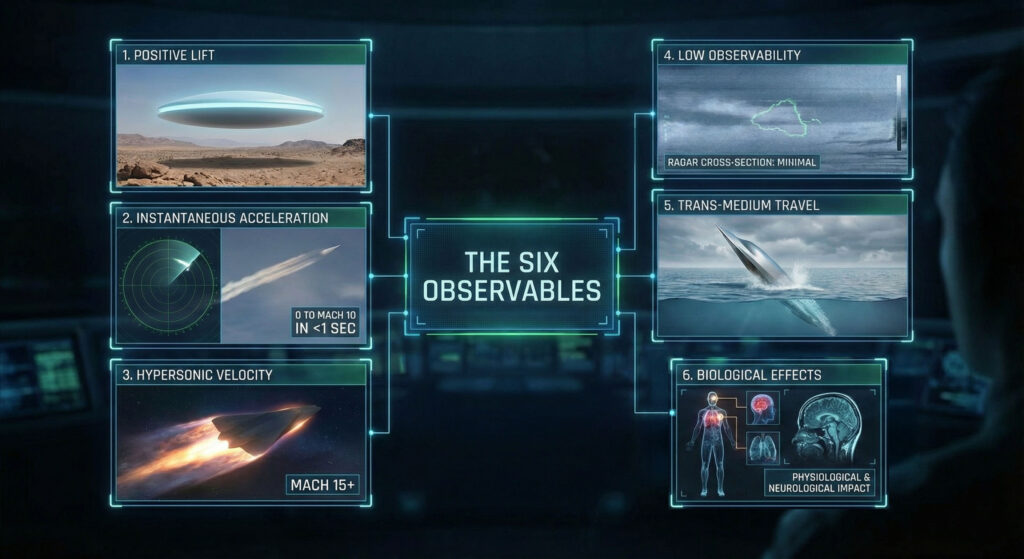
The “Six Observables” (originally “Five Observables”) are a descriptive framework popularized by former Department of Defense official Luis (“Lue”) Elizondo to characterize a recurring cluster of performance traits reported in some Unidentified Anomalous Phenomena (UAP) cases. They are (1) positive lift without visible means of propulsion, (2) instantaneous acceleration, (3) hypersonic velocity without signatures, (4) low observability (signature management), (5) trans-medium travel, and (6) biological effects. For UAP analysis these traits publicly as the set of “specific observables” that separate a small subset of UAP from conventional aircraft and known drones. The list is not a government standard, but a field heuristic born inside the post-2007 Pentagon UAP effort and later used to communicate with policymakers, aviators, and the public. (The Washington Post)
This article defines each observable, of which there were previously five, showing where and how it appears in the contemporary record, and, crucially, lays out evidence caveats and counterpoints. The aim is to help readers recognize why the model gained traction while keeping a clear, disciplined view of what the declassified record does and does not support.
Why this model emerged
From 2007 onward, DIA and DoD contracted and studied UAP under programs now known as AAWSAP/AATIP. Those efforts – and the later Navy/UAP Task Force (UAPTF), NASA’s independent study, and today’s DoD All-domain Anomaly Resolution Office (AARO) – were motivated less by curiosity than by operational hazards and potential national-security risk from “range incursions.” In 2019 the U.S. Navy formalized UAP reporting procedures; in 2020 DoD officially released three Navy videos (FLIR1/Tic Tac, Gimbal, GoFast); and in 2021 ODNI issued a preliminary UAP assessment. Elizondo’s “observables” functioned during this period as a compact way to triage cases: if multiple traits clustered together across multiple sensors and credible witnesses, those cases warranted priority. (Military.com)
The public springboard for this era was the 2017 media exposure of the Pentagon program and associated Navy encounters. DoD has since confirmed the authenticity of several Navy videos and acknowledged an increased number of UAP range incursions, without endorsing any specific origin hypothesis. This official posture created space for descriptive, cross-case models like the Six Observables to circulate while the government worked to standardize data collection and analysis. (defense.gov)
Observable 1: Positive lift without visible means of propulsion
Definition (as used in practice). Objects maintain altitude, hover, or maneuver with no evident aerodynamic control surfaces (wings/rotors) or thermal exhaust plumes consistent with known propulsion. In the 2004 USS Nimitz (“Tic Tac”) case, pilots reported a wingless, cylindrical object maneuvering above disturbed ocean water and then rapidly departing; ODNI later summarized broader reporting in which UAP “moved at considerable speed, without discernable means of propulsion.” (CBS News)
Representative evidence.
Pilot testimony & sensor context. In sworn congressional testimony and media interviews, Cmdr. David Fravor and Lt. Cmdr. Alex Dietrich described a smooth, white, wingless object with no visible exhaust. The subsequent FLIR1/Tic Tac video is consistent with an object lacking obvious wings/rotor, though its range and size are not established by the clip alone. ODNI (2021) noted that many UAP reports involve multi-sensor observations (radar, IR, EO, and visual) and in some cases reported RF energy associated with the sighting. (House Oversight Committee)
Caveats & counterpoints.
Sensor physics. Mid-wave infrared systems (e.g., ATFLIR) are exceptional targeting sensors, but plume visibility can vary with geometry, distance, atmospheric conditions, and sensor settings; lack of a visible plume is not definitive proof of “no propulsion.” ODNI explicitly warns that many military sensors are optimized for other missions and are not generally suited for identifying UAP, and that sensor vantage points can mislead size/structure inference. Thus “no wings/plume” in a video is a weakly diagnostic trait by itself; it acquires weight only when corroborated by other sensors and close visual observation.
Observable 2: Instantaneous acceleration
Definition. The object exhibits abrupt, high-g changes in velocity or direction beyond the performance envelopes of known aircraft, apparently without the transitional behaviors (banking, energy bleed) seen in aerodynamic flight.
Representative evidence.
Tacit acceleration claim. Fravor’s account emphasizes that the object “accelerated and disappeared” at close range and was subsequently detected approximately 60 miles away near the Combat Air Patrol point – implying extreme acceleration and speed. ODNI’s 2021 review notes 21 reports (18 incidents) with unusual movement patterns including abrupt maneuvers. These summaries stop short of publishing measured acceleration profiles but confirm that such reports exist in curated datasets. (House Oversight Committee)
Caveats & counterpoints.
Track fusion & perception. In dynamic intercepts, radar/FLIR track files can drop and reacquire separate contacts, creating the appearance of a “jump.” Without synchronized, timestamped raw sensor data (airborne radar, SPY-1 logs, IR imagery, INS/attitude data), one cannot compute a robust acceleration curve. ODNI therefore flags observer misperception or sensor error as potential confounders and calls for “additional rigorous analysis.” The burden is to publish enough parameters to exclude track-management artifacts.
Observable 3: Hypersonic velocity without signatures
Definition. Apparent Mach 5+ (or otherwise extreme) velocities without sonic booms or thermal/ionization signatures normally associated with such speeds in the atmosphere.
Representative evidence.
Case claims & ODNI language. In the Nimitz narrative, the “60 miles in <1 minute” observation, if taken literally, would imply hypersonic transit. ODNI’s 2021 assessment references reports of “considerable speed” and possible signature management (i.e., UAP appearing to operate without expected observables). (House Oversight Committee)
Caveats & counterpoints.
Parallax & range errors. The 2015 GoFast video is often cited as “hypersonic over water,” yet technical analyses show that parallax from a fast-moving jet observing a slow, low object can produce the appearance of great speed. Independent reconstructions (including discussions around NASA’s 2023 UAP panel) argue the GoFast target was likely moving modestly; the “speed” impression results from aircraft motion and viewing geometry. This does not explain all cases, but it underscores how a single FLIR clip cannot establish true velocity without range and geometry. (Metabunk)
Observable 4: Low observability / signature management
Definition. Objects appear to minimize radar cross-section, IR, optical, and/or RF signatures, sometimes evading tracking or presenting as low-contrast/low-RCS targets while still maneuvering with high performance.
Representative evidence.
Government phrasing. ODNI reported a “small amount of data” suggesting “signature management.” Separately, the U.S. Navy publicly acknowledged an increase in training-range incursions by UAP and updated reporting guidelines – implicitly treating some events as safety-of-flight hazards even when the objects were difficult to characterize.
Caveats & counterpoints.
Bias & equipment limits. ODNI points to collection bias (modern sensors concentrate around training ranges) and warns that many sensors are not tuned to discriminate UAP. Low observability can be a property of the sensor/operator stack rather than the target (e.g., weak returns at certain aspects, glare, auto-gain, or “bokeh” artifacts in low-light EO). Hypotheses of “active signature management” must progress beyond negative evidence (“we didn’t see a plume”) to positive evidence (e.g., anomalous RF or thermal behavior across multiple instruments).
Observable 5: Trans-medium travel
Definition. Objects operate seamlessly across air, space, and water (or pass from air to water) without visible performance penalty or transition signature.
Representative evidence.
2019 fleet incidents. In 2021, DoD spokeswoman Sue Gough confirmed that several leaked images and videos (including a spherical object observed from USS Omaha and “pyramidal” lights filmed from USS Russell) were taken by Navy personnel; these have been widely cited to suggest trans-medium behavior (“splash”). The confirmation speaks to provenance (Navy-sourced imagery), not to the nature of the objects. Elizondo has also said publicly that some observables have been recorded underwater, which is consistent with the mandate of the new AARO to address all domains. (CBS News)
Caveats & counterpoints.
Ambiguity of “splash” videos & optical artifacts. Analysts have shown that some “triangular” lights are consistent with bokeh (out-of-focus point sources) through a triangular aperture; again, provenance is not identity. Rigorous trans-medium claims require synchronized air/sea sensor fusion (e.g., IR + radar + sonar + EO) with precise timestamps demonstrating the same object before, during, and after interface crossing. As of the public record, such datasets have not been released. (CBS News)
Observable 6: Biological Effects
In The Age of Disclosure, Lue Elizondo introduced a sixth observable that extends far beyond aerospace performance characteristics: Biological Effects. These physiological reactions, documented across military, intelligence, and civilian encounters, form a consistent pattern suggesting that UAP are capable of producing measurable interactions with the human body. The symptoms reported: transient neurological disruption, nausea, headaches, vertigo, paresthesia, cognitive fog, memory anomalies, and skin erythema, have emerged repeatedly in proximity encounters. Crucially, the distribution of effects is neither random nor easily attributable to psychological stress alone. Instead, the recurrent signature across decades indicates a technologically mediated interaction, possibly linked to electromagnetic fields, microwave emissions, ionizing radiation, or yet-unknown energy modalities. (The Age of Disclosure)
What elevates Biological Effects into the observable category is not their rarity, but their consistency and cross-case coherence. Historical cases such as the Cash–Landrum incident, the Colares case with the “Chupa-Chupa” injuries in Brazil, and physiological reports associated with Rendlesham Forest have long hinted at close-range health impacts. Under AAWSAP, these patterns were studied systematically. Medical files assembled by program contractors and later discussed by Dr. Christopher “Kit” Green and Dr. Garry Nolan reveal anomalies in brain structure (e.g., caudate–putamen enlargement), immune dysregulation, and biomarkers consistent with directed-energy exposure. Together, these data suggest that the human body acts as an inadvertent sensor platform, registering environmental conditions that conventional instrumentation may not yet detect or interpret fully.
Elizondo’s framing of Biological Effects as an observable signals a doctrinal shift: the phenomenon must be evaluated not only through radar tracks or FLIR footage, but also through human-system interaction. Biological data becomes a diagnostic indicator of proximity to advanced technology. In military contexts, where aviators report both acute symptoms and near-misses, this observable carries implications for safety, intelligence assessment, and national security. If a technology can produce such effects without overt kinetic action, its underlying mechanisms warrant rigorous scientific analysis. More importantly, the consistent medical footprint strengthens the case for treating UAP as a genuine, measurable aerospace and environmental phenomenon, rather than an imagined one.
Evidence base and what the record actually says
Authentic Navy imagery exists. The Department of Defense formally released three Navy videos (FLIR1/Tic Tac 2004; Gimbal & GoFast 2015) and later confirmed the authenticity (not the nature) of several other Navy-sourced clips and photos from 2019. This establishes a real signal to study, but it does not by itself identify the objects. (defense.gov)
Government assessments remain cautious. ODNI’s 2021 preliminary assessment acknowledges 18 incidents (21 reports) with unusual movements and potential signature management, while also emphasizing sensor limitations, observer misperception, and the need for rigorous analysis. NASA’s 2023 independent study likewise found no evidence of extraterrestrial origin in available data and called for better calibrated, open, multi-sensor data and less stigma. AARO’s 2024 historical review reported no evidence of U.S. programs exploiting non-human technology and concluded that many legacy claims likely stem from misidentifications or narrative inflation. None of these reports declare the problem solved; they call for higher-quality data and standard processes.
Range incursions and safety. The Navy has stated that incursions by UAP into training ranges have increased and that the service updated reporting guidance for aircrew. This is operationally significant irrespective of ultimate identification, and it explains why performance-based heuristics (like the Six Observables) were useful to triage events for hazard and intelligence value. (TIME)
Why Elizondo’s Six Observables resonated
Within the government, the central problem was triaging ambiguous, stigmatized reports into analytically tractable bins. Elizondo has said that analysts saw repeatable patterns – objects apparently hovering without visible lift, executing abrupt accelerations, and in some cases outpacing aircraft, all while eluding standard signatures – across multiple, independent cases and sensors. The Six Observables distilled those patterns into a performance fingerprint that analysts and pilots could recognize quickly. In public, the same list became a translation layer for non-specialists: if an incident showed several observables together with decent data fidelity, it deserved attention first. (The Washington Post)
Where the government stands today
The AARO office, established in 2022, coordinates all-domain UAP reporting, standardizes data, and publishes assessments. AARO’s 2024 historical report emphasized the absence of verified non-human technology in U.S. hands and urged better data discipline; NASA’s 2023 panel likewise called for more science, less stigma and for open, calibrated, multi-sensor datasets. ODNI’s 2021 assessment framed the central bottleneck: insufficient high-quality data. Together, these government sources define a research agenda that is agnostic on origin and tightly focused on measurement, a stance compatible with using the Six Observables as hypothesis-generators, not conclusions. (AARO)
Implications for research policy & data collection
- Mandate multi-sensor capture. For any case suspected of meeting ≥3 observables, require synchronized RF/radar, EO/IR, and platform state data with preserved chain of custody. This is the minimum to adjudicate acceleration, velocity, and signature claims. (ODNI and NASA have already recommended standardization and better calibration.)
- Open, anonymized datasets. Where classification allows, release time-synchronized, calibrated datasets (even if down-sampled). This invites independent replication and reduces the “video speculation” problem that fuels confusion. NASA explicitly urges this approach. (NASA Science)
- All-domain coverage. If trans-medium claims are to be evaluated, AARO (working with the Navy and NOAA) should pilot joint air-sea instrumented ranges to catch interface crossings with acoustic and sonar corroboration. AARO’s remit is designed for such cross-domain testbeds. (AARO)
- Bioeffects protocols. Given the DIA’s interest in physiological effects, any incident with close exposure and symptoms should trigger a standard medical protocol and de-identified health data capture for longitudinal study. (Defense Intelligence Agency)
Bottom line
The Elizondo Six Observables distill a performance vocabulary for the subset of UAP cases that look least compatible with ordinary aircraft, balloons, or drones. The public record now includes authentic Navy imagery, official acknowledgments of increased range incursions, and government assessments that both (a) recognize unusual dynamics in some incidents and (b) underscore the limits of current data. Read correctly, the observables do not proclaim conclusions; they point to where to look harder. When several observables co-occur and multi-sensor data survive mundane explanations, that’s precisely the class of case the Researchers, NASA, and governments tell us to prioritize.
References
DoD press release formally releases three Navy UAP videos (FLIR1, Gimbal, GoFast), with provenance confirmation. (defense.gov)
ODNI Preliminary Assessment (2021) summarizing 144 reports, 18 incidents with unusual movement, and sensor limitations. (ODNI)
AARO site and Historical Record Report (2024) describing mandate, methods, and cautious conclusions on legacy claims. (AARO)
DoD confirmation that 2019 Navy photos/videos (e.g., USS Russell “pyramidal” lights; USS Omaha sphere clip) were taken by Navy personnel. (CBS News)
NASA UAP Independent Study (2023) calling for calibrated, open, multi-sensor data and reduced stigma. (NASA Science)
Washington Post Live transcript/video: Elizondo explaining “five specific observables” distinguishing some UAP. (The Washington Post)
Cash, B., & Landrum, V. (1981). Cash–Landrum incident witness statements and medical records. Department of the Air Force (unpublished case materials; FOIA-released summaries available via The Black Vault).
Haines, R. F. (1994). Aviation safety and UFOs: A review of pilot reports and associated physiological effects. National Aviation Reporting Center on Anomalous Phenomena (NARCAP).
Holanda, U. (1997). Operação Prato: Depoimentos, relatórios e arquivos da Força Aérea Brasileira. Brazilian Air Force, Comando Aéreo Regional-I. (English summaries available in Jacques Vallée’s Confrontations).
Vallée, J. (1992). Confrontations: A scientist’s search for alien contact. Ballantine Books.
Vallée, J., & Davis, E. W. (2003). Incommensurability, orthodoxy, and the physics of high strangeness: A 6-layer model. Journal of Scientific Exploration, 17(1), 37–62.
Green, C. E., Nolan, G. P., & Ziegler, M. (2019). Anomalous health incidents (AHIs) and neurological correlates in UAP witnesses. Stanford University School of Medicine (unpublished medical briefings; referenced in public interviews).
Kelleher, C., & Knapp, G. (2021). Skinwalkers at the Pentagon: An insider’s account of the secret government UFO program. Fourth Millennium Press.
Lacatski, J. T., Kelleher, C., & Knapp, G. (2023). Inside the U.S. government covert UFO program: Initial revelations. Fourth Millennium Press.
U.S. Defense Intelligence Agency. (2009). Advanced Aerospace Threat and Identification Program (AATIP) DIRDs. Defense Intelligence Reference Documents (DIRD 5: “Physiological effects in anomalous aerospace environments”).
Elizondo, L. (2024). The Age of Disclosure [Documentary]. Directed by J. Fox. Amazon Prime Studios.
Fox, J. (2020). The Phenomenon [Film]. 1091 Pictures.
Knapp, G., & Corbell, J. (2023). Weaponized [Podcast episodes on AAWSAP medical findings].
Frey, A. H. (1961). Auditory system response to radio frequency energy. Aerospace Medicine, 32(12), 1140–1142.
SEO Keywords
Five Observables, Six Observables, Elizondo Model, Luis Elizondo UAP, UAP Observables, Sixth Observable Biological Effects, UAP Biological Effects, Hypersonic Acceleration UAP, Transmedium UAP, Zero Observable Propulsion, Low Observability UAP, UAP Cloaking, UAP Electromagnetic Effects, UAP Radiation Injuries, AATIP UAP, AAWSAP UAP Research, Military UAP Encounters, Sensor-Verified UAP, UAP Flight Characteristics, UAP Propulsion Anomalies