
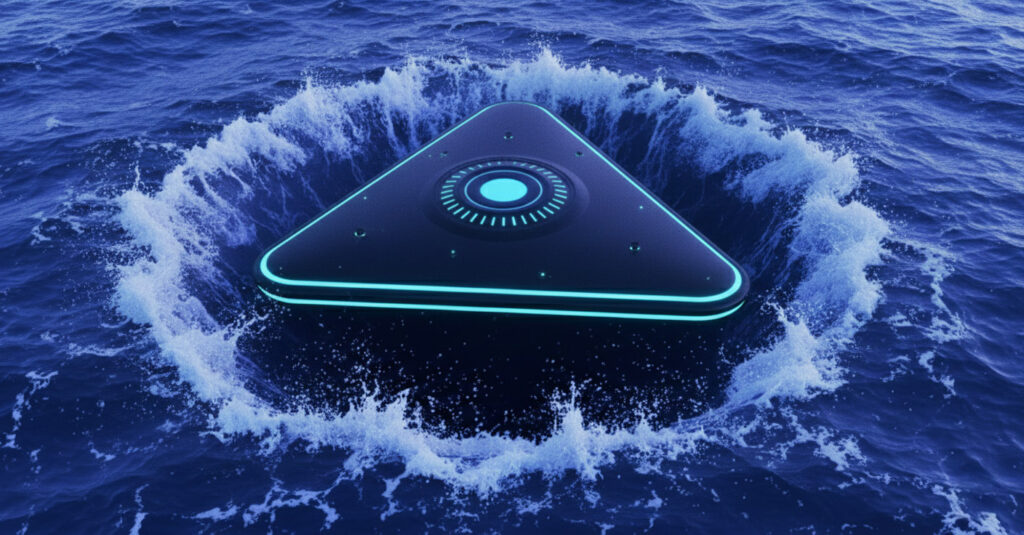
If there is one UAP behavior that keeps aerospace engineers awake at night, it is this: objects that seem to move seamlessly from air into water and sometimes back out again without slowing down, splashing, or behaving like anything we know how to build.
Those are trans-medium craft. Whether they are non-human vehicles, black-budget platforms, misinterpreted sensor artifacts, or some mix of all three, the pattern is now so persistent that even official U.S. definitions of UAP explicitly call out “transmedium objects or devices” as a category that requires its own attention. (AARO)
This explainer takes a data-first look at the subject. We will define trans-medium capabilities in concrete physical terms, walk through historical and modern cases where they seem to show up, and highlight the tug-of-war between independent researchers and recent government reassessments. Along the way we will clearly separate evidence from speculation using the Claims Taxonomy and Speculation Labels.
What “trans-medium” actually means
In everyday UAP discussions “trans-medium” often gets used loosely as a synonym for “can go into the ocean”. The formal usage is narrower and more demanding.
The U.S. National Defense Authorization Act definition of UAP, reflected on the All-domain Anomaly Resolution Office (AARO) site, explicitly includes
Airborne objects that are not immediately identifiable, transmedium objects or devices, and submerged objects or devices that are not immediately identifiable and that display behavior or performance characteristics suggesting that the objects or devices may be related. (AARO)
In UAP analysis circles, “trans-medium” has been pulled into the “Six Observables” framework that Luis Elizondo and others use to identify a small subset of particularly anomalous cases. One of those observables is trans-medium travel, meaning the ability to move between air, water and vacuum without apparent loss of performance. (UAPedia)
So for our purposes a craft is genuinely trans-medium if:
- It clearly operates in at least two physical domains
(air and water, or water and vacuum, etc). - It crosses the boundary between those domains while retaining speed and control at levels that exceed known technology.
- The transition is supported by more than just a single ambiguous frame on a noisy sensor.
That is a very high bar. It is why we differentiate between air-to-sea contact in general and true trans-medium performance.
Physics check: why trans-medium is a big deal
Going from air into water is not a subtle engineering challenge. It is more like driving a race car into wet concrete and expecting it to keep doing 200 km/h.
Some basic numbers:
- Air density at sea level is about 1.2 kg/m³.
- Seawater density averages about 1025 kg/m³.
That is roughly an 800 to 1 ratio. Drag forces in water at a given speed are orders of magnitude higher than in air, which is why even torpedoes designed for fast undersea travel top out around 50 knots and use rocket motors or supercavitation tricks to do it.
Known human technology that crosses media includes:
- Seaplanes and flying boats that land and take off from water, but only after long deceleration and with massive hydrodynamic loads.
- Supercavitating torpedoes like the Russian Shkval that create a gas bubble in front of themselves to reduce drag. They still require immense thrust and do not leap out of the sea and fly away.
- Ballistic re-entry vehicles that can move from vacuum to plasma to air to soil, but only by shedding huge amounts of energy in heat and shock.
A true trans-medium craft, as described in some UAP cases, would:
- Enter the ocean at aircraft speeds without a shock plume that matches known hydrodynamics.
- Maneuver underwater as if the density jump does not matter.
- Possibly exit again with little or no spray, sonic boom or visible engine plume.
If those reports are taken at face value, the craft is not just “good engineering”. It is operating on some different set of physical tricks, for example manipulating the medium around it or using fields to decouple itself from drag and inertia.
Historical hints: from USOs to Shag Harbour
Decades before anyone used the word “trans-medium” in a defense context, navies and coastal communities were already reporting USOs – unidentified submerged objects – that seemed to move in and out of the sea with unusual agility.
A 2009 Wired article summarizing declassified Russian Navy reports quoted a senior officer stating that
around 50 percent of their UFO encounters were connected with oceans and another 15 percent with lakes, suggesting that UAP “tend to stick to the water”. (WIRED)
Many of these cases describe objects that appear on sonar like fast submarines, then break the surface and fly away, or conversely plunge from the sky and continue on underwater. The evidentiary quality varies wildly, but the pattern is consistent.
The most famous Cold War air-to-sea incident in the West is Shag Harbour, Nova Scotia, 1967.
- On the night of 4 October 1967 at least eleven witnesses saw a large, lit object descend at low altitude toward Shag Harbour and apparently crash into the water with a whistling sound, a “whoosh” and a loud bang.
- Witnesses reported an object or lighted mass floating about 250 meters offshore. When the Royal Canadian Mounted Police and Coast Guard arrived they found only a patch of yellowish foam on the surface and no debris.
- Assuming an aircraft crash, Canadian military divers from Fleet Diving Unit Atlantic scoured the seabed for several days. Officially they found not a trace.
Local lore and later research by Don Ledger and Chris Styles added another layer. Some ex-military witnesses told Styles that an earlier 1960 NATO naval exercise off Shelburne, Nova Scotia, involved divers encountering unknown craft or objects on the seafloor and being sworn to secrecy. (Popular Mechanics)
Taken together, these cases suggest at least that something unknown entered the water in 1967 and that Canadian authorities treated it as a real object, not just lights or misperception.
Our classification for Shag Harbour’s trans-medium aspect:
- Multi-witness aerial object descending into the sea: Probable unknown UAP.
- Hypothesis that it continued underwater as a controlled craft: Disputed. There is no sensor track.
- Claims of a linked Shelburne seafloor encounter: Disputed, though supported by emotionally compelling diver testimony. (Popular Mechanics)
Cold War seas: Russian and NATO USO encounters
Beyond Shag Harbour, the richest trans-medium lore cluster sits in naval archives.
Authors Paul Stonehill and Philip Mantle compiled many Soviet and Russian naval USO cases in their book Russia’s USO Secrets, drawing in part on accounts summarized when the Russian Navy declassified some Cold War material. (Scribd)
Typical patterns include:
- Submarines at depth tracking unknown objects moving faster than any known torpedo, then shooting upwards at steep angles.
- Large underwater lights pacing vessels in silence and then breaking the surface, sometimes without disturbance consistent with their apparent size.
- Reports from Lake Baikal of divers encountering unknown “swimmers” at depth around an object before being ordered to abort. (Facebook)
Western navies have similar folklore. Popular Mechanics recently revisited Canadian stories of a 1960s Shelburne incident in which divers allegedly saw structured craft on the seabed during a NATO minesweeping exercise, triggering a temporary high alert. (Popular Mechanics)
From a data perspective these reports are frustrating. Many are anecdotal or come via retired personnel without releasable sonar tracks or logs. Yet they form a large and internally consistent body of testimony that strongly associates UAP with underwater domains.
Researcher stance:
- The global pattern of USO sightings and fast underwater tracks in naval reports is Probable evidence that at least some UAP have a genuine undersea component.
- Specific dramatic stories, like Baikal “swimmers” or DEFCON-level seafloor encounters, are Disputed unless backed by documentation or multiple independent witnesses on record.
Speculation label: Witness Interpretation
It is possible that some of the more dramatic underwater narratives reflect psychological stress, rumor amplification or misidentified classified hardware filtered through later UAP belief systems.
Modern sensor-rich case 1: Aguadilla, Puerto Rico (2013)
The Aguadilla UAP is ground zero for modern trans-medium debates.
On 25 April 2013 a U.S. Customs and Border Protection DHC-8 aircraft with an infrared turret camera departed Rafael Hernández Airport in Aguadilla, Puerto Rico. Shortly after takeoff the crew began tracking a small, hot object moving just offshore. The complete video leaked anonymously and was later analyzed in depth by the Scientific Coalition for UAP Studies (SCU). (The SCU)
Key observational data from the SCU report:
- The object’s apparent size was estimated around 1 to 1.5 meters.
- It moved at speeds mostly between 80 and 120 mph at low altitude, weaving over land and sea without navigation lights.
- At one point the object appears to enter the ocean, reemerge several hundred meters later, then seemingly split into two identical objects that continue on. (The SCU)
SCU systematically evaluated alternatives, including:
- Birds or bats.
- Balloons or lanterns.
- A small aircraft or drone.
- Pure infrared artifact.
The team rejected wind-blown lanterns by calculating that any object matching the track would require wind speeds around 16 mph at low altitude, which they argue is too high for most paper lanterns to remain aloft. They also noted the lack of characteristic movement or flicker. (The SCU)
Their conclusion in 2015 was that the object represented a real, solid UAP with no conventional explanation, apparently exhibiting trans-medium behavior when interacting with the ocean.
Then AARO weighs in
In 2025 AARO released an official “Puerto Rico UAP Case Resolution” report that reconstructed the CBP aircraft and object tracks using Systems Tool Kit (STK) software. AARO’s analysts concluded that:
- The object remained over land throughout the video.
- The apparent “ocean entry” was a thermal illusion when the water temperature matched the object and the camera could no longer differentiate it.
- The “split” was probably two separate objects that came into the field of view or a gimbal artifact. (AARO)
They explicitly stated that the object did not display trans-medium performance characteristics and that a mundane explanation such as a small airborne craft was likely.
So we have a rare, clean clash:
- SCU, an independent group of engineers and scientists, treating Aguadilla as a genuine trans-medium UAP. (The SCU)
- AARO, a government office, reclassifying it as a non-trans-medium airborne object, possibly even identified. (AARO)
Our classification for Aguadilla:
- Existence of a small, real object tracked on FLIR at low altitude: Verified. Both sides accept that.
- Interpretation as an object entering the ocean and exiting again at speed: Disputed between SCU and AARO.
- Broader claims that Aguadilla is a flagship trans-medium craft example: Disputed.
Speculation label: Researcher Opinion
From a data-centric perspective, Aguadilla illustrates how sensitive trans-medium claims are to assumptions about camera calibration, local environment and software reconstruction. It is a case where genuinely careful analysts can look at the same video and reach opposite conclusions.
Modern sensor-rich case 2: USS Omaha sphere (2019)
In July 2019, the U.S. Navy littoral combat ship USS Omaha and other vessels off San Diego recorded multiple unknown objects on radar and infrared sensors. One of these was a self-illuminated sphere, estimated at least 2 meters in diameter, that hovered and maneuvered near the Omaha before apparently plunging into the ocean. (Reddit)
A short segment of FLIR video leaked in 2021 via filmmaker Jeremy Corbell shows the sphere crossing the frame before dropping toward the sea and vanishing at the moment it meets the waterline.
The U.S. Department of Defense later confirmed that the video is authentic Navy imagery and that it was included among UAP material under review, though they did not endorse any particular interpretation.
Open questions:
- Did the sphere actually continue underwater, or did it simply disappear into the sea like any falling object while the ship’s sensors and crew lost track of it.
- Was there any sonar contact correlated with the sighting? The Navy has not released such data if it exists.
- Was the object a trans-medium craft, a drone, debris, or some test platform?
Media outlets like Live Science and Inverse have covered the video cautiously, calling it an “unidentified” object that “plunges into the ocean”, without claiming exotic performance.
Classification for USS Omaha sphere:
- Authentic U.S. Navy FLIR footage of an unknown spherical object over the ocean: Verified.
- Evidence that the object continued underwater in a controlled fashion: Unresolved, therefore part of the broader Disputed trans-medium category.
Other modern threads: GoFast, global data and AARO’s definition war
Several other events sit at the edge of the trans-medium conversation.
- The Navy “GoFast” video has often been described online as a fast, low-altitude object skimming the ocean. AARO’s 2024 update indicated that their reconstruction shows a small object at more modest speed and altitude, with no trans-medium behavior. (DefenseScoop)
- New scientific work on “unidentified aerospace-undersea phenomena” explicitly treats the air and sea as a single coupled domain. A 2025 arXiv paper reviewing roughly 20 historical government UAP studies emphasizes that many serious cases involve objects tracked in both air and underwater contexts, and argues for all-domain sensor strategies. (arXiv)
- Congressional materials like the IMMACULATE CONSTELLATION program briefing refer to “transmedium platforms” and the need to detect and quarantine them across multiple domains, hinting at classified concern even as AARO’s public posture is conservative. (Congress.gov)
The result is a kind of definitional tug-of-war. On paper, AARO and ODNI use “transmedium” as a technical term. In practice, AARO has so far tended to deny that specific high profile videos truly meet that standard, while independent groups like SCU and private theorists actively look for such cases.
From a UAPedia perspective this just reinforces the need not to over-rely on any single government narrative, in line with our editorial policy. Trans-medium behavior is too important to be left entirely to one office’s interpretation. (Director of National Intelligence)
Emerging literature and design studies
The past few years have seen a small but growing literature that treats trans-medium craft not as a sci-fi trope but as a design problem.
Examples include:
- The 2025 paper “Unidentified Anomalous Phenomena (UAP) Materials Science and Aerospace Technology Application: Designing trans medium superluminal craft”, which proposes a permeable hull membrane that couples with electromagnetic and scalar fields to manipulate the medium around a craft. (UAP Caucus)
- The Sol Foundation’s “New Science of UAP” whitepaper series, which frames UAPs as aerospace-undersea phenomena and calls for serious materials science and propulsion research that could be informed by UAP data. (arXiv)
- UAP Caucus and Scientific Coalition for UAP Studies publications that analyze shape, speed, hovering capacity, electromagnetic effects and sound across large datasets, trying to see whether trans-medium performance correlates with particular clusters. (The SCU)
Speculation label: Hypothesis
These studies largely assume that some subset of UAP really are advanced craft, then ask “what physics would be required”. They do not, by themselves, prove that such craft exist. Their value is in clarifying which observables should be prioritized and what signatures a genuine trans-medium vehicle would produce in air, water and on sensors.
Applications and implications if trans-medium craft are real
If even a small fraction of reported trans-medium UAP represent actual craft of non-prosaic origin, the implications are enormous.
- Strategic mobility
A vehicle that can move at aircraft speeds under water and in air, then potentially transition to exoatmospheric flight, can access any point on Earth clandestinely. It can bypass traditional chokepoints, radar fences and naval blockades. - Undersea domain awareness
Navies already struggle to track quiet submarines. Add fast, silent trans-medium craft and the entire logic of anti-submarine warfare changes. Initiatives like IMMACULATE CONSTELLATION, which aims to detect, quarantine and transfer UAP across domains, hint that some defense planners are already gaming out this possibility. (Congress.gov) - Energy and propulsion
Any technology that dramatically reduces drag in both water and air would revolutionize civil transport and space access. Even partial understanding of such systems could cascade into more efficient ships, aircraft and launch systems. - Scientific paradigms
Robust evidence for trans-medium craft would pressure orthodox fluid dynamics and materials science, or at least show that we have not fully exploited known physics at scale. It would also constitute strong evidence for non-human technological cultures, whether extraterrestrial, ultraterrestrial or advanced human.
Speculation label: Researcher Opinion
Some analysts argue that trans-medium craft might represent a natural outcome of any long-lived technological civilization that needs to operate in multi-domain planetary environments. In other words, if non-human intelligences are here, we should expect their vehicles to be trans-medium by default, not as an exception.
Claims Taxonomy
Because “trans-medium” is such a powerful concept, it collects hype and sloppy usage. We therefore apply the Claims Taxonomy carefully.
Verified
- Official U.S. definitions of UAP explicitly include “transmedium objects or devices” and treat all-domain anomalous behavior as a real category of interest. (AARO)
- The 2013 Aguadilla video and 2019 USS Omaha FLIR footage are authentic government sensor recordings of unknown objects over coastal waters. (Zenodo)
- Historical cases like Shag Harbour involve documented multi-witness reports of an object descending from air into water followed by official underwater searches that found no conventional wreckage. (Wikipedia)
Probable
- The overall pattern of UAP reports associated with oceans and lakes, including Russian Navy statistics and international USO narratives, makes it probable that at least some UAP events involve real objects operating both in the air and underwater. (WIRED)
Disputed
- The claim that the Aguadilla object truly entered and exited the ocean while maintaining performance inconsistent with known vehicles. SCU endorses this; AARO’s 2025 reconstruction rejects it. (The SCU)
- The claim that the USS Omaha sphere continued underwater as a controlled craft, rather than simply falling into the sea with tracking lost. There is no released sonar data to resolve this. (Reddit)
- Dramatic Cold War USO accounts such as Lake Baikal “swimmers” or DEFCON-level seafloor standoffs. These rest largely on testimony and secondary reporting. (Facebook)
Legend
- Stories that embellish documented incidents with unverified details, for example claims that Shag Harbour’s object definitely traveled underwater to a second site or that entire fleets of trans-medium craft routinely battle submarines. These legends may be culturally important but cannot be treated as evidence. (Popular Mechanics)
Misidentification
- Many alleged trans-medium sightings are likely misreadings of sensor limitations. AARO’s Puerto Rico analysis shows how an object flying over land can appear to “enter water” when infrared contrast vanishes at the shoreline. (AARO)
- Low-resolution videos of small objects near the ocean surface often lack the detail needed to distinguish a plunging drone, balloon or bird from a true cross-domain maneuver.
Hoax
- None to date. There is no widely accepted, fully debunked “trans-medium” hoax case at the Nimitz level of fame. That said, the usual rules apply: any single anonymous clip of an “object entering water” with no metadata should be treated as unproven, and some social media content is almost certainly fabricated.
Speculation Labels
Hypothesis
- Field-effect hulls or permeable membranes that manipulate the medium to enable drag-free trans-medium travel. (UAP Caucus)
- The idea that trans-medium craft are the default vehicle type for mature planetary civilizations.
Witness Interpretation
- Diver accounts of underwater craft at Shelburne and Baikal, which may mix perception, stress and later meaning-making. (Popular Mechanics)
Researcher Opinion
- Randles-style view that all-domain behavior is central to understanding UAP, not a fringe feature.
- Conclusions drawn by SCU vs AARO about Aguadilla’s flight profile and medium transitions. (The SCU)
References
Scientific Coalition for UAP Studies. (2015). 2013 Aguadilla, Puerto Rico UAP: A detailed analysis of an Unidentified Anomalous Phenomenon captured by the Department of Homeland Security.
www.explorescu.org/post/2013-aguadilla-puerto-rico-uap-incident-report-a-detailed-analysis?utm_source=uapedia.ai (The SCU)
All-domain Anomaly Resolution Office. (2025). Puerto Rico UAP case resolution.
www.aaro.mil/Portals/136/PDFs/case_resolution_reports/AARO_Puerto_Rico_UAP_Case_Resolution.pdf?utm_source=uapedia.ai (AARO)
Office of the Director of National Intelligence. (2021). Preliminary assessment: Unidentified aerial phenomena.
www.dni.gov/files/ODNI/documents/assessments/Unclassified-2022-Annual-Report-UAP.pdf?utm_source=uapedia.ai (Director of National Intelligence)
Barrington Municipality. (n.d.). Shag Harbour UAP incident.
www.barringtonmunicipality.com/Visiting-Us/shag-harbour-ufo-incident?utm_source=uapedia.ai (Barrington Municipality)
“Shag Harbour UFO incident.” (2025). Wikipedia.
en.wikipedia.org/wiki/Shag_Harbour_UFO_incident?utm_source=uapedia.ai (Wikipedia)
Stonehill, P., & Mantle, P. (2016). Russia’s USO secrets: Unidentified submersible objects in Russian and international waters. Flying Disk Press.
www.amazon.com/Russias-USO-Secrets-Unidentified-International/dp/1532898401?utm_source=uapedia.ai (Scribd)
Wired. (2009, July 24). Russian Navy declassifies Cold War close encounters.
www.wired.com/2009/07/russian-navy-declassifies-cold-war-close-encounters/?utm_source=uapedia.ai (WIRED)
Live Science. (2021). Spherical UAP plunges into the ocean in U.S. Navy footage.
www.livescience.com/ufo-flies-and-dives-navy-footage.html?utm_source=uapedia.ai
Scientific American. (2025). The U.S. government’s top UAP scientist has an open mind about alien life.
www.scientificamerican.com/article/the-u-s-governments-top-ufo-scientist-has-an-open-mind-about-alien/?utm_source=uapedia.ai (Scientific American)
UAP Caucus. (2025). Designing trans medium superluminal craft.
www.uapcaucus.com/research/unidentified-anomalous-phenomena-%28uap%29-materials-science-and-aerospace-technology-application-designing-trans-medium-superluminal-craft?utm_source=uapedia.ai (UAP Caucus)
Vallée, J., et al. (2025). The new science of unidentified aerospace-undersea phenomena. arXiv preprint.
arxiv.org/html/2502.06794v2?utm_source=uapedia.ai (arXiv)
History.com Editors. (2019). These 5 UAP traits, captured on video by Navy fighters, defy explanation. History.
www.history.com/articles/ufo-sightings-speed-appearance-movement?utm_source=uapedia.ai (HISTORY)
UAPedia. (2025). The Six Observables (Elizondo model).
www.uapedia.ai/wiki/the-six-observables-elizondo-model/?utm_source=uapedia.ai (UAPedia – Unlocking New Realities)
Popular Mechanics. (2025). Military divers claimed they found an underwater UAP crash site.
www.popularmechanics.com/science/a68066027/ufo-crash-defcon-mystery-underwater/?utm_source=uapedia.ai (Popular Mechanics)
SEO keywords
trans-medium UAP, transmedium craft capabilities, Aguadilla Puerto Rico UAP, USS Omaha sphere video, Shag Harbour USO incident, underwater UAP USO reports, Russian Navy USO secrets, Six Observables trans-medium travel, AARO Puerto Rico case resolution, designing trans medium superluminal craft, aerospace-undersea phenomena, all-domain UAP detection