
The room is dark, but not fully dark. You can make out the edge of the wardrobe, the doorframe, the pale geometry of the ceiling. You are awake enough to know where you are. Then comes the break in reality. Your body will not move. Your chest feels pinned. A presence seems to enter the room before it has a shape. What follows can feel less like a dream than like an invasion.
That threshold between sleeping and waking is where this article begins. In sleep research, the territory includes hypnagogic states, hypnopompic states, and sleep paralysis.
In UAP contact or abduction testimony, it is the same zone where some of the most intimate and disturbing reports cluster.
A large UK community study found that 37 percent of respondents reported hypnagogic hallucinations and 12.5 percent reported hypnopompic hallucinations. A later systematic review found lifetime sleep paralysis prevalence of 7.6 percent in the general population, rising to 28.3 percent among students and 31.9 percent among psychiatric patients. The overlap is not rare, and that matters before anyone reaches for grand explanations. (PubMed)
“Waking dreams” are not a convenient escape hatch for dismissing strange testimony. They are a measurable human condition, with known features, known prevalence, and known cultural consequences.
Sleep paralysis in particular is associated with waking awareness arriving before REM-related muscle atonia has fully switched off. Reviews of the literature note that episodes can include chest pressure, sensed presence, vivid intruder imagery, and a powerful feeling that an intelligent being is in the room.
Those same reviews also note that the experience has been interpreted, depending on culture and era, as witchcraft, demons, spirits, and in the modern period, extraterrestrial visitation. (PMC)
That does not solve the UAP problem. It simply sets the denominator. If an investigator ignores the biology of liminal sleep, the case file starts with a hole in it. If an investigator assumes liminal sleep explains everything, the case file is being closed before it is opened, and the phenomena will not go away easily if real.
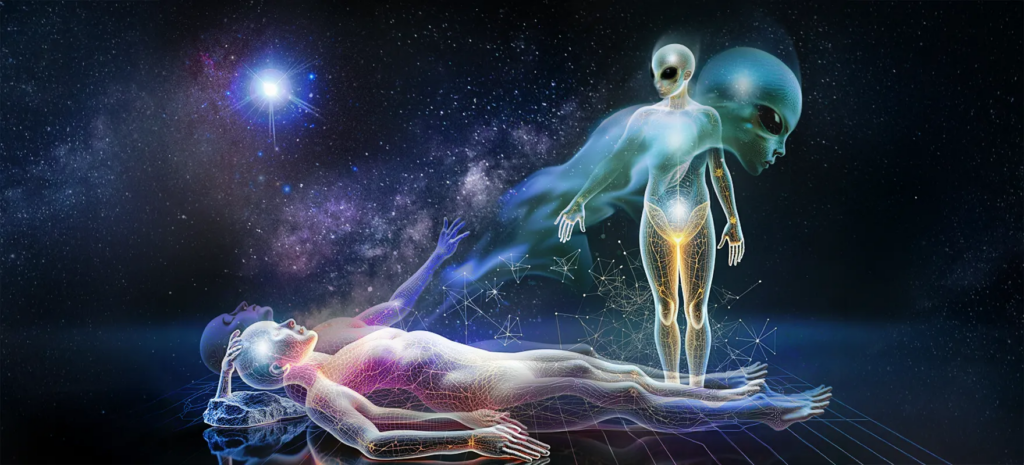
The old night visitor, wearing modern clothes
Long before the language of spacecraft, radar, and military secrecy, people described a recurring nighttime assault. A hostile presence enters the room. The witness wakes but cannot move. Breathing feels constricted. Panic rises.
In older European traditions, this was the nightmare or incubus. In later folklore, it became the old hag. Modern medical reviews explicitly connect these traditions to sleep paralysis and related hallucinatory states, arguing that the cultural costume changes while the physiological skeleton remains recognizable. (PMC)
That historical continuity matters because it shows how human beings build meaning around a terrifying state of consciousness. The structure remains stable. The imagery updates.
Once the 20th century filled the sky with rockets, bombers, satellites, and the possibility of visitors from elsewhere, the night visitor acquired new clothing. The being at the bedside became an examiner, an operator, a technician, an occupant. The bedroom became a procedure room. The curse became missing time.
Greg Eghigian’s recent historical overview captures the shift well. He notes that through the 1950s and early 1960s many contact reports were framed as pleasant or spiritually elevated, while the later 1960s and 1970s saw a growing number of claims about forcible taking.
He also places the 1961 Betty and Barney Hill case at the center of this evolution, because the couple turned to psychiatric help to make sense of their distress and memory gaps, and hypnotic regression became a durable tool in the abduction literature that followed.
On the side of the true experiencers lies David Jacobs, a historian who dedicated the latter part of his life to the abductions phenomena, adds three distinctive points-of-view:
- Rejection of Sleep Paralysis Explanations: while many skeptics and psychologists argue that abduction accounts are actually “waking dreams” or sleep paralysis, Jacobs contends that the physical evidence and the extreme consistency of accounts across unrelated individuals refute this.
- The Problem with Dreams: Jacobs argues that dreams are typically idiosyncratic and disjointed, whereas abduction reports follow a highly orchestrated narrative involving specific, repeatable procedures like reproductive experiments.
- Validation through Hypnosis: to distinguish “real” memories from dreams or fabrications, Jacobs utilized hypnotherapy to help subjects recover details he believed were suppressed by the aliens’ mind control.
By the early 1990s, abductees were routinely consulting psychotherapists, psychiatrists, hypnotists, social workers, and self-appointed consultants, while experimental psychologists and clinicians were mounting a strong backlash centered on memory reliability, suggestion, and research integrity.
At the height of that 1990s wave, the subject was visible enough to feed directly into The X-Files. (Aeon)
This is where waking dreams become more than a sleep-science footnote. They become a hinge between neurophysiology, media culture, clinical practice, and anomalous testimony. That hinge is why the subject survives. It belongs to too many domains at once to be disposed of by any single one.
Case study one: when sleep paralysis and abduction testimony collide
Evidence
One of the clearest academic attempts to examine the overlap came from Richard McNally and Susan Clancy. In a 2005 paper, they summarized two studies, including one involving 10 individuals who reported abduction by alien beings and whose claims were linked to apparent episodes of sleep paralysis accompanied by hypnopompic hallucinations. Their conclusion was careful and memorable: people rely on personally plausible cultural narratives to interpret baffling sleep paralysis episodes. (PubMed)
That finding matters because it is precise. It does not say all abduction accounts are sleep paralysis. It does not say witnesses are lying. It says at least some abduction narratives grow out of a known physiological state, and that culture supplies the language of interpretation.
A related study from the same research orbit adds an important human detail. People who believed they had been abducted showed marked physiological arousal when listening to personalized scripts describing those experiences. In other words, the emotional force of the memory was real enough to register bodily. That still does not settle what happened in the room or on the road or in the night sky. But it does tell investigators and clinicians that psychological effects, sincerity and distress cannot be brushed aside as trivial. (PubMed)
Witness Interpretation
For witnesses, this is often the least satisfying explanation in the world. Many do not describe these events as dream fragments. They describe intent. They describe presence. They describe being studied, warned, touched, or watched. They often insist that the event felt more real than ordinary waking life, not less.
Researcher Opinion
McNally and Clancy’s work is most useful when read as a map of one pathway into UAP contact narratives. It is strong evidence for overlap, not for total equivalence. The paper supports a cultural-interpretation model for some cases. It does not establish that every high-strangeness bedroom encounter reduces to REM intrusion. (PubMed)
Hypothesis
A careful working hypothesis is that some “bedroom visitation” reports are best understood as parasomnia-related experiences interpreted through contemporary UAP culture, while another subset may involve stress, sleep disruption, expectation, memory shaping, and perhaps in rare cases external anomalies not captured by the current literature. That second clause remains unproven. It belongs under hypothesis, not evidence.
Case study two: the strongest skeptical paper is not definitive
Evidence
Katharine J. Holden and Christopher C. French’s 2002 paper, correctly titled Alien abduction experiences: Some clues from neuropsychology and neuropsychiatry, is often cited in softened form.
The authors conclude: “Although the neurosciences provide many clues to the nature of this bizarre experience, further research is required before a full understanding will be attained”, and prescribe review four areas that may help explain them: sleep paralysis, false memories, mental health factors, and temporal-lobe activity. They also conclude that there is no convincing evidence that abductees show higher rates of psychopathology than the general population, although they may score slightly higher on measures such as dissociation. (PubMed)
That combination is one reason the paper still echos. It does not simply pathologize experiencers. It tries to reject the literal abduction claim while still trying to understand why the experience is persuasive, emotionally potent, and psychologically patterned, in normally otherwise healthy patients.
Witness Interpretation
This is exactly why many experiencers resist the skeptical literature. If serious psychopathology is not the main story, then being told the event was “just psychological” can feel evasive rather than explanatory. Many witnesses experience the label as an erasure of the most important fact from their point of view, which is that something happened.
Researcher Opinion
Holden and French are best read as an explanatory checklist. Sleep paralysis, memory formation, dissociation, and temporal-lobe mechanisms all deserve attention. Besides the overview, their paper suggests that neurosciences can illuminate a large slice of the testimony, but can not explain it away: it is not a license to skip the details of any individual case. (PubMed)
One of the confounding factors in any UAP study is the timeframe, trying to close in on the waking dream, sleep paralysis or other sleep related event, requires to study just the personality or what brought about the events, when it is known that contact with the phenomena brings about multiple life-long measurable changes in perception as mentioned by experiencer studies. (The Wiser Project, UAPCon – Implications of the Phenomena)
Hypothesis
The real value of this paper for UAP investigation is procedural. It suggests the variables that should be logged before anyone starts arguing ontology: sleep state, prior episodes, memory recovery methods, dissociative tendency, neurological history, and the timing and structure of the experience itself.
Case study three: John E. Mack and the cost of taking testimony seriously
Evidence
John E. Mack remains the unavoidable figure in this territory because he forced the problem into public view. The Harvard psychiatrist treated experiencer testimony as psychologically real and worthy of serious attention, mainly because he came to the conclusion the patients had no pathology, were intelligent and genuine in their lived experiences testimony. That decision triggered an institutional confrontation. The BMJ obituary on Mack states that Harvard’s review committee concluded he was not using “rational and scholarly” methods, though he was allowed to remain, with recommendations to improve his approach. (PMC)
That missing context matters. Mack was not simply “controversial.” He became the focal point for a dispute about whether empathy toward experiencers had slipped into methodological looseness. Besides these discussions Mack proved the abduction phenomena can be taken seriously and studied, with special focus on cross-cultural similarities between abductee experiencers stories. He was tried in a court of his peers at Harvard and came out unscathed and cleared of charges, his methods were sound.
Anyway skeptics worried about suggestion, blurred lines between clinical care and research, and the inflation of uncertain memories into ontological claims. Supporters argued that he was one of the few public intellectuals willing to engage witness testimony without ridicule. Eghigian’s historical review shows how central that fight became to the broader 1990s argument over memory, authority, and the credibility of anomalous experience. (PMC)
Witness Interpretation
To many experiencers, Mack’s importance was simple. He listened. In a field defined by stigma, that alone changed the social meaning of the testimony.
Researcher Opinion
To many critics, listening was not the problem. The method was. The Mack controversy crystallized a lasting concern in UAP research: how do you investigate a report compassionately without laundering interpretation into fact?
Special attention must be paid to the experiencer studies correlations already pointing the way to separate genuine abductions from dream state events. (The Wiser Project, UAPCon – Implications of the Phenomena)
Hypothesis
Mack’s legacy is proof that the hardest argument in this field is often epistemic, not merely evidential. Who gets to decide what counts as knowledge when the event is intimate, destabilizing, and not mainstream?
What a better investigation looks like
A serious intake for waking-dream-linked UAP testimony should begin with free narrative and then move into structured questions.
Some of the early falsifiable questions are: Was the witness falling asleep, waking, or fully active? Was there sleep deprivation, medication use, recent trauma, alcohol, or recurrent parasomnia history? Was anyone else in the home awake? Was anything recorded, observed, or physically altered? Did the event recur? Did the witness feel watched before seeing anything? Did the experience continue after full motor control returned?
These questions do not tend to bring all the clarity needed to these cases, because if a UAP experience did happen, then the effects are more likely longer lasting and deeper in nature – as reported by countless experiencer studies. On the other hand if it was just a waking dream, who is to say the lived experiences do not have a profound meaning or origin?
On the longer lasting effects of UAP encounters you have life-long serial experiences derived from a first close encounter. Among the reported after-effects and implications of contact with the phenomena by experiencers are several distinct types of measurable changes in perception or manifestations that would not come from waking dreams alone, most of which are explained in the study conducted by Sean Esbjorn-Hargens at CIHS. (The Wiser Project, UAPCon – Implications of the Phenomena)
The human impact is real, even when the ontology is unsettled
One reason the waking-dream/UAP overlap remains so emotionally charged is that the personal consequences do not wait for consensus.
The experience can be terrifying. It can destabilize sleep, relationships, religious beliefs, and trust in one’s own mind. Clinical literature on anomalous experiences argues for non-judgmental listening precisely because these events can produce distress and ontological shock even when an objective cause cannot be established.
That literature does not require the clinician to endorse the witness’s interpretation. It requires the clinician not to treat the witness as disposable data, and look at the commonalities amongst cases like the very similar narratives, as a clue to something else unfolding here. (PMC)
Speculation labels
Evidence
Sleep-related liminal states are common, measurable, and capable of producing sensed presence, paralysis, intruder imagery, and hyper-real fear.
Some abduction-like reports in the literature are explicitly linked to apparent sleep paralysis and hypnopompic hallucinations. Official UAP systems increasingly emphasize narrative data, metadata, ethics, and reporting standardization because existing reports are often too sparse and heterogeneous for strong conclusions. (PubMed)
Witness Interpretation
Many experiencers interpret these events as encounters with an external intelligence, not as sleep phenomena. They often point to intention, communication, recurrence, and the lasting transformation of their lives as evidence that something more than ordinary dreaming occurred.
Researcher Opinion
Researchers divide sharply. Some see parasomnias, false memory processes, dissociation, and temporal-lobe factors as the main explanatory cluster. Others emphasize that subjective reality, trauma-like impact, and coherent testimony deserve more respectful treatment than blunt dismissal allows. Even within skeptical literature, the absence of elevated serious psychopathology in abductee samples complicates lazy caricatures. (PubMed)
It is known that contact with the phenomena brings about multiple life-long measurable changes in perception as mentioned by experiencer studies, which if not measured by the waking dream studies, would miss out on the cohort where the UAP experience really took place. (The Wiser Project, UAPCon – Implications of the Phenomena)
Hypothesis
A minority of waking-dream-linked UAP reports may remain unresolved after sleep science, memory science, and ordinary misidentification have been accounted for. That is a live hypothesis for future investigation, not an established conclusion in the evidence reviewed here.
Claims taxonomy
Verified
- Hypnagogic and hypnopompic hallucinations are common in the general population, and sleep paralysis has a measurable lifetime prevalence that rises in some subpopulations. (PubMed)
- McNally and Clancy documented a small group of abduction claimants whose reports were linked to apparent sleep paralysis and hypnopompic hallucinations, and Holden and French argued that sleep paralysis, false memories, dissociation, and temporal-lobe factors are all relevant to understanding such reports. (PubMed)
- Experiences report several lifelong effects of UAP close encounters, most of which tend to involve measurable changes in perceptions and accompanying manifestations. (The Wiser Project, UAPCon – Implications of the Phenomena)
Probable
- Some subset of bedroom-visitation and abduction-like reports substantially overlaps with known parasomnias and liminal sleep phenomena. (PubMed)
Disputed
- Whether some subset of waking-dream-linked UAP testimony reflects an external anomalous trigger rather than an internally generated or culturally shaped experience remains unresolved on the evidence reviewed here.
Legend
- Cross-cultural narratives of night visitors, incubi, and related entities preserve a longstanding human interpretation of liminal sleep states, though the narratives themselves are cultural forms, not standalone proof of external beings. (PMC)
References
Ohayon, M. M., Priest, R. G., Caulet, M., & Guilleminault, C. (1996). Hypnagogic and hypnopompic hallucinations: Pathological phenomena? The British Journal of Psychiatry, 169(4), 459–467.
Sharpless, B. A., & Barber, J. P. (2011). Lifetime prevalence rates of sleep paralysis: A systematic review. Sleep Medicine Reviews, 15(5), 311–315.
Holden, K. J., & French, C. C. (2002). Alien abduction experiences: Some clues from neuropsychology and neuropsychiatry. Cognitive Neuropsychiatry, 7(3), 163–178.
McNally, R. J., & Clancy, S. A. (2005). Sleep paralysis, sexual abuse, and space alien abduction. Transcultural Psychiatry, 42(1), 113–122.
McNally, R. J., Lasko, N. B., Clancy, S. A., Macklin, M. L., Pitman, R. K., & Orr, S. P. (2004). Psychophysiological responding during script-driven imagery in people reporting abduction by space aliens. Psychological Science, 15(7), 493–497.
Lenzer, J. (2004). John E Mack. BMJ, 329(7471), 920.
Eghigian, G. (2025, June 12). The short, dramatic history of alien abduction in the US. Aeon.
Travis Dumsday; Alien Abduction as Enlightenment: Whitley Strieber’s Trauma-Fueled Spirituality. Journal of Religion and Popular Culture 2025
Esbjorn-Hargens, S., (2025) WISER – the Worldwide Initiative for Super Experiencer Research, CIHS.
Panel on the Implications of the Phenomena (2026) UAPCon (Youtube)
SEO keywords
waking dreams and UAP; sleep paralysis and UAP; hypnagogic hallucinations UAP; hypnopompic hallucinations UAP; abduction narratives and sleep science; John E. Mack UAP; Holden and French alien abduction; McNally and Clancy sleep paralysis; AARO narrative data workshop; NASA UAP report; Department of War UAP; UAP metadata standards; ontological shock and UAP; missing time and UAP; witness testimony and anomalous experiences