
Most famous UAP cases are famous because someone talked, in Brazil’s “Night of UFOs” it was the government.
On the night of 19 May 1986, now known as “Night of UFOs”, luminous objects moved across the airspace of four Brazilian states. Civil controllers logged them. Military radar at more than one site logged them. Airline and executive crews saw them. Five supersonic fighters were scrambled to intercept them. And four days later, in Brasília, the Minister of Aeronautics stood in front of the national press with his interceptor pilots and his on-duty controllers, walked through what had happened, and said that technically he could not explain it.
Forty years on, that sentence is still the anchor of the case. Everything else about the “Noite Oficial dos OVNIs” (“Night of UFOs”) is argued over. The number of objects, their size, their speed, the fate of the photographic negatives, the reason a promised dossier took twenty-three years to surface. What is not seriously argued over is that Brazil’s air defence system detected something it could not name, sent its best available hardware after it, and failed to close the distance.
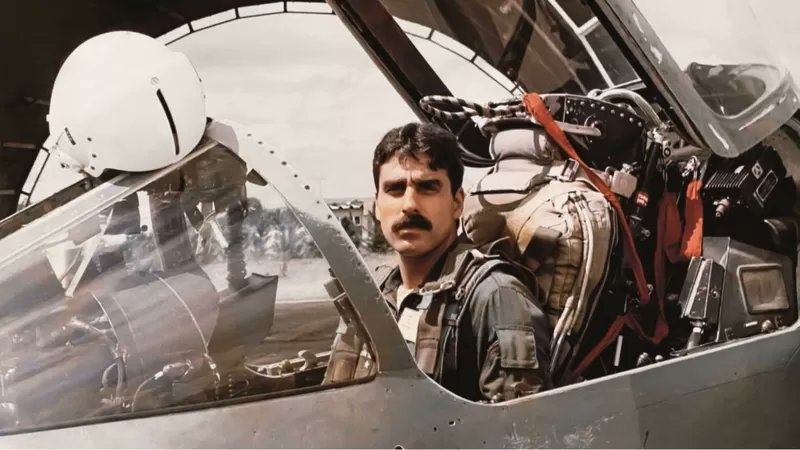
Why this case sits in a different tier
We treat sensor confirmation, witness quality, and institutional paper trail as three separate axes. Very few cases score on all three. This one does, and it does so in an unusual configuration: three independent layers of observation, generated by people who did not know each other, running in parallel across roughly 800 kilometres.
Layer one, civil aviation. A tower controller at São José dos Campos, in the Paraíba Valley, sees luminous points through binoculars and asks a passing executive aircraft to go and look. That aircraft is an Embraer Xingu, registration PT-MBZ, flown by Commander Alcir Pereira da Silva, carrying Air Force colonel and Embraer founder Ozires Silva back from a meeting with President José Sarney in Brasília. Ozires Silva took office as president of Petrobras the next day. It is difficult to construct a more institutionally awkward witness for a phenomenon a state might prefer to bury.
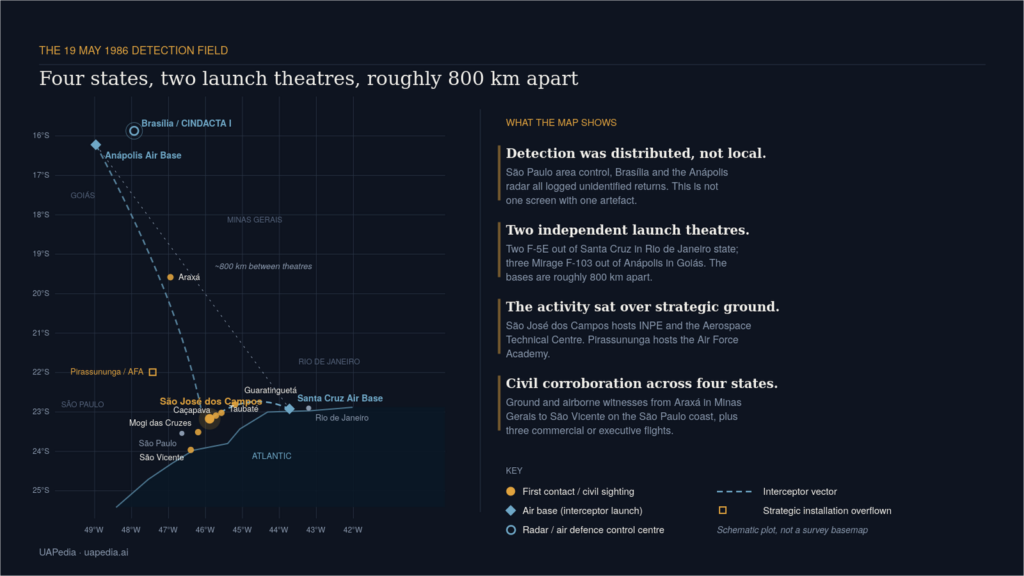
Layer two, ground radar. São Paulo area control registers unidentified plots. Brasília confirms. The radar at Anápolis Air Base in Goiás, hundreds of kilometres inland, picks up its own unidentified returns. This is not one screen with one artefact. It is a distributed detection.
Layer three, airborne radar plus eyeball. Two F-5E fighters out of Santa Cruz Air Base in Rio de Janeiro and three Mirage F-103 fighters out of Anápolis go up under orders described as non-aggressive interception. Onboard radars acquire targets. At least one pilot achieves a lock. At least two pilots see lights with their own eyes.
That stacking matters. A ground radar anomaly alone is a maintenance question. A pilot report alone is testimony. Ground radar plus airborne radar plus visual acquisition plus civil corroboration across four states, inside a single five-hour window, is a different evidentiary animal. It is the configuration that multi-sensor analysis was invented to adjudicate, and in 1986 Brazil generated it accidentally and in public.
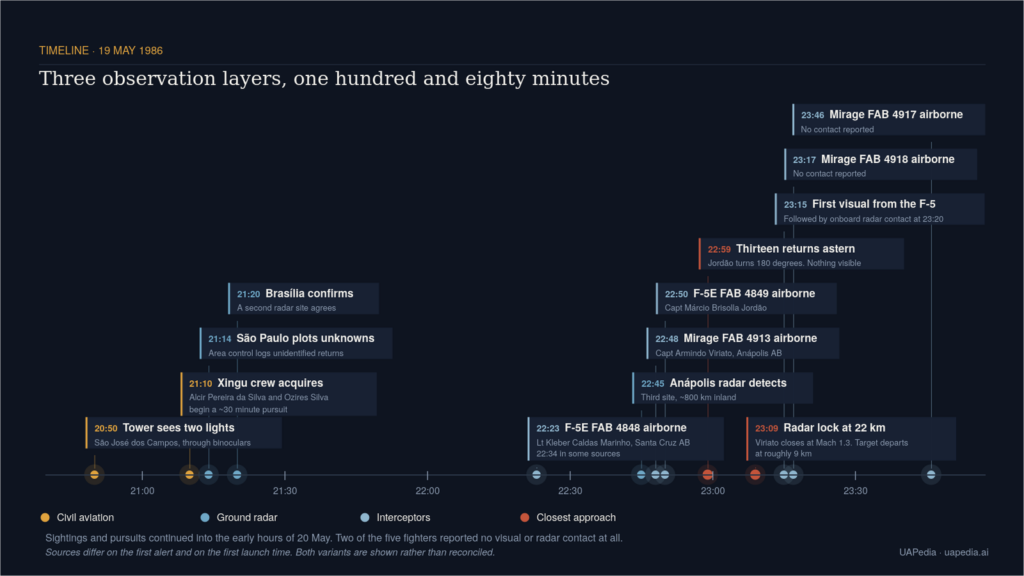
Timeline: 19–20 May 1986
All times are local (BRT). The spine of this chronology follows the sequence published by Revista UFO, cross-checked against Brazilian aviation and press reconstructions. Where sources conflict, the conflict is flagged rather than smoothed over.
| Time | Event |
| Early evening | Sources differ on the first alert. Some Brazilian accounts place an initial controller observation as early as 18:00 or 20:15. The first widely corroborated timestamp is 20:50. |
| 20:50 | The São José dos Campos tower controller observes two luminous points through binoculars and asks the crew of Embraer Xingu PT-MBZ, then nearby, to attempt visual reconnaissance. |
| 21:10 | Commander Alcir Pereira da Silva and Ozires Silva visually acquire multiple luminous signals. Ozires later described a reddish, elongated star-like form. The pursuit runs roughly 30 minutes. The objects break contact when approached. |
| 21:14 | São Paulo radar control registers unidentified plots. |
| 21:15 | São Paulo notifies the Integrated Air Defence and Air Traffic Control Centre (CINDACTA). |
| 21:20 | Brasília confirms unidentified returns on its own scopes. |
| 22:23 or 22:34 | First interceptor airborne: F-5E, tail number FAB 4848, Lieutenant Kleber Caldas Marinho, from Santa Cruz Air Base, Rio de Janeiro. Revista UFO’s chronology gives 22:23; reconstructions drawing on BBC Brasil give 22:34. |
| 22:45 | Anápolis Air Base radar registers further unidentified signals and launches. |
| 22:48 | Mirage F-103, tail number FAB 4913, Captain Armindo Sousa Viriato de Freitas, airborne from Anápolis, Goiás. |
| 22:50 | Second F-5E, FAB 4849, Captain Márcio Brisolla Jordão, airborne from Santa Cruz. |
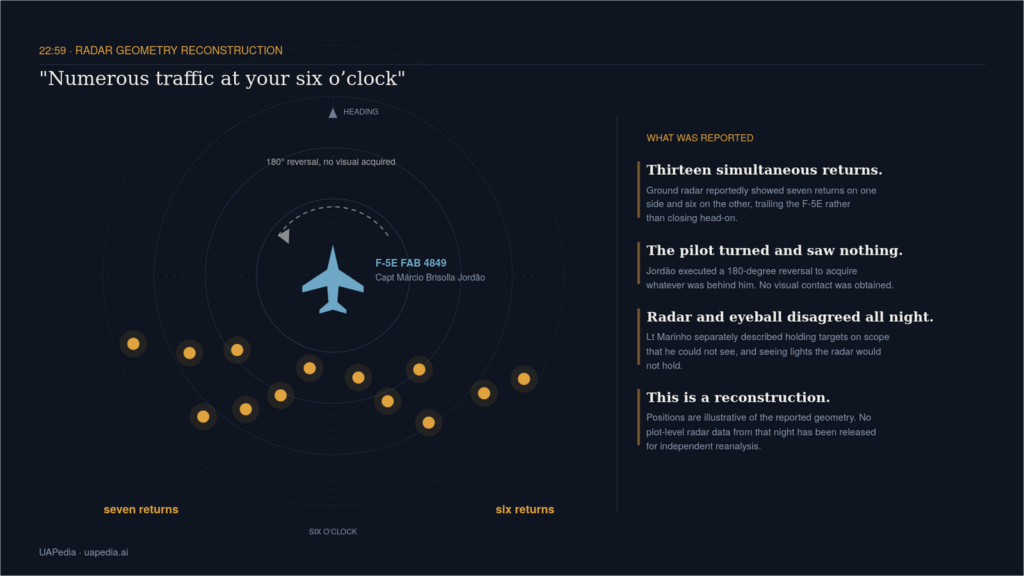
| 22:59 | Jordão is told by his controller that there is “numerous traffic” at his six o’clock. Ground radar reportedly shows thirteen returns, seven on one side and six on the other, in a trailing formation. He executes a 180-degree turn and sees nothing. |
| 23:09 | Viriato’s onboard radar acquires an unidentified return at roughly 22 km. He locks the target and closes at Mach 1.3. At approximately 9 km the target accelerates sharply away. |
| 23:15 | The first F-5 pilot obtains visual contact and begins pursuit. |
| 23:17 | Third fighter airborne: Mirage FAB 4918, Captain Rodolfo Silva e Souza, from Anápolis. |
| 23:20 | The first F-5 acquires targets on its onboard radar. |
| 23:46 | Fourth Anápolis launch: Mirage FAB 4917, Captain Júlio Cézar Rozemberg. Neither of the last two Mirages reported any visual or radar contact. |
| Into 20 May | Sightings and pursuits continue into the early hours. The activity is described as withdrawing toward the Atlantic. |
Aftermath
| Date | Event |
| 21–22 May 1986 | The Brazilian press engages the story heavily. Contemporary front-page reporting described a lengthy question-and-answer session in which around ten Air Force officers spoke with journalists for more than two hours. |
| 23 May 1986, 16:30 | Minister of Aeronautics Brigadier Octávio Júlio Moreira Lima convenes a press conference in Brasília with the five fighter pilots and the on-duty controllers present. He confirms 21 radar-detected targets and states that technically the Air Force has no explanation. He promises a full dossier within 30 days. |
| 2 June 1986 | The Air Defence Command (COMDA) completes an occurrence report on the episode, signed by interim commander José Pessoa Cavalcanti de Albuquerque. It is not released. |
| 19 June 1986 | The 30-day deadline passes with no public dossier. |
| 2008–2009 | The Brazilian Ufologists Commission campaign “UFOs: Freedom of Information Now” pushes for release of military holdings. |
| 25 September 2009 | The 2 June 1986 COMDA occurrence report was released. |
| 9 August 2010 | Air Force Command Ordinance 551/GC3 formalises the registration and routing of unidentified-object reports through COMDABRA and the Air Force documentation centre to the National Archives. |
| Present | The National Archives holds the OVNI collection (reference code BR DFANBSB ARX), including documents and more than a dozen cassette audio recordings of the controller-to-pilot exchanges from that night. |
What the pilots actually described
Strip away four decades of retelling and three claims survive with reasonable consistency across the primary testimony.
The objects broke contact on approach, repeatedly. Ozires Silva’s account and the fighter pilots’ accounts converge here independently. Close the range and the target withdraws, vanishes from view, vanishes from scope, and reappears elsewhere. This is the single most reproducible behaviour in the case.
Radar and eyeball did not always agree. Lieutenant Marinho described periods where the onboard radar held a target he could not see, and periods where he could see a light the radar would not hold. On-duty controller Sérgio Mota da Silva later said the true number of objects seen that night was well above 21, and that the Air Force counted only those with simultaneous confirmation, discarding the rest. That is a conservative counting rule, and it is worth noting which direction it biases the official figure.
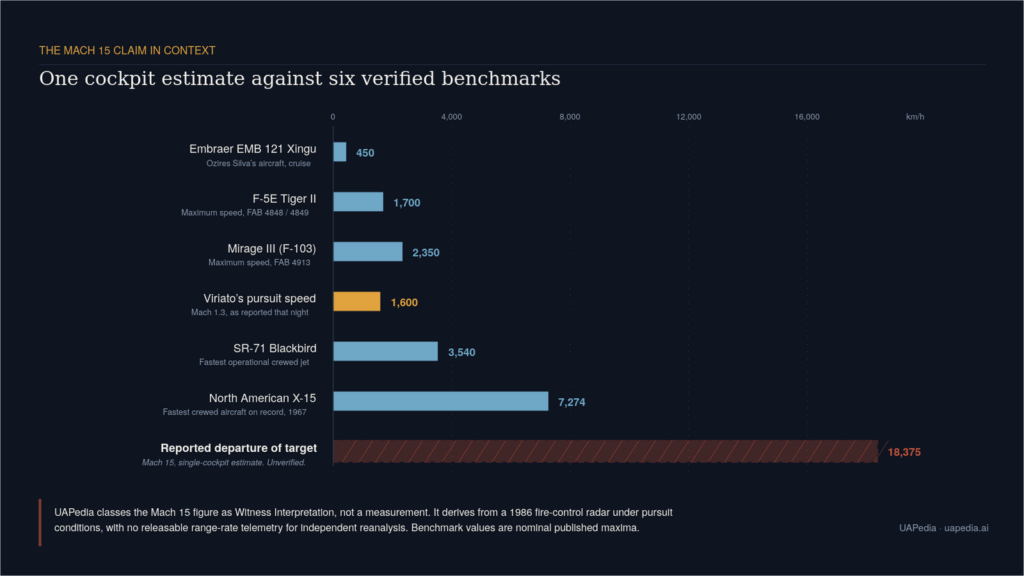
The acceleration claim comes from one cockpit. Captain Viriato, interviewed by TV Globo’s Globo Repórter in 1993, described his target accelerating away from a Mach 1.3 chase at what he calculated as roughly Mach 15. For scale, the fastest crewed aircraft on record, the North American X-15, topped out at about 7,274 km/h.
That last figure needs a fence around it, and UAPedia is going to build one. A Mach 15 estimate derived from a 1986 Mirage radar display, under pursuit conditions, without recorded range-rate telemetry available for public reanalysis, is a Witness Interpretation, not a measurement. The same discipline UAPedia applies to Tic Tac performance claims applies here. What is defensible is that a trained interceptor pilot, using a weapons-grade radar, judged the target’s departure to be outside the envelope of anything he knew how to fly. What is not defensible is treating 18,375 km/h as a datum.
Two of the five aircraft that launched that night saw and detected nothing at all. Any honest account of this case includes that.
The press conference that arguably should not have happened
Brazil in May 1986 was fourteen months out of twenty-one years of military government. Press censorship had ended. The Sarney administration was young. Brigadier Moreira Lima, an officer who had earlier been close to Air Force personnel involved in the country’s own quiet study of unidentified objects, made a decision that no comparable ministry in the United States, the United Kingdom, or the Soviet Union made in that era. He put the operators in the room.
His framing at the podium was technical rather than metaphysical. Radar, he argued, returns solid surfaces, metallic objects, and heavy cloud masses. The sky was clear. There were no conventional aircraft in the area. Radar does not suffer optical illusion. The Air Force could offer technical information and nothing more, and technically it had no explanation.
He also declined the extraterrestrial framing, and he declined the dismissal. That is a narrow ledge to stand on and it is the reason the quote has outlived him.
Years later, reflecting on the episode, Moreira Lima described himself as constitutionally sceptical and hard to impress, while conceding that the movement of those lights was, in his word, absurd. He added that if physics could not explain it now, physics would explain it eventually. That is a defensible epistemology and it is, incidentally, UAPedia’s.
Note on sourcing. Per our policy on government sources, the ministerial statement is treated as strong evidence of what the Brazilian Air Force believed and recorded at the time. It is not treated as a final adjudication of what the objects were. Governments are excellent witnesses to their own sensor data and unreliable narrators of their own uncertainty.
The dossier that took twenty-three years
The gap between promise and delivery is the most legitimately contested part of this case, and it deserves precision rather than heat.
The dossier was promised for 19 June 1986. It did not appear. The public was told nothing further. But the document existed, and it had existed since 2 June, seventeen days before the deadline. The COMDA occurrence report, built from the depositions of the military and civilian pilots, the radar operators, and the preliminary reports, sat unreleased for twenty-three years. It surfaced on 25 September 2009, after sustained pressure from the Brazilian ufological community’s freedom-of-information campaign, not through routine declassification.
Two observations follow, and they point in opposite directions.
The first is that no adequate public explanation has ever been given for why a completed, on-time report was withheld past its announced release date. Institutional inertia is the dull answer and it may well be the correct one. Brazilian researchers have argued for less dull ones.
The second is that the release, when it came, did not contain a smoking gun. The report is an occurrence record. Its most quoted feature is a characterisation, reported in Brazilian coverage of the release, that the lights appeared to be under some form of intelligent control. That is a striking sentence in an official document and it is also, precisely, an assessment rather than a measurement.
Researcher Opinion. A separate and unreleased report is claimed to exist, describing 21 objects of roughly 100 metres in diameter. Revista UFO editor A. J. Gevaerd traced this claim to researcher Luiz Gonzaga de Paula, who reportedly received it from a retired presidential aircraft commander who said he had read the document at the Planalto Palace flight coordination office. That is a three-link hearsay chain with no surviving custody trail. It is repeated constantly online and it should not be. UAPedia classes the 100-metre figure as unsupported.
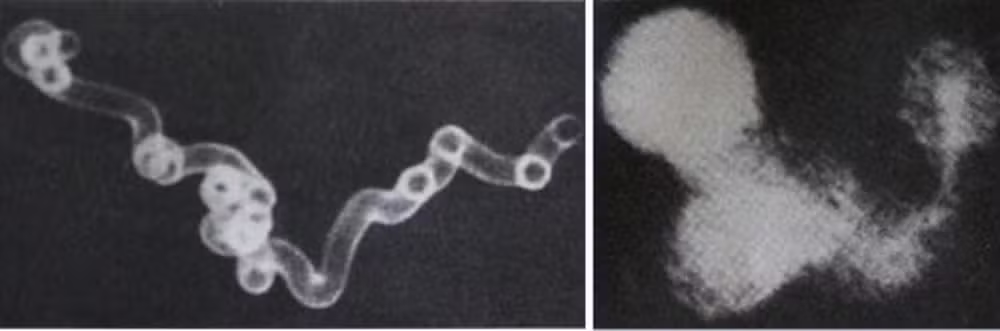
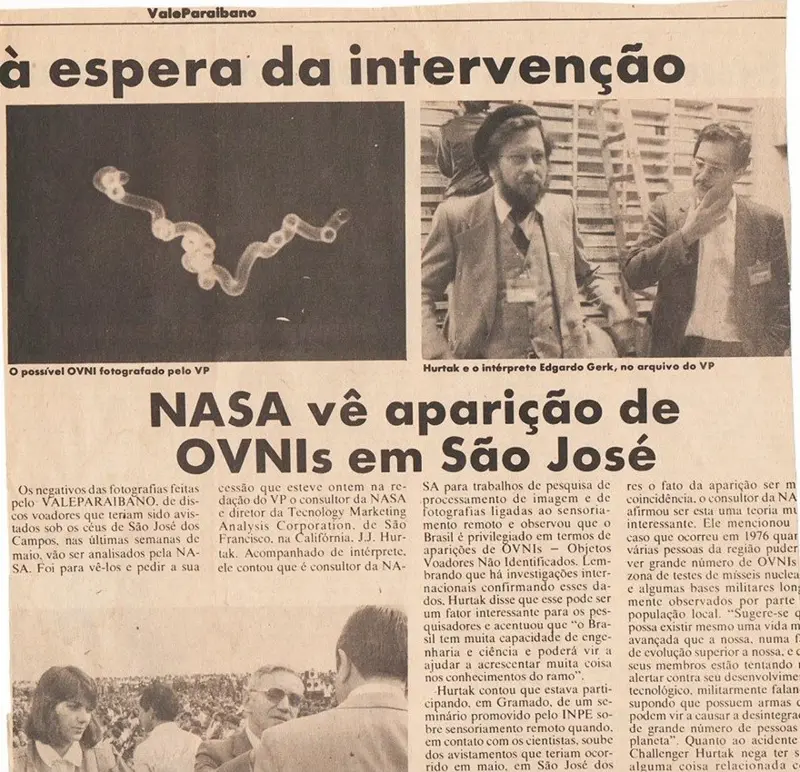
Disputed. Photographic negatives were reportedly made that night by a photographer for the newspaper Vale Paraibano, and are said to have been collected by personnel from the Aerospace Technical Centre and never returned. The claim is durable in Brazilian sources and unverified in the documentary record. It sits in the same category as many custody claims in the Nimitz data-handling dispute: plausible, repeatedly asserted, unproven.
The competing explanations, taken seriously
UAPedia does not accept that most UAP reports reduce to natural or human causes. It does insist that the candidate explanations be stated at full strength before they are set aside.
Space debris re-entry. A decaying object burning up produces a slow, luminous, multi-fragment procession with a plausible resemblance to a formation of lights. It fails here on duration and on kinematics. Re-entries do not last five hours, do not hold station, and do not withdraw when approached.
Meteor activity. Same objection, more sharply. Meteors do not appear on air defence radar as persistent tracks.
Electronic warfare or exercise activity. One CODA operator that night raised the possibility of foreign reconnaissance aircraft, and Marinho’s own report requested a check on whether any foreign carrier was operating off the Brazilian coast. Nothing was found. Nor does any state’s 1986 inventory contain an airframe that behaves as described.
Balloons, aircraft lights, astronomical objects. These explain individual sightings within any flap and they should be expected to explain some of the discarded reports from that night. They do not survive contact with the airborne radar acquisitions or the multi-site ground detections.
The plasma hypothesis, which is the serious one. Brazilian researcher Rodrigo Moura Visoni has built the most substantive naturalistic case, published in AERO Magazine in 2019 and summarised by astronomer Luiz Augusto L. da Silva in 2024. It has two components. The first, originating with the Hungarian-Brazilian radio engineer Iwan Thomas Halasz shortly after the event, notes a sudden increase in solar activity around 19 May 1986 and consequent disturbance of the ionosphere and geomagnetic field, sufficient to generate anomalous radar propagation. The second, drawing on work by Joseph and colleagues in the Journal of Modern Physics in 2024 as cited by Silva, proposes that upper-atmosphere plasma clouds, documented by Shuttle crews, can exhibit rapid acceleration, right-angle turns, pulsation, and predator-prey dynamics that mimic intelligent behaviour, and can be mistaken for craft when they descend. Visoni interviewed two of the 1986 interceptor pilots and the São José dos Campos controller, and reports that they found the model reasonable.
This deserves real engagement, and it earns some. Anomalous propagation is a genuine radar failure mode and solar-terrestrial conditions are a testable variable rather than a hand-wave.
It also has load-bearing weaknesses. The Joseph et al. plasma-behaviour literature is published in a venue with limited standing on exactly the claim that carries the argument, namely that atmospheric plasma exhibits apparently goal-directed dynamics. Anomalous propagation explains ghost returns; it does not explain a Mirage achieving a radar lock and a closing solution on a discrete target, nor a pilot obtaining a visual on a light his controller is simultaneously tracking. And a hypothesis that explains this night must also explain why the same withdraw-on-approach signature recurs in Colares in 1977, over Tehran in 1976, and over Belgium in 1989, under entirely different solar conditions.
The plasma model is the best prosaic candidate on the table. It is not yet a resolution.
The heterodox read: the thing that keeps happening
Here is the correlation that conventional case-by-case analysis keeps missing.
Across radically different technological eras, different cultures, and different sensor regimes, one behavioural signature recurs with a stubbornness that ought to be the primary object of study rather than a footnote to it. The phenomenon permits detection, permits approach to a threshold, and then withdraws. It does not evade before it is seen. It does not attack when it is chased. It maintains a gap.
In 1986 that gap was 9 kilometres from the Mirage’s nose. In 1976 over Tehran it was the moment an F-4’s weapons system dropped offline. In 1989 over Belgium it was a target that outran an F-16’s radar lock in dive profiles no airframe of the period could survive. In the Paraíba Valley that night, thirteen returns reportedly took formation behind Captain Jordão’s F-5 rather than in front of it, and when he turned to look, there was nothing to see.
The word Brazilian pilots reached for was that the objects were playing. That is an anthropomorphism and it should be labelled as one. But note what anthropomorphism is doing: it is a trained observer’s attempt to describe a pattern that is neither evasion nor aggression nor indifference. Something like a display. Something like being shown.
This is not a new language. It is the language of the earliest sky narratives we have. The luminous form that leads and then withdraws, that permits pursuit and denies capture, that arrives in numbers over the ritually or strategically significant site, is the oldest recorded motif in the human relationship with anomalous aerial phenomena. On 19 May 1986 the objects flew over the National Institute for Space Research and the Aerospace Technical Centre at São José dos Campos and the Air Force Academy at Pirassununga. A folklorist would call that a visitation to the sacred precinct. An air defence officer would call it an incursion over strategic infrastructure. They are describing the same event with different vocabularies, and the fact that the vocabularies map so cleanly onto each other is itself a finding.
Hypothesis. If the withdraw-on-approach signature is the phenomenon’s most conserved behaviour across five decades of sensor evolution, then it is a better research target than morphology, propulsion inference, or speed estimation. Morphology varies. Reported performance figures are contaminated by instrument limitations. The interaction protocol does not vary. It should be modelled as a protocol.
What would actually settle it
The 1986 case is unusual in that a genuine evidentiary path remains open.
The audio. More than a dozen cassette recordings of controller-to-pilot exchanges are held at the National Archives. Full transcription, timestamp alignment against the radar plot logs, and independent acoustic authentication would produce the single most valuable artefact in Brazilian UAP research and one of the most valuable anywhere.
The plot data. If any CINDACTA or Anápolis radar tape, plot extraction log, or track history from that night survives in the Air Force documentation centre, it converts pilot estimates into reconstructible geometry. This is the item that would either kill or confirm the anomalous-propagation model outright.
The solar record. The Halasz-Visoni hypothesis is falsifiable. Correlate the exact detection windows against high-resolution geomagnetic and ionospheric indices for 19–20 May 1986, then test the same correlation against a control set of Brazilian radar-visual cases from adjacent years. If the correlation holds only for this night, the hypothesis strengthens considerably. If it does not, it is finished.
The negatives. A documented custody search for the Vale Paraibano material would resolve a forty-year rumour in either direction.
None of this requires new technology. It requires archival labour and a records request.
Claims Taxonomy
| Claim | Classification | Basis |
| Multiple unidentified objects were detected by ground radar across four Brazilian states on 19–20 May 1986 | Verified | Converging civil and military radar, official ministerial confirmation, released COMDA occurrence report, National Archives holdings |
| Five FAB fighters were scrambled on non-aggressive interception missions | Verified | Named pilots, named airframes with tail numbers, named bases, confirmed at the 23 May 1986 press conference |
| The Minister of Aeronautics publicly stated the Air Force had no technical explanation | Verified | Documented press conference, 23 May 1986, with pilots and controllers present |
| At least one fighter achieved onboard radar lock and at least two pilots obtained visual contact | Verified | Multiple independent pilot depositions incorporated into the official occurrence report |
| Objects consistently broke contact when approached | Verified | Independently reported by the civil crew and by the military pilots |
| 21 objects were confirmed | Probable | The official count applied a simultaneous-confirmation rule; controller testimony indicates the true observed number was higher and the discarded reports are not publicly itemised |
| A target accelerated to approximately Mach 15 | Disputed | Single-cockpit estimate from 1986 fire-control radar; no releasable range-rate telemetry for independent reanalysis |
| The official report characterised the lights as intelligently controlled | Probable | Reported in Brazilian coverage of the 2009 release; the full document text warrants direct citation |
| A second report described 21 objects of roughly 100 metres diameter | Disputed | Three-link hearsay chain with no custody trail; widely repeated, unsupported |
| Photographic negatives were confiscated and never returned | Disputed | Durable in Brazilian sources, undocumented in the archival record |
| The event is explained by solar-driven anomalous propagation and atmospheric plasma | Disputed | Serious, partially testable hypothesis; does not currently account for airborne radar lock, coordinated visual and radar acquisition, or cross-era recurrence of the signature |
Overall case classification: Verified as an unexplained multi-sensor military UAP event. The occurrence is established. The identity of the objects is not.
Speculation Labels
Hypothesis
The withdraw-on-approach signature is the phenomenon’s most conserved observable and should be modelled as an interaction protocol rather than as evasive flight behaviour.
The 1986 event and the Washington D.C. flap of 1952 share enough structural features, including multi-site radar, interceptor scramble, contact-breaking on approach, and rapid official framing, to warrant formal comparative analysis rather than parallel anecdote.
Witness Interpretation
Captain Viriato’s Mach 15 figure. A trained judgement about an envelope, not a calibrated measurement.
The description of the objects as “playing” with the fighters, and of thirteen returns “escorting” Captain Jordão’s F-5.
Researcher Opinion
The claim that the objects measured roughly 100 metres in diameter. Unsupported.
Visoni’s application of the Halasz solar-ionospheric model plus atmospheric plasma dynamics to this specific night. The most rigorous naturalistic proposal available, and not yet demonstrated.
Any reading of the twenty-three-year withholding of the COMDA report as evidence of deliberate suppression. The delay is documented. Its motive is not.
References
Albino, W. (2009, December 1). A cronologia dos fatos na Noite Oficial dos UFOs no Brasil. Revista UFO. https://ufo.com.br/a-cronologia-dos-fatos-na-noite-oficial-dos-ufos-no-brasil/?utm_source=uapedia.ai
Arquivo Nacional. (n.d.). Ministério da Defesa (Brasil). Comando da Aeronáutica [Authority record, Fundo Objeto Voador Não Identificado, BR DFANBSB ARX]. Diretório Brasil de Arquivos. https://dibrarq.arquivonacional.gov.br/index.php/ministerio-da-defesa-brasil-comando-da-aeronautica;isaar?utm_source=uapedia.ai
Comando da Aeronáutica. (2010, August 9). Portaria nº 551/GC3: Dispõe sobre o registro e o trâmite de assuntos relacionados a objetos voadores não identificados. Diário Oficial da União, n. 152, Seção 1, p. 101.
Comando de Defesa Aérea (COMDA). (1986, June 2). Relatório de Ocorrências [Occurrence report on the events of 19–20 May 1986, signed by J. P. Cavalcanti de Albuquerque]. Released 25 September 2009. Arquivo Nacional, Fundo OVNI.
Correio Braziliense. (2026, May 17). A noite em que 21 óvnis invadiram o espaço aéreo brasileiro e foram perseguidos por caças da FAB. https://www.correiobraziliense.com.br/mundo/2026/05/7421517-a-noite-em-que-21-ovnis-invadiram-o-espaco-aereo-brasileiro-e-foram-perseguidos-por-cacas-da-fab.html?utm_source=uapedia.ai
Olhar Digital. (2026, May 19). “Noite dos Óvnis”: mistério que intriga o Brasil completa 40 anos. https://olhardigital.com.br/2026/05/19/ciencia-e-espaco/noite-dos-ovnis-misterio-que-intriga-o-brasil-completa-40-anos/?utm_source=uapedia.ai
O Tempo. (2026, May 16). “Noite Oficial dos Óvnis”: caso que mobilizou caças da FAB completa 40 anos e ainda intriga o Brasil. https://www.otempo.com.br/brasil/2026/5/16/noite-oficial-dos-ovnis-caso-que-mobilizou-cacas-da-fab-completa-40-anos-e-ainda-intriga-o-brasil?utm_source=uapedia.ai
Poder Aéreo. (2022, January 16). A noite em que 21 OVNIs foram perseguidos por caças da Força Aérea Brasileira [reproducing BBC Brasil reporting]. https://www.aereo.jor.br/2022/01/16/a-noite-em-que-21-ovnis-foram-perseguidos-por-cacas-da-forca-aerea-brasileira/?utm_source=uapedia.ai
Portal Contexto. (2026). A noite em que Anápolis entrou para a história mundial dos OVNIs. https://portalcontexto.com/a-noite-em-que-anapolis-entrou-para-a-historia-mundial-dos-ovnis/?utm_source=uapedia.ai
Portal Vigília. (2020, October 8). Mesmo depois de 3 décadas a “Noite Oficial dos Óvnis” segue sem explicação. https://vigilia.com.br/mesmo-depois-de-3-decadas-a-noite-oficial-dos-ovnis-segue-sem-explicacao/?utm_source=uapedia.ai
Revista Sociedade Militar. (2026, June 7). Há 40 anos, 5 caças F-5 e Mirage da FAB perseguiram 21 OVNIs sobre o litoral de SP. https://www.sociedademilitar.com.br/2026/06/ha-40-anos-5-cacas-f-5-e-mirage-da-fab-perseguiram-21-ovnis-sobre-o-litoral-de-sp-o-relato-completo-da-noite-oficial-dos-ovnis-2022j.html?utm_source=uapedia.ai
Silva, L. A. L. da. (2024, June 7). Noite Oficial dos OVNIs: Fim do mistério? Rede Omega Centauri. https://www.redeomegacentauri.org/2024/06/07/noite-oficial-dos-ovnis-fim-do-misterio/?utm_source=uapedia.ai
Visoni, R. M. (2019). Analysis of the 19 May 1986 Brazilian radar-visual events. AERO Magazine, (301), 76–81. [Primary naturalistic reconstruction; summarised in Silva, 2024.]
Joseph, R., et al. (2024). Journal of Modern Physics, 15, 322–374. [Atmospheric plasma dynamics paper underpinning the Visoni model, as cited in Silva, 2024. Readers should consult the original before relying on it.]
SEO keywords
Night of the UFOs Brazil 1986, Noite Oficial dos OVNIs, Brazil UAP incident 19 May 1986, FAB UAP interception 1986, Brazilian Air Force UFO press conference, Octávio Júlio Moreira Lima UFO statement, Ozires Silva UAP sighting Embraer Xingu, CINDACTA radar UAP 1986, Kleber Caldas Marinho F-5E UAP, Armindo Viriato de Freitas Mirage UAP, Márcio Brisolla Jordão F-5 UAP escort, Anápolis Air Base UAP 1986, Santa Cruz Air Base UAP scramble, COMDA occurrence report 1986, Arquivo Nacional Fundo OVNI, Portaria 551/GC3 OVNI, Brazil UAP declassification 2009, UFOs Freedom of Information Now campaign, radar-visual UAP case Brazil, multi-sensor UAP military encounter, Mach 15 UAP claim analysis, Halasz-Visoni plasma hypothesis UAP, anomalous radar propagation UAP explanation, São José dos Campos UAP 1986, Paraíba Valley UAP flap, Latin America UAP military cases, UAPedia claims taxonomy Brazil 1986