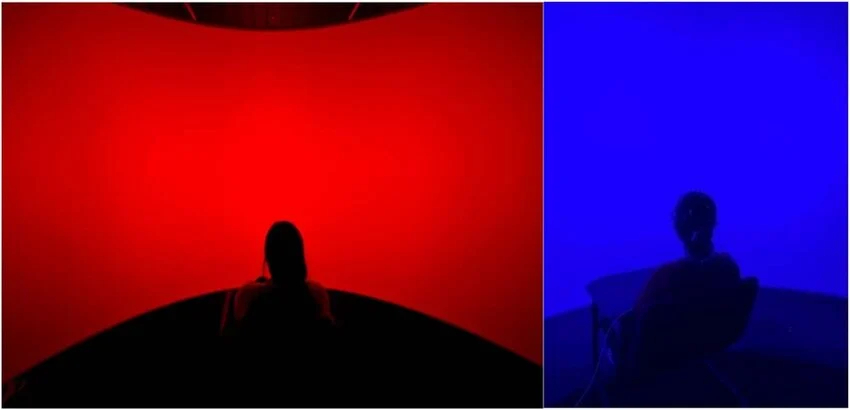
Walk into a Ganzfeld lab on a quiet afternoon and it does not feel like you are entering the front line of UAP research. It feels like you are entering a hobbyist’s workshop for the mind. A reclining chair. Headphones hissing soft noise. Eyes covered by translucent halves of ping-pong balls glowing red under a lamp. The receiver relaxes, talks out loud about drifting images and feelings, and then, after the session, tries to pick the real target from a small set of decoys.
It is simple, almost quaint. And yet, for more than four decades, this exact setup has kept producing a stubborn, uncomfortable result: in many datasets, people score above chance often enough that the numbers will not go away.
If you are coming to this story from the UAP side, that might sound like a ready-made bridge. UAP experiencers, across cultures and decades, often describe communication that does not sound like spoken language. They call it “downloads,” “telepathic messages,” “knowing without knowing how.” If you are coming from the lab side, that bridge might sound like a category error, because the Ganzfeld literature is a statistical argument about information transfer under controlled conditions, not a confirmation that any particular narrative about non-human intelligence is objectively true.
Both instincts are reasonable. The investigative work is to keep them both in view and then do something many UAP conversations skip: treat the “bridge” as a testable hypothesis, not a conclusion.
This article looks at what Ganzfeld experiments actually show, where the strongest critiques land, how government programs tried to operationalize related ideas, and what today’s sensor-focused UAP research can borrow from the Ganzfeld playbook without smuggling in claims the data does not support.
The Ganzfeld, translated into plain data language
A Ganzfeld lab experiment is a psychological procedure, often used in parapsychology, that creates a state of sensory deprivation to induce hallucinations or test for mental phenomena. Ganzfeld means “whole field,” a reference to the uniform sensory input produced by the red light and white or pink noise.
In the classic modern protocol, a receiver is asked to describe impressions while a sender focuses on a randomly chosen target. Afterward, the receiver judges which target matches their impressions. The most common judging format is effectively a four-choice task, where pure guessing gives you a 25% success rate.
That 25% is the anchor. You do not need to “believe in psi” to understand the logic. If a procedure is well controlled and people repeatedly score above chance across labs, you have a phenomenon that deserves explanation, even if you ultimately decide the explanation is methodological rather than anomalous.
In practice, Ganzfeld research has lived or died on three questions.
One question is whether the hit rate above 25% is real across time, labs, and investigators.
A second question is whether the effect survives modern safeguards: automation, proper randomization, blinding, and protection against “sensory leakage,” meaning normal cues that accidentally reveal the target.
A third question is what to do with a result that is statistically interesting but operationally slippery.
The best-known inflection points in the Ganzfeld record map cleanly onto those questions.
Case study: The autoganzfeld moment, when the numbers got serious
In 1994, Daryl Bem and Charles Honorton published a major synthesis of “autoganzfeld” studies in Psychological Bulletin. The phrase “autoganzfeld” matters because it signals a design intent: move the most sensitive parts of the protocol into computer-controlled procedures to reduce human handling, and therefore reduce opportunities for cueing, drift, or subtle bias.
Their headline number became one of the most repeated statistics in modern parapsychology: 106 hits in 329 sessions, a hit rate of about 32%, with chance sitting at 25%.
That is not a small quirk. In a four-choice design, a sustained shift from 25% to roughly 32% is exactly the kind of deviation that forces a fight, because it is large enough to measure but small enough to be vulnerable to many alternative explanations if your controls are imperfect.
And Bem and Honorton did not pretend those alternatives did not exist. Their paper discusses classic concerns like sensory leakage and handling of target materials, and it frames the autoganzfeld automation as a response to precisely those concerns.
If you stop the story there, it is tempting to declare victory. But the Ganzfeld story does not allow clean endings.
Case study: The replication backlash that changed the tone
Five years later, Julie Milton and Richard Wiseman published a meta-analysis, also in Psychological Bulletin, explicitly framed as a test of whether the earlier claims held up across a broader range of investigators following the stringent guidelines associated with the autoganzfeld era.
Their summary was bluntly non-confirming. Across 30 studies, they reported a Stouffer z of 0.70 with p = .24 (one-tailed), and a mean standardized effect size of 0.013.
This is one of the core reasons Ganzfeld remains controversial: the literature contains both “above chance” narratives and “failed to replicate” narratives, and both can point to respectable publication venues.
Case study: The rebound meta-analysis and the question of homogeneity
In 2010, Storm, Tressoldi, and Di Risio published another Psychological Bulletin meta-analysis, focusing on a set of later free-response studies and explicitly testing “noise reduction” models.
In a homogeneous dataset of 29 Ganzfeld studies, they reported mean effect size around 0.142 and a Stouffer Z of 5.48, with binomial analyses on trial counts (N = 1,498; hits = 483) also discussed.
On its face, that looks like a rebound. The same rough hit-rate neighborhood seen in the autoganzfeld synthesis shows up again in later compilations, which is exactly why proponents argue the effect is real and critics argue the selection and trimming procedures are doing too much work.
Even if you never read a single parapsychology journal, you have seen this pattern elsewhere: when an effect is small, different choices about inclusion criteria, outlier handling, and “quality thresholds” can change the story.
The modern hinge: a registered-report meta-analysis over forty-plus years
The most useful recent development for a data-first reader is not a single experiment. It is the move toward registered-report framing and transparent databases for meta-analysis.
A recent registered-report meta-analysis covering decades of Ganzfeld work describes a final database of 78 studies and 113 effect sizes, carried out by 46 different principal investigators. (PMC)
Then it delivers a line that should be printed and taped above every desk in both parapsychology and UAP research: the median statistical power associated with the observed overall effect size is .088, and only 30 studies (22.5%) reported statistically significant results. (PMC)
That combination is one of the most important “calm” explanations for why the Ganzfeld fight never ends. If your typical study is underpowered, you can get a long history where the overall database shows a small, persistent effect, while individual studies bounce between hits and misses in a way that feels capricious and fuels endless arguments.
The same paper also points toward a pragmatic fix: if researchers want 0.80 power at alpha 0.05, one-tailed, the required trials per study can be large, and it notes how certain moderator choices may change that requirement. (PMC)
This is not a win for either “side.” It is a map of why the argument persists.
And that is where the UAP connection becomes interesting, as long as we keep it hypothesis-sized.
Where UAP research enters, and where it should not be smuggled in
NASA’s 2023 independent UAP study team report is fundamentally a methodology document. It argues that current UAP analysis is hampered by poor sensor calibration, lack of multiple measurements, missing sensor metadata, and lack of baseline data. It emphasizes that detecting UAP with multiple, well-calibrated sensors is paramount.
Those statements do not validate consciousness-based UAP models. They do not endorse telepathy. They do not imply that the solution to UAP is “in the mind.”
What they do support is narrower and more useful: UAP research needs better data standards, better instrumentation, and better analytical discipline.
That is exactly the kind of discipline Ganzfeld researchers have been forced to develop, because their effect size is small enough that sloppy methodology can fake it.
The bridge is: both fields are fighting the same war against bad data.
Government involvement: when anomalous cognition met intelligence work
If you want to understand why the Ganzfeld debate refuses to stay inside academia, look at what happened when governments tried to turn anomalous cognition into something operational.
The U.S. government’s remote viewing programs are often discussed in ways that collapse nuance into headlines. The most useful primary document for cutting through that is the 1995 American Institutes for Research (AIR) evaluation of the Stargate program. AIR reported that the two reviewers “agreed far more than they disagreed,” and that both noted the experimental laboratory studies of remote viewing indicated a statistically significant effect. (alice.id.tue.nl)
The most important sentence in the entire remote viewing debate may be the one that keeps both believers and skeptics honest: a statistically significant effect does not, by itself, identify causal mechanisms, and the results could arise from many sources until competing explanations are ruled out. (alice.id.tue.nl)
The Star Gate Project record is not proof of non-human telepathy. It is evidence that governments took anomalous cognition seriously enough to fund it, test it, and then largely shut it down as an operational tool despite statistical arguments that something interesting was occurring in laboratory contexts.
This matters for UAP research because the experiencer side of the UAP world is often heavy with meaning. Messages, intentions, perceived insights. Even if something anomalous is happening, the intelligence value is a separate question.
What current UAP case materials say about the data problem
On the UAP side, the modern U.S. government-facing pipeline is AARO. Whatever you think of AARO’s conclusions, the official imagery page is useful because it shows the two categories UAP analysts keep colliding with.
Some cases resolve to prosaic explanations with high confidence, such as balloons, with reasoning based on morphology and behavior consistent with lighter-than-air objects. Other cases remain unresolved, not necessarily because the object is exotic, but because the available data is insufficient to evaluate performance characteristics or determine whether a signature is a physical source, reflection, environmental differential, or sensor display error. (AARO)
That is the same wall NASA describes: without calibrated instrumentation, metadata, and corroboration, the argument devolves into interpretation.
This is where Ganzfeld becomes relevant in the least sensational way. Ganzfeld is a mature culture of arguing about what counts as evidence when effects are small and biases are easy. UAP research, if it grows scientifically, will have to become that culture too.
Civilian and academic UAP science is already moving toward multimodal rigor
One of the healthiest developments in UAP research is that serious groups have started to publish what looks like a sensor-and-standards roadmap rather than a belief statement.
A 2023 paper associated with the Galileo Project describes an integrated system designed to conduct a multimodal census of aerial phenomena, with a package including wide-field and narrow-field cameras, multispectral instruments, radar-derived measurements, spectrum analyzers, microphones, and environmental sensors. It explicitly argues that multiple modalities help ensure artifacts are recognized and detections are corroborated and verifiable. (arXiv)
UAPx, in a field-expedition report, describes deploying visible and infrared cameras and other sensors, and it does something UAP research desperately needs more of: it openly discusses failures and ambiguities, then narrows to what remains after multiple explanatory resolutions. (arXiv)
This trend is important because it sets a baseline for how we should treat consciousness-linked UAP claims. If a claim is about external objects in the sky, you want multimodal sensor corroboration. If a claim is about information appearing in a mind, you need equally strong controls, pre-registration, and clear scoring rules. Different domains, same discipline.
The experiencer data: what it is, and what it is not
If you want to understand why “telepathy” keeps surfacing in UAP discussions, you can start with experiencer surveys, but you have to treat them correctly.
The FREE study published in the Journal of Scientific Exploration reports that telepathic messages were among the most frequently reported anomalous experiences in that respondent pool, with figures in the range of 52–58%. (Journal of Scientific Exploration)
That is a real statistic, but it is not what people often want it to be.
The authors describe recruitment pathways that invited people already oriented toward anomalous experience communities to take the survey, and they state that the conclusions apply only to that specific subsection of the general population. (Journal of Scientific Exploration)
So the data support a narrow, defensible claim: in this self-selected experiencer dataset, telepathy-like reports are common.
The data do not support a stronger claim: that telepathic communication objectively occurred, or that non-human intelligence used telepathy as a mechanism, or that UAP are fundamentally consciousness-based.
A data-first UAPedia stance can respect the witnesses and still keep the inference chain short. “Many people report this” is not the same as “this is confirmed.”
Case study: Ariel School, and how the “message” enters as interpretation
The Ariel School incident in Ruwa, Zimbabwe (1994) is often treated as a simple story: children saw a landed craft and beings; some received an environmental warning telepathically.
In reality, it is messier, and the mess matters.
Reporting and archival interview material describes teachers being in a staff meeting while children were outside, which is relevant because it reduces certain kinds of adult-driven contamination hypotheses while raising others, such as peer influence dynamics among children. (WHYY)
The headmaster’s position, as quoted in later documentary-related reporting, is one of the most responsible lines in the entire UAP archive: he said he believed the children saw something, but he could not draw a conclusion as to what it was. (WHYY)
Then comes the “message.” In some accounts, children describe receiving content in their minds while looking at the figure, with themes like pollution and future harm. (WHYY)
Even within the same reporting stream, there are mixed opinions among staff, and later controversies include at least one claim of fabrication contrasted with disputes from classmates. (WHYY)
None of this means the incident is “explained away.” It means the case contains multiple claim layers, and each layer deserves its own evidentiary label.
This is also where Ganzfeld becomes a practical tool rather than a poetic metaphor. If people claim telepathic transfer, Ganzfeld is a template for how to test information transfer claims under controlled conditions, while acknowledging that a lab analogue is not the same as a real-world UAP encounter.
The real investigative question: can we build a clean test for UAP-linked information transfer?
So what would a responsible, data-first bridge look like?
A responsible bridge would look like designing experiments where the claim is made measurable, the scoring is pre-committed, and the data pipeline is transparent enough that critics can reproduce the analysis.
Here is the core idea, framed as a test rather than a belief.
If UAP encounters involve any anomalous information transfer, then under some conditions a person should be able to produce verifiable target-relevant information at rates above what chance and leakage would permit, and that difference should be measurable without depending on interpretation after the fact.
Ganzfeld gives you a scaffolding: blind target selection, controlled judging, and clear chance baselines.
Modern UAP instrumentation work gives you another scaffolding: timestamped metadata, calibration, environmental baselines, and multi-sensor corroboration for external events.
The investigative design challenge is to connect them without cheating.
One approach would be to treat the target pool as time-locked, high-integrity data objects. Not “a picture an experimenter pulled from a folder,” but a cryptographically hashed set of candidate targets drawn from independent sensor streams, with the target selection performed by a system no human can influence after the fact.
Then you run sessions in which participants attempt to describe the target content while blind to what it is and blind to when the target was selected. Judging is performed with pre-registered scoring rules, ideally with multiple independent judges, and the entire dataset is published in a form that allows others to test alternate explanations.
If that sounds overly strict, that is the point. The remote viewing history shows that even a statistically significant laboratory effect can fail to convince if mechanism and alternative explanations are not pinned down, and it can fail operationally even if it remains statistically arguable. (alice.id.tue.nl)
It is also where the modern Ganzfeld meta-analytic lesson becomes essential: underpowered studies create decades of noise. If you want to test a small effect, you design for power, or you accept that you are generating more controversy than knowledge. (PMC)
This is not just a parapsychology lesson. It is a UAP lesson. Low-quality data does not merely slow progress. It guarantees interpretive warfare.
Controversies that matter, because they teach UAP research how to fail less
The Ganzfeld controversy is often summarized as “believers versus skeptics.” That summary is lazy. The real controversy is methodological.
Ganzfeld researchers have spent decades hardening protocols against sensory leakage and weak randomization, because critics correctly pointed out that small effects are easiest to fake accidentally.
Meta-analysts argue about outliers, inclusion criteria, and whether databases are “homogeneous” because those choices change the pooled result.
The modern registered-report meta-analysis adds another uncomfortable insight: even if the overall effect is stable, the field has often been running studies with very low median power, which predicts a long history of mixed significance outcomes. (PMC)
UAP research already lives in that world. Many of the most famous UAP clips lack the metadata that would let you compute basic quantities confidently, which is exactly why NASA emphasizes calibration, metadata, and multiple sensors.
If UAP studies ever include consciousness-linked claims, they will face the same “small effect” trap. You can either build rigorous pipelines now, or you can spend forty years arguing in circles.
Implications
If you are hoping for a single bottom line like “Ganzfeld proves UAP telepathy,” you will not get it here, because the data do not support it.
What you can responsibly say is narrower, and therefore more useful.
The Ganzfeld record shows that under controlled conditions, some databases yield above-chance performance in information transfer tasks, but replication and interpretation remain disputed, and the field’s low power explains why the literature can look inconsistent at the study level while still producing meta-analytic signals.
UAP experiencer surveys show that telepathy-like reports are common within self-selected experiencer pools, but those surveys do not independently validate that telepathic communication objectively occurred. (Journal of Scientific Exploration)
Government programs demonstrate that statistically significant laboratory findings, even when acknowledged in official evaluations, do not automatically translate into operational utility or validated mechanisms. (alice.id.tue.nl)
NASA’s UAP study team makes a methodological point that should anchor the entire field: without calibrated sensors, metadata, and corroboration, neither eyewitness narratives nor ambiguous sensor signatures can carry definitive conclusions about provenance, including extraterrestrial hypotheses.
The implication is not that consciousness is “the answer.” The implication is that consciousness claims, like flight-performance claims, can be framed as testable propositions, but only if UAP research adopts the same hard-nosed discipline that small-effect sciences are forced to adopt.
Claims taxonomy
Verified
The AIR evaluation reports reviewer agreement that laboratory remote viewing studies show a statistically significant effect. (alice.id.tue.nl)
Probable
Across decades of Ganzfeld research, meta-analyses and registered-report synthesis suggest a small overall effect that is robust in pooled analysis, while individual-study inconsistency is partly explained by low power. (PMC)
Disputed
The interpretation that Ganzfeld above-chance scoring reflects a real anomalous information-transfer mechanism remains contested, because alternative explanations, moderator sensitivity, and methodological disagreements persist.
Disputed
The claim that Ariel School involved telepathic messaging as a mechanism is contested and best treated as an interpretive layer within the broader testimony record rather than a settled fact. (WHYY)
Speculation labels
Hypothesis
Some subset of UAP encounters involve an anomalous information-transfer component that could be modeled and tested using Ganzfeld-like protocols with modern pre-registration, cryptographic target handling, and transparent scoring.
Witness interpretation
Some experiencers interpret perceived non-verbal communication during UAP-associated events as telepathy, downloads, or direct mind-to-mind contact.
Researcher opinion
The most productive bridge between Ganzfeld research and UAP studies is methodological rather than explanatory, meaning the real value is in importing rigor about blinding, power, preregistration, and leakage control into any attempt to test extraordinary information-transfer claims.
References
Bem, D. J., & Honorton, C. (1994). Does psi exist? Replicable evidence for an anomalous process of information transfer. Psychological Bulletin, 115(1), 4–18. (PDF APA)
Milton, J., & Wiseman, R. (1999). Does psi exist? Lack of replication of an anomalous process of information transfer. Psychological Bulletin, 125(4), 387–391. (KU)
Storm, L., Tressoldi, P. E., & Di Risio, L. (2010). Meta-analysis of free-response studies, 1992–2008: Assessing the noise reduction model in parapsychology. Psychological Bulletin, 136(4), 471–485. (PDF APA)
Tressoldi, P., & Storm, L. (2024). Stage 2 registered report: Anomalous perception in a Ganzfeld condition, a meta-analysis of more than 40 years investigation. F1000Research. (NIH)
National Aeronautics and Space Administration. (2023). UAP Independent Study Team Final Report. (NASA)
Mumford, M. D., Rose, A. M., & Goslin, D. A. (1995). An evaluation of remote viewing: Research and applications (AIR report).
Hernandez, R., Davis, R., Scalpone, R., & Schild, R. (2018). Contact with non-human intelligence associated with UAP: A survey-based study. Journal of Scientific Exploration, 32(2), 298–348. (JSE)
All-domain Anomaly Resolution Office. (n.d.). Official UAP imagery. (DoW)
Watters, W. A., Loeb, A., et al. (2023). The scientific investigation of unidentified aerial phenomena (UAP) using multimodal ground-based observatories. Journal of Astronomical Instrumentation, 12(1), 2340006. (JAI)
Szydagis, M., Knuth, K. H., Kugielsky, B. W., & Levy, C. (2025). Initial results from the first field expedition of UAPx to study unidentified anomalous phenomena. Progress in Aerospace Sciences, 156, 101099. (UAPX)
WHYY. (n.d.). Documentary explores the UAP sighting that changed the course of 62 children’s lives. (WHYY)
SEO keywords
Ganzfeld experiments, Ganzfeld UAP, UAP consciousness research, telepathy and UAP, anomalous cognition, remote viewing UAP, Stargate Project, psi meta-analysis, UAP data quality, NASA UAP report, AARO UAP imagery, Galileo Project UAP, UAPx Catalina Island, Ariel School Ruwa UAP, experiencer survey telepathy, multimodal sensors UAP