
In this article, “Sun-Spheres” is used as a modern shorthand for a Swedish nineteenth-century report describing an unusual daylight sky event near the village of Biskopsberga, close to Skänninge. The label is not presented as a historical nickname used by the witnesses themselves. What matters is the documented account: a published narrative attributed to Erik Acharius, a Swedish physician and naturalist, who states that he went to the locality to interview eyewitnesses after hearing conflicting rumors, then communicated the details through a scientific channel later translated and printed for English-language readers in 1816. The text is frequently accessed today through a JSTOR-hosted scan, which may require institutional access or a subscription.
If you are used to modern UAP stories, the structure of the report can feel unexpectedly familiar. There is a moment when the sun appears altered, both in brightness and color. There is a prolonged, community-scale observation in full daylight. There is an emphasis on repeated forms described as “balls, or spherical bodies,” moving in a steady west-to-east flow. There is also a claim of a transient residue after some of the bodies reportedly “fell” near the observers.
At the same time, this is an early nineteenth-century record. It does not give us instrument readings, photographs, or preserved samples. We are working with a text, its provenance, and the way its author frames evidence and uncertainty. A sober reading treats the Acharius account as the backbone and treats later summaries, nicknames, and rhetorical flourishes as secondary. The case can remain intriguing without being inflated.
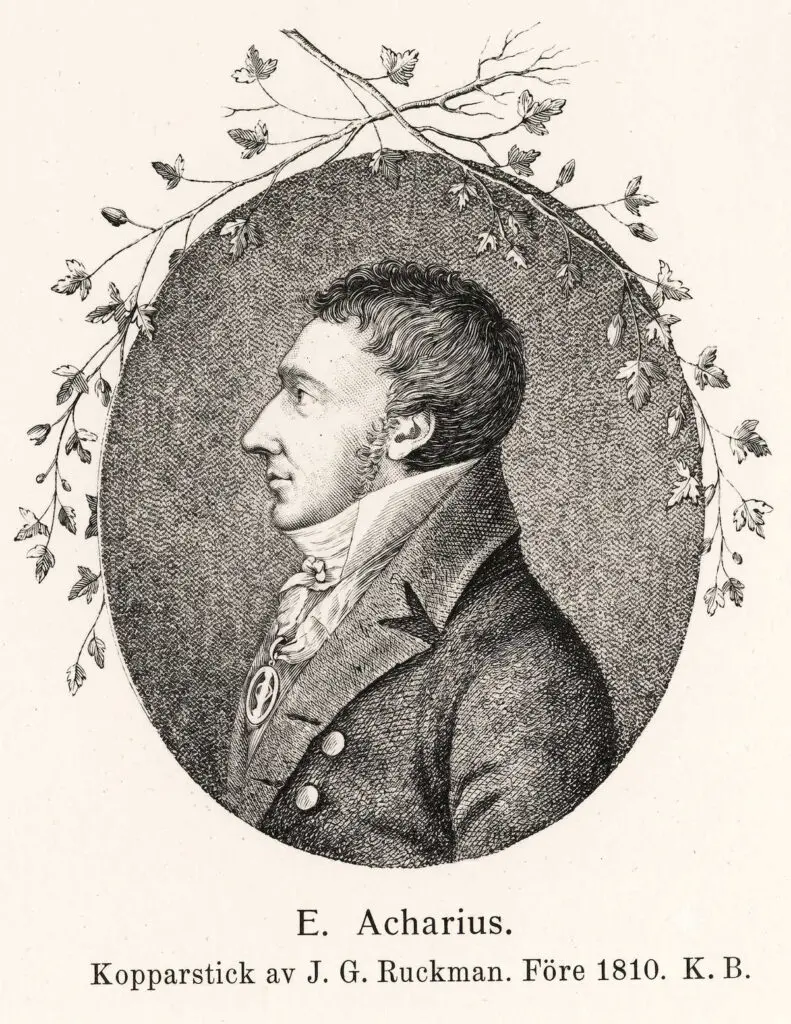
The reporting chain and what it implies
Acharius is not a random name in Swedish science. He is widely described in scholarly and reference sources as a key figure in the development of lichenology, and his broader career placed him inside the learned networks of his time rather than on the fringes of public spectacle.
The English-language presentation of the event is itself an important clue. The report appears as a translation, framed as a communication to the editor and tied back to a Swedish academy publication. That translation pathway matters because it reminds us that we are reading through at least one linguistic lens. Words like “meteor,” “ball,” and “pellicle” are not only descriptions of things in the sky. They are also products of an era’s vocabulary, and of a translator’s choices when moving Swedish scientific prose into English.
None of this undermines the case, but it sets boundaries. We can say with confidence that a translated report exists and contains specific claims about the event. We cannot pretend we possess the raw witness notebooks, verbatim transcripts, or physical samples. That difference is exactly where historical UAP research either stays rigorous or drifts into storytelling.
A final point about “official” status: Acharius’s description is not a state document. It is better understood as a learned communication moving through a scientific institution. The Royal Swedish Academy of Sciences has long described itself as an independent scientific organization devoted to promoting the sciences, and that institutional context helps explain why Acharius would think the event deserved preservation rather than dismissal.
What the Acharius account says happened
According to the translated report, the event took place on 16 May 1808 in the vicinity of Biskopsberga near Skänninge. The weather is described as very warm, with a strong wind from the southwest, and a sky otherwise free of clouds. Around 4 p.m., witnesses reported that the sun became unusually dim, allowing it to be looked at without the normal discomfort, and that its color shifted toward a dark red, described with a brick-like tone.
Soon after, observers reported that a great number of “balls, or spherical bodies” began to rise from the western horizon and travel toward the east. Their apparent size is compared, in human-scale terms, to something like the crown of a hat. Their color is described as dark brown, becoming darker as they approached the region of the sun, and in that vicinity appearing entirely black.
The report then adds motion details that witnesses found striking. Near the sun, the objects were said to slacken in speed, and many appeared almost stationary for a time. After this, they resumed rapid motion and continued eastward, moving “almost horizontally,” eventually being lost toward the eastern horizon. The text also reports that some of these bodies disappeared during transit, while others fell down toward the ground.
Crucially, the event was not a brief flash. Acharius records it as continuing for upwards of two hours, with vast numbers of similar bodies repeatedly rising in the west and traversing the sky toward the east. No accompanying sound was perceived.
Here is where careful reading helps. A historical witness saying “millions” may be expressing “countless” rather than a measured census. Still, the underlying claim remains robust: the observers described a sustained flow of very many discrete, sphere-like forms. The case does not require the exact number to be meaningful.
Excerpt
Account of “an extraordinary and probably hitherto unseen Phenomenon” over Biskopsberga, Sweden, May 16, 1808, reported by E. Acharius in the Transactions of the Swedish Academy of Sciences, 1808:
“At about 4 o’clock, P.M. the sun became dim … At the same time there appeared at the western horizon, from where the wind blew, to arise gradually, and in quick succession, a great number of balls, or spherical bodies, to the naked eye of a size of the crown of a hat, and of a dark brown colour. … [Near the sun] their course seemed to lessen, and a great many of them remained, as it were, stationary; but they soon resumed their former, and an accelerated, motion, and passed in the same direction with great velocity and almost horizontally. During this course some disappeared, others fell down, but the most part of them continued their progress almost in a straight line, till they were lost sight of at the eastern horizon. The phenomenon lasted uninterruptedly, upwards of two hours, during which time millions of similar bodies continually rose in the west, one after the other irregularly, and continued their career exactly in the same manner. No report, noise, nor any whistling or buzzing in the air was perceived.
“Such have been the real circumstances attending this phenomenon, to which all the people in the village can testify. I have drawn up this report from the accounts of none but eye witnesses, and have compared them one with the other; and I cannot doubt the truth of the incidents, having been related to me in a manner agreeing in particulars and details.”
Chains, tails, and the problem of description
The details that make the Biskopsberga report persist in catalogs are also the details most likely to be misread if we rush.
The translated account says that as the bodies slackened near the sun, several appeared “linked together,” sometimes in groups of three, six, or eight, compared to chain-shot joined by a thin straight bar. When they resumed rapid motion, they were no longer seen as linked.
It also states that each body appeared to have a trailing form, described as a tail extending behind it and tapering to a point, fading gradually.
These phrases are often treated as if they were engineering schematics. They are not. They are the best-fit metaphors available to rural observers and a scientific narrator in 1808, translated for readers in 1816. “Chain-shot” is a culturally specific analogy. It conveys alignment and connection, but it does not tell us whether the linkage was physical, optical, or perceptual. A rigorous approach respects what the report actually claims without forcing it into a modern template.
The Wettermark fall and the “cobweb” pellicle
The report’s most concrete-seeming element involves an alleged ground interaction.
Acharius states that some bodies fell a short distance from an observer identified as Secretary K. G. Wettermark, who was watching attentively. During descent, their black color was reported to fade until they almost vanished, then they became visible again close to the ground displaying changing colors, compared to the iridescence of soap bubbles.
When the landing spot was examined immediately, the witness reportedly found a scarcely perceptible film or pellicle, “as thin and fine as a cobweb,” still showing changing colors, then drying and disappearing.
This is trace testimony, and it should be treated as trace testimony. It is a claim recorded in a published account, but it is not preserved physical evidence. That limitation is not a weakness unique to this case. It is a common constraint in pre-twentieth-century anomaly reports, where even sincere witnesses lacked the habit and materials to collect and store residues for later testing.
How Acharius frames witness agreement
One of the most important editorial differences between careful historical work and casual retelling is how we handle witness consistency.
In the translated account, Acharius emphasizes that many people in the village observed the event and that he constructed his report from eyewitness statements. He also reports that, after comparing the accounts, he found them to agree in their essential details.
What we can responsibly say is that Acharius presents the testimony as consistent after his inquiry. What we cannot say is that we possess the underlying, raw statements to independently verify the degree of agreement. This distinction does not diminish the value of the report, but it keeps the wording honest.
Observation versus explanation in an early scientific voice
A particularly publishable feature of the Acharius report is its separation of what was seen from what might explain it.
After describing the event, Acharius explicitly leaves the ultimate cause to more capable investigators. He offers a tentative hypothesis that the strong wind might have carried vegetable substances of a jelly-like nature which, through some process, formed thin globular masses or bubbles visible in sunlight.
Then he immediately points to the gaps. He asks why the sun lost its brightness and how an innumerable quantity of such material could be generated in one place.
That is the right shape of an anomaly report. It documents, proposes, and then admits where the proposal fails.
Why the case belongs in “Wonders in the Sky” style catalogs
Wonders in the Sky, compiled by Jacques Vallée and Chris Aubeck, is best understood as a curated attempt to preserve a long historical record of unusual aerial reports, not to declare a single solution to all of them. A stable bibliographic record exists through major catalogs and listings, confirming the work’s role as a recognized compilation in this niche of historical inquiry.
Within that broader historical frame, the Biskopsberga report is valuable because it reads less like a moralized prodigy story and more like an early naturalist’s case write-up: environmental conditions, timing, repeated forms, a named observer for a claimed trace, and an author who describes traveling to collect testimony after hearing inconsistent rumors.
This is also where the “Sun-Sphere” shorthand earns its keep. It is a handle for a report whose defining features are the dimmed sun and the profusion of sphere-like bodies. Used carefully, it helps readers remember the case without implying historical certainty about naming.
The main interpretive debates, stated conservatively
The Biskopsberga report invites explanation, but it resists tidy closure. The debates around it tend to cluster into a few explanatory families.
One family emphasizes atmospheric and lighting conditions. A dimmed, reddened sun can occur when the air is loaded with fine particulate matter or haze, changing contrast and enabling observers to look toward the sun for longer than usual. Under such conditions, distant drifting material can appear darker and more sharply contoured. The Acharius text supports that the sun’s brightness diminished and that the wind was strong, which is consistent with some kind of transported material even if the source is unknown.
Another family emphasizes airborne biological or botanical material. Acharius’s own suggestion of “vegetable substances” points in that direction. The reported cobweb-like pellicle, the description of an extremely thin film, and the fleeting iridescence near the ground are all at least compatible with fragile, filamentary or membranous material.
Where these explanations strain is also clear, and the strain points are already embedded in the original report. Witnesses describe discrete sphere-like bodies rather than a continuous veil. They describe repeated tails. They describe moments of apparent slowing and near-stationary behavior near the sun. They describe linked chains compared to chain-shots. Even if some of these details could reflect perception and metaphor under challenging viewing conditions, they still function as constraints that any proposed explanation should try to satisfy.
A careful historical approach does not force the reader to pick a single answer. It instead treats the report as an object of study: what was claimed, how it was recorded, what contexts might shape perception, and what remains unresolved given the limits of surviving evidence.
Responsible bridges to modern UAP themes
It is tempting to draw straight lines from this 1808 account to modern “orb” narratives. Those bridges can be useful as long as they are clearly presented as interpretive comparisons rather than as evidence of identity.
Researcher Opinion: The Biskopsberga report is historically notable because it shows that sphere-like aerial forms and group behavior motifs appear in the record long before the technologies that dominate modern UAP imagination. That does not prove continuity of cause, but it does make the report relevant to pattern-based historical study.
Witness Interpretation: A community watching the sun under unusual dimming conditions for two hours may be especially vulnerable to contrast-driven illusions of speed change and connection, even while accurately describing the presence of many moving forms. The report’s value is that it preserves what observers thought they saw, not that it validates a specific modern category.
Hypothesis: If airborne material was present in enormous quantities, the perception of discrete “balls” could reflect clumping, turbulence, or visibility thresholds where only denser parts of a drifting mass were seen as objects. The reported “tails” could reflect trailing filaments or fading visibility behind each perceived clump. This hypothesis remains speculative because the historical record cannot confirm material composition.
What the case implies
The most useful implications of the Biskopsberga report are methodological rather than sensational.
It shows how quickly an unusual event can splinter into inconsistent rumor, and how an investigator can respond by going to the source, interviewing witnesses, and trying to preserve details before they degrade.
It shows why environmental context matters. The dimmed red sun is not decorative. It might be central to both perception and mechanism.
It shows the limits of historical trace claims. A fleeting film, seen and then vanished, is the kind of thing that can be honestly reported and still be impossible to verify later. That reality should encourage humility rather than cynicism.
And it demonstrates why pre-twentieth-century accounts remain relevant to UAP studies. They extend the baseline of human reporting and remind us that not all unresolved aerial narratives are artifacts of modern technology or media.
Claims Taxonomy
Verified
A published English translation (1816) attributed to Erik Acharius exists and describes a dimmed red sun, numerous “balls, or spherical bodies,” apparent chaining, tails, a duration of upwards of two hours, and a reported cobweb-like pellicle after some bodies fell.
Probable
Acharius reports that he traveled to obtain an exact account after hearing inconsistent rumors, and he presents the multi-witness testimony as consistent after comparison, although the underlying raw statements are not preserved in the published translation.
Disputed
The cause remains unresolved. Naturalistic explanations may account for portions of the narrative, but surviving documentation does not allow a definitive attribution, and the residue claim cannot be independently tested today.
Legend
In its published form, the report is framed as an observational account of an unusual atmospheric event rather than as a religious or mythic narrative.
Misidentification
Not demonstrable from available documentation; the record does not contain decisive information that would allow confident re-attribution to a specific known phenomenon.
Speculation Labels
Hypothesis
A windborne mass of fragile airborne material, viewed under unusual solar dimming conditions, produced the appearance of numerous dark sphere-like forms with trailing structures, with occasional near-ground deposition creating a brief iridescent film that rapidly dried and disappeared.
Witness Interpretation
Changes in apparent speed and the impression of objects becoming nearly stationary near the sun may reflect viewing geometry, contrast effects, and shifting visibility in a bright field, rather than deliberate motion changes.
Researcher Opinion
The case remains worth preserving because a named scientific author reports conducting local inquiry, presents the event as witnessed by many residents over a long interval, and records distinctive motifs including apparent chaining and a transient residue claim, while also acknowledging explanatory gaps.
References
Acharius, E. (1816). Account of an extraordinary meteoric phenomenon (J. C. Hauff, Trans.). The North-American Review, 3, 320–322. (https://www.jstor.org/stable/25121204 Archived access via JSTOR; may require subscription).
Kungliga Vetenskapsakademien. (n.d.). Royal Swedish Academy of Sciences, institutional context: https://www.kva.se/en/about-us/history/ History.
Erik Acharius biography (scientific background):
https://snl.no/Erik_Acharius
Store norske leksikon. (n.d.). Erik Acharius.
Vallée, J., & Aubeck, C. (2010). Wonders in the Sky: Unexplained Aerial Objects from Antiquity to Modern Times. Tarcher/Penguin. (https://books.google.com/books/about/Wonders_in_the_Sky.html?id=XINLC2ubHqwC Bibliographic listing and catalog record).
SEO keywords
Biskopsberga Sweden 1808, Skänninge UAP report, Sweden Sun-Sphere, Erik Acharius meteoric phenomenon, spherical bodies 1808, cobweb pellicle residue, Wonders in the Sky Vallée Aubeck, pre-twentieth-century UAP accounts, historical Swedish UAP case