
Marseille has always had an extra relationship with the horizon. A port trains people to read the sea and the sky the way other places read fields. In the early seventeenth century, that habit mattered even more than it does now, because weather, shipping, and coastal security were daily concerns rather than background noise. The result is that when something unusual was thought to be happening overhead near Martigues, the story had an obvious audience. It belonged to the maritime corridor, and Marseille was the nearest major point of reference.
The case survives because it was printed.
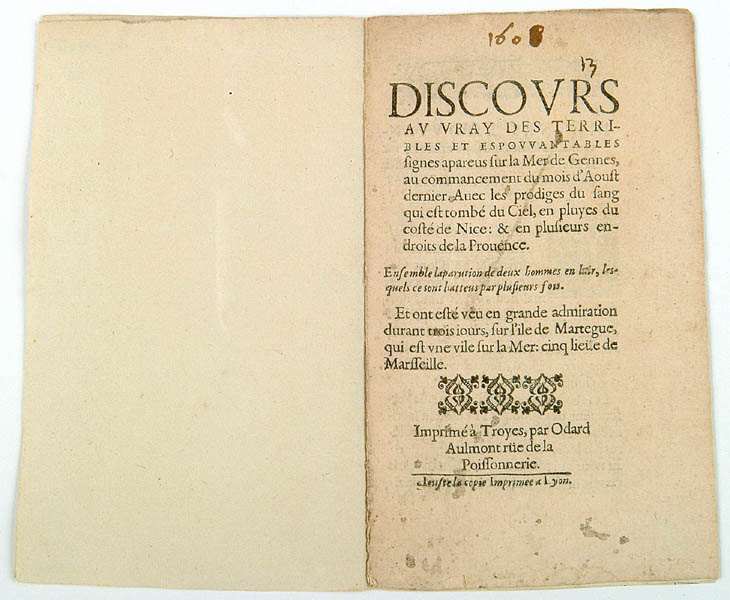
In 1608, an anonymous French pamphlet, printed in Troyes by Odard Aulmont, circulated under the title Discours au vray des terribles & espouventables signes apparus sur la mer de Gennes… The title page advertises a bundle of “signs”: prodigies on the sea near Genoa, “blood” falling in rains near Nice and elsewhere in Provence, and “the apparition of two men in the air” who fought repeatedly and were seen “during three days” above the Île de Martigues, described as “a town on the sea, five leagues from Marseille.”
That title framing is the fixed point for everything that follows. It establishes what the pamphlet claims, where it locates the event, and how it wants the reader to understand it. The author is not writing in the language of later scientific reporting. This is prodigy literature: part news, part rumor transmission, part moral instruction. Scholarship on French “canards” and pamphlet culture emphasizes that these prints commonly mixed reportage, rumor, and moral messaging, and they were designed to move quickly through public conversation.
None of that makes the pamphlet useless. It tells us what was being said in 1608, what details were considered worth preserving, and how a coastal community could experience the sky as something more than weather. For historical UAP work, that documentary footprint is exactly what can be evaluated carefully.
What the 1608 pamphlet actually says
The Martigues passage is not a single line tossed into a sensational title. It reads as a structured sequence with time markers and escalating elements.
The pamphlet states that in the town on the Île de Martigues, “almost at the same time” as other prodigies, on the 22nd of August, “two men appeared in the air,” each holding weapons and shields. They fought in a way that astonished spectators, rested briefly, and returned to combat for a total duration of about two hours.
Then the text returns to the phenomenon with additional dates and changing “modes,” which is one reason the report continues to stand out among early modern “wonders” accounts.
On the 26th, the two were said to fight on foot, clashing so that it sounded like blacksmiths striking an anvil. The next day they appeared to be on horseback, making their horses “vault” like soldiers. On the following day, the author says it seemed certain that each had seized a bulwark or fortress, facing the other. A noise “like cannon shots” followed, described as terrifying. After “continuing those days” for seven hours, a thick cloud suddenly appeared, obscuring the scene so completely that for two hours nothing could be seen but dark fog and clouds, and the air smelled “like saltpeter.” After the air cleared, nothing remained visible.
Those are the claims as preserved in the source. Everything else, including modern reconstructions of what “two men in the air” might map onto, is interpretation.
A built-in timeline ambiguity that should remain visible
There is an internal tension in the pamphlet’s chronology that is easy to blur in retelling and better to keep explicit.
The title page says the figures were seen “during three days” over Martigues.
The body text also names a sequence beginning on the 22nd and then continuing on the 26th, with events on “the next day” and “the day following.”
Several reconciliations are possible without assuming bad faith: the title may summarize the principal run of activity as three days (for example 26–28) while the body preserves an earlier preliminary sighting on the 22nd; the dates may have been imperfectly harmonized from multiple reports; or the author may have compressed or expanded the story in the course of compilation. With the present evidence base, the safest approach is to report the tension rather than resolve it.
Why Marseille is part of the case even though the scene is Martigues
The pamphlet is careful about distance: Martigues is the stage, but Marseille is the anchor. “Five leagues from Marseille” is not just geography; it is editorial targeting, a way to tell readers where to place the event on their mental map.
It also locates the incident in a distinctive coastal environment. Martigues sits between the Mediterranean and the Étang de Berre, functioning historically as a fishing and maritime town shaped by water routes and channels. (Encyclopedia Britannica) That setting matters because coastal air layers can produce striking visual effects, and coastal communities also contain the social infrastructure of watchers: people outside, people scanning the sky, people who talk to each other fast because their work depends on it.
None of this explains the case. It explains why a case like this could be observed, shared, and printed with enough intensity to survive four centuries.
The August 1608 “prodigy cluster” and the discipline it requires
The 1608 pamphlet is not a single-incident record. It is a cluster narrative tying together multiple anomalies around the Ligurian Sea and Provence.
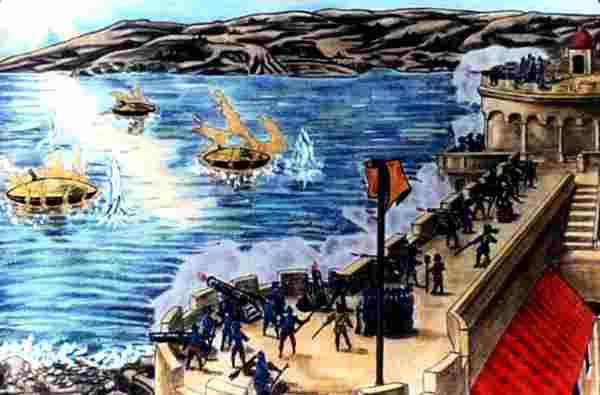
In addition to Martigues, the pamphlet describes prodigies over the sea near Genoa and claims that authorities fired cannon shots at frightening forms without effect. It also describes an August 15th event near Genoa involving “three coaches” over the sea drawn by fiery figures, circling and plunging back into the water.
Separately, it reports red staining interpreted as “blood rain” along the coast “from Nice to Marseille,” naming towns and places in Provence.
This is where Wonders in the Sky is useful, not because it “solves” Martigues, but because it models the correct hygiene for bundled pamphlet material. Vallée and Aubeck explicitly caution that the Genoa events have often been confused with unrelated bloody-rain reports between Nice and Lambesc.
That warning applies as a method to the whole pamphlet: shared publication does not guarantee shared cause. The Martigues “aerial duel” should be treated as a discrete sub-case anchored to its own passages, even while acknowledging its original circulation inside a broader prodigy package.
“Official study” in early modern Provence: the Peiresc parallel
It is reasonable to ask what counts as “official study” for 1608. Modern readers may expect a government commission or an academic paper. But early modern Europe often handled strange natural reports through the work of learned investigators whose conclusions circulated through correspondence networks and later biographical records.
For the “rain of blood” motif, Nicolas-Claude Fabri de Peiresc provides a relevant example from the same year. A reference account describes how, in 1608, when red splashes were popularly feared as “rain of blood,” Peiresc investigated and concluded the red matter came from butterfly chrysalides rather than literal blood.
This does not verify or invalidate the Martigues duel. It does something more valuable: it demonstrates that the same cultural moment contained both prodigy interpretation and empirical investigation. Some anomalies in the 1608 cluster are consistent with mundane mechanisms and were approached that way by contemporary investigators. The implication is not “therefore all the rest is mundane,” but rather “treat each claim independently.”
That independence is especially important in prodigy literature because these pamphlets were built to bundle and intensify.
Separating documentary reality, social reality, and event reality
For a publication-ready historical case, three layers should remain distinct, because each can be supported to a different degree.
Documentary reality is the strongest layer here. A 1608 pamphlet exists with the stated title framing, and it can be consulted via a Gallica scan and a readable transcription.
Social reality is also well supported. Whatever the underlying cause, the story was compelling enough to be printed, and the pamphlet explicitly frames the events as morally urgent signs meant to prompt prayer and penitence. Whether the reaction was widespread or localized, the author’s framing reveals the expected social function of the report.
Event reality is where caution is appropriate. The pamphlet claims a structured aerial display lasting multiple days, with sound and a saltpeter-associated smell, culminating in obscuration by cloud and disappearance. But the surviving, commonly cited core for the Martigues duel remains heavily anchored to this single printed artifact. That means the existence of the report is strong; the mechanics behind it remain unresolved on this evidence base alone.
The embellishment problem, strengthened with better historiography
Historic UAP cases often attract later retellings that add modern features. The pattern is familiar: an older report framed in the vocabulary of its era gets “translated” into contemporary imagery until it begins to resemble modern close-encounter narratives. This is not unique to UAP history; it is how folklore and popular history operate when primary sources are distant and hard to access.
A useful way to address this without leaning on weak catalog citations is to cite scholars and reviewers discussing source limits and contamination. A review in the Journal of Scientific Exploration (discussing historical UAP scholarship) praises careful methodology while explicitly warning modern readers about earlier print cultures where wild stories could circulate, hoaxes could be treated as entertainment, and even reputable names might be attached to newspaper yarns. (journalofscientificexploration.org) That warning maps neatly onto why the Martigues pamphlet must be handled with care: even honest witnesses and sincere authors can transmit composite stories in a culture that rewards prodigies.
Jacques Vallée’s own work also supports a disciplined stance toward “scene-like” elements in encounter narratives. In “Passport to Magonia”, he discusses cases in which it is tempting to interpret bizarre details as a “scene designed to be recorded,” and he treats absurdity and cultural resonance as meaningful features of the phenomenon’s narrative layer rather than as straightforward mechanical description. Whether or not one accepts his broader framework, the methodological point is applicable: details can be shaped by expectations, and reports can read like staged tableaux.
In Marseille 1608, the risk is not that the case is worthless. The risk is that later retellings retrofit the pamphlet into a modern template and then that retrofitted version circulates as if it were original. The best protection is to keep the evidentiary core tied to the 1608 text and to treat later “craft and occupants” motifs as separate traditions unless an independent primary document is located.
A historically grounded reading of “two men in the air”
The phrase “two men in the air” is both vivid and non-technical. That matters. Seventeenth-century observers did not have the vocabulary of aviation, propulsion, drones, or aircraft silhouettes. When they described unfamiliar aerial phenomena, they reached for available imagery: warfare, divine signs, chariots, armies, monstrous forms, and human figures.
This does not mean the report is “just a metaphor.” It means the report is an interface between perception and language.
The Martigues passage also contains features that push it beyond the simplest categories. The text emphasizes duration and recurrence, as well as a progression of forms across days: foot combat, horse combat, then a fortress-like standoff. The acoustic component is described as cannon-like, and the obscuring cloud is described with a saltpeter-like smell.
From a strictly historical standpoint, several interpretive pathways remain open without overcommitting.
One pathway is atmospheric optics combined with narrative stabilization. A coastal environment can produce layered air and haze effects, while a community primed by prodigy expectation may interpret ambiguous shapes as legible “actors.” If a second-day event occurred, the story could crystallize and elaborate.
A second pathway is composite reporting, in which multiple stimuli (weather, smoke, distant firing, storm acoustics) are gathered into a single narrative arc after the fact. This is a common mechanism in historical oddities reporting, especially in pamphlet culture.
A third pathway is that something genuinely anomalous, in the sense of “unattributed by the reporting culture,” was perceived and described using the closest available representational language. This is not a claim of extraterrestrial origin; it is simply a recognition that “unknown” is an available category when the report’s structure exceeds a clean match to a single mundane explanation.
The correct publication posture is to keep these as interpretive options and to refrain from declaring one as settled without additional contemporaneous corroboration.
Why this case remains important in pre-twentieth-century UAP work
Marseille 1608 matters less as a proof and more as a pattern marker.
It preserves an early modern example of a “performative” aerial episode, one described not as a single light but as an unfolding sequence with characters, duration, and a curtain-like obscuration.
It demonstrates how coastal societies turn unusual sky events into shared public narratives quickly enough to reach print, with Marseille serving as the geographic anchor for relevance. (Encyclopedia Britannica)
It also shows why source hygiene is not optional. Bundled prodigies require disentangling, as Vallée and Aubeck explicitly warn in relation to Genoa and the bloody-rain reports. And the broader historiography cautions that early print cultures often blurred the line between sincere report, moral framing, and sensational packaging. (journalofscientificexploration.org)
Finally, the blood-rain component illustrates a parallel track of inquiry inside the same era: Peiresc’s 1608 conclusion that red deposits came from butterfly chrysalides shows that empirical investigation existed alongside prodigy interpretation.
Taken together, Marseille 1608 becomes a compact lesson in how to read deep history: not with dismissal, not with certainty, but with layered evaluation.
Evidence
The 1608 pamphlet title page explicitly advertises “the apparition of two men in the air” over Martigues, “five leagues from Marseille,” described as occurring “during three days.”
The pamphlet body text describes an initial sighting on August 22 and further episodes beginning August 26 and continuing over subsequent days, with variations in perceived form, cannon-like sound, and an obscuring cloud described as smelling like saltpeter.
The pamphlet also reports red staining interpreted as “blood rain” along the coastal corridor from Nice to Marseille, naming multiple towns in Provence.
Peiresc’s 1608 investigation of “rain of blood” is documented in reference literature describing his conclusion that the red material derived from butterfly chrysalides.
Claims Taxonomy
Verified
A 1608 printed pamphlet exists (attested via a BnF Gallica scan/record and a modern transcription) that reports an aerial duel over Martigues near Marseille and includes the explicit framing “five leagues from Marseille.”
Disputed
The claim that two literal humanoid figures fought in the air across multiple days with cannon-like sound and a saltpeter-scented obscuring cloud. The claim is source-attested but remains anchored primarily to this pamphlet tradition in the commonly cited corpus.
The claim that a distinct external aerial phenomenon occurred exactly as described, rather than narrative amplification, composite reporting, or misperception shaped by prodigy culture. The documentary claim is strong; the underlying mechanics remain open on present sourcing. (journalofscientificexploration.org)
Misidentification
Some “blood rain” reports from the same regional window are consistent with natural explanations documented by contemporary investigation (for example Peiresc’s butterfly-chrysalides conclusion), even if contemporaries interpreted them as literal blood.
Hoax
Not established. The pamphlet belongs to a sensational prodigy genre, but the cited sources do not provide decisive evidence that the Martigues duel was deliberately fabricated as a hoax rather than transmitted belief, rumor, or a composite narrative built from lived stimuli.
Speculation Labels
Hypothesis
A visually ambiguous aerial and atmospheric sequence over a coastal environment, combined with strong narrative framing inside prodigy culture, produced a stable “aerial duel” interpretation that persisted long enough to be printed.
A non-human intelligence or anomalous agency produced a display that was legible within early modern symbolic vocabulary (combatants, cavalry, fortifications), consistent with a broader pattern in which reports often resemble staged scenes designed to be recorded and repeated in culture.
Witness Interpretation
The pamphlet frames the events as divine warning signs and urges prayer, fasting, and penitence, presenting the prodigies as prompts for moral reform.
Researcher Opinion
The Martigues duel should be treated as a discrete historical case anchored to its own passages and not merged with the Genoa narratives or later modernized retellings unless additional independent primary documentation is identified.
References
Anonyme. (1608). Discours au vray des terribles & espouventables signes apparus sur la mer de Gennes, au commencement du mois d’aoust dernier… Ensemble l’apparition de deux hommes en l’air… Troyes: Odard Aulmont. Gallica scan and metadata record.
Anonyme. (1608/2022). Discours au vray des terribles & espouventables signes apparus sur la mer de Gennes (transcription). Wikisource.
Peiresc, N.-C. F. de. (1608; biographical summary). “Peiresc, Nicolas Claude Fabri De.” Encyclopedia.com.
Pillière, L. (2020). [Thesis on French canards and pamphlet culture] (University of Warwick).
Vallée, J. (1993). Passport to Magonia: On UAP, Folklore, and Parallel Worlds (PDF edition as archived).
Vallée, J., & Aubeck, C. (2010). Wonders in the Sky: Unexplained Aerial Objects from Antiquity to Modern Times. (Method note on conflation of Genoa events and bloody-rain reports).
Journal of Scientific Exploration. (2016). Book review: Return to Magonia (methodological caution about historical sources and the need for modern readers to beware of hoax cultures in earlier print environments). (journalofscientificexploration.org)
Internal links
Jacques Vallée: The Father of Modern UAP Studies
The Control System Theory of UAP
Medieval Arabic Texts and UAP: A Comparative Perspective
Ancient Greece, Greek Mythology and UAPs
SEO Keywords
Marseille 1608 UAP, Martigues aerial duel, Île de Martigues prodigy 1608, Discours au vray terribles espouventables signes, Gallica bpt6k55234929, Odard Aulmont Troyes 1608 pamphlet, Provence blood rain 1608, Peiresc butterfly chrysalides 1608, pre-20th-century UAP France, Wonders in the Sky Vallée Aubeck historical cases