
There are UAP stories that begin with the sky, a distant light drifting over treetops, a blink-and-you-miss-it streak, a silhouette that vanishes the second you try to focus. And then there are the cases that begin where you live. In the kitchen. In the hallway. In the place where you keep your children safe and your doors locked. The Andreasson Affair belongs to that second category, which is one reason it has never stopped bothering people.
It is also the sort of case that can tempt a writer into overstatement. This is an abduction narrative with multiple witnesses in the same house, a date that investigators tried to pin down with records, and a long, vivid “contact sequence” that largely emerged later through hypnotic regression. That combination makes it powerful, and it makes it precarious. The story has anchors that deserve respect, and it has sections that must stay clearly marked as regression-derived testimony rather than confirmed external events.
Before we go deeper, a useful piece of orientation. UAP reports sometimes involve alleged traces and aftereffects: odd rings on the ground, localized impressions, geometric marks, a pattern that looks “punched” into soil, or transient markings on skin. In UAPedia’s editorial ecosystem, recurring patterns like that are sometimes grouped under the label “residual geometric tracings.” It’s an internal way of naming a motif across reports, not a standardized scientific term and not a formal category used by most official investigative frameworks. The Andreasson Affair is not primarily known as a trace case. Its evidentiary interest is mainly in the household disruption, corroborating testimony, and the contested memory-retrieval zone that later shaped the abduction narrative.

A winter home, a family under strain, and a date that sticks
Raymond E. Fowler’s published investigation places the central event on Wednesday, 25 January 1967, in South Ashburnham, Massachusetts. That specificity matters. Classic abduction cases often drift around in “sometime in the sixties” fog. Andreasson is presented with a calendar day, a household roster, and a set of circumstances that can be checked.
Those circumstances include the family’s stress and schedule. Betty Andreasson’s husband, James, had been severely injured in a car accident on 23 December 1966. Fowler reports that investigators checked hospital records and that James was transferred to a Veterans Administration hospital near Boston on 23 January 1967, remaining hospitalized until 17 March 1967. That backdrop is not decoration. It explains why grandparents were living in the home, why routines were rigid, and why a disruption to power and light in the house would land like a hammer blow.
In Fowler’s telling, the evening begins normally, the family watching television, and then the electricity starts flickering before cutting out. A pulsing pinkish light appears through the kitchen window. In many UAP accounts, light is the first “instrument” of control, not necessarily a thing in the sky but a phenomenon that enters a witness’s environment and perception. Here, the light is described as close enough to paint the walls, and it arrives with the kind of abruptness that makes a family stop talking mid-sentence.
The case’s tone is set right there. This is not a story about scanning the heavens. It is about an intrusion into the domestic.
The “hard anchors,” stated correctly
One of the strongest improvements you can make in any abduction case write-up is to be precise about what has actually been independently reproduced, versus what a primary investigator reports having checked. The Andreasson Affair includes both, but the distinction matters.
Fowler reports that investigators checked hospital records, power-company records, weather records, and television listings to test whether the family’s timeline cohered with external data. The most cited of these checks involves the Ashburnham Municipal Light Company. Fowler writes that municipal records show a power failure occurred in Betty’s neighborhood on 25 January 1967 and that it was traced to a defective component that was replaced the following day.
The limitation is just as important as the claim. Fowler notes that the exact time of the failure was not preserved in the record. So the record supports “there was an outage on that date,” but it cannot, by itself, prove the outage happened at precisely the moment the family reports the pinkish light and intrusion. That does not weaken the case into nothing. It simply prevents a common error: sliding from date-correlation into time-locked verification.
Fowler also reports that weather station logs were consistent with the family’s description of winter conditions, and that TV listings matched the program the family remembered watching. These too are “Fowler-reported checks.” They are valuable because they show investigative intent and coherence, but they are not the same as publishing the raw documents for independent replication.
That’s the correct evidentiary posture. Stronger than pure anecdote, weaker than fully reproducible documentation, and still meaningful.
The piece many people miss: a signed statement from another witness
Abduction literature is full of solitary witnesses. Andreasson is famous partly because it is not solitary.
Fowler includes a signed statement from Betty’s father, Waino Aho, describing what he believed he saw through the pantry window after the light appeared. He describes “creatures,” compares them to “Halloween freaks,” and emphasizes their odd movement, “jumping like grasshoppers.” He also writes that he told his wife not to look.
This statement does not “prove” entities entered the house. Skeptical readers can fairly ask about memory drift, later influence, and whether the language of “creatures” reflects interpretation rather than neutral description. But as evidence, it is significant because it is first-person, signed, and associated with the same household disruption. It strengthens the claim that multiple people experienced something they interpreted as extraordinary, even if only one person becomes the primary narrator of the later contact sequence.
In court-of-law terms, it’s corroborating testimony for the disruption and perception of an anomalous presence, not forensic proof of a craft.
Why the story became detailed years later
If you want to understand classic abduction cases as a genre, you have to understand delay. Witnesses rarely deliver a full, cinematic narrative immediately. They often carry fragments: missing time, nightmares, fear reactions, intrusive imagery, and a sense that something happened that their conscious mind refuses to assemble into a single timeline.
Andreasson fits that pattern. Fowler’s account emphasizes the later investigative phase, when the narrative became structured through interviews and hypnotic regression. Some summaries of the case note that Betty reached out to J. Allen Hynek, and that the case gained traction in the mid-1970s when she sought formal investigation.
It is easy to misread this delay as a red flag. Sometimes it is. But delay can also reflect stigma, fear, and the very human reality that saying “something came into my house” can cost you friendships, work, and family stability. Whether the event was external, internal, or a blend, the social penalty for reporting is real.
Hypnosis, stated without romance
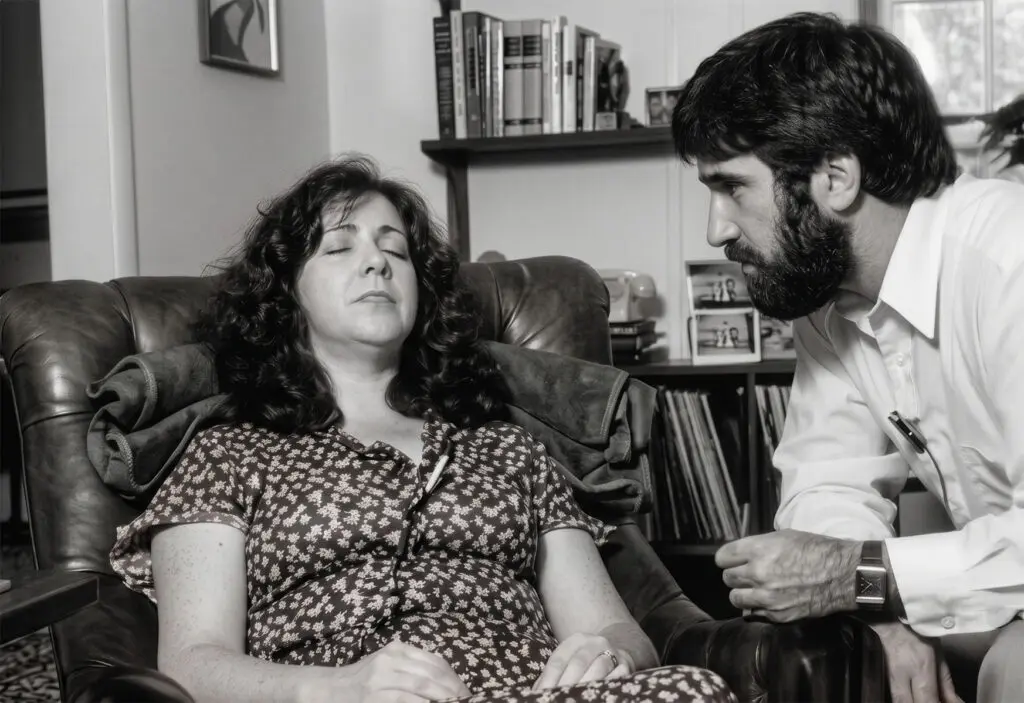
The Andreasson Affair stands on a fault line that divides much abduction research. Its most elaborate and most famous elements are largely regression-derived, and hypnosis is controversial because it can generate confident memories that are not reliable.
This is not merely an internet talking point. Medical and psychological discussions have repeatedly warned that recollections obtained during hypnosis can include confabulations and “pseudomemories,” and that hypnosis can inflate confidence in inaccurate recall.
So in Andreasson, the responsible approach is straightforward. The household disruption and corroborating witness statement deserve weight as testimony about an anomalous event in the home. The craft interior, the medical procedures, the “blue book,” the phoenix imagery, and overt religious messaging are best treated as regression-derived testimony: important as part of what the witness reported and experienced, but disputed as historical fact.
Fowler’s own writing reflects this tension. He documents the narrative while also acknowledging interpretive hazards and the possibility of subconscious shaping. That internal caution is part of the record, and it should travel with the case wherever it is retold.
What Betty reported, with the caveats kept close
When people say “the Andreasson Affair,” they usually mean the full contact sequence: the entities in the home, the immobilization of others, the removal of Betty, and what happens afterward. Nearly all of that detail is presented as regression-derived testimony.
In Fowler’s account, the household becomes strangely hushed, family members appear immobilized or held in place, and Betty is the one who remains interactive. The narrative then shifts into an environment described as craft-like, where examination and communication occur.
Two regression-derived elements are central to the case’s fame.
The first is the medical motif. In the regression narrative, Betty describes an instrument inserted into her nostril, and when it is withdrawn, she describes a small object appearing on the end, a “ball” with prickly features. Fowler raises the question of whether this resembles an “implant” scenario, but it remains interpretive. The case does not provide an independently recovered object with a chain of custody. The “implant implication” is therefore best treated as witness testimony and researcher inference, not as verified physical evidence.
The second is the visionary sequence, including a phoenix-like bird and a death-and-rebirth theme accompanied by sensory description, such as an incense-like smell. Fowler discusses the phoenix symbolism and compares it to historical treatments of the motif. Whatever your conclusion about the event’s external reality, this part of the report shows how abduction narratives can blend the clinical and the mythic. It is one of the reasons Andreasson still grips readers who are not otherwise interested in “medical exam” accounts.
Then there is the “blue book,” another regression-derived motif. Betty describes a thin blue volume, allegedly left behind, filled with symbols and framed as restricted knowledge. In the story, it is hidden, briefly examined, and then disappears. It is a classic almost-artifact: physical enough to spark the investigator’s imagination, elusive enough to resist documentation. In an evidence-weighted reading, it functions more like a symbolic object inside the narrative’s logic than like an item we can test.
Finally, there is the religious messaging, including exchanges that connect the experience to spiritual themes. These claims should remain explicitly tagged as regression-derived and interpreted through the witness’s framework, especially because Fowler himself notes the risk of subconscious contribution.
That’s the key discipline. You can discuss these details without granting them evidentiary status they do not have.
Publications, history, and why this case became “classic”
The Andreasson Affair entered public awareness primarily through publication. Fowler’s book, The Andreasson Affair, is the foundational text for the case.
A sequel, The Andreasson Affair, Phase Two, was published in 1982 by Prentice-Hall and is cataloged as a continuation of the investigation.
The case also quickly attracted a structured skeptical critique. Ernest H. Taves reviewed it in Skeptical Inquirer (Winter 1979/1980) and argued that the narrative reads like fantasy elaboration shaped by regression and expectation. This critique matters not because it “solves” the case, but because it defines the strongest skeptical position: that the household disruption may be real, but the elaborate abduction storyline is primarily a product of memory reconstruction under hypnosis.
The persistence of Andreasson across decades, through multiple editions and continuing discussion, is itself part of the case’s impact. It became a reference point in the broader abduction canon, alongside the Hills, Pascagoula, Travis Walton, Allagash, and others. It’s one of the stories that helped set public expectations for what “abduction” means, for better and for worse.
That’s also why it must be handled carefully. Once a case becomes archetypal, it begins to feed back into new testimony. People reach for the language they already have. Researchers unconsciously cue witnesses toward familiar motifs. Pop culture amplifies the loop. Andreasson sits right in the era where those feedback effects became pronounced.
What Andreasson suggests about the phenomenon, without pretending to settle it
If you read the Andreasson Affair purely as a literal intrusion by non-human agents, it suggests something deeply unsettling: that an intelligence can operate in close domestic spaces, selectively engaging one witness while neutralizing others, and can shape communication to fit the witness’s symbolic vocabulary, including religious language. In that reading, the visionary and theological elements are not “noise,” but strategy.
If you read the case as primarily psychological, the implications are still serious. It suggests that under stress, in an environment shaped by cultural narratives and personal belief, human memory can assemble intense, coherent experiences that feel externally imposed, and those experiences can reorganize a person’s life. That does not make the witness “lying,” and it does not make the experience trivial. It means the mechanism might not be what the witness believes it is.
A third reading, and one many researchers find hardest to articulate, is the hybrid possibility: that an anomalous disruption occurred, possibly involving unusual light and altered household experience, and that later memory work constructed a detailed narrative around a real but incompletely understood core event. That reading does not satisfy purists on either side, but it fits the evidence mosaic: some parts anchored, some parts fluid.
The Andreasson Affair remains valuable precisely because it resists reduction. It forces a reader to keep track of evidence categories, to respect testimony without turning it into certainty, and to remain alert to the ways method can shape narrative.
Speculation Labels
Hypothesis
A plausible hypothesis consistent with the record is that the experience functioned, for Betty, as an initiation narrative: bodily control and examination motifs paired with symbolic instruction, with the phoenix imagery and “blue book” acting as meaning-scaffolds in a regression-derived storyline.
Witness Interpretation
Betty’s religious framing, including spiritual and eschatological themes, is best treated as her interpretive layer, especially where those elements appear in regression-derived exchanges.
Researcher Opinion
Fowler’s documentation is most persuasive where it stays close to timelines, testimony, and reported record checks, and least decisive where it must rely on regression-derived detail. His willingness to acknowledge interpretive hazards is itself an important feature of the case history.
Claims Taxonomy
Verified
Fowler’s published investigation places the event on 25 January 1967, describes James Andreasson’s December 1966 accident and subsequent hospitalization timeline, and reports that investigators checked external records including municipal power outage information for that date.
Probable
The Andreasson household experienced, or credibly reported, a significant anomalous disruption associated with abrupt power loss, unusual pinkish light, a fear response, and secondary witness testimony describing perceived entities. The municipal outage is documented for the date, though not for the exact time.
Disputed
The detailed abduction narrative, including the craft interior, the nasal instrument and “ball” detail, the “blue book,” the phoenix imagery, and explicit religious messaging, is largely regression-derived. These high-detail claims are therefore disputed and should be interpreted through the known limitations of hypnosis and false-memory risk.
Misidentification
No single conventional explanation is demonstrated in the core published record to account for all reported elements, but specific high-detail regression-derived segments could plausibly reflect confabulation, dream incorporation, or memory distortion, consistent with clinical cautions regarding hypnotically refreshed recollection.
References
Fowler, R. E. (1979). The Andreasson Affair: The documented investigation of a woman’s abduction aboard a UFO. Englewood Cliffs, NJ: Prentice-Hall.
Fowler, R. E. (1982). The Andreasson Affair, Phase Two: The continuing investigation of a woman’s abduction by alien beings. Englewood Cliffs, NJ: Prentice-Hall.
Friedlander, M. D. (1985). Scientific status of refreshing recollection by the use of hypnosis. JAMA, 253, 1918–1923.
Leo, D. G. (2025). Remembering what did not happen: The role of hypnosis in memory recall and false memories formation. Frontiers in Psychology. https://doi.org/10.3389/fpsyg.2025.1433762
Taves, E. H. (1979/1980, Winter). The Andreasson Affair. Skeptical Inquirer, 4(2).
SEO keywords
Andreasson Affair, Betty Andreasson, South Ashburnham Massachusetts, 25 January 1967, Raymond E. Fowler, CUFOS, J. Allen Hynek, Waino Aho statement, abduction case study, hypnosis regression controversy, UAP contact experience, classic abduction cases, missing time, phoenix symbolism, blue book encounter, implant claim analysis