
In UAP history, some cases endure because they come with pristine paperwork, clean timelines, and tidy answers. The Stanford, Kentucky Abductions endure for the opposite reason. They are a knotted, human case, full of fear, physiological complaints, missing time, contested investigative techniques, and the kind of publicity that can both bankroll an inquiry and contaminate it.
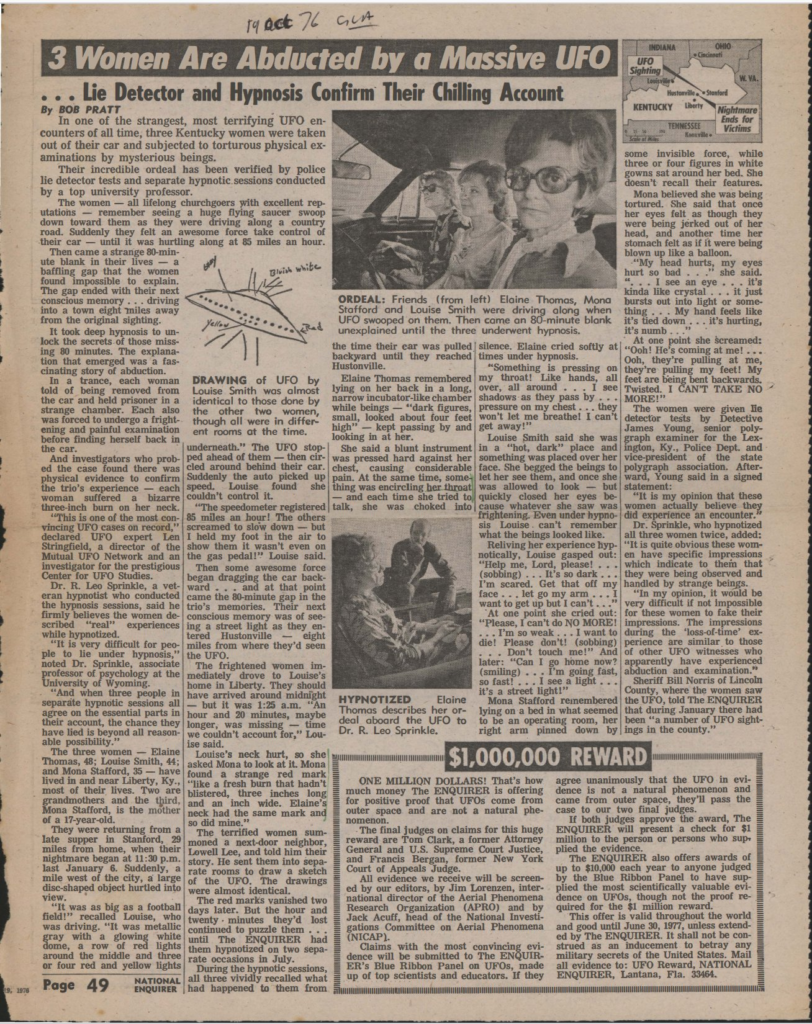
And yet, beneath the noise, the core story remains stubbornly consistent across major civilian summaries from the era: on January 6, 1976, three women, Louise Smith, Mona Stafford, and Elaine Thomas, reported a close-range encounter near Stanford, Kentucky that escalated into a loss of control over their vehicle, a significant time anomaly, and an aftermath they described as physically painful and psychologically destabilizing. The CUFOS/IUR summary later placed the case in its progress-report format and recounted hypnosis-derived abduction claims alongside reported physical effects such as burn-like marks, eye irritation, weight loss, and a watch malfunction. (cufos.org)
If you’re coming to this story for a quick punchline, you will not get one. Stanford is not built for easy certainty. It is built to test how we weigh testimony, how we treat trauma, and how we separate what witnesses say they experienced from what can be independently demonstrated.
Dinner, dark roads, and the first red light
The evening began in a way that feels almost painfully ordinary. The women had been out for a birthday dinner, in good spirits. Leonard Stringfield’s MUFON-era account emphasizes that they had taken “no intoxicants” and were in an “amiable mood” as they left the Redwood restaurant and drove out of town. (sciences-faits-histoires.com)
Where, exactly, were they when it started? Here the record shows a small but important disagreement that good case-writing should not paper over.
A later retrospective profile of investigator Jerry Black describes the women traveling along U.S. Route 27 in Stanford when the encounter began. (citybeat.com)
Stringfield’s MUFON-era reporting, closer to the initial investigative period, says that while traveling out of Stanford and heading for Hustonville they were on Highway 78 when they first noticed the bright red object. (sciences-faits-histoires.com)
Those two details can plausibly describe adjacent segments of the same route. In that area, a driver can be on or near U.S. 27 and then turn onto KY 78 toward Hustonville. What matters most is not the label on the asphalt but the setting the women describe: a rural stretch with treetops, open darkness, and enough isolation that a light in the sky becomes the dominant presence in the world.
They reported seeing a bright red object ahead that initially suggested an aircraft in distress. That’s a detail worth lingering on. Many classic close encounters begin with misinterpretation, not certainty. The mind reaches for the nearest familiar category. The shock comes when the object refuses to behave like anything familiar.
In the CityBeat account, Jerry Black recalls the women believing they were about to witness a crash, only for the object to stop abruptly and then track them. (citybeat.com) In Stringfield’s MUFON write-up, the same emotional pivot appears: Mona Stafford is frightened, thinking it may be an aircraft on fire, until the “glowing object came closer.” (sciences-faits-histoires.com)
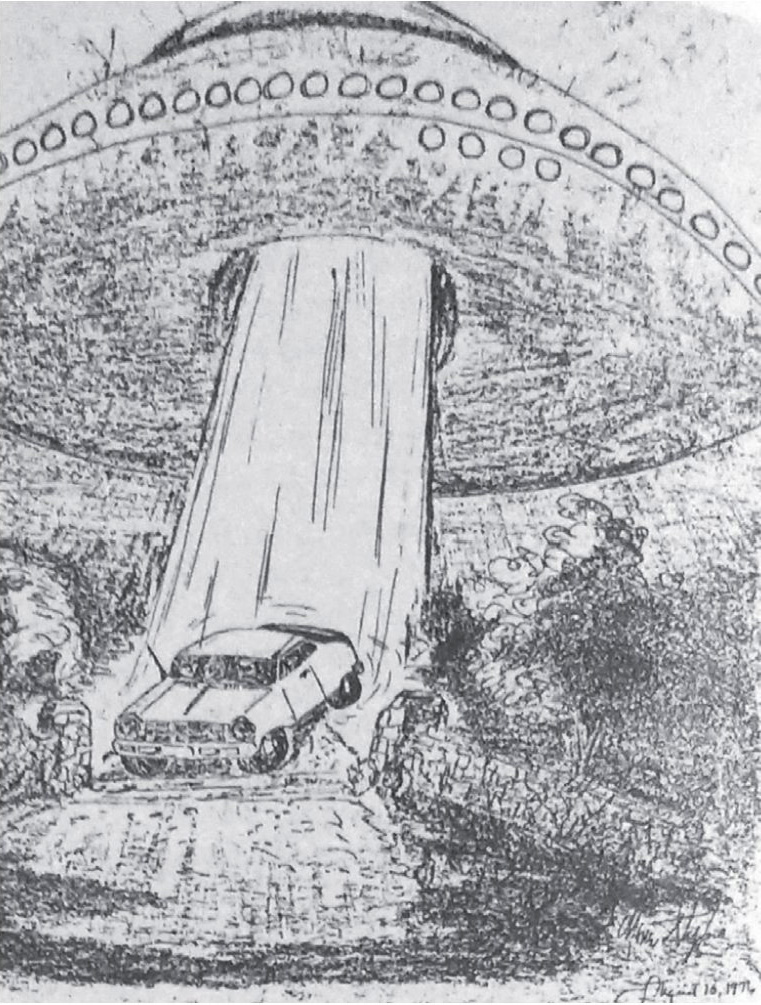
Then the case takes its sharp turn into the classic abduction-era motif set: a UAP close enough to dominate the car windows, a sensation of being acted upon, and a growing realization that the car is no longer entirely “theirs.”
The car that would not obey
The car-control claim is one of Stanford’s most-discussed elements because it is both vivid and difficult to reduce to a single prosaic explanation without stretching.
In later retellings, the most repeated detail is that the car accelerated to roughly 85 mph even as the driver insisted her foot was not pressing the pedal. The CityBeat profile describes exactly that, including the insistence that taking a foot off the gas did not stop the acceleration. (citybeat.com)
The CUFOS/IUR summary gives the encounter’s time as about 11:30 p.m., the duration at approximately 80 minutes, and frames it as a three-witness abduction report with additional effects logged afterward. (cufos.org) That matters, because it shows IUR treating the case as more than a brief sighting. More broadly, IUR’s format routinely distinguished stronger cases from limited-merit or identified reports, and Stanford was included among the former. (cufos.org)
The car-control element is also one of the reasons Stanford stayed culturally sticky. People who have never had a close UAP encounter still understand a car. They understand what it means to lose control at highway speed. The terror in that is immediate, no specialized belief system required.
Yet from an evidentiary standpoint, the car-control claim remains an interpretive bridge between testimony and mechanism. Even if the women are perfectly sincere, and even if their perception is accurate, “why” remains wide open.
The missing time that defines the case
If Stanford had ended with a frightening chase and nothing else, it might sit as a strong multi-witness close encounter. What makes it a classic abduction case is the missing time.
In the CityBeat narrative, the women later realized they had lost “an hour and 25 minutes worth of time.” (citybeat.com) The CUFOS/IUR summary is consistent with the broader framing, giving an approximate 80-minute duration and then describing what emerged under hypnosis. (cufos.org)
Missing time is a deceptively simple phrase for something that can be psychologically shattering. People expect fear to pass. They do not expect time to fracture. When experiencers describe missing time, they often describe it as an aftershock, a destabilizing discovery that reality did not unfold in the order it should.
It is also one of the hardest claims to handle responsibly. Stress can distort time perception. Fatigue can create micro-sleeps. Memory can compress or expand duration. And yet, the abduction literature is full of reports where time loss is not just a feeling but a mismatch between an internal timeline and external clocks.
Stanford sits in that ambiguous middle zone. The women’s conviction about the time loss was strong enough that it became central to the case’s investigative trajectory, but the documentation available in major summaries is not the kind of instrumented timeline a modern field team would crave.
What the CUFOS/IUR summary recorded as reported effects
A good case article does not overclaim. Stanford has physical-effect claims, some described as investigator-observed, but the publicly accessible summaries do not provide a complete set of released medical records that would allow independent diagnosis today. The responsible way to present the effects is as reported, and, where relevant, as described by investigators of the era.
The CUFOS/IUR summary lists reported effects that include strange burn marks on the backs of the women’s necks and exposed skin, blistering under rings (especially for Mona Stafford), burning and tearing eyes, considerable weight loss, a burning sensation when water was applied afterward, and a temporary malfunction of Louise Smith’s watch described as rapid motion. (cufos.org)
In the same CUFOS-associated section, Stringfield describes an on-the-spot investigation in which investigators saw a trace skin burn effect on the nape of Smith’s neck and observed eye inflammation suffered by Stafford, while noting he was still awaiting confirmation of Stafford’s medical treatment in the form of a signed physician statement. (cufos.org)
That last clause is crucial. It shows an investigator trying to move from anecdote toward documentation, and it shows that, at least in this published summary, the file was not fully closed with complete medical corroboration.
There is also a practical artifact mentioned: Stringfield wrote that he received a paid bill as proof that Smith’s car lighting system failed following the close encounter. (cufos.org) A repair bill cannot tell you why something failed, but as a contemporaneous artifact it can anchor a claim in time and demonstrate consequences beyond talk.
This is where Stanford feels like an era-defining case. It exists on the edge of what civilian investigators could document with the tools and norms of the 1970s. There is “harder” data than many abduction narratives provide, but not enough to settle the mechanism.
Hypnosis enters the story, and the story changes
Stanford’s abduction narrative, in the full “onboard” sense, largely entered public circulation through hypnosis.
The CUFOS/IUR summary states that, under hypnosis, all three women related similar tales of abduction into a craft described as enormous, with a glowing white dome, red lights around the middle, and additional lights underneath. The women described small dark humanoids around four feet tall, and all three reported being subjected to a physical examination they experienced as torturously painful. (cufos.org)
Those details are familiar to anyone who has studied classic abduction reports. That familiarity is precisely why the hypnosis layer has to be handled with care. It is not that hypnosis automatically produces falsehood, but that it can produce confident narrative elaboration, including pseudomemories, especially when interviewer expectations, prior media exposure, and repeated questioning are present.
The National Institute of Justice summarizes the forensic concern plainly: research has not shown hypnotized witnesses to be more accurate, and hypnosis can create pseudomemories that the witness cannot distinguish from original recollections. (nij.ojp.gov)
So where does that leave Stanford?
It leaves the case with two layers of content that must be weighed differently. The first layer is the shared, wakeful encounter report: the light, the proximity, the fear, the car-control anomaly, and the time gap. The second layer is the hypnosis-derived abduction narrative, which may reflect recovered memory, symbolic reconstruction, confabulation, or a blend.
A serious reader should be allowed to hold both truths at once: the woman may be sincere, and hypnosis may still be an unreliable tool for reconstructing exact events.
The polygraph: sincerity, not mechanism
Stanford also includes a polygraph component, often cited to argue the women were not consciously fabricating their story.
The CUFOS/IUR summary reports that Detective James Young of the Lexington Police Department administered polygraph tests and concluded it was his opinion that the women actually believe they experienced an encounter. (cufos.org) That is not the same as “therefore it happened exactly as described,” but it is significant in one narrow and meaningful way. It supports the claim that the witnesses were not simply telling a story they knew to be false.
Polygraphs, however, are not truth machines. The National Academies’ review of polygraph research concluded that specific-incident polygraphs can discriminate lying from truth telling at rates well above chance, though well below perfection, and that accuracy varies widely across studies and conditions. (nationalacademies.org)
So the polygraph can be presented as an element that supports witness sincerity under test conditions, without pretending it resolves the underlying UAP question.
Publicity and the contamination problem
Stanford’s history includes an uncomfortable detail that cannot be ignored: tabloid involvement.
In the CUFOS/IUR summary, Stringfield notes that the story broke nationally in October 1976 and that investigator Jerry Black contacted the National Enquirer, arranging financial help for the women that included a professional polygraph and additional hypnosis work. (cufos.org)
Whatever you think of the Enquirer’s editorial culture, this creates a real methodological tension.
Financial support can be compassionate, especially when witnesses face medical expenses, harassment, or the inability to work. But publicity also invites narrative pressure. It can push witnesses toward a more dramatic telling. It can reward certainty over nuance. It can attract opportunists, and it can shape the way investigators themselves approach the story.
The later CityBeat profile captures this broader tension through Jerry Black’s own frustrations with money and sensationalism in the UAP field, even as he describes the Kentucky case as one that still baffled him. (citybeat.com)
If Stanford had remained a quiet file in a local newspaper and a couple of investigative newsletters, it might look cleaner today. But then it might not have been investigated as extensively at all. That is the paradox of many classic cases: the attention that makes them famous is also what makes them harder to evaluate.
Corroboration: the kind we have, and the kind we want
Stanford is a three-witness case, and that alone gives it a different structure than most solitary abduction claims. Three people in the same car, experiencing the same unfolding event, can corroborate the basic arc even if they differ on specifics.
But independent corroboration outside the car is thinner in the best-known published summaries than many casual retellings suggest.
The CUFOS/IUR report emphasizes a diversified evidentiary picture, including physiological complaints, reported electromagnetic and animal reactions, and other UAP reports in the general Casey County area that same night, described as lending correlative substantiation. (cufos.org) That phrasing is careful: correlative, not conclusive.
Modern readers often want something Stanford does not clearly provide in public documentation: named independent witnesses with preserved statements, contemporaneous police reports released in full, medical documentation available for independent review, or instrument data.
That absence does not disprove the case, but it keeps the case in a “strong but incomplete” evidentiary posture. Stanford remains important partly because it shows the limits of what could be captured in a pre-digital, civilian-led investigation, and what future investigations should do differently.
A case that shaped how abductions were discussed
Even if you bracket the hypnosis-derived details and focus on the core encounter, Stanford helped reinforce a cluster of motifs that became central to classic abduction discourse: close-range structured craft, helplessness, time discontinuity, bodily aftereffects, and a lingering sense that the experience did not end when the craft vanished.
Those motifs matter culturally and academically because they recur across geography and time, sometimes with striking consistency, and sometimes with local flavor that hints at cultural shaping.
Stanford’s timing also matters. It sits in the decade when abduction narratives were becoming part of the public vocabulary, but before later media saturation made it easy to argue that every experience is simply a copy of a copy. The pre-hypnosis elements of Stanford, in particular, function as a kind of anchor: whatever else happened, three women said something close, frightening, and time-disrupting occurred on a Kentucky road that night.
Implications: what Stanford suggests if you treat the witnesses as credible
There are at least three broad implications that fall out of Stanford, even if you stay cautious.
The first is that close encounters, if taken at face value, can include physical and physiological dimensions. The CUFOS/IUR summary’s list of reported burns, eye irritation, and other symptoms is not proof of exposure, but it is evidence that the witnesses experienced their encounter as bodily, not merely visual. (cufos.org)
The second is that UAP encounters can create time anomalies at the level of lived experience. Whether the missing time reflects altered states, memory gaps under stress, or something more exotic, it is a feature that repeatedly shows up in classic cases and deserves a better research framework than it has historically received.
The third is that investigative tools can alter a case. Hypnosis, polygraphs, and media involvement each add a layer that can be both helpful and distorting. Stanford is a reminder that methodology is not just a technical detail. It changes the story.
Claims Taxonomy
Verified
The CUFOS/IUR summary identifies a January 6, 1976 three-witness Stanford, Kentucky close encounter/abduction report with the time listed as about 11:30 p.m. and duration as approximately 80 minutes, naming Smith, Stafford, and Thomas and listing reported aftereffects including burn-like marks, eye symptoms, weight loss, and a watch malfunction. (cufos.org)
Stringfield’s MUFON-era reporting describes the women leaving the Redwood restaurant after Stafford’s birthday dinner, using no intoxicants, traveling out of Stanford toward Hustonville on Highway 78, seeing a bright red object, and reporting loss of control and acceleration up to 85 mph while Smith said her foot was not on the gas pedal. (sciences-faits-histoires.com)
Probable
The women sincerely believed they experienced an anomalous encounter; the CUFOS/IUR summary reports a Lexington Police Department polygraph examiner’s opinion that the women believed they had an encounter. (cufos.org)
Physical effects and electrical anomalies are part of the published investigative record as reported and, in some aspects, described as investigator-observed (trace burn effect; eye inflammation), but the publicly available summaries do not provide complete medical documentation sufficient for independent clinical verification. (cufos.org)
Disputed
The hypnosis-derived onboard abduction narrative is contested as a literal reconstruction because forensic guidance indicates hypnosis can generate pseudomemories and does not reliably increase accuracy. (nij.ojp.gov)
The polygraph supports sincerity more than mechanism; the National Academies concludes specific-incident polygraphs perform well above chance but well below perfection, with wide variability across studies. (nationalacademies.org)
Speculation Labels
Hypothesis
Stanford may represent a close-range interaction with a structured UAP that coincided with a perceived loss of vehicle control and a time discontinuity, followed by reported physiological effects. This hypothesis aligns with the CUFOS/IUR characterization of the case as unusually well documented for its type, but it remains unverified by modern instrumented data. (cufos.org)
Witness Interpretation
The women’s interpretation, as recorded in CUFOS and MUFON-era reporting, is that they were taken aboard a craft and subjected to a painful examination by small humanoid entities. (cufos.org)
Researcher Opinion
The Stanford file is best approached as layered evidence. The wakeful encounter narrative and missing time are the most stable core; hypnosis-derived detail is methodologically fragile and should be treated as potentially informative but not inherently literal, consistent with NIJ warnings about pseudomemories and confidence inflation under hypnosis. (nij.ojp.gov)
References
Hendry, A. (Ed.). (1977, March). International UFO Reporter, 2(3). “UFO Progress Reports: Stanford, Kentucky.” Center for UFO Studies (CUFOS). https://cufos.org/PDFs/IUR%20issues/IUR%20Vol.%202%20No.%203%20March%201977.pdf
Kemp, C. (2001, May 3; updated 2025, July 23). Cover Story: A Close Encounter with Jerry Black. Cincinnati CityBeat. https://www.citybeat.com/news/cover-story-a-close-encounter-with-jerry-black-12215115/
National Institute of Justice. (n.d.). Forensic Use of Hypnosis. Office of Justice Programs. https://nij.ojp.gov/library/publications/forensic-use-hypnosis
National Research Council. (2003). The Polygraph and Lie Detection (Chapter 2). Washington, DC: The National Academies Press. https://www.nationalacademies.org/read/10420/chapter/2
Stringfield, L. H. (1977, January). The Stanford, Kentucky Abduction. MUFON UFO Journal. (PDF scan) https://www.sciences-faits-histoires.com/medias/files/mufonufojournal-19771-january-130429023417-phpapp02.pdf
SEO keywords
Stanford Kentucky abduction 1976, Stanford KY UAP encounter, Kentucky abduction case, Mona Stafford Louise Smith Elaine Thomas, missing time Kentucky, Highway 78 Stanford Hustonville UAP, Route 27 Stanford Kentucky UAP, CUFOS IUR Kentucky abduction, MUFON Stanford Kentucky case, Leo Sprinkle hypnosis abduction, Jerry Black investigator Kentucky, James Young polygraph Lexington Police, classic abduction cases USA, UAP physiological effects burns eyes, UAP vehicle interference case