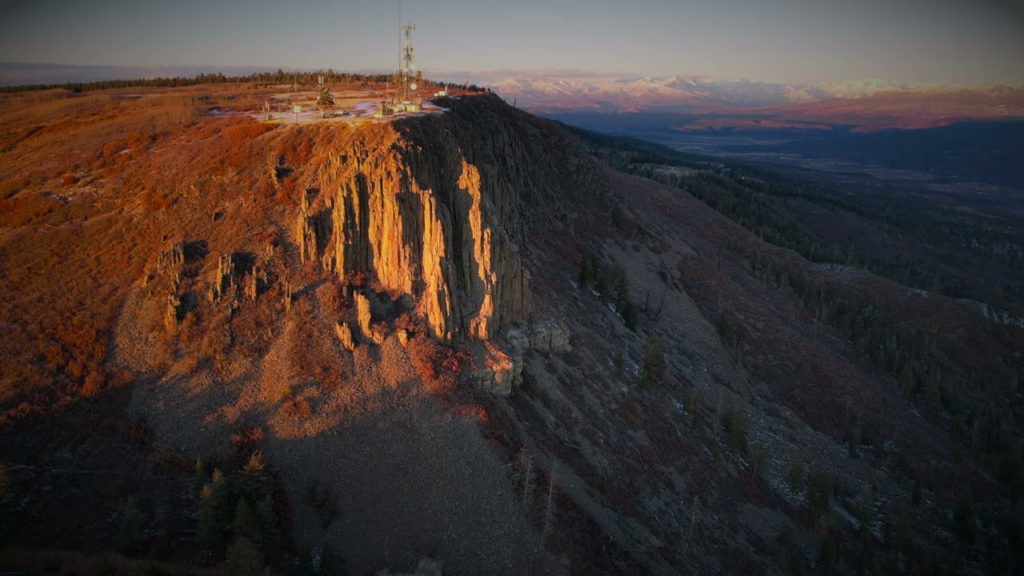
Dulce is easy to turn into an idea. In modern UAP culture, the name has become shorthand for “the underground place,” a location people picture before they can even point to it on a map: a mesa with secrets under it, a perimeter no one can cross, and an invisible boundary between what locals live and what outsiders think must be happening. But Dulce is also a real community on sovereign Indigenous land, and it is described in a federal partner profile as the Jicarilla Apache Nation’s sole community and the home of its tribal headquarters. That is not lore. It is a plain statement about a living place with governance, history, and daily life. (U.S. Fish & Wildlife Service, n.d.)
Those two truths create friction. One truth asks you to treat Dulce with the care you would give any living community, especially one that has had to field decades of outsider fascination. The other truth is that Dulce has been pulled repeatedly into a web of UAP narratives that refuse to stay contained. If you want to understand why the region became a high-strangeness hotspot, you have to hold both truths at once, and you have to keep your feet on a simple rule: strong claims deserve strong sourcing, and contested claims should look contested on the page.
This explainer does not try to “solve” Dulce with one master key. It separates what is documented, what is witness testimony, what is disputed, and what is culturally influential but weakly corroborated. Dulce’s reputation didn’t arrive fully formed. It accreted. Some layers are sturdy enough to stand on public records. Others function more like modern folklore, including “insider” documents and stories that spread because they feel like closure. The internet tends to blend all layers into one super-story. The historical pattern is more complicated, and more revealing.
Why Dulce became a hotspot rather than just “another UAP place”
Most places that become famous in UAP culture do so because of sightings: lights over a ridge, an object pacing a plane, a triangular shape crossing a highway. Dulce’s trajectory is different. Its reputation grows from an episode of distress and unresolved harm that drew formal attention. That matters because it changes the emotional charge. A sighting can be thrilling or unsettling. A wave of livestock deaths, experienced by ranchers as unnatural, becomes personal and financially punishing. It makes people feel targeted. It makes them demand an answer. And when the answer does not arrive, the vacuum doesn’t stay empty.
Dulce also sits in a context that naturally amplifies uncertainty. It is on tribal land, with the jurisdictional complexity that comes with sovereignty and overlapping law enforcement responsibilities. It is also in a broader region where large-scale federal projects have historically existed, sometimes with underground components, sometimes with long tails of monitoring and stewardship. That doesn’t prove an underground base narrative, but it does help explain why “something hidden” feels plausible to many people even before the more elaborate myths enter the picture.
So the best way to understand Dulce is not as a single claim (“base or no base”), but as an environment where multiple forces intersect: documented investigation, unresolved fear, secrecy-adjacent regional history, and later myth-making.
The documented spine: cattle mutilations and formal FBI attention
The most defensible foundation for Dulce as a high-strangeness zone is not an underground facility story. It is the livestock mutilation crisis of the late 1970s and early 1980s and the unusually clear traces it left in official records.
The FBI’s released “Animal Mutilation” files contain the key backbone statements that anchor this phase. A central line in the Part 5 (Final) document states that by communication from FBI Headquarters dated March 6, 1979, the FBI Albuquerque Office was instructed to conduct investigation into the mutilations of animals occurring on Indian lands in New Mexico. (Federal Bureau of Investigation [FBI], n.d.-b)
That sentence matters because it establishes three things at once. First, the issue was significant enough to trigger a headquarters-to-field directive. Second, the investigative emphasis is specifically tied to Indian lands, which is directly relevant to the Dulce area’s jurisdictional reality. Third, the record is not retrospective folklore. It is a contemporaneous bureaucratic trace.
The same FBI document trail also records an April 20, 1979 conference on livestock mutilation convened in Albuquerque, stating that approximately 180 persons were in attendance and noting involvement by public officials, including Senator Harrison Schmitt and U.S. Attorney R. E. Thompson. (FBI, n.d.-b) Whatever one thinks caused the livestock deaths, this conference demonstrates that the phenomenon had escalated into a public and institutional concern that could not be dismissed as a few isolated ranch stories.
The file material also reflects the challenge of coordinating across agencies and jurisdictions, including discussions about investigative coordination through the First Judicial District and District Attorney’s office. (FBI, n.d.-b) That coordination problem is not just procedural trivia. In high-strangeness hotspots, messy investigative structure can amplify perception that “no one is in charge” or “someone is preventing clarity,” even when the real cause is mundane complexity.
Witness experience: why this phase stuck in memory
File trails matter, but Dulce is not a hotspot because people love PDFs. It’s a hotspot because those documents correspond to lived experience: ranchers finding animals dead and believing the damage didn’t match predation or normal decay patterns, families feeling watched or threatened, and communities forced to choose between telling outsiders “nothing is happening” and admitting “something is happening and we don’t understand it.”
This is where Dulce begins to feel like high strangeness even if you never accept a single later underground-base claim. A place becomes “active” when harm and uncertainty coincide, and when official attention arrives without delivering a satisfying explanation. If your neighbor’s cattle are found mutilated and then you see investigators, meetings, and conferences, you may conclude the problem is bigger than anyone is admitting. If you later hear rumors about helicopters, labs, or underground work, those rumors don’t land on an empty field. They land on soil already churned by fear.
Kenneth Rommel and the effort to impose investigative discipline
The FBI release set also captures the system’s attempt to impose discipline on the chaos, including the role of Kenneth M. Rommel in an animal mutilation project context. (FBI, n.d.-b) Rommel is important not because he “proves” anything extraordinary, but because his correspondence shows how investigators handled the kind of physical claims that often arise in anomalous episodes.
In the Part 5 (Final) release, Rommel correspondence to the FBI Laboratory requests analysis of unknown material described as flakes. The correspondence notes that some vocal individuals had attempted to connect the flakes to a substance derived from cowhide in tests associated with the Dulce area, while Rommel indicates he could not confirm such a connection and asks for laboratory identification. (FBI, n.d.-b) The tone is procedural. It is not “this is alien.” It is “identify this material.”
This matters because it illustrates a key Dulce dynamic: even in the official investigative layer, there is evidence of an ecosystem around the cases where people attempted to tie unusual physical fragments to extraordinary narratives. Rommel’s approach, at least in the portion visible in the public release, is cautious and evidence-seeking rather than sensational.
Underground context that is real: Project Gasbuggy and long-tail stewardship
Dulce’s later underground mythology didn’t appear from nothing. Northern New Mexico has a documented history of subterranean, high-consequence federal activity. The clearest nearby example is Project Gasbuggy, an underground nuclear experiment intended to stimulate natural gas production.
DOE’s Gasbuggy fact sheet places the site in Rio Arriba County, approximately 55 miles east of Farmington and about 12 miles southwest of Dulce, New Mexico, and describes the site’s history as part of the Plowshare program. (U.S. Department of Energy [DOE], 2021) DOE also states that the Office of Legacy Management took responsibility for long-term surveillance and maintenance at the Gasbuggy site in 2008. (DOE, n.d.)
This doesn’t prove a Dulce Base claim. But it supports a narrower contextual point: the region has hosted subterranean federal-industrial projects serious enough to require monitoring frameworks decades later. In communities shaped by that kind of history, “underground work” does not sound inherently impossible. It sounds like a category the federal government has used before.
That’s the subtle way Gasbuggy influences the Dulce mythos. It doesn’t provide evidence of a specific base. It provides plausibility for the idea that major underground activity can be real in this landscape. When later stories describe subterranean installations near Dulce, the region’s historical record makes the general concept feel less like science fiction, especially to audiences already primed by the mutilation wave’s unresolved anxiety.
The mythology layer: Bennewitz and narrative shaping in the UAP ecosystem
If the mutilation years are Dulce’s documented spine, the Paul Bennewitz saga is one of the major pathways that connects Dulce to modern UAP myth-making on a national scale.
In a Wired feature discussing Mark Pilkington’s Mirage Men, the story is framed around deception, manipulation, and psychological warfare in the UAP world, and it describes how Bennewitz’s beliefs and interpretations were encouraged rather than simply left to rise or fall on their own. (Wired, 2013) The value of this source in a Dulce explainer is not that it “confirms” Dulce Base. It does not. The value is that credible journalism supports the broader claim that UAP narratives in New Mexico formed in an environment where manipulation and sincere belief could intertwine. (Wired, 2013)
That context matters because it changes how later Dulce claims should be read. When a region’s UAP mythology includes documented or credibly reported episodes of story-shaping, later “insider” narratives stop looking automatically self-authenticating. Provenance becomes central. Corroboration becomes central. Incentives become central.
Here’s an important boundary, though, because this is where explainers can accidentally overstate. Saying “Dulce is better understood as a place where a real investigative crisis happened first, and then later narratives arrived and nested inside it” is an editorial synthesis. It is not a sentence you will find in an FBI memo. The synthesis is still useful because it describes the pattern the sources collectively suggest: a documented crisis (mutilations) creates a platform; later narratives (base stories) attach to the platform. But it should remain a visible analysis, not masquerade as a record-stated conclusion.
Contested lore: the “Dulce Papers,” “Castello,” and the authentication problem
Many readers meet Dulce through the “Dulce Papers” and related claims attributed to an alleged insider described as “Thomas E. Castello.” This layer describes a multi-level underground complex, human–non-human collaboration, genetic experimentation, and secret agreements.
Under evidence-weighted standards, this material should be treated as influential lore with weak authentication.
The key issue is not whether extraordinary claims are impossible. The key issue is that the publicly accessible record does not provide a verifiable chain of custody for these documents, nor independent corroboration strong enough to elevate them beyond dispute. The documents circulate widely and are often treated as foundational within some subcultures, but circulation is not verification.
So the responsible posture is: the Castello/Dulce Papers layer is a major cultural driver of “Dulce Base” belief, but it remains difficult to authenticate and should not be treated as an established fact in an explainer. It belongs in the “contested lore” layer.
Paradoxically, that contested status helps explain the story’s longevity. Vivid, unprovable narratives behave like perpetual engines in hotspot lore. They supply detail, drama, and apparent insider access, while remaining slippery enough that they cannot be conclusively resolved using public methods. For believers, the lack of closure is proof of secrecy. For skeptics, it is proof of fabrication. For the culture, it is proof that the story will keep generating heat.
Phil Schneider and the “underground confrontation” claim
Phil Schneider’s claims about an underground confrontation near Dulce involving non-human entities and human forces are among the most dramatic and widely repeated parts of the Dulce mythos. They are also among the least supported by independent documentation in the publicly accessible record.
Schneider’s influence is undeniable culturally. His narrative gives Dulce a single, decisive “event” that seems to explain everything: why secrecy would be enforced, why witnesses would be afraid, why rumors would cluster around the mesa. But the evidentiary support remains largely testimonial. Without converging corroboration, the correct editorial posture is to treat the Schneider claim as disputed testimony and to frame its significance primarily in terms of influence on the Dulce legend rather than as established history.
This is a recurring pattern in anomalous hotspots: early phases produce unresolved events and fear; later phases produce a mechanism story that claims to reveal what is behind it all. The mechanism story spreads because it offers closure. Whether it is true becomes secondary to the psychological function it serves.
Dulce as a living hotspot: local voices, visitors, and ongoing testimony
Dulce’s story is not only an internet legend. It has repeatedly surfaced in real-world conference culture and in local testimony presented through media coverage.
A 2016 Indianz.com report about a “Dulce Base” themed conference states that believers place an alleged “secret alien-human facility underneath the Archuleta Mesa near Dulce, the tribe’s headquarters,” and it includes testimony from a tribal member expressing personal belief rooted in her claimed personal experience. (Indianz.com, 2016) That report is useful in an explainer because it demonstrates something specific and documentable: conference culture and local testimony exist, and Dulce is socially positioned as a focal location in that culture. (Indianz.com, 2016)
But the same source also demonstrates why careful wording matters. Indianz.com supports “Dulce as the tribe’s headquarters” and the presence of testimony and belief. It does not support broader claims about the number of sightings, the mechanics of alleged facilities, or the factuality of base lore. In an explainer, that means Indianz.com should be used for exactly what it supports: that this belief is present, publicly stated, and socially active, not that it is proven.
It’s also essential not to flatten local attitudes. Local opinions are not uniform. Some residents embrace the legend, some reject it, some ignore it, some feel it is intrusive outsider fascination, and some engage with it as a form of tourism or economic activity. A hotspot is not only a set of claims. It is a social environment where claims are negotiated.
What the record supports, and what it does not
If someone wants a binary answer to “Is Dulce Base real,” Dulce tends to disappoint because the strongest public layer is not “a base,” it is an investigative episode.
The public record supports that federal authorities treated animal mutilations on Indian lands in New Mexico as an issue warranting FBI involvement and investigative coordination, and it documents the April 20, 1979 Albuquerque conference with approximately 180 attendees and involvement of key public officials. (FBI, n.d.-b)
The public record supports that the region has a documented history of subterranean federal-industrial activity, including Project Gasbuggy about 12 miles southwest of Dulce, and that DOE’s Office of Legacy Management manages long-term stewardship, including responsibilities assumed in 2008. (DOE, 2021; DOE, n.d.)
Credible journalism supports that modern UAP mythology in New Mexico was shaped in an environment where manipulation and psychological operations are discussed as relevant factors, which in turn should shape how later “insider” narratives are evaluated. (Wired, 2013)
What the public record does not provide is clean, independently corroborated proof of a joint human–non-human underground facility beneath Archuleta Mesa, nor definitive documentation for the more extreme insider-paper and confrontation narratives. Those layers remain disputed and should be presented as such.
Indigenous material: why this explainer keeps distance
Because Dulce is on Jicarilla Apache land, any explainer that gestures at Indigenous tradition must be careful not to use sacred narratives as mood-setting for sensational folklore.
Morris E. Opler’s Myths and Tales of the Jicarilla Apache Indians (1938) exists as a historical ethnographic publication and is cataloged in major library systems including HathiTrust. (Opler, 1938) That existence can tempt outsiders to treat Jicarilla origin material as a readily available cultural texture. A more responsible reading is: availability does not equal permission, and ethnographic framing itself can be contested.
A modern caution in exactly this direction appears in the American Philosophical Society’s discussion of contesting anthropological knowledge regarding the Jicarilla Apache Nation’s origin story, including emphasis that some information was not meant to be shared beyond the tribe and that outside labeling and framing can be disputed. (American Philosophical Society, 2021) That supports a narrow editorial conclusion: Indigenous knowledge should not be recruited as “evidence” for Dulce Base claims, and the safest stance is to keep a disciplined distance between sacred tradition and modern UAP folklore unless there is a specific, well-supported scholarly reason to connect them.
This explainer acknowledges that boundary explicitly. Dulce can be explained without borrowing sacred material as narrative fuel.
Implications: why Dulce still matters
Dulce remains valuable as a case study even if you never accept the underground-base claim.
It shows how an anomalous event cluster can generate official attention without generating official resolution. That gap between “attention” and “closure” is one of the strongest engines of high-strangeness belief. (FBI, n.d.-b)
It shows how a region’s real history of federal projects can seed plausibility for broader secrecy narratives. Gasbuggy is not a Dulce Base precursor in any literal sense, but it demonstrates that underground experimentation happened in the region and that federal stewardship can remain active for decades. (DOE, 2021; DOE, n.d.)
It shows how UAP mythology can be shaped by information dynamics. Even if you treat the Bennewitz era as a cautionary tale rather than a universal template, it still argues for stricter standards when evaluating later insider narratives: provenance first, corroboration second, spectacle last. (Wired, 2013)
And maybe most importantly, it shows how hotspots are built. They are rarely built from a single “proof.” They are built from unresolved events, recurring testimony, partial official engagement, and an audience hungry for a mechanism story. Dulce has all of those ingredients. That is why it persists.
Claims taxonomy
Verified
Dulce, NM is the Jicarilla Apache Nation’s sole community and is home to the Nation’s tribal headquarters. (U.S. Fish & Wildlife Service, n.d.)
FBI records document formal FBI attention to investigating animal mutilations on Indian lands in New Mexico and document the April 20, 1979 Albuquerque conference, including attendance scale and involvement of public officials. (FBI, n.d.-b)
DOE records document Project Gasbuggy’s location (about 12 miles southwest of Dulce) and DOE Office of Legacy Management stewardship, including long-term surveillance and maintenance responsibility assumed in 2008. (DOE, 2021; DOE, n.d.)
Probable
Dulce’s role as a focal symbol in the wider mutilation-era narrative is consistent with the FBI file’s emphasis on Indian lands in New Mexico and with the way later public discourse repeatedly anchors claims to Dulce’s governance location. This is an interpretive synthesis rather than a record-stated fact. (FBI, n.d.-b; Indianz.com, 2016)
Disputed
Claims that a joint human–non-human underground facility exists beneath Archuleta Mesa remain unverified in the public record and rely primarily on contested testimony and difficult-to-authenticate document streams. (Indianz.com, 2016)
Claims of a violent underground confrontation near Dulce remain largely testimonial and lack strong independent corroboration in publicly accessible documentation.
Legend
“Dulce Base” as popularly told functions as modern folklore that blends documented investigative history with evolving story layers and recurring testimony.
Misidentification
Some reported aerial anomalies and “strange activity” may involve conventional aircraft, environmental effects, or misperception, though this does not adjudicate the mutilation-era investigative record.
Speculation labels
Evidence: FBI-released records state that FBI Headquarters instructed the Albuquerque Office (March 6, 1979) to investigate animal mutilations occurring on Indian lands in New Mexico, and the same file trail documents the April 20, 1979 Albuquerque livestock mutilation conference with approximately 180 attendees and involvement of public officials. (FBI, n.d.-b)
Evidence: DOE documentation states that the Gasbuggy site is about 12 miles southwest of Dulce and that the DOE Office of Legacy Management took responsibility for long-term surveillance and maintenance in 2008. (DOE, 2021; DOE, n.d.)
Hypothesis: Dulce functions as a high-strangeness attractor because it sits at the overlap of an unresolved investigative episode (mutilations with formal attention), a regional history of subterranean federal activity, and a later mythology pipeline that repeatedly refreshes Dulce with insider narratives that are difficult to authenticate.
Witness Interpretation: Some witnesses interpret the mutilation era, aerial anomalies, and regional secrecy history as evidence of non-human involvement or hidden installations. This remains visible in conference culture and published local testimony. (Indianz.com, 2016)
Researcher Opinion: Journalism discussing the Bennewitz-era information environment supports the view that deception and manipulation played a role in shaping parts of New Mexico’s modern UAP mythology, a context that affects how later Dulce narratives are evaluated. (Wired, 2013)
References
American Philosophical Society. (2021, November 24). Contesting anthropological knowledge of the Jicarilla Apache Nation’s origin story. https://www.amphilsoc.org/blog/contesting-anthropological-knowledge-jicarilla-apache-nations-origin-story
Federal Bureau of Investigation. (n.d.-a). Animal mutilation (FBI Vault collection). https://vault.fbi.gov/Animal%20Mutilation
Federal Bureau of Investigation. (n.d.-b). Animal mutilation, Part 5 (Final) (PDF release). https://vault.fbi.gov/Animal%20Mutilation/Animal%20Mutilation%20Part%2005%20%28Final%29/at_download/file
Indianz.com. (2016, May 10). Jicarilla Apache Nation draws true believers for conference in Dulce area. https://indianz.com/News/2016/05/10/jicarilla-apache-nation-draws-true-belie.asp
Opler, M. E. (1938). Myths and tales of the Jicarilla Apache Indians. American Folk-Lore Society. (Catalog record available via HathiTrust.) https://catalog.hathitrust.org/Record/001631379
U.S. Department of Energy, Office of Legacy Management. (2021). Gasbuggy, New Mexico, site fact sheet (PDF). https://www.energy.gov/sites/default/files/2021-08/GasbuggyFactSheet.pdf
U.S. Department of Energy, Office of Legacy Management. (n.d.). Gasbuggy, New Mexico, site. https://www.energy.gov/lm/gasbuggy-new-mexico-site
U.S. Fish & Wildlife Service. (n.d.). Jicarilla Apache Nation (Partner profile). https://www.fws.gov/partner/jicarilla-apache-nation
Wired. (2013, June 13). Mirage Men: A dizzying ride through deception, manipulation and psychological warfare. https://www.wired.com/story/mirage-men/
SEO keywords
Dulce Base, Dulce New Mexico, Jicarilla Apache Nation, Archuleta Mesa, New Mexico cattle mutilations, FBI Animal Mutilation files, 1979 livestock mutilation conference, Kenneth Rommel, Project Gasbuggy, DOE Legacy Management, Paul Bennewitz, Mirage Men, UAP hotspot, high strangeness New Mexico, underground base lore