Mary Rodwell did not build her reputation by chasing lights across the sky. She built it by listening to people who said the encounter followed them home. Her work changed the language of contact research, but it also sharpened an unresolved question: when does compassionate listening become evidence, and when does interpretation move beyond what the record can bear?
The counselor before the cosmology
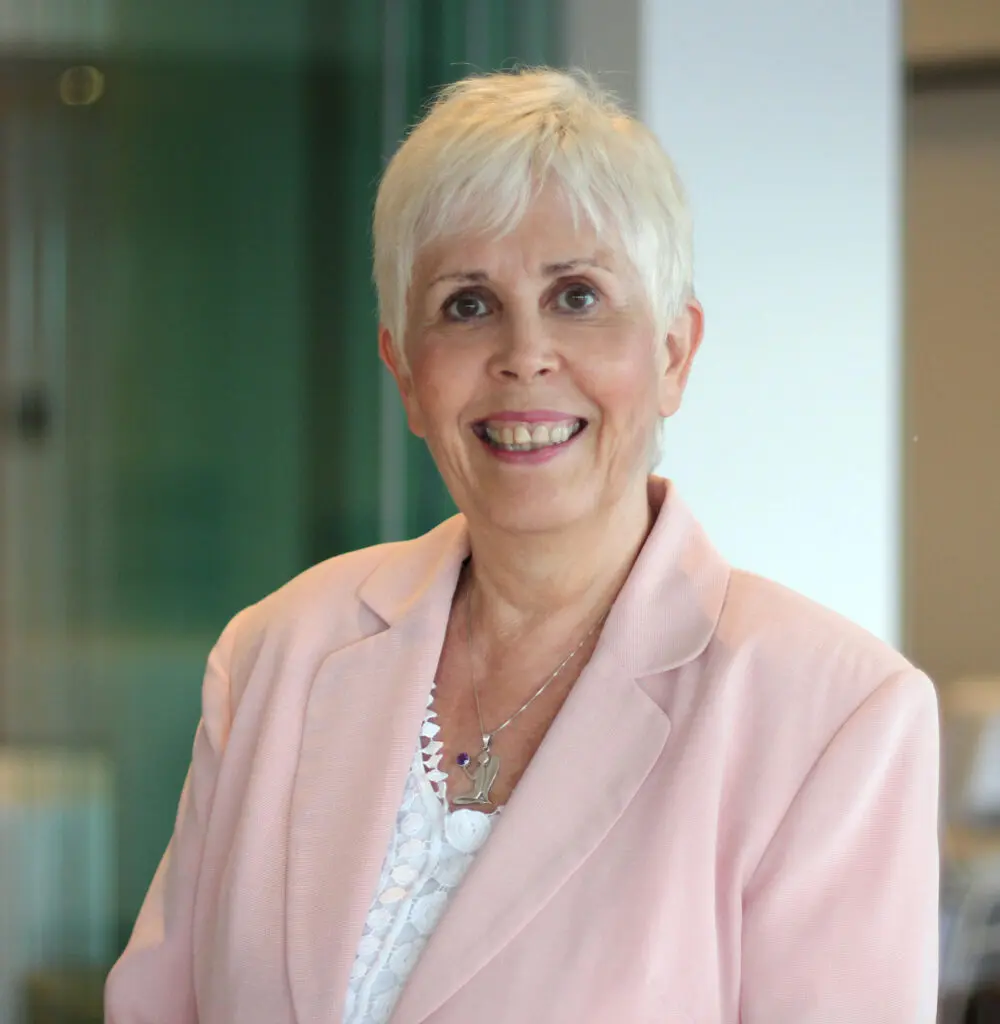
Mary Rodwell’s career as a contact researcher began, by her account, in a counseling room in 1994. A man told her that he and members of his family had experienced disturbing nocturnal “visits.” They believed they had been taken somewhere. They awoke with unexplained marks, shaved areas of skin and a deep fear that something was entering their lives without permission.
Rodwell had already encountered the work of psychiatrist John E. Mack and author Whitley Strieber. Instead of immediately treating the family’s story as fantasy or pathology, she listened. She came to regard the consistency among family members, their emotional reactions and the reported bodily effects as indications that they had undergone something real, even if its cause could not yet be demonstrated. That encounter became the template for the work that followed. The account is described in Talking Close Encounters, published by The Echo in 2017. (The Echo, 2017)
The distinction matters. It is verifiable that Rodwell reports meeting this family and that the meeting influenced her subsequent career. The public record cited here does not independently establish what caused the family’s experiences. That boundary between documented testimony and inferred cause is the central tension running through Rodwell’s work.
In 1997, Rodwell established the Australian Close Encounter Resource Network, better known as ACERN. Its purpose was to provide information, counseling and support to people reporting contact, missing time, bedroom encounters, telepathic communication and related anomalous experiences. Rodwell’s official biography describes her background as including nursing, midwifery, health education, counseling and clinical hypnotherapy. It also states that she has researched more than 3,000 cases. That figure should be understood as a biographical claim about Rodwell’s reported case history, not as an independently audited database of 3,000 evidentially confirmed encounters. (Rodwell, n.d.)
Affiliated biographies describe Rodwell as a co-founder and director of the Edgar Mitchell FREE Foundation, where she participated in experiencer support and research activities. This status is best treated as a biographical or affiliated-source claim unless confirmed through primary archival records from the foundation itself. (Behind Greatness, n.d.)
At a 2017 contact conference in Byron Bay, Australia, Rodwell said that she had not personally experienced an encounter of the kind described by the witnesses she supported. She presented her authority as that of a counselor, investigator and collector of testimony rather than as a primary witness. (Australian Broadcasting Corporation, 2017)
This gives Rodwell an unusual position within contact research. She is not primarily a sensor analyst, astronomer or physical-evidence specialist. She works in the intimate territory where memory, fear, dreams, altered states, family relationships, spirituality and claims of non-human intelligence overlap.
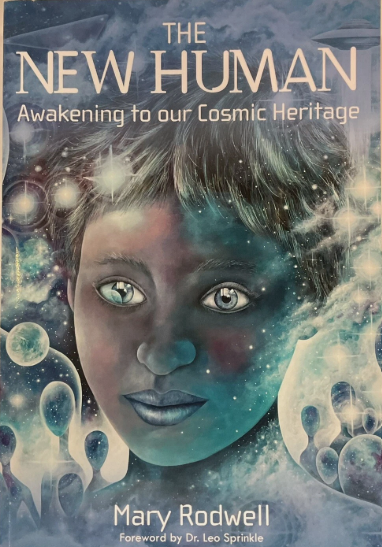
describes how the recent generations of star seeds have different needs and requirements and are more consciously aware of who they are and what they have to do in assisting with the evolutionary shift in human consciousness that is now taking place.
What does a contact researcher actually investigate?
The phrase “contact researcher” can imply more certainty than the evidence permits. In practice, Rodwell studies two different questions, and they should not be confused.
The first is phenomenological: What did the person experience? What did they see, feel, remember or dream? Were there recurring images, bodily sensations, unusual marks, missing time, changes in beliefs or lasting psychological effects? Did another person report something similar without being prompted?
The second is ontological: What actually caused the experience? Was it an interaction with an external non-human intelligence? A sleep-related episode? A neurological event? A trauma-linked memory? A symbolic spiritual experience? A mixture of subjective and physical processes? Something not yet represented in established categories?
Rodwell’s strongest work lies in the first domain. She has collected narratives, recognized recurring motifs and created spaces in which witnesses can speak without ridicule. Her more controversial conclusions arise when patterns in testimony are used to argue for a particular external cause, including non-human contact, reproductive intervention or directed human transformation.
A courtroom analogy is useful. Testimony is evidence, especially when it is detailed, emotionally consequential and given against a witness’s social interests. Yet the weight assigned to testimony depends on independence, consistency, proximity to the event, prior exposure, interview methods and corroboration. A sincere witness can still misinterpret an event. Conversely, the absence of laboratory evidence does not prove that an unusual event never occurred.
Rodwell’s work is therefore neither meaningless anecdote nor conclusive proof. It is a large body of human testimony whose evidential value changes from case to case.
Case study: The family who said the visits followed them home
Rodwell’s first reported family case contained several elements that would recur throughout her later work: nocturnal events, bodily traces, multiple family members, fear, reluctance to disclose and the belief that the experiences had continued across generations.
Family corroboration can increase the evidential weight of a report, particularly if each person gives an account independently and before discussing it with the others. It becomes less powerful when memories have been repeatedly compared, when the interviewer introduces a preferred interpretation or when the accounts are reconstructed long after the event.
In Rodwell’s telling, the family’s distress and the similarity of their accounts persuaded her that they were not simply fabricating a story. That judgment may be reasonable as an assessment of sincerity. It does not, on its own, identify what produced the events.
The reported marks and shaved areas could potentially have moved the case beyond testimony. To do that, however, investigators would need dated photographs, prompt medical examinations, prior health records, controlled sample collection and a documented chain of custody. Without those safeguards, a physical anomaly may remain genuinely unexplained while still being incapable of supporting a specific conclusion.
The case’s greatest importance may be historical rather than forensic. It redirected Rodwell’s professional life toward people who felt abandoned by conventional support systems. It also established her core premise: the investigator should begin by taking the witness seriously, even while the cause remains uncertain. (The Echo, 2017)
Case study: Tracey Taylor and a visual language
One of the most detailed first-person narratives associated with Rodwell is that of Australian experiencer Tracey Taylor. Taylor described vivid childhood dreams, bedroom visitors, paralysis, craft-like environments, medical scenes and communications that she believed did not originate in her ordinary conscious mind.
She also produced geometric drawings, symbols and passages of an unfamiliar script. Taylor interpreted these as forms of non-human communication or “star language.” She described receiving inner answers to questions and feeling compelled to draw complex images whose meanings were only partly understood.
Rodwell presented Taylor’s artwork and testimony in Expressions of ET Contact: A Visual Blueprint?, a film drawing on more than 50 images, symbols, written forms and spoken expressions attributed to anomalous contact. Taylor later wrote that meeting Rodwell and becoming involved with ACERN reduced her sense of isolation and helped her place her experiences within a wider community of similar reports. (Taylor, n.d.)
Taylor’s material illustrates both the value and the limitation of the experiencer archive.
The drawings exist. The testimony exists. The reported emotional and social effects are part of the record. This is evidence that Taylor created an unusual symbolic body of work and understood it through the framework of contact.
The claim that the symbols originated with a non-human intelligence is a witness interpretation. Establishing that origin would require considerably more. A serious linguistic assessment would need full chronological samples, information about Taylor’s exposure to known writing systems, blind comparison by specialists and a method for testing whether the symbols encode consistent meaning rather than functioning as personal art, automatic writing or a private symbolic language.
This does not make the material unimportant. Human beings have always responded to anomalous experiences through images, scripts, visions and symbolic systems. Similar processes can be found in religious revelation, dream art, mediumistic writing and visionary traditions. Taylor’s archive belongs in that larger comparative field, whether its ultimate explanation is external, psychological, spiritual or mixed.
The case connects naturally with UAPedia’s examinations of Cross-cultural Abduction Comparisons, Common Elements in Abduction Narratives and UAP as an Entry Point to High Consciousness.
Case study: “Anna” and the reproductive narrative
At an Australian conference covered by the Australian Broadcasting Corporation in 2017, a woman identified by the pseudonym “Anna” described experiences that she interpreted as participation in a non-human reproductive program. She said she had been taken aboard craft and believed her eggs had been used in the creation of hybrid beings.
Anna reportedly disclosed her experiences selectively because she feared ridicule and social rejection. Rodwell presented her story within a wider pattern of accounts involving medical procedures, education, telepathic communication and alleged reproductive activity. (Australian Broadcasting Corporation, 2017)
The case represents one of the most consequential motifs in contact literature. It is also one of the most difficult to assess.
Anna’s account is first-hand testimony about what she remembers and believes happened. The public report does not include medical documentation, reproductive records, biological samples or independent witnesses capable of confirming an external intervention. Her interpretation should therefore not be converted into a verified medical conclusion.
At the same time, the account should not be dismissed merely because it resembles other contact narratives. Repetition is a research signal. The signal may point toward a shared external cause, a shared physiological mechanism, common cultural imagery, recurring structures of trauma and memory, or several processes operating at once. Pattern recognition begins an investigation. It does not finish one.
Rodwell treats recurrence as one reason to take the reproductive motif literally. Critics argue that similarity can also develop through books, documentaries, support groups and interviewer expectations. Both possibilities deserve testing.
The broader motif is examined in UAPedia’s Reproductive and Hybridization Themes and Historical Evolution of Abduction Narratives.
From private cases to a large experiencer survey
Rodwell’s influence expanded through her association with the Edgar Mitchell FREE Foundation. The foundation attempted to move beyond individual stories by surveying thousands of people who identified themselves as contact experiencers.
A 2018 paper in the Journal of Scientific Exploration reported findings from 3,256 respondents in the first survey phase and 1,919 in a second phase. The two surveys contained 554 questions covering family histories, the character of reported beings, physical and psychological effects, information allegedly received and changes following the experiences. The authors stated that respondents answered from non-hypnotic recall rather than while under hypnosis. (Hernandez et al., 2018)
Approximately 70 percent of respondents described their experiences as having changed their lives positively, while roughly 15 to 20 percent reported a predominantly negative effect. Many described reduced fear of death, increased spiritual interest, changes in values and a heightened sense of connection. These findings support the conclusion that reported contact can be psychologically and spiritually transformative for the people involved. They do not establish what caused the transformation. (Hernandez et al., 2018)
The survey also reported that about 41 percent of respondents believed they had participated in a reproductive or breeding program. Among that subgroup, a large majority believed they had a hybrid child. Those figures describe the beliefs and reported memories of a self-selected sample. They are not biological confirmation of such a program. (Hernandez et al., 2018)
The study’s limitations are substantial and were partly acknowledged by its authors. Respondents had already been identified as experiencers, so the project was not a random survey of the general population. More than 70 percent identified as White or Caucasian, and over 88 percent came from the United States, Canada, Australia and the United Kingdom. The participants reported that they had not been diagnosed with mental illness, but the study did not conduct standardized independent psychological testing. (Hernandez et al., 2018)
Most importantly, the paper acknowledged that its primary evidence consisted of personal accounts, that objective physical evidence remained scarce and that the existence of actual interaction with non-human intelligence was still an open question. The authors concluded that the research raised more questions than it answered. (Hernandez et al., 2018)
Rodwell was associated with the foundation through roles described in affiliated biographies, but she was not listed as an author of the 2018 paper. Her connection to the project is institutionally relevant, yet the published findings should be attributed to the paper’s named authors.
The 2017 Australian Broadcasting Corporation report described survey findings that were then expected to appear in a different journal. The later study cited here was published in the Journal of Scientific Exploration. The survey evidence discussed in this article is therefore attributed directly to the published 2018 paper rather than to the earlier media description of its anticipated publication venue.
The study remains useful when read for what it is: a descriptive survey of a particular experiencer population. It maps recurring reports and aftereffects. It does not measure the prevalence of contact in society, verify external entities or establish that every respondent experienced the same underlying phenomenon.
Books, films and the changing language of contact
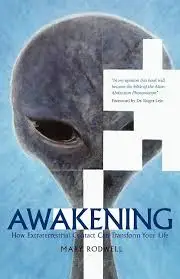
Rodwell’s first major book, Awakening: How Extraterrestrial Contact Can Transform Your Life, was initially published in 2002 and later issued in a revised edition. Its title captures her defining departure from older abduction research. Rather than concentrating only on violation, helplessness and fear, Rodwell emphasized transformation, expanded awareness and the possibility that contact had an educational or evolutionary purpose.
Her documentary work included Expressions of ET Contact: A Visual Blueprint? in 2000 and Expressions of ET Contact: A Communication and Healing Blueprint? in 2004. These productions presented experiencer artwork, symbols, vocalizations and personal narratives as possible manifestations of contact. The titles and dates are listed in Rodwell’s official biography. (Rodwell, n.d.)
In 2016, she published The New Human: Awakening to Our Cosmic Heritage. The book extended her argument to children and young people whom she described as unusually intuitive, telepathic, spiritually aware or connected to non-human intelligences. It also advanced claims involving genetic intervention and an emerging form of humanity. (Rodwell, 2016)
Together, these works helped move the field’s vocabulary from “victim” and “abductee” toward “experiencer,” “contactee” and “awakening.” That linguistic change had practical consequences. It gave some witnesses a less frightening way to describe what had happened and opened space for accounts that were not experienced as hostile.
Yet language also frames evidence. Calling an event an “abduction” foregrounds coercion. Calling it “contact” may imply communication or relationship. Calling it an “awakening” already introduces a positive interpretation. A careful investigator should preserve the witness’s own language while avoiding labels that decide the meaning of the event before the evidence has been examined.
The skeptic in the family
Rodwell’s public work had consequences inside her own family. The 2010 documentary My Mum Talks to Aliens followed Rodwell and her son Chris, a veterinarian who identified as a skeptic, as they travelled through Australia examining the subject and meeting witnesses.
The documentary’s synopsis describes Rodwell’s work as a source of strain within the family and in her marriage. Chris questioned the quality of the evidence and worried that his mother accepted extraordinary interpretations too readily. The production did not end with a laboratory resolution. Its more durable outcome was relational. The director later said the journey helped Chris understand what motivated his mother, even though it did not simply convert him to her conclusions. (Screenwest, 2010)
That makes the film one of the most revealing studies of Rodwell’s impact. Contact research is not confined to an alleged encounter. It enters marriages, parent-child relationships, professional identities and decisions about whom to trust.
The documentary also featured evidential disputes. Australian UAP investigator Bill Chalker later argued in commentary published on his research blog that the program raised important questions but moved too quickly over technical issues, including contested biological and DNA material associated with contact claims. Chalker criticized what he considered selective treatment of poorly documented evidence used to support “new human” interpretations. His assessment is a researcher’s critique published outside peer-reviewed forensic literature, not an independent scientific adjudication. It nevertheless points to a recurring problem: suggestive physical material cannot become strong evidence without provenance, independent replication and transparent methods. (Chalker, 2014)
Where Rodwell’s evidence becomes controversial
Rodwell’s case for contact often rests on convergence. People separated by geography report similar beings, examination rooms, luminous environments, telepathic messages, unusual children and profound changes in worldview. She argues that the volume and emotional authenticity of these reports cannot be adequately explained as invention.
Convergence deserves attention, but it has more than one possible source.
Similar stories could reflect a common external intelligence. They could also arise from shared human neurobiology, especially during sleep paralysis, hypnagogic states or episodes of dissociation. Cultural transmission can provide common images. Interviewers may unintentionally shape accounts through questions and expectations. Support groups can reduce isolation while also giving members a shared vocabulary through which ambiguous memories are organized.
None of these possibilities should be treated as a universal explanation. Sleep paralysis may explain some bedroom encounters but not every daylight event, multi-witness episode or alleged physical trace. Cultural influence may shape how an event is described without fully producing the underlying experience. Conversely, an account’s emotional power does not establish that its literal interpretation is correct.
The best research question is not, “Do we believe the witness?” It is, “Which parts of the account can be independently supported, and what range of causes remains consistent with those parts?”
Hypnosis, memory and the danger of certainty
Rodwell’s professional biography includes clinical hypnotherapy, and hypnosis has been used widely in contact and abduction research. It can help people relax, explore imagery and organize distressing memories. It can also create a dangerous impression that recovered detail is necessarily historical detail.
Research on forensic hypnosis has repeatedly warned that hypnosis may increase the amount of information reported while reducing accuracy, increasing suggestibility and giving witnesses unwarranted confidence in details that may be mistaken. Reviews have generally favored neutral, evidence-based interview methods over hypnosis when factual reconstruction is the goal. (Kebbell & Wagstaff, 1998)
A study led by Susan Clancy found that people reporting recovered memories of abduction showed greater susceptibility to certain laboratory false-memory effects than control participants, although such experiments cannot prove that any individual autobiographical account is false. (Clancy et al., 2002)
A separate British study involving a small sample of reported contact experiencers found higher average levels of dissociation, absorption, paranormal belief, fantasy proneness, hallucination tendency and self-reported sleep paralysis. It did not find a significant difference from controls in the false-memory measure used. The results suggest that psychological characteristics may influence the form and interpretation of some experiences, but they do not reduce all reports to a single psychological profile. (French et al., 2008)
Another study found that people recounting alleged abductions could show strong physiological stress responses while listening to scripts describing their experiences. Their bodies reacted as though the memories were deeply threatening. This establishes the reality of distress. It does not, by itself, establish the external cause of the remembered event. (McNally et al., 2004)
These findings point toward a practical standard. Hypnosis may have a therapeutic role when conducted ethically, but it is not a forensic truth machine. Any details that emerge only during hypnosis should be separated from pre-existing memories and classified as disputed unless independently corroborated.
A rigorous case file should preserve the earliest account, record the exact wording of questions, identify prior exposure to contact literature, interview witnesses separately and distinguish spontaneous recall from material produced after suggestion. Rodwell’s support-first approach can coexist with these safeguards. In fact, the witnesses deserve nothing less.
The “new human” claim and neurodiversity
Rodwell’s most ambitious and controversial argument concerns children and adults whom she describes as part of an emerging or modified humanity. Her official material connects contact with heightened intuition, telepathy, spiritual awareness and possible genetic “upgrading.” It has also suggested relationships with diagnoses or traits associated with ADHD, Asperger’s syndrome and autism. (Rodwell, n.d.)
For some families, this interpretation may feel affirming. A child who has been treated as deficient is recast as unusually sensitive, perceptive or gifted. That change in narrative can reduce shame.
It can also create serious problems if metaphorical affirmation becomes a medical or genetic claim.
Autism is recognized as a neurological and developmental condition encompassing a broad range of abilities, support needs and life experiences. Large genetic studies point to complex combinations of inherited and newly arising variants involving many genes and biological pathways. A major study of more than 42,000 autism cases identified dozens of statistically associated genes and reinforced the complexity of autism’s genetic architecture. The research did not provide evidence of directed alteration by a non-human intelligence. (National Institute of Mental Health, n.d.; Zhou et al., 2022)
No credible genomic evidence in the sources reviewed establishes that autistic people, people with ADHD or unusually intuitive children represent an externally engineered human lineage.
That does not settle every philosophical question about human consciousness or unusual cognition. It does mean that claims of genetic intervention should not be presented as established science. Such claims require identifiable genomic signatures, independently verified samples, transparent methods and replication by laboratories unaware of the preferred hypothesis.
There is also an ethical issue. Neurodivergent children should not be assigned a cosmic identity they did not choose. They should not be encouraged to treat ordinary medical, educational or psychological support as evidence that society is suppressing their “true” nature. A child may be creative, intuitive and spiritually curious while also benefiting from evidence-based care.
Rodwell’s language of difference as potential rather than defect has humane value. Her genetic explanation remains unsubstantiated.
What official UAP studies can and cannot tell us
Modern official UAP studies operate in a different evidential universe from Rodwell’s counseling archive.
The 2021 Preliminary Assessment: Unidentified Aerial Phenomena, issued by the Office of the Director of National Intelligence, examined 144 military reports. Eighty involved observations by multiple sensors. The assessment said limited high-quality reporting prevented firm conclusions, while noting that many reports probably represented physical objects because they appeared across multiple sensing systems. It did not conclude that the objects were non-human. (Office of the Director of National Intelligence, 2021)
NASA’s 2023 Unidentified Anomalous Phenomena Independent Study Team Report emphasized calibrated sensors, metadata, standardized civilian reporting and reduction of stigma. The study noted that eyewitness reports can be compelling but usually lack the reproducible measurements needed to determine an object’s origin or physical characteristics conclusively. It was designed as a research roadmap rather than a review of every historical incident. (National Aeronautics and Space Administration, 2023)
AARO’s 2024 Report on the Historical Record of U.S. Government Involvement with Unidentified Anomalous Phenomena, Volume I stated that the office found no empirical evidence in the government records it examined for off-world technology or secret reverse-engineering programs. It also acknowledged that some cases remained unresolved because the available data were insufficient. That conclusion is an institutional assessment of a defined government record set. It is not an experimental test of Rodwell’s private contact cases, dreams, bedroom encounters or telepathic reports. (All-domain Anomaly Resolution Office, 2024)
These reports neither validate nor directly disprove Rodwell’s central claims. They do, however, demonstrate the evidential standard required when investigators want to move from “unexplained” to a specific physical conclusion: timestamps, calibrated instruments, independent observations, preserved metadata and methods capable of replication.
Government assessments should be read as sources with particular access, mandates and limitations, not as final arbiters of the phenomenon. Rodwell’s mistake would be to treat the absence of official answers as confirmation of her preferred explanation. The equal and opposite mistake would be to assume that an official office’s inability to verify contact proves that the witnesses experienced nothing significant.
Rodwell’s impact on experiencer research
Rodwell’s influence is easiest to see in the social architecture she helped create.
She offered witnesses a vocabulary that did not begin with ridicule or psychiatric suspicion. People who believed they had encountered non-human beings could speak to someone familiar with the recurring motifs. They could meet others, compare experiences and explore how the events affected their relationships, fears, spirituality and sense of identity.
Tracey Taylor’s account provides direct evidence of that supportive effect. The documentary involving Rodwell’s son shows that the work also forced families to discuss belief, evidence and loyalty. The FREE survey demonstrated that a substantial self-selected population connects contact experiences with long-term psychological transformation.
Rodwell also helped broaden contact research beyond the image of a person physically taken into a metallic craft. Her archive includes dreams, telepathic impressions, symbolic art, altered states, synchronicities, spiritual changes and encounters that witnesses place somewhere between physical and consciousness-mediated reality.
This expansion can be productive. It encourages comparison with near-death experiences, apparitions, mystical states and other forms of high strangeness. It is explored further in UAPedia’s Non-Human Consciousness and UAP Interaction and Post-Abduction Psychological Effects.
The expansion also risks making the contact hypothesis impossible to disconfirm. If a visible being, a dream, an inner voice, a coincidence and a bodily sensation can all be interpreted as contact, almost any unusual experience can be incorporated into the theory. A useful hypothesis must specify what evidence would count against it.
Rodwell’s legacy therefore has two faces. She humanized the experiencer and enlarged the field’s questions. She also promoted conclusions that remain ahead of independent evidence.
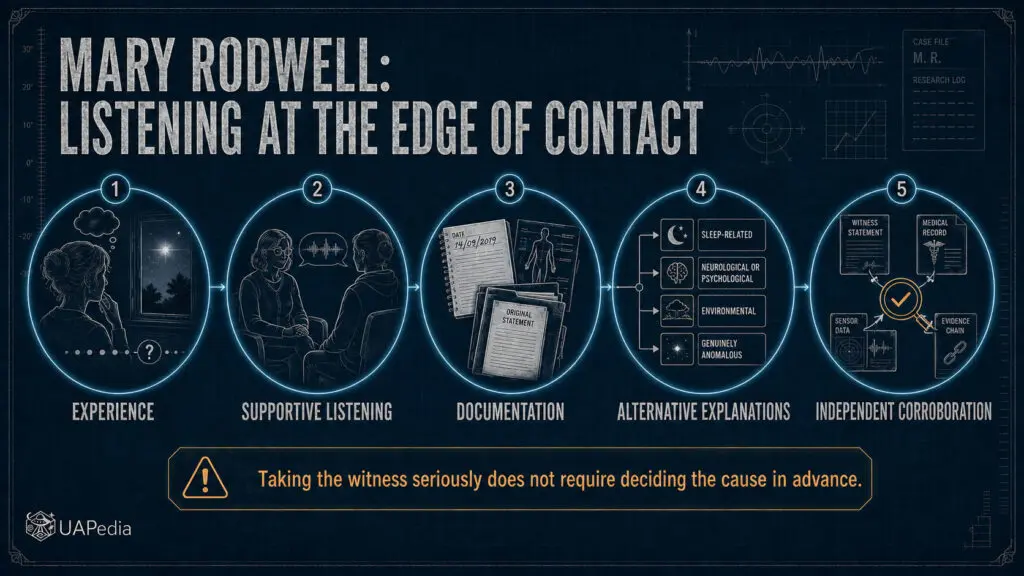
A research model worthy of the witnesses
The next generation of contact research can retain Rodwell’s compassion while adopting stronger evidential controls.
Witnesses should be encouraged to create contemporaneous diaries containing exact dates, times, locations, sleep conditions, medications, environmental circumstances and all sensory details. Original notes should be preserved rather than rewritten after exposure to books, films or group discussions.
Family members and other witnesses should be interviewed separately. Investigators should document precisely what each person knew about the others’ accounts. Interviews should use neutral prompts and avoid introducing beings, craft, medical procedures or reproductive themes that the witness has not mentioned spontaneously.
Reported injuries or bodily changes should be examined promptly by independent clinicians, with informed consent and respect for privacy. Physical samples require a documented chain of custody, appropriate controls and blind analysis. Genetic claims require accredited laboratories and open methods, not visual impressions or results transmitted through several intermediaries.
Sleep medicine, neurology and trauma-informed psychology should be offered as complementary avenues rather than instruments of dismissal. Finding a sleep-related or neurological factor in one case does not invalidate another case. Failing to look for such factors, however, weakens the investigation.
Artwork and unusual scripts should be dated, archived and submitted to blind analysis by linguists, cryptographers and specialists in writing systems. Researchers should publish negative findings as readily as suggestive ones.
Children require additional safeguards. Their accounts should not be shaped by leading questions, adult expectations or imposed identities. Support should focus on their well-being rather than on proving that they belong to a special lineage.
This approach would not force a choice between respect and rigor. Respect without rigor may reinforce a mistaken interpretation. Rigor without respect may silence a valuable witness. The field needs both.
The enduring question
Mary Rodwell is not best understood as a conventional laboratory scientist. Nor is she adequately described as merely a promoter of unusual beliefs. She is a counselor, witness collector, cultural translator and advocate whose work occupies the unstable border between trauma support, spiritual interpretation, anomalous cognition and claims of external intelligence.
Her archive is important because people continue to report these experiences, often at personal cost. Their testimony records fear, wonder, physical sensation, family patterns, symbolic creativity and life-changing shifts in belief. Those human facts deserve study.
The archive does not yet demonstrate that non-human beings are conducting medical procedures, creating hybrid children or altering the human genome. It also cannot be responsibly erased by declaring every witness confused, suggestible or culturally programmed.
Rodwell’s most defensible insight is that the experience, whatever its ultimate cause, can reorganize a person’s life. Her least defensible move is treating transformation and narrative convergence as sufficient proof of a particular cosmic history.
If an external intelligence is interacting with humanity partly through consciousness, Rodwell’s files may eventually be recognized as an early ethnography of that relationship. If no such external interaction is occurring, the same archive will remain valuable as evidence of a durable human phenomenon involving memory, identity, spirituality, fear and meaning.
The mystery survives either conclusion.
Claims Taxonomy
Verified
Mary Rodwell has a documented public career as an Australian contact researcher, author, lecturer and experiencer advocate. She established ACERN in 1997 and published Awakening and The New Human, along with visual and audio productions concerning reported contact. Affiliated biographies describe her as holding co-founder and director roles within the Edgar Mitchell FREE Foundation, although this remains a biographical claim rather than one established here through primary foundation archives. (Rodwell, n.d.; Behind Greatness, n.d.)
It is also verified that witnesses including Tracey Taylor and the pseudonymous “Anna” publicly described anomalous experiences and attributed them to non-human contact. Their testimony, artwork and reported aftereffects form part of the documentary record. Verification of the existence of testimony does not verify the witnesses’ explanation of its cause.
The 2018 FREE-related survey is a published study documenting the responses of thousands of self-selected experiencers. Its results verify the presence of recurring beliefs, motifs and reported transformations within that sample. They do not verify physical interaction with non-human intelligence. (Hernandez et al., 2018)
Probable
It is probable that Rodwell’s support work reduced isolation and distress for at least some people who approached her. Tracey Taylor’s first-person account directly describes such an effect, and ACERN was explicitly structured around counseling and peer support.
It is also probable that contact experiencers constitute a genuine and understudied psychological, social and cultural population. Their experiences can produce durable changes in behaviour, relationships, spirituality and emotional health regardless of whether the originating cause is external, internal or mixed.
Stigma probably suppresses reporting and discourages some witnesses from seeking medical or psychological help. Both experiencer testimony and official UAP studies have identified stigma as an obstacle to reliable reporting.
These conclusions do not make non-human causation itself probable in every Rodwell case. The probability must be assessed individually according to corroboration and evidence quality.
Disputed
The claim that non-human intelligences caused the specific experiences described by Rodwell’s witnesses remains disputed.
Alleged reproductive programs, hybrid children, telepathic instruction, “star languages,” directed genetic upgrading and engineered “new humans” remain disputed because publicly available evidence does not yet provide independent biological, linguistic or technical confirmation.
Details recovered only through hypnosis are disputed unless corroborated through records, independent witnesses or physical evidence. Claims involving marks, implants or biological material remain disputed when provenance and chain of custody are incomplete.
Rodwell’s interpretation that narrative convergence demonstrates a common non-human source is also disputed. Convergence may be significant, but alternative mechanisms including shared physiology, cultural influence and interviewer effects have not been excluded.
Legend
“Star children,” cosmic ancestry, hybrid generations and spiritually directed human evolution can be classified as legend when presented as modern cultural or spiritual narratives without independent verification.
The label does not mean that witnesses are insincere or that the stories lack value. Legends may preserve experiences, ethical teachings, identities and collective fears. Rodwell’s “new human” framework may be studied alongside older traditions of divine children, culture-bringers, spirit ancestry and human transformation.
A legendary classification should change if verifiable physical evidence emerges.
Speculation Labels
Evidence
The evidential record includes Rodwell’s documented books, films, public lectures, organizational roles and published accounts of her work. It includes witness interviews, Tracey Taylor’s artwork and writings, descriptions of Rodwell’s first family case, the public testimony of “Anna,” the FREE survey data and reported psychological effects.
This evidence establishes that a substantial body of people report contact-like experiences and sometimes reorganize their lives around them. It does not, by itself, establish the identity or origin of the reported agents.
Witness Interpretation
The first family interpreted nocturnal events, marks and shaved areas as evidence that they had been visited or taken.
Tracey Taylor interpreted unusual drawings, scripts, inner communications and remembered environments as contact with non-human beings.
“Anna” interpreted her experiences as participation in a reproductive program involving her eggs and hybrid offspring.
These interpretations are essential parts of the cases. They should be recorded accurately without being silently converted into verified external events.
Researcher Opinion
Rodwell’s opinion is that the recurrence, emotional authenticity and transformative effects of the reports support the reality of continuing contact with non-human intelligence.
Bill Chalker’s opinion, expressed in non-peer-reviewed research commentary, is that Rodwell’s presentation has sometimes favored suggestive material without resolving fundamental problems of documentation, provenance and technical analysis.
Psychological researchers have proposed that sleep paralysis, dissociation, absorption, memory processes and cultural framing may contribute to some reports. Those findings identify possible mechanisms and correlations. They do not establish a universal explanation.
Hypothesis
One hypothesis is that an external non-human intelligence interacts with people through both physical and consciousness-mediated processes, producing experiences that may include UAP observations, telepathy, dreams, altered states and lasting transformation.
A second hypothesis is that several distinct phenomena are being grouped together under the language of contact, including physical anomalies, sleep-related events, trauma responses, spiritual experiences and culturally shaped memory.
A third hypothesis is that contact narratives express a recurring human encounter with an intelligence or level of consciousness that current scientific categories cannot adequately describe.
The claim that non-human agents are directing human genetic evolution is also a hypothesis, but it presently lacks the genomic evidence required to make it scientifically persuasive.
References
All-domain Anomaly Resolution Office. (2024). Report on the historical record of U.S. government involvement with unidentified anomalous phenomena, Volume I. U.S. Department of Defense. https://media.defense.gov/2024/Mar/08/2003409233/-1/-1/0/DOPSR-2024-0263-AARO-HISTORICAL-RECORD-REPORT-VOLUME-1-2024.PDF
Australian Broadcasting Corporation. (2017, January 17). Stories of alien and UAP experiences shared at Close Encounters Conference in Byron Bay. https://www.abc.net.au/news/2017-01-17/alien-and-ufo-experiences-shared-at-close-encounters-conference/8188416
Behind Greatness. (n.d.). Mary Rodwell. https://behindgreatness.org/episode/mary-rodwell/
Chalker, B. (2014). The alien DNA paradigm. https://aliendnaparadigm.blogspot.com/2014/
Clancy, S. A., McNally, R. J., Schacter, D. L., Lenzenweger, M. F., & Pitman, R. K. (2002). Memory distortion in people reporting abduction by aliens. Journal of Abnormal Psychology, 111(3), 455–461. https://doi.org/10.1037/0021-843X.111.3.455
French, C. C., Santomauro, J., Hamilton, V., Fox, R., & Thalbourne, M. A. (2008). Psychological aspects of the alien contact experience. Cortex, 44(10), 1387–1395. https://doi.org/10.1016/j.cortex.2007.11.011
Hernandez, R., Davis, R., Scalpone, R., & Schild, R. (2018). A study on reported contact with non-human intelligence associated with unidentified aerial phenomena. Journal of Scientific Exploration, 32(2), 298–348. https://doi.org/10.31275/2018.1282
Kebbell, M. R., & Wagstaff, G. F. (1998). Hypnotic interviewing: The best way to interview eyewitnesses? Behavioral Sciences & the Law, 16(1), 115–129. https://doi.org/10.1002/(SICI)1098-2337(1998)16:1%3C115::AID-BSL296%3E3.0.CO;2-I
McNally, R. J., Lasko, N. B., Clancy, S. A., Macklin, M. L., Pitman, R. K., & Orr, S. P. (2004). Psychophysiological responding during script-driven imagery in people reporting abduction by space aliens. Psychological Science, 15(7), 493–497. https://doi.org/10.1111/j.0956-7976.2004.00707.x
National Aeronautics and Space Administration. (2023). Unidentified anomalous phenomena independent study team report. https://science.nasa.gov/wp-content/uploads/2023/09/uap-independent-study-team-final-report.pdf
National Institute of Mental Health. (n.d.). Autism spectrum disorder. https://www.nimh.nih.gov/health/publications/autism-spectrum-disorder
Office of the Director of National Intelligence. (2021). Preliminary assessment: Unidentified aerial phenomena. https://www.dni.gov/files/ODNI/documents/assessments/Prelimary-Assessment-UAP-20210625.pdf
Rodwell, M. (n.d.). Who is Mary Rodwell? https://www.maryrodwell.com.au/maryrodwel
Rodwell, M. (2010). Awakening: How extraterrestrial contact can transform your life (Rev. ed.). New Mind Publishers. https://www.waterstones.com/book/awakening/mary-rodwell/9780980755503
Rodwell, M. (2016). The new human: Awakening to our cosmic heritage. New Mind Publishers. https://shop.harvard.com/book/9780980755510
Screenwest. (2010). My Mum Talks to Aliens. https://www.screenwest.com.au/made-in-wa/production-highlights/my-mum-talks-to-aliens/
Taylor, T. (n.d.). Little Owl: Experiences and artwork. Cosmic Harmony. https://www.cosmicharmony.com/LightWorkers/LittleOwl/LittleOwl.htm
The Echo. (2017, January 19). Talking close encounters. https://www.echo.net.au/2017/01/talking-close-encounters/
Zhou, X., Feliciano, P., Shu, C., et al. (2022). Integrating de novo and inherited variants in 42,607 autism cases identifies mutations in new moderate-risk genes. Nature Genetics, 54, 1305–1319. https://doi.org/10.1038/s41588-022-01148-2
SEO keywords
Mary Rodwell, Australian contact researcher, ACERN, contact experiencers, UAP contact, abduction research, non-human intelligence, Edgar Mitchell FREE Foundation, experiencer testimony, hypnotic regression, contact transformation, star children claims, reproductive contact narratives, UAP consciousness, contact case studies, Mary Rodwell books, The New Human, Awakening, experiencer support, Australian UAP research