
Phoenix Forgotten turns the real 1997 Phoenix Lights into an unusually persuasive piece of faux-documentary horror. Its strongest idea is not that a camera can prove extraordinary contact, but that images acquire power from the people who need them to provide an answer. The film is most interesting when it explores that tension between evidence, memory and belief, and less distinctive when its family mystery gives way to familiar found-footage survival horror.
This is a research-based media analysis rather than a review based on a complete screening of the finished film. It draws on creator and cast interviews, production information, historical reporting on the Phoenix Lights, contemporary and later criticism, available promotional material and reception data. The UAPedia UAP Cinema Rating is therefore a research-based assessment of the film’s documented UAP treatment and cultural significance, not a claim of scene-by-scene evaluation from a complete screening.
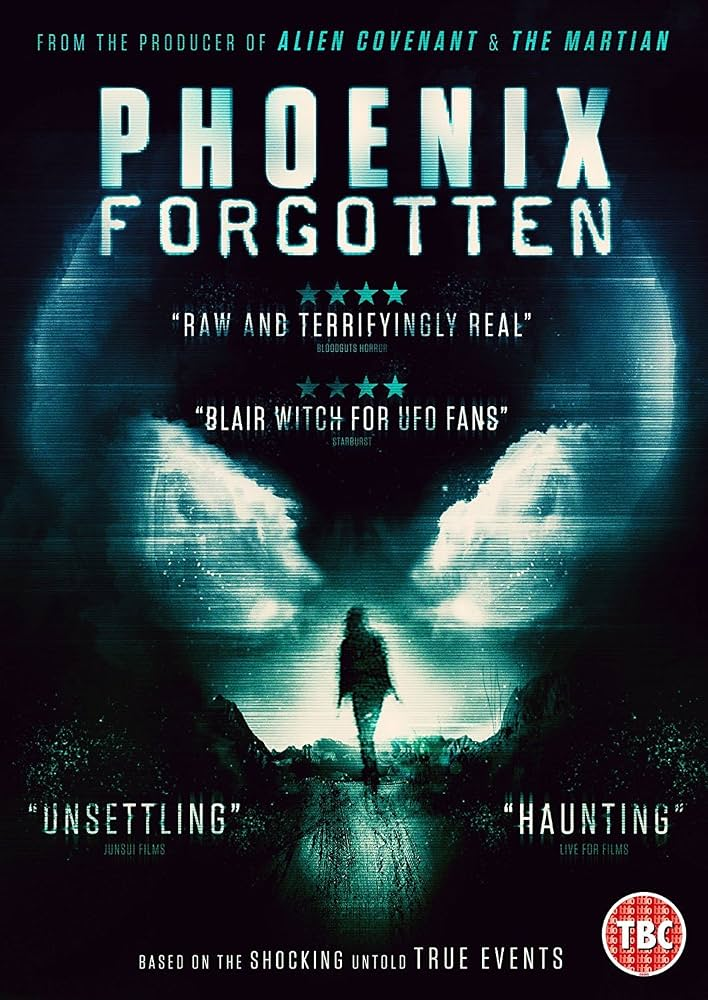
Quick Facts
| Field | Details |
| Title | Phoenix Forgotten |
| Year | 2017 |
| Director | Justin Barber |
| Writers | T. S. Nowlin, Justin Barber |
| Principal cast | Florence Hartigan, Luke Spencer Roberts, Chelsea Lopez, Justin Matthews |
| Runtime | 87 minutes (Rotten Tomatoes and Sitges; The Numbers lists 85 minutes) |
| Country | United States |
| Genre | Science-fiction horror, mystery, faux documentary, found footage |
| Producers | Wes Ball, T. S. Nowlin, Ridley Scott, Mark Canton, Courtney Solomon |
| Principal production companies | Cinelou Films, Scott Free Productions |
| U.S. theatrical release | 21 April 2017 |
| Principal U.S. theatrical distributor | Entertainment Studios Motion Pictures |
| Source material | Original fictional story incorporating the real Phoenix Lights events of 13 March 1997 |
| UAPedia category | Media, Events, Books and News Outlets / Film |
| Review type | Research-based critical and cultural analysis |
| Rating status | Research-based UCR assigned: 11.5/25; Partial or uneven UAP relevance |
Rotten Tomatoes identifies Barber as director, Nowlin and Barber as screenwriters, lists the four principal performers and gives the running time as 87 minutes. The official Sitges Film Festival archive also lists 87 minutes, while The Numbers presently gives 85 minutes. This article retains 87 minutes as the principal value while documenting the discrepancy rather than silently reconciling it. Metacritic lists Cinelou Films and Scott Free Productions among a larger group of production companies associated with the film, which is why they are described here as principal rather than exclusive production companies (Metacritic, n.d.; Rotten Tomatoes, n.d.; Sitges Film Festival, 2017; The Numbers, n.d.).
Distribution credits vary by source. The Numbers identifies the 21 April 2017 wide U.S. release as by Entertainment Studios Motion Pictures, and contemporary Screen Daily reporting described the film as an Entertainment Studios release. Rotten Tomatoes lists Cinelou Films alongside Entertainment Studios Motion Pictures, while IMDb records Cinelou Releasing and Freestyle Releasing as U.S. theatrical distributors. The Quick Facts field therefore identifies Entertainment Studios Motion Pictures as the principal U.S. theatrical distributor rather than as the only credited distributor (IMDb, n.d.; Kay, 2017; Rotten Tomatoes, n.d.; The Numbers, n.d.).
The truth is somewhere on this tape
A family video ordinarily makes a modest promise: these people were here, this happened, somebody thought the occasion worth preserving. Phoenix Forgotten exploits that trust. Its fictional teenager Josh Bishop points a camera away from a family gathering and towards strange lights in the Arizona sky, transforming an ordinary home recording into the apparent beginning of a mystery.
That scene is especially revealing because director Justin Barber has been explicit that Josh’s key Phoenix Lights footage was not authentic archival material. The production recreated the sighting from scratch with visual effects, using actual imagery as reference. Barber said the historical photographs looked to him more like military flares than the otherworldly image he needed for Josh’s experience, so he altered the movement and appearance of the lights for dramatic purposes. Elsewhere in the film, genuine news material and real Phoenix residents were blended with fictional characters (Phoenix Film Festival, 2017).
That choice encapsulates both the strength and the problem of the film. As cinema, the reconstruction gives Josh a compelling reason to become obsessed. As UAP culture, it demonstrates how easily fiction can produce an image more narratively satisfying than the historical material that inspired it.
This review argues that Phoenix Forgotten is therefore most valuable not as a fictional solution to the Phoenix Lights but as a study in how anomalous events become stories. The film takes uncertain observations, contested testimony, imperfect recordings and an unresolved public memory, then gives them the thing history rarely supplies: protagonists, causality and an ending.
Review analysis convention
Unless otherwise attributed, evaluative statements in this article about cinematic technique, symbolism, emotional function, evidentiary aesthetics and cultural meaning are Researcher Opinion. Documented production facts, historical claims and witness accounts are sourced separately, and the Claims Taxonomy applies only to real-world claims.
The film in the record
The project originated in conversations between writer-producer T. S. Nowlin and producer Wes Ball. Nowlin said they wanted to bring a documentary-like authenticity to the kind of science-fiction material they had grown up with, naming Close Encounters of the Third Kind and Poltergeist as reference points. Justin Barber was subsequently brought into the project. In a separate interview, Barber described the opportunity more personally as a chance to make his own The X-Files (Wixson, 2017a, 2017b).
That distinction matters because the film’s influences were not inferred after the fact. The creators themselves identified them. Close Encounters supplies the tradition of ordinary people becoming consumed by contact with the extraordinary; The X-Files supplies the 1990s atmosphere of unresolved investigation; and The Blair Witch Project, which Barber directly discussed in relation to the visual treatment of the 1997 footage, provides the clearest formal ancestor for the film’s recovered-camera material.
Barber also brought documentary experience to the production. He explained that shooting began with an approximately fifty-page “scriptment”, that improvisation played a significant role and that writing continued during editing. He cited Errol Morris as an influence on the contemporary documentary portions. To reproduce the degraded appearance of 1990s video, footage shot on a modern camcorder was transferred through an actual tape deck and then re-ingested (Wixson, 2017b).
The production reached U.S. cinemas on 21 April 2017. The Numbers records a domestic theatrical gross of $3,600,146 and an international gross of $97,583, for a worldwide total of $3,697,729 (The Numbers, n.d.).
The film also appeared in the 2017 Sitges Film Festival programme. IMDb records one 2017 Molins Film Festival Audience Award nomination, in the “Being Different” category, for director Justin Barber. The latter is a secondary database record rather than a surviving primary festival award archive and should be treated accordingly (IMDb, n.d.; Sitges Film Festival, 2017).
Its reception was mixed. Checked on 18 November 2026, Rotten Tomatoes lists 53 percent positive reviews from nineteen critics and a 40 percent audience score from more than 1,000 ratings. Metacritic reports a 33/100 Metascore based on five critic reviews. These figures describe reception rather than settle the film’s quality, particularly given the small critical sample (Metacritic, n.d.; Rotten Tomatoes, n.d.).
Cinema built from authenticity
A recurring positive in contemporary criticism was the film’s attempt to make its period material appear genuinely recovered. Roger Moore, writing for Movie Nation, singled out the convincing appearance of misplaced family home movies, while other reviewers acknowledged aspects of Barber’s faux-documentary and found-footage construction (Metacritic, n.d.; Moore, 2017).
The approach also solves one of the recurrent problems of found-footage horror: why is anybody still filming? Josh is characterised as an aspiring filmmaker whose fixation on the lights makes the camera part of the story rather than merely a genre requirement. Barber told Daily Dead that Josh contains autobiographical elements from his own adolescence and fascination with this kind of material (Wixson, 2017b).
The technique has a second, subtler effect. Analogue degradation carries cultural authority because damaged video often looks accidental rather than authored. Tape noise, unstable exposure and imperfect framing suggest that nobody created the image for an audience. The impression of authenticity is itself carefully manufactured, however. Phoenix Forgotten is a reminder that aesthetic roughness is not an evidentiary category.
That distinction becomes particularly important when the production mixes fictional characters with actual residents and genuine historical reporting. Florence Hartigan said Barber interviewed real Phoenix residents about their experiences while actors interacted with them and real news material was combined with material produced for the film. Hartigan also recalled receiving messages from viewers asking whether the story was real and whether her family was safe. That anecdote does not demonstrate widespread public confusion, but it shows that the film’s fact-fiction boundary worked convincingly for at least some viewers (Walkley, 2017).
Spoiler notice
The discussion below describes the film’s premise, dual-documentary structure and the general nature of its final act. It does not reveal the precise concluding images or final resolution.
Plot in focus
The film is structured around Sophie Bishop, played by Florence Hartigan, who returns to the disappearance of her older brother Josh and his friends Ashley and Mark two decades earlier. Josh had become preoccupied with the Phoenix Lights after recording them during a family event. He and his friends subsequently went into the desert seeking further evidence and disappeared.
Those disappearances are fictional. Barber has described Josh and the others as invented characters inserted into the real historical backdrop of the Phoenix Lights. The distinction is essential: the Phoenix Lights are a genuine case in the historical record; the missing teenagers, their investigation and the recovered footage belong to the screenplay (Phoenix Film Festival, 2017).
The framing creates two intertwined filmmaking projects. Josh records because he believes a discovery may be within reach. Sophie records because she wants to understand what happened to her brother. One camera reaches towards the unknown; the other reaches backwards towards an absence.
Hartigan prepared for Sophie’s investigative role by researching missing-person procedures and desert disappearances. She also studied interview techniques associated with Terry Gross and Chana Joffe-Walt. The result, at least according to the production’s stated intentions and contemporary responses, was meant to resemble a documentary made by somebody who has both personal and investigative reasons for finding an answer (Walkley, 2017).
The structural criticism raised by several reviewers is that this promising framework is eventually displaced by the recovered footage itself. Dawn Keetley argued in Horror Homeroom that the film develops Sophie during its first portion, only for her to disappear once the 1997 recording takes over. The result, in her reading, is essentially two stories that do not have sufficient time to develop either set of characters fully (Keetley, 2017).
That criticism is echoed more broadly in the contemporary reception. Joe Leydon saw a promising opening give way to familiar found-footage conventions, while Justin Lowe found the 1997 performances relatively restrained but regarded the contemporary framing as less substantial. Metacritic’s record of the film’s five contemporary critic reviews preserves both assessments (Metacritic, n.d.).
What actually happened over Arizona?
The historical material is more complicated than the phrase “the Phoenix Lights” sometimes suggests. Sources distinguish at least two major visual episodes on 13 March 1997: an earlier moving chevron or V-shaped formation reported over Arizona around 8:30 p.m., and a later group of bright lights seen southwest of Phoenix at roughly 10 p.m. Treating every observation that evening as one event can create misleading arguments because an explanation relevant to the later display does not automatically explain the earlier moving formation (McGaha & Nickell, 2015).
Contemporary reporting also shows that witnesses did not agree on whether the earlier lights were attached to a single object. Phoenix New Times journalist Tony Ortega reported in June 1997 that two of the paper’s own writers, David Holthouse and Michael Kiefer, had independently seen a north-to-south V formation of bright lights. Holthouse perceived something joining the lights into a boomerang form; Kiefer did not. Reports of altitude, speed and even the number of visible lights varied (Ortega, 1997).
Later retrospective testimony contains stronger structured-object descriptions. In a Phoenix New Times oral history, Jon Vanderlin recalled a V of lights that appeared to block stars, while Conni Ersland recalled a distinct triangular or bat-wing configuration. Anthony Schmidt described dark space that he interpreted as an underlying aircraft. These are important accounts because they preserve the structured-object side of the witness record rather than reducing the event to distant points of light. They are nevertheless recollections reported many years after the event, and their interpretations should remain distinguishable from the observations themselves (Leatherman, 2025).
There is significant counter-testimony. Amateur astronomer Mitch Stanley told Ortega in 1997 that he viewed the formation through a 10-inch Dobsonian telescope and saw what he interpreted as several aircraft. He said that lights which appeared singular to the naked eye separated under magnification into pairs located beneath squarish wings. His mother witnessed the lights but did not look through the telescope herself. Stanley’s account is unusually relevant because it involved magnified observation, although it still represents the interpretation of one observer rather than a complete identification of every report made that evening (Ortega, 1997).
The later lights have a stronger conventional explanation. James McGaha and Joe Nickell describe a Maryland Air National Guard training exercise involving parachute illumination flares over a range southwest of Phoenix. A preserved scan of Scott Craven’s 25 February 2007 Arizona Republic report provides a direct participant account: Lt. Col. Ed Jones said he piloted one of the four A-10s in the squadron that released flares and described reminding pilots to eject their remaining flares while returning toward Tucson. Jones’s retrospective testimony materially strengthens the flare-source chain for the later display, but it does not identify every light reported that night or address the earlier moving formation (Craven, 2007; McGaha & Nickell, 2015).
The evidentiary position is therefore more precise than either “the Phoenix Lights were explained” or “the Phoenix Lights remain completely unexplained.” The later display has substantial evidence supporting the flare explanation. The earlier moving formation has competing witness interpretations, including Stanley’s aircraft identification and other accounts describing apparent structure or star blockage. The material reviewed here does not establish an extraterrestrial or NHI origin for either event.
The film makes the evidence better than history does
Barber’s reconstruction becomes especially important against that messy background. He said explicitly that the key fictional recording was redesigned because the historical photographic material did not look sufficiently otherworldly to him. The director needed Josh to encounter something visually persuasive enough to motivate the story (Phoenix Film Festival, 2017).
There is nothing improper about a science-fiction film inventing more dramatic imagery. The issue is interpretive. When reconstructed imagery is embedded among real news footage, actual residents and documentary techniques, the fictional component inherits some of the historical material’s authority while the historical material inherits some of the fiction’s clarity.
T. S. Nowlin’s promotional discussion demonstrates how easily the separate phases of the Phoenix Lights can also be blurred. In a Daily Dead interview, he questioned the flare explanation by observing that flares could not fly in formation across hundreds of miles. That objection makes sense when discussing the earlier moving formation, but it does not rebut a flare explanation for the later lights near the Sierra Estrella range. The historical distinction between the two episodes is therefore necessary before evaluating any explanation (Wixson, 2017a).
The film’s fictional model of the phenomenon is essentially extraterrestrial or NHI contact with a threatening abduction component. Within the story that is an artistic premise, not a real-world claim requiring proof. The important cultural move is the conversion of an ambiguous mass sighting into intentional encounter. History gives the filmmakers unexplained or contested lights; horror gives those lights agency.
Grief, belief and the desire for an answer
Researcher Opinion
This review interprets the film’s two cameras as different responses to helplessness. Josh’s filmmaking turns uncertainty into a possible adventure and a possible future identity. Sophie’s documentary turns bereavement into investigation. Both characters seek control by recording.
That framework is potentially richer than a conventional extraterrestrial chase because it allows evidence to mean different things to different people. To Josh, an unusual recording represents discovery. To Sophie, a recording may represent access to somebody who is gone. The same object can therefore function as evidence, memory and emotional substitute.
The problem identified by several critics is that the film eventually prioritises danger over this psychological structure. As the recovered footage becomes dominant, the story’s question shifts from how a family lives with irresolution to what happened to three people in the desert. That change produces more immediate genre tension but narrows the thematic field.
The teenage relationships also appear to rely on familiar devices. Keetley noted the limited time available to make the trio’s interpersonal tensions matter, while contemporary genre criticism similarly questioned whether the interpersonal subplot justified the amount of attention it received (Keetley, 2017).
What the film gets right, distorts and invents
What it gets right is the cultural texture of the case. The Phoenix Lights really did produce a large and varied witness record, genuine home video, intense media attention and enduring disagreement over what different people saw. The filmmakers also recognised something important about the case’s longevity: the absence of one uncontested explanation for every report leaves considerable space for interpretation (Leatherman, 2025; Ortega, 1997).
The production also gets something right about witnesses by incorporating actual Phoenix residents rather than treating the historical event merely as decorative mythology. Their presence does not prove the fictional story, but it gives the film access to the human memory surrounding the case. Hartigan’s description of actors interacting with real residents confirms that this blending was intentional (Walkley, 2017).
Its principal distortion is visual rather than historical: the film’s central sighting was deliberately made more anomalous than the imagery Barber found in the record. That is a documented artistic decision. The more general risk is that the documentary format encourages a viewer to carry the credibility of authentic material across the boundary into fabrication (Phoenix Film Festival, 2017).
What it invents is much larger. Josh Bishop, Ashley, Mark, their disappearance, Sophie’s investigation and the recovered material are fiction. Barber plainly described the characters as inventions placed against a real event. Nothing in the historical Phoenix Lights record reviewed for this article establishes a corresponding missing-teenager or abduction case (Phoenix Film Festival, 2017).
Myth without theology
Researcher Opinion
The film is not notably religious, and there is little basis for forcing a consciousness framework onto it. Its mythic layer is more secular: revelation, forbidden knowledge and the danger of pursuing contact beyond the limits of ordinary life.
In that respect, Josh belongs to the same broad cinematic family as Roy Neary in Close Encounters of the Third Kind, but the emotional direction is reversed. In Spielberg’s film, obsession eventually opens into contact and transcendence. In Phoenix Forgotten, the desire to see more carries the logic of horror. Being noticed by the unknown is not necessarily a reward.
That distinction gives the film a modest existential dimension. Human curiosity is treated as both admirable and dangerous. The universe may contain an answer, but the desire for that answer can itself alter the course of a life.
The film within UAP cinema
The most obvious comparison is The Blair Witch Project, but principally at the level of form. Barber acknowledged the resemblance in the 1997 material, and critics repeatedly noted it. Both films use apparently recovered recordings to constrain what viewers can know and to make off-screen events more frightening than fully visualised ones (Wixson, 2017b).
Close Encounters of the Third Kind is the more useful comparison for the theme because Nowlin explicitly named it as an influence. Both films begin with an individual whose encounter with anomalous phenomena becomes an obsession. The difference is that Phoenix Forgotten translates the contact narrative into found-footage horror rather than wonder (Wixson, 2017a).
The X-Files supplies another documented creative reference. Barber’s description of the project as an opportunity to make his own X-Files helps explain the 1990s setting, the investigative rhythm and the attraction of unresolved evidence. The comparison should not be exaggerated into a claim that the film inherited the television series’ elaborate conspiracy mythology. Its scale is smaller and more personal (Wixson, 2017b).
Within films specifically exploiting the Phoenix Lights, Phoenix Forgotten was also not alone. By 2017, other productions had already turned the case into found-footage or faux-documentary material, including the 2016 film The Phoenix Tapes ’97 (IMDb, n.d.). Its distinction lies less in inventing a new Phoenix Lights mythology than in combining the case with a comparatively polished production and an explicit family-documentary frame.
Reception and cultural impact
Contemporary reviewers frequently saw the film as technically credible but structurally derivative. Metacritic’s five recorded critic reviews include Mike D’Angelo’s criticism of its adherence to formula, Joe Leydon’s complaint that its promising opening eventually becomes familiar found footage, Justin Lowe’s qualified praise for the low-key performances in the 1997 scenes, and Roger Moore’s recognition of the convincing period-video treatment (Metacritic, n.d.; Moore, 2017).
Later criticism has been somewhat more receptive without establishing a major rehabilitation. Grant Watson’s 2021 review praised the growing paranoia of the earlier sections and found some effective ideas in the finale while still regarding the last act as heavily indebted to The Blair Witch Project (Watson, 2021).
Its commercial scale was modest. A worldwide theatrical gross of approximately $3.7 million does not support claims that the film became a major mainstream cultural event. Likewise, the available sources do not demonstrate that it substantially changed public understanding of the Phoenix Lights, UAP or NHI (The Numbers, n.d.).
Its cultural value is narrower but real. It shows how a famous UAP case can be transformed into a self-authenticating fiction. The historical case gives the story credibility; documentary aesthetics give the fiction immediacy; and fictional recovered footage supplies the clarity that the historical case lacks. Hartigan’s anecdote about viewers asking whether the story was real is a small but concrete example of that permeability (Walkley, 2017).
Why it matters now
A contemporary viewer encounters Phoenix Forgotten in a media environment even more saturated with ambiguous aerial video than the one in which the film appeared. That makes its central mechanism newly legible: images often arrive before context, provenance or interpretation.
The useful lesson is not that visual evidence is worthless. It is that images do not interpret themselves. A recording can be authentic while its explanation remains uncertain. A witness can sincerely report an observation while being mistaken about its cause. A filmmaker can use genuine archival material while surrounding it with fiction.
The film is therefore a useful cultural object precisely because it makes those boundaries unstable. Its fictional tape feels conclusive because somebody has written what is on it. Historical UAP imagery rarely comes with that luxury.
This resemblance to contemporary debates should not be treated as prediction, insider knowledge or evidence that the filmmakers knew anything classified. It is a retrospective cultural parallel. The production draws on a problem that long predates the current UAP debate: human beings tend to want ambiguous images to resolve into stories.
UAPedia UAP Cinema Rating
The rating below assesses Phoenix Forgotten as UAP cinema rather than assigning a general star rating. It is based on the documented production record, historical case analysis, available promotional material and published criticism described above. Because this article is not based on a complete screening, the craft-related judgments remain limited to what those sources support.
| Category | Score | Assessment |
|---|---|---|
| Phenomenon Fidelity | 2.5/5 | The film is anchored in a documented mass sighting, includes genuine Phoenix residents and preserves some of the case’s evidentiary ambiguity. Its central sighting was nevertheless redesigned to appear more anomalous, while the fictional disappearance and abduction narrative can blur the distinction between the earlier moving formation, the later probable flare display and invented events. |
| Mythic and Religious Depth | 2.0/5 | The film finds modest secular mythic weight in revelation, forbidden knowledge, grief and the danger of pursuing contact. It offers little sustained religious, spiritual or consciousness analysis. |
| Secrecy and Institutional Realism | 1.5/5 | News coverage, public uncertainty and a missing-person investigation give the story a credible social frame, but classification, intelligence activity, corporate secrecy, whistleblowing and information control are not substantially developed. |
| Experiencer Empathy | 3.5/5 | Sophie’s grief, Josh’s obsession and the inclusion of real residents give witnesses and affected families dignity rather than ridicule. The shift into conventional found-footage danger and the limited development of the teenage characters reduce the psychological depth. |
| Cultural Impact | 2.0/5 | The film effectively demonstrates how archival material and fabricated footage can merge in public memory, but its modest theatrical performance, mixed reception and limited evidence of lasting influence keep the score restrained. |
Total UCR score: 11.5/25
UAPedia verdict: Partial or uneven UAP relevance
Overall verdict
Phoenix Forgotten has a better central idea than its reputation as another Blair Witch descendant might suggest. Its most interesting subject is not extraterrestrial invasion but evidentiary hunger: the desire for a fragment of footage to become the thing that finally explains an absence.
The production’s documentary techniques, analogue treatment and use of genuine Phoenix material give that idea unusual force. The same techniques also create its principal UAP-cultural hazard. Fiction and archive are blended so smoothly that the invented material can feel as historically grounded as the event that surrounds it.
The real Phoenix Lights are more complicated than the film needs them to be. There were different observations at different times, witnesses disagreed about structure, one telescopic observer identified aircraft, and the later display has substantial support for a flare explanation. None of that makes the historical event culturally uninteresting. It makes it more interesting, because the uncertainty is genuine rather than scripted.
As UAP cinema, Phoenix Forgotten is therefore most useful as a film about the manufacture of certainty. The camera records something, the witness interprets it, the investigator constructs a theory, and the storyteller fills the gaps. Those steps are not interchangeable.
Its enduring insight is that evidence may preserve an event without preserving its meaning. The person behind the camera, and the person watching years later, still has to decide what the image is allowed to prove. That combination earns a Total UCR score of 11.5/25 and the UAPedia verdict Partial or uneven UAP relevance.
Media Suggestions
Suitable supporting media would include the theatrical poster; the official trailer; clearly labelled genuine 1997 Phoenix Lights footage; a separate still of the film’s recreated Josh sighting with an explicit “fictional reconstruction” caption; a map distinguishing the earlier moving formation from the later Sierra Estrella lights; a simple timeline of the 13 March 1997 reports; excerpts or screenshots from Barber’s production interviews; and, where licensing permits, archival local-news coverage illustrating how the case entered public consciousness.
A particularly useful UAPedia graphic would place three columns side by side: historical footage, witness descriptions and the film’s recreated imagery. That would make the distinction between evidence, interpretation and dramatic invention visible rather than merely textual.
References
Craven, S. (2007, February 25). Intrigue persists over lights in sky. The Arizona Republic. Reproduced in UFO Newsclipping Service, No. 453 (April 2007).
https://projectaquarius.mufon.com/wp-content/uploads/NewsClippings/UFO-Newsclipping-Service/UFO-Newsclipping-Service-2007-04-no-453.pdf
IMDb. (n.d.). Phoenix Forgotten (2017): Awards. Retrieved September 25, 2026.
https://www.imdb.com/title/tt6574272/awards/
IMDb. (n.d.). Phoenix Forgotten (2017): Company credits. Retrieved November 18, 2026.
https://www.imdb.com/title/tt6574272/companycredits/
IMDb. (n.d.). The Phoenix Tapes ’97. Retrieved September 25, 2026.
https://www.imdb.com/title/tt9036998/
Kay, J. (2017, May 1). The Exchange acquires Cinelou Films’ Phoenix Forgotten. Screen Daily.
https://www.screendaily.com/news/the-exchange-acquires-cinelou-films-phoenix-forgotten/5117289.article
Keetley, D. (2017, April 22). Phoenix Forgotten. Horror Homeroom.
https://www.horrorhomeroom.com/phoenix-forgotten/
Leatherman, B. (2025, March 13). The Phoenix Lights UFO sightings in 1997: An oral history. Phoenix New Times.
https://www.phoenixnewtimes.com/arts-culture/the-phoenix-lights-ufo-sightings-in-1997-an-oral-history-25th-anniversary-13176244/
McGaha, J., & Nickell, J. (2015, March/April). Alien lights? At Phoenix, Stephenville, and elsewhere: A postmortem. Skeptical Inquirer, 39(2).
https://skepticalinquirer.org/2015/03/alien-lights-at-phoenix-stephenville-and-elsewhere-a-postmortem/
Metacritic. (n.d.). Phoenix Forgotten: Critic reviews. Retrieved September 25, 2026.
https://www.metacritic.com/movie/phoenix-forgotten/critic-reviews/
Moore, R. (2017, April 25). Movie review: Phoenix Forgotten remember Blair Witch tricks. Movie Nation.
https://rogersmovienation.com/2017/04/25/movie-review-phoenix-forgotten-remember-blair-witch-tricks/
Ortega, T. (1997, June 26). The great UFO cover-up. Phoenix New Times.
https://www.phoenixnewtimes.com/news/the-great-ufo-cover-up-6422930/
Phoenix Film Festival. (2017, April 18). An interview with director Justin Barber, director of Phoenix Forgotten, by Jeff Mitchell.
https://www.phoenixfilmfestival.com/blog/2017/4/an-interview-with-director-justin-barber-director-of-phoenix-forgotten-by-jeff-mitchell
Rotten Tomatoes. (n.d.). Phoenix Forgotten. Retrieved September 25, 2026.
https://www.rottentomatoes.com/m/phoenix_forgotten
Sitges Film Festival. (2017). Phoenix Forgotten.
https://sitgesfilmfestival.com/en/film/2017/phoenix-forgotten
The Numbers. (n.d.). Phoenix Forgotten (2017): Box office and financial information. Retrieved September 25, 2026.
https://www.the-numbers.com/movie/Phoenix-Forgotten
Walkley, L. (2017, September 11). An interview with Florence Hartigan (Phoenix Forgotten). Movie Marker.
https://www.moviemarker.co.uk/interview-florence-hartigan-phoenix-forgotten/
Watson, G. (2021, May 24). Review: Phoenix Forgotten (2017). FictionMachine.
https://fictionmachine.com/2021/05/24/review-phoenix-forgotten-2017/
Wixson, H. (2017a, April 19). Interview: Co-writer/producer T. S. Nowlin on digging into the real-life mysteries behind Phoenix Forgotten. Daily Dead.
https://dailydead.com/interview-co-writerproducer-t-s-nowlin-on-digging-into-the-real-life-mysteries-behind-phoenix-forgotten/
Wixson, H. (2017b, April 21). Interview: Co-writer/director Justin Barber discusses Phoenix Forgotten. Daily Dead.
https://dailydead.com/interview-co-writerdirector-justin-barber-discusses-phoenix-forgotten/
SEO keywords
Phoenix Forgotten, Justin Barber, T. S. Nowlin, Phoenix Lights, UAP film, UAP cinema, found footage, Florence Hartigan, Luke Spencer Roberts, Chelsea Lopez, Mitch Stanley, UAP witness testimony, Phoenix Lights film, Scott Free Productions, Ridley Scott, UAP in popular culture