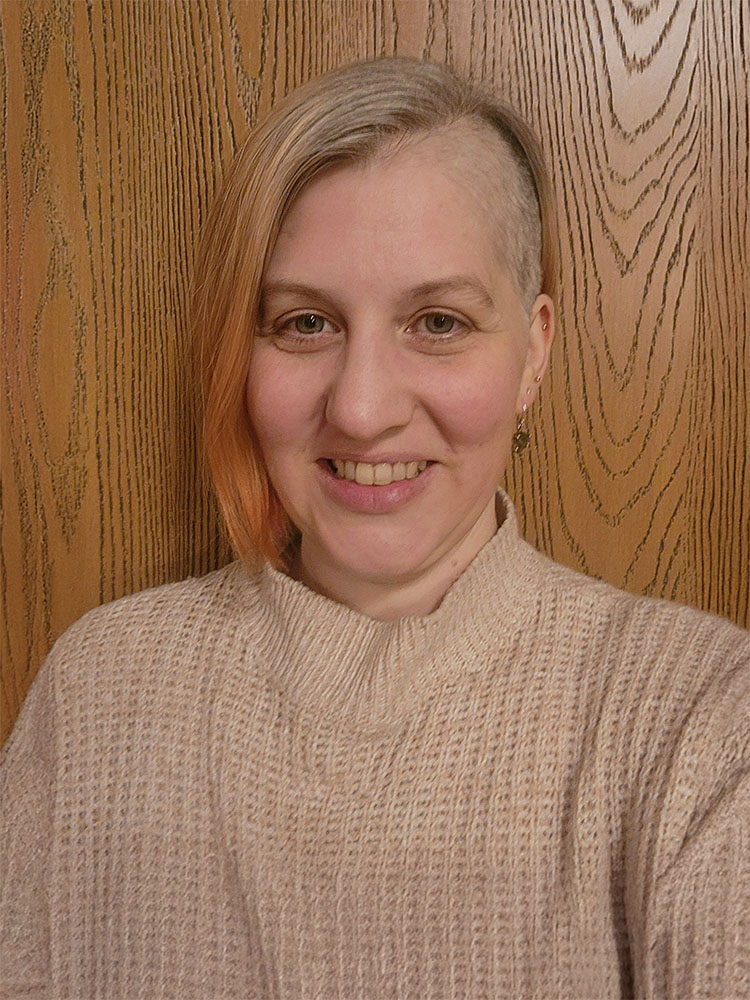
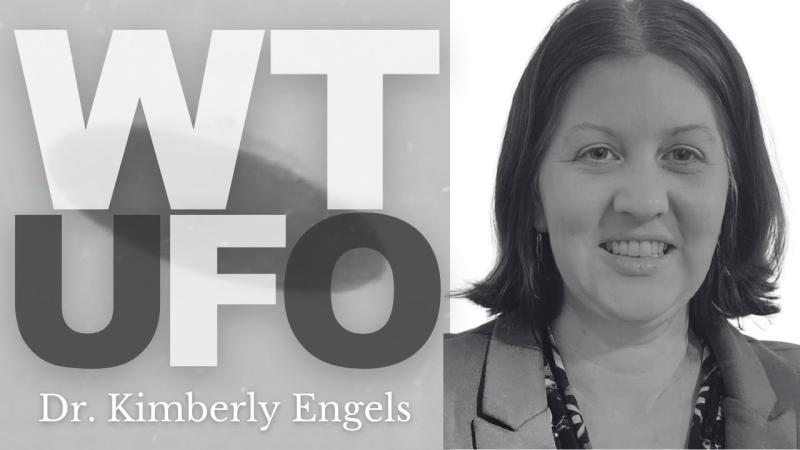
Kimberly S. Engels, PhD, occupies an unusual position in contemporary UAP studies. She is not principally an investigator of radar returns, propulsion systems, disputed imagery or individual aerial cases. Her subject is the person who encounters something that appears to exceed familiar categories, then has to live with what happened afterwards.
Her central question is deceptively simple: before deciding what caused an anomalous encounter, what was actually experienced? From that starting point, Engels examines perception, embodiment, altered senses of time, encounters with an apparent Other, changes in worldview, and the ethical consequences that witnesses associate with contact. Her publications, courses and conference work have contributed to the growing use of phenomenological methods in academic UAP studies, particularly in research centred on experiencer testimony.
As of October 2026, Engels is Chair and Associate Professor of Philosophy at Molloy University in New York. Molloy lists bioethics, existentialism and public philosophy among her areas of specialisation, while its research profile also identifies interests in contemporary philosophy, Indigenous philosophy and the philosophy of extraordinary experiences. She is Research Director of the John Mack Institute and an advisory board member of the Society for UAP Studies.
Her importance to UAP studies lies less in proposing a final explanation for anomalous encounters than in challenging a methodological habit: deciding what an experience must have been before carefully describing what the witness says actually occurred. At its strongest, Engels’s work keeps two propositions in view simultaneously. A reported encounter can be psychologically, philosophically and ethically consequential without its external cause having been established, while uncertainty about cause does not make the experience itself irrelevant.
From Iowa to existential philosophy
Engels is originally from Fayette, Iowa. She attended Luther College and initially intended to pursue music before an introductory philosophy course redirected her academic interests. She completed a BA at Luther in 2008, studying religion and philosophy, and later entered graduate study at Marquette University. Molloy’s institutional research profile confirms her Luther and Marquette education.
At Marquette, Engels developed the philosophical concerns that would eventually underpin her work on anomalous experience. Her doctoral research centred on Jean-Paul Sartre and Michel Foucault, two thinkers whose work repeatedly asks how human beings become particular kinds of subjects within social, historical and material conditions.
Marquette records her PhD in Philosophy as awarded in summer 2017. Her dissertation, The Social and Historical Subject in Sartre and Foucault and Its Implications for Healthcare Ethics, was supervised principally by Pol Vandevelde, with Kevin Gibson and Stanley Harrison serving as additional advisers. The dissertation argues that subjectivity is not simply an isolated interior condition but develops through interaction with social practices, systems of thought, power relations and material circumstances.
This work provides an important intellectual foundation for Engels’s later UAP scholarship. If the categories through which human beings understand themselves and the world are partly historically constructed, then an experience that appears to violate those categories may create more than intellectual puzzlement. It may disrupt a person’s sense of what kinds of things can exist, what forms of experience are credible, and how their own identity fits within a previously stable world.
Engels joined Molloy in 2017. Her academic record lists her as an assistant professor from September 2017 through August 2023 and an associate professor from September 2023 onwards. Molloy’s current faculty directory identifies her as department chair as well as associate professor.
She also became active in organised Sartre scholarship. Engels served as President of the North American Sartre Society from 2021 to 2023 and subsequently continued as its Treasurer. A Molloy-hosted 2022 conference page identifies her as NASS President, while the society’s current leadership information lists her as Treasurer.
Subjectivity before UAP
Engels’s scholarship before her turn towards UAP reveals a persistent concern with freedom, constraint and transformation.
Her 2018 article “From In-Itself to Practico-Inert: Freedom, Subjectivity, and Progress” examined Sartre’s concept of the practico-inert. Sartre used the term for the accumulated products of human action that subsequently confront people as apparently fixed features of their world. These can include physical objects, language, social ideas and institutions. Engels argued that such structures can limit human freedom but can also provide the material through which new possibilities become available. The article appeared in Sartre Studies International, volume 24, issue 1, pages 48–69.
Her 2019 paper “Ethical Invention in Sartre and Foucault: Courage, Freedom, Transformation” extended these concerns into ethics. Engels compared the later ethical thinking of Sartre and Foucault and emphasised their shared attention to critical reflection, historical conditions and the possibility of transforming inherited ways of relating to oneself and others. Ethical action, in this framework, can require recognising that supposedly inevitable arrangements are neither permanent nor beyond challenge.
Her 2022 article on medically unexplained symptoms moved similar questions into healthcare. Drawing on Sartre and Simone de Beauvoir, Engels considered the situation of patients who experience symptoms for which medicine cannot provide a satisfactory explanation. She argued that such patients can find themselves in an existential bind, because the unexplained condition affects their identity and life projects even when institutional medicine lacks an accepted causal account.
There is a clear bridge here to her later treatment of UAP experiencers, although the comparison should not be pushed too far. In both settings, the absence of an accepted causal explanation does not erase the lived event. A researcher may remain uncertain about what caused an experience while still examining what the experience did to the person who underwent it.
Popular culture, consciousness and the non-human
A second strand of Engels’s career developed through public philosophy and popular culture. She co-edited Westworld and Philosophy with James B. South in 2018 and edited The Good Place and Philosophy in 2020. She later joined David Kyle Johnson, Dean A. Kowalski and Chris Lay as an editor of The Palgrave Handbook of Popular Culture as Philosophy.
These projects brought questions of consciousness, autonomy, moral agency, personhood and constructed reality into dialogue with television, film and games. Engels also co-authored philosophical work addressing Detroit: Become Human, whose narrative raises the moral question of whether apparently artificial beings can become subjects deserving ethical consideration.
It would be speculative to claim that this work caused her later turn towards UAP. It does, however, provide significant intellectual context. Engels was already interested in philosophical situations in which something initially classified as an object begins to appear as a subject, and in what follows when established distinctions between human and non-human intelligence become unstable.
That question would later return in a more radical form through experiencer reports of apparent contact with non-human intelligence.
The turn towards anomalous experience
Engels has described the period beginning in 2020 as a turning point in her research. In a June 2026 interview on Fire in the Cosmos, she recalled having previously worked as a more conventional philosopher of ethics, phenomenology and lived experience before anomalous phenomena again became a serious research interest. She described her research as taking a new direction after 2020 as she increasingly recognised philosophical implications in experiencer accounts. The statement is best understood as Engels’s own retrospective account of her intellectual development.
The scholarly transition is independently visible by 2023. Engels’s curriculum vitae records Molloy funding for the transcription of fifteen interviews examining reported encounters with non-human intelligence, together with separate support for eighteen days of research at Rice University’s Archives of the Impossible.
One of her earliest journal articles focused directly on UAP was “Reviving Philosophical Discussion of Close Encounters through the Strieber Letters”, published in Philosophy and Theology in 2023. The paper drew on correspondence held in the Whitley Strieber archive at Rice University and compared those accounts with previous research into reported close encounters.
Engels argued that these experiences can violate an experiencer’s existing social ontology, meaning the largely taken-for-granted framework through which a society identifies what is possible, real or credible. Reported encounters may therefore be subversive not merely because they contain unusual perceptions, but because they threaten the conceptual structures through which the experiencer previously understood reality.
The paper also reveals a productive tension within Engels’s work. Phenomenology can establish that witnesses describe encounters as transformative. Moving from that observation to the proposition that the encounter was intended to transform the experiencer involves an additional interpretive step. That stronger conclusion belongs to philosophical interpretation rather than independently demonstrated evidence of an external intelligence’s intentions.
What phenomenology contributes to UAP studies
Phenomenology begins with experience as it appears to consciousness. In this context, “appearance” does not mean illusion. It refers to what is presented to experience before a final explanation of its origin is imposed.
For UAP research, this changes the order of inquiry. A phenomenological investigator may ask what a witness saw or sensed, how the body responded, whether time appeared normal or altered, how an apparent entity was encountered, whether communication seemed verbal or non-verbal, and how the event subsequently affected memory, identity and expectations.
The method therefore differs from beginning with the question, “What was the object?” Engels does not argue that phenomenology should replace physical investigation. Her 2025 Limina article presents it as another methodological dimension, capable of studying the first-person character of events that cannot be captured fully by third-person instrumentation alone.
Central to this approach is bracketing, or epoché. The researcher temporarily suspends judgement about what an experience ultimately was. Engels’s Society for UAP Studies course explicitly applies Husserlian bracketing to UAP encounters, asking students to suspend assumptions and preconceptions about what appears before analysing its structure.
This restraint is crucial. Phenomenological analysis cannot by itself prove that an intelligence exists independently of the experiencer. It cannot authenticate telepathy, determine the physical status of an apparent entity or establish the origin of an unusual perception. Its task is first to describe what was experienced and how it was experienced.
Engels also draws attention to intentionality, the phenomenological idea that consciousness is always consciousness of something. A UAP can continue to function as an object of consciousness long after a sighting ends. It may be remembered, anticipated, feared, sought or interpreted through later events. Absence can therefore become part of the phenomenology as much as presence.
This helps explain why some UAP encounters cannot be understood simply as isolated visual observations. In experiencer testimony, an event may reorganise subsequent interpretation of dreams, bodily sensations, coincidences, memories or later anomalous experiences. Phenomenology can map that development without deciding in advance whether those later experiences share a common external cause.
Intersubjectivity and the unacknowledged Other
Engels’s programme becomes more heterodox when the object of experience begins to appear as a subject.
Classical phenomenology devoted considerable attention to intersubjectivity, the encounter with another consciousness. Engels asks what happens when a witness believes the Other encountered is not human and may not conform to familiar assumptions about embodiment, communication, temporality or individuality.
Her 2025 article “The Unacknowledged Other: Sartrean Phenomenology and Encounters with Non-Human Intelligences” applies Sartrean phenomenology to reports of apparent NHI. The paper examines how an experiencer may confront an apparent subject for which mainstream social reality supplies no generally accepted category, creating what Engels describes through concepts such as ontological shock, existential rupture and abjection. Her published record places the article in Sartre Studies International, volume 31, issue 2, pages 76–93.
The evidentiary distinction is important. Engels is analysing reports of apparent or alleged NHI. Her philosophical framework can illuminate what it means for a witness to experience an encounter as intersubjective. It does not independently establish the identity or external reality of the perceived Other.
This is particularly significant where testimony contains reports of telepathic communication, mind-to-mind impressions, perceived downloads of information or the sensation of being mentally observed. These motifs can be legitimate objects of comparative phenomenology. Their recurrence, however, does not by itself determine their mechanism.
From a course to a research programme
Teaching became one of the principal laboratories for Engels’s UAP philosophy.
During October and November 2023, she taught an eight-week Society for UAP Studies course examining close encounters through Husserl, Maurice Merleau-Ponty and Sartre. Engels subsequently reflected that these thinkers provided necessary methodological tools but did not offer a complete vocabulary for some of the forms of perception and intersubjectivity described in contact reports.
The Society formally offered Phenomenology of UAP again from 24 April to 12 June 2024. The eight-week course began with Husserlian phenomenology and moved through perception, embodiment and successive classes of close encounter, ending with what the syllabus called the “Phenomenology of the Impossible”. It also incorporated literature by Jacques Vallée, John E. Mack, Thomas Bullard, Kenneth Ring, Peter Gutilla and Michael E. Zimmerman.
In 2025 Engels taught Phenomenology of UAP II: Intersubjectivity. That course placed Husserl, Sartre, Emmanuel Levinas, Julia Kristeva, Jean-Luc Marion and Martin Heidegger alongside literature concerned with anomalous encounters. Its focus was the philosophical problem of encountering another consciousness, including an apparent non-human Other.
These courses are significant because they represent more than public discussion of UAP. They attempt to translate a specialised philosophical method into a repeatable educational framework. Together with Engels’s publications, they provide the strongest evidence for describing her as a contributor to the developing academic use of phenomenology in UAP studies.
John Mack, epistemic justice and marginalised experience
Engels became Research Director of the John Mack Institute in September 2023. The connection is intellectually significant. Mack, the Harvard psychiatrist whose work gives the Institute its name, argued that people reporting extraordinary contact experiences should be studied without automatically treating their testimony as evidence of psychopathology.
Engels approaches related material through philosophy rather than psychiatry. Her concern is how institutions determine what kinds of experiences can count as knowledge, and what happens to people whose testimony challenges those limits.
Her 2025 World Futures article, “Marginalized Knowledges and the Boundaries of the Real: UAP Studies as an Ethical Project”, makes this argument explicitly. Engels describes UAP studies not only as an epistemic problem but as an ethical one. Drawing on disability studies and Indigenous American thought, she argues for greater attention to forms of knowledge that dominant institutions have historically classified as marginal, abnormal or impossible. The journal’s disclosure statement identifies her as Research Director of the John Mack Institute.
The argument is strongest when understood as a demand for serious listening rather than automatic belief. Treating a witness as a legitimate participant in inquiry does not require accepting every causal interpretation the witness attaches to the experience.
This gives Engels’s career an unusual continuity. Her healthcare ethics examined situations in which suffering may not fit a recognised diagnostic explanation. Her UAP scholarship examines experiences that may not fit an accepted ontology. In both cases she asks what happens when institutions lack adequate language for something a person nevertheless experiences as consequentially real.
Transformative contact
The interview project begun in 2023 eventually became “The Transformative Potential of Contact Experiences: A Phenomenological Study”, published online by the Journal of Humanistic Psychology on 28 June 2026.
The study examined people who self-reported experiences of contact with advanced non-human intelligence and asked how those experiences had changed their beliefs, values and worldviews. Engels explicitly begins from a position of bracketing, suspending judgement about the source or origin of the reported phenomena while examining what appeared within participants’ conscious experience.
Participants described changes in their understanding of consciousness, time, interconnectedness and moral concern. Engels interprets those changes through descriptive, generative and interpretive phenomenology, examining how the experiences reorganised subjectivity and meaning.
The epistemic boundary is clear. The study establishes that participants reported contact and associated those experiences with significant personal transformation. It does not establish that an advanced NHI objectively caused either the experiences or the transformation. This distinction follows directly from Engels’s stated methodology rather than being a sceptical qualification added from outside it.
The paper also contains an important data limitation. The complete qualitative interview transcripts are not publicly available because of their sensitive and confidential nature. Anonymised excerpts appear in the article, and additional material may be available on reasonable request subject to ethical approval. Independent researchers therefore cannot presently inspect the entire interview corpus as they could an open dataset.
A phenomenology of disclosure
Engels’s 2026 book Contact and Multidimensional Subjectivity: Toward a Phenomenology of Disclosure brings much of this programme together. Published by College Publications as volume five in its Marked States series, the book asks what follows when first-person accounts of contact are not immediately reduced either to pathology or to a purely technological threat model.
The concept of disclosure is broadened accordingly. Rather than referring only to governments, documents or the public acknowledgement of unusual craft, disclosure becomes a possible event within subjectivity itself. Contact, if experienced as real by the subject, can destabilise distinctions between self and Other, mind and world, human and non-human, ordinary and extraordinary.
This move is philosophically ambitious. It also requires precision. A phenomenology of disclosure can analyse the transformation of consciousness associated with an encounter without demonstrating that the encounter constitutes disclosure of an independently verified NHI presence. The phenomenological and ontological claims remain related but distinct.
Ethics at the edge of knowledge
On 10 July 2026, Engels co-organised Breaking the Taboo: Reviving Academic UAP, Abduction, and Experiencer Research, an online symposium associated with the John Mack Institute and Rice University’s Center for the Impossible. The official event record names Engels alongside Karin Austin and Michael Bohlander as organisers. Her presentation addressed the limitations of anthropocentric ethics when considering encounters with an apparent non-human Other.
The question follows naturally from her earlier work. Ordinary ethical concepts such as consent, reciprocity, autonomy and responsibility were developed primarily for relationships between human moral agents. Reported contact narratives sometimes describe an Other whose intelligence, power, embodiment or understanding of time appears radically different from that of the witness.
Engels asks whether familiar ethical categories would remain adequate under those circumstances. The question is philosophically legitimate even before NHI has been established empirically. It can be stated conditionally: if humans encounter a genuinely different intelligent subject, what obligations and concepts would be required?
The methodological danger arises only when the conditional question is transformed silently into a declaration that the proposed Other has already been demonstrated. Engels’s work is most rigorous when that boundary remains explicit.
Methodological limits and unresolved questions
Phenomenology gives UAP research something that sensor-centred investigation frequently leaves aside: a disciplined vocabulary for examining the witness as a conscious subject. It is much less capable of determining external causation.
A richly described experience remains compatible with several possibilities. Physical events, neurological processes, altered states of consciousness, sleep phenomena, social interpretation, genuinely anomalous interactions and combinations of these possibilities cannot be separated merely by increasing the detail of first-person description. Phenomenology can identify structures within experience without automatically identifying the mechanism that produced them.
Qualitative experiencer research also carries familiar selection problems. People who volunteer for studies specifically concerned with contact may differ from people who have anomalous experiences but interpret them through other frameworks. Retrospective testimony may change as witnesses encounter researchers, books, communities or new explanatory concepts.
These factors do not make experiencer testimony valueless. They identify the points at which phenomenology benefits from collaboration with psychology, history, neuroscience, archival research and, where available, instrumented observation.
A further distinction concerns transformation and purpose. Evidence that an experience changed someone’s worldview does not establish that an external intelligence intended that change. The first proposition may be documented through interviews. The second requires additional evidence about agency and intention.
Engels’s engagement with Indigenous philosophy likewise requires specificity. Indigenous peoples do not constitute a single philosophical tradition. Comparisons involving relational ontology, trickster figures or alternative epistemologies are strongest when particular thinkers, nations and intellectual traditions are identified, rather than treating Indigenous knowledge as a general validating category for conclusions developed elsewhere.
These limits do not defeat Engels’s programme. They clarify its proper domain.
A contribution still taking shape
Engels’s UAP-specific scholarship is recent. Her major publications, courses and institutional work in the field have largely developed since 2023. It is therefore too early to measure a settled intellectual legacy.
What can already be identified is a coherent research programme. Engels argues that UAP studies contain both an external and an internal problem. The external problem asks what the phenomenon is, how it behaves, where it originates and what physical evidence accompanies it. The internal problem asks what happens to the human subject who experiences something that appears to overturn their prior understanding of reality.
Those problems cannot substitute for one another. A profoundly transformed life does not prove an NHI cause. A lack of definitive physical evidence does not mean that the reported transformation is unreal.
This distinction is where Engels’s work makes its clearest contribution. Phenomenology preserves the complexity of testimony while withholding a premature judgement about causal origin. It creates methodological space between uncritical acceptance and automatic reduction, allowing perception, meaning, embodiment, intersubjectivity and ethical consequence to become objects of serious inquiry.
If some UAP encounters involve more than distant objects and fleeting observations, and if at least some reports genuinely include profound alterations of consciousness or apparent engagement with another intelligence, then a comprehensive UAP research programme will require methods capable of examining those dimensions.
Engels is attempting to supply part of that vocabulary.
Whether the ultimate sources of such experiences prove physical, neurological, psychological, transpersonal, non-human or more complex than the available categories permit remains unresolved. Her central methodological challenge is more modest and arguably more durable: the witness should not disappear from UAP research simply because the phenomenon is difficult to classify.
References
Engels, K. S. (2017). The social and historical subject in Sartre and Foucault and its implications for healthcare ethics [Doctoral dissertation, Marquette University]. e-Publications@Marquette.
Engels, K. S. (2018). From in-itself to practico-inert: Freedom, subjectivity, and progress. Sartre Studies International, 24(1), 48–69. doi:10.3167/ssi.2018.240105.
Engels, K. S. (2019). Ethical invention in Sartre and Foucault: Courage, freedom, transformation. Foucault Studies, 27, 96–116. doi:10.22439/fs.v27i27.5893.
Engels, K. S. (2022). The patient experience of medically unexplained symptoms: An existentialist analysis. Theoretical Medicine and Bioethics, 43(5–6), 355–373. doi:10.1007/s11017-022-09587-y.
Engels, K. S. (2023). Reviving philosophical discussion of close encounters through the Strieber letters. Philosophy and Theology, 35(1–2), 229–253. doi:10.5840/philtheol2024911172.
Engels, K. S. (2025). The importance of phenomenology for UAP studies. Limina: The Journal of UAP Studies, 2(1). doi:10.59661/001c.131704.
Engels, K. S. (2025). The unacknowledged Other: Sartrean phenomenology and encounters with non-human intelligences. Sartre Studies International, 31(2), 76–93.
Engels, K. S. (2025). Marginalized knowledges and the boundaries of the real: UAP studies as an ethical project. World Futures. Advance online publication. doi:10.1080/02604027.2025.2603164.
Engels, K. S. (2026). Contact and multidimensional subjectivity: Toward a phenomenology of disclosure. College Publications.
Engels, K. S. (2026). The transformative potential of contact experiences: A phenomenological study. Journal of Humanistic Psychology. Advance online publication. doi:10.1177/00221678261458414.
Miller, A., & Whelehan, S. (Hosts). (2026, June 19). What can experiencers teach us? Phenomenology, contact & the trickster | Dr. Kimberly Engels [Audio podcast episode]. In Fire in the Cosmos.
Society for UAP Studies. (2024). Phenomenology of UAP.
Society for UAP Studies. (2025). Phenomenology of UAP II: Intersubjectivity.
John Mack Institute. (2026, July 10). Breaking the Taboo: Reviving academic UAP, abduction, and experiencer research.
SEO Keywords
Kimberly Engels biography; Kimberly S. Engels PhD; Phenomenology of UAP; UAP phenomenology; UAP experiencer research; non-human intelligence; NHI contact; philosophy of UAP; John Mack Institute; Society for UAP Studies; Molloy University philosophy; phenomenology of contact; ontological shock; experiencer testimony; intersubjectivity and UAP; epistemic justice; contact experiences; multidimensional subjectivity; phenomenology of disclosure; Sartre and UAP; consciousness and UAP; philosophy of anomalous experience; ethics of contact; transformative contact experiences.