
Lubbock in late August has a particular kind of night. The heat backs off just enough to make porches livable. The wind, when it shows up, smells like dry grass and distant farms. The sky is the kind you remember for years, because there’s so little humidity that the stars look sharpened, as if someone turned a focus ring on the Milky Way.
It’s the perfect stage for a UAP story, and in 1951 it delivered one that never fully left. The Lubbock Lights were not a single “sighting.” They were a wave. The lights were reported across multiple nights, by multiple groups, in patterns that felt coordinated enough to provoke debate in real time. Some witnesses were certain they could see wings. Others were certain there were no wings to see. A young man took photographs that became iconic. Official investigators arrived, interviewed, tested, doubted, and documented. And the result, unusually for early 1950s UAP files, was not a neat official ending, but a case that stayed elastic: part plausible natural explanation, part unresolved residue.
That combination is why the Lubbock Lights still matter. Not because they “prove” any single interpretation, but because the case shows you what happens when something unusual is seen repeatedly by capable observers, and then photographed, and then processed by institutions that are both curious and cautious. In other words, it’s a UAP case that behaves like a real event instead of a tidy anecdote.
The night the professors stopped talking
The official Project Grudge paperwork places the start of the core story on Saturday, August 25, 1951, around 9:10 p.m. Central time. Four faculty members at Texas Technological College (now Texas Tech University) were outdoors, initially engaged with sky observation related to micrometeorite work. In the Grudge summary, they noticed a group of lights pass from north to south at what they judged to be a high rate of speed. The formation is described as an almost perfect semicircle containing roughly 20 to 30 individual lights. The lights were described as blue-green. There was no sound that could be assigned to aircraft. The lights did not behave like a plane approaching from a distance, and they appeared and disappeared abruptly across the sky.
The case gained traction quickly because of who those first witnesses were. Grudge emphasizes their professional backgrounds: senior faculty and technical specialists with training in observation and measurement. In the report’s characterization, this was not a crowd primed for sensationalism. It was a group familiar with the discipline of uncertainty and the embarrassment of overstatement. That matters, because one of the Lubbock case’s persistent features is how often it invites people to overstate: speed estimates, altitude estimates, shape certainty. The early witnesses, if anything, were notable for being bothered by how hard it was to pin the basics down.
And they tried.
The Grudge report notes that the professors attempted to set up a measured baseline and use angle-measuring devices to triangulate altitude. They even prepared for additional attempts, expecting the phenomenon might return when they were ready. But the lights did not cooperate. Some nights they appeared. Other nights, the nights the observers were positioned for measurements, they did not. It is a small detail that tells you something big: the witnesses were treating the sky like a problem they might solve with method, and the phenomenon stayed slippery enough to prevent clean triangulation.
Grudge’s documentation includes an estimated angular velocity that still makes modern readers blink: about 30 degrees of arc per second. That is an impression measurement, not an instrument reading. But it conveys the same thing every witness narrative conveys, whether skeptical or convinced: the lights moved fast across the sky. They did not drift like lanterns. They did not crawl like satellites. They behaved, to observers on the ground, like a coordinated group passing overhead with purpose and momentum.
A wave, not a single object
If Lubbock were only one night and one sighting, it would be a footnote. The reason it became a case is that it repeated.
Project Grudge reports that the phenomenon was observed by at least one hundred people in and around Lubbock. It also notes that there were multiple “flights” on some nights, sometimes two or three passes. As a result, you get something that case investigators both need and fear: volume. Volume can reveal patterns, but it also invites noise. Once people expect something, they watch more, talk more, and report more. That can be a gift to analysis, or a trap. Lubbock was both.
One of the most important parts of the Grudge record is that it preserves disagreement inside the wave itself. Some witnesses said the objects were birds reflecting city light, and some claimed they could see wings flapping. The report acknowledges that duck flights were present in the area during the period. But it also preserves the opposing stance: technically trained witnesses who did not accept the bird explanation based on their impressions of speed, formation, and repeated behavior.
This is where many retellings oversimplify, and where the official record is actually more interesting than the myth. Grudge does not fully collapse the wave into “birds,” nor does it endorse “unknown craft” as a settled identity. It preserves the ambiguity, and it even suggests that some observers may indeed have been seeing birds while others were seeing “some other objects.” That sentence is rare in early UAP documentation because it admits the possibility of a mixed wave.
Donald Menzel and Lyle Boyd later described the Lubbock Lights as a “conglomerate” case, which is another way of saying the same thing: one label may have come to cover multiple stimuli and multiple interpretations. Even if you do not accept their overall skeptical framing, that structural observation matches what the Grudge paperwork already implies.
The photographs, and why the date matters
The photographs are the hinge point. They are the reason many people know the Lubbock Lights at all. They are also the reason the case became a national argument rather than a local curiosity.
But before you even talk about what the photographs show, it is worth getting one precision point right. The date attached to the Hart photographs is reported differently in the documentary trail.
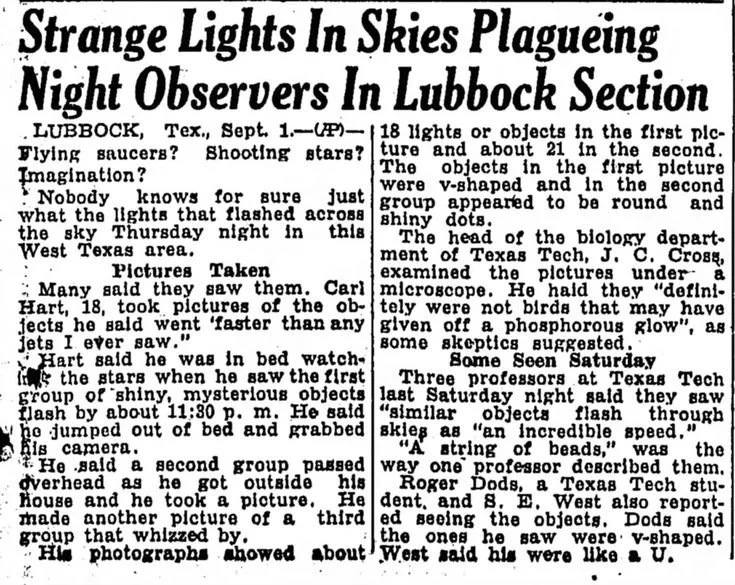
In Project Grudge Status Report No. 2, the photographed incident is dated to the evening of August 31, 1951, around 11:30 p.m. Central time. The report describes a Texas Tech college freshman who saw the lights from inside a home, went into the backyard, and obtained five photographs across multiple passes.
In the widely circulated Life magazine feature “Have We Visitors from Space?” published April 7, 1952, the photographs are dated to August 30, 1951, and are credited to Carl Hart Jr. That date, repeated in later popular accounts, became the common shorthand.
So what should a careful reader do with this? Keep both dates in view. The photography occurred during the late-August wave, and primary Grudge documentation and later mass-circulation journalism do not fully align on whether it was August 30 or August 31. That discrepancy does not, by itself, change what was captured, but it matters for timeline reconstruction and for correlating other reports.
Now, the photos themselves.
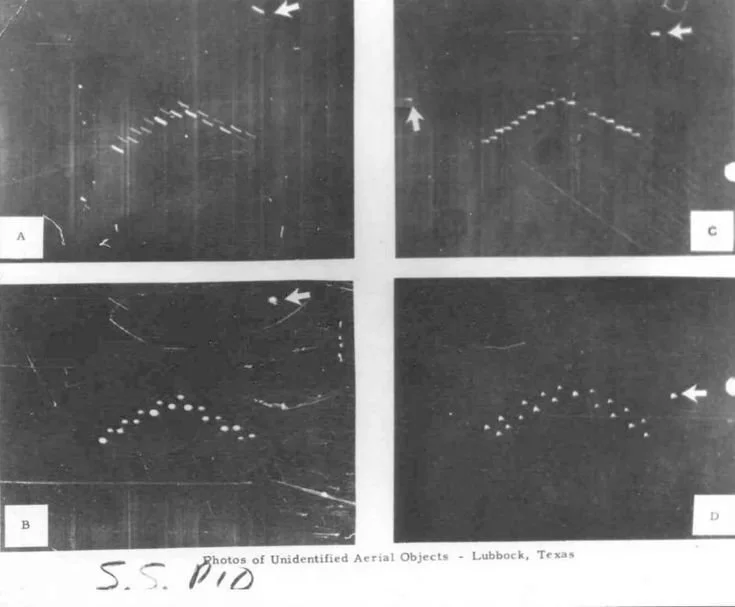
The Grudge report says the photographs show rows of lights in a V formation. The images became famous for looking structured, almost architectural: points of light arranged in a clean geometric pattern. Life magazine went further, giving camera settings and describing the lights as brighter than Venus, a detail designed to hook readers and provide a sense of scale.
But a key tension appears immediately in the official record: the professors did not think the photographs necessarily matched what they had seen.
Grudge records that the professors were doubtful the photographs were of the same objects because they had never observed a perfect V-shaped formation, and they believed the lights they saw were not bright enough to be photographed. The report allows for mundane explanations of the mismatch, such as different flights appearing differently, or different observers seeing different subsets of the wave. But it does not hide the mismatch.
Then there is the detail that sounds like a throwaway until you appreciate what it implies: the photographer reportedly said the formation appeared U-shaped to him in the moment, but on developing the negatives it appeared V-shaped. That might be perceptual, a function of motion and exposure, or it might reflect the way a pattern can look curved when it’s moving and angular when it’s frozen on film. It is also one more clue that “the Lubbock Lights” may not be one stable object in one stable configuration.
“Not a hoax” is not the same as “identified”
The Hart photographs entered a tricky evidentiary category that UAP cases often live in: physically consistent images of something real, paired with insufficient context to identify what the something is.
Project Grudge Status Report No. 2 states that there were no indications that the photographs were not authentic. It also reports that representatives of the Associated Press and Life magazine examined the photos and considered them not obviously a hoax.
The same reporting describes how the photographs were routed for analysis at the Photographic Reconnaissance Laboratory, Wright Air Development Center. The preliminary analysis involved inspection of the negatives using a comparator microscope. Among the reported conclusions were that the images were produced by light striking unexposed film, with no evidence of retouching, and that the individual lights varied in intensity. The analysis also noted that the stars did not register, implying the recorded lights were intense enough relative to the exposure.
These statements are often misused in opposite directions. Some readers treat “no retouching” as if it proves exotic origin. Others treat “not obviously a hoax” as if it proves nothing at all. The more grounded reading is simpler: the negatives appear consistent with having recorded real luminous sources, but the analysis does not supply range, altitude, size, or mechanism. It supports authenticity as a photographic event, not identification as an object.
Grudge also shows that investigators did not simply accept the photographer’s narrative at face value. The status reports note interrogation and re-interrogation, including OSI involvement, after investigators believed discrepancies existed. The file reads like an attempt to test integrity rather than assume it, which is an important context for why the photographs became a lasting puzzle instead of being discarded.
Birds, streetlights, and the temptation of a simple wrap-up
The most famous conventional explanation for the Lubbock Lights is that they were migratory birds reflecting city lighting. Variations of the explanation often mention plovers, because of their pale undersides, and emphasize the role of bright mercury-vapor lights that might illuminate the underside of a flock.
This is not a lazy idea. It is a plausible mechanism. Birds do fly in loose formations. Under certain lighting, a group can flash and look like discrete points. Night perception can compress distance, exaggerate speed, and flatten depth. Even in the Grudge material, “birds reflecting city lights” is presented as a live hypothesis supported by some witness accounts, including claims of visible wing flapping.
But the same Grudge reporting records skepticism. A federal game warden consulted during the investigation expressed doubt that enough plovers would be present to account for the number of flights unless there had been a sudden influx, even while acknowledging plovers were a “likely suspect” if it was birds. The professors, for their part, did not accept the explanation as satisfying, especially given repetition and perceived speed.
There is also a practical replication issue recorded in the official reporting: an experienced newspaper photographer attempted to photograph ducks at night using natural light and flash, and failed. The report treats this as significant if the Hart photographs are authentic, and suggests that if the photographed lights were real and bright enough to expose film the way they did, then ducks were unlikely. Notice the careful narrowing: “not ducks” is not the same as “not birds,” but it does show investigators were trying, however imperfectly, to test the best prosaic candidates.
Menzel and Boyd, in their skeptical treatment, also discuss how the Lubbock photos complicated the bird theory because attempts to reproduce night bird reflections did not yield images comparable to the published photos. They use that to argue the public story became an overgrown bundle of reports, but even their framing implicitly concedes that the photos did not comfortably behave like the simplest version of “it was just birds.”
If you are honest with the record, you end up with a nuanced position: birds may explain some portion of the wave, especially given explicit wing-flap testimony. Birds may even explain many reports once public attention turned the sky into a stage. But birds do not cleanly account for every documented element that made investigators and witnesses uncomfortable, especially the photographic component and the inability to replicate the effect easily.
Ruppelt’s account, and why his “solution” stays slippery
Edward J. Ruppelt’s writing is one of the reasons the Lubbock Lights remained culturally alive beyond the 1950s. He writes with the voice of someone who knows the machinery inside official investigation and also feels the tension between paperwork and experience.
In The Report on Unidentified Flying Objects, he says that officially, the sightings (except a radar-related report) were classified as unknowns. He also suggests, in the same larger narrative arc, that there was a “positive identification” of the Lubbock Lights that he would not reveal, framing it as something he was asked not to disclose.
That combination is why readers should treat the “positive identification” as ambiguous. It may reflect a real internal conclusion. It may reflect an assumption that felt satisfying at the time. It may reflect pressure, or simply Ruppelt’s attempt to balance public curiosity with professional boundaries. But as presented, it is not auditable. It does not supply the evidence chain. And it sits alongside the official “unknown” classification language he himself records.
So the most responsible way to use Ruppelt is not as a referee who ends the case, but as a witness to the atmosphere: the struggle of early UAP investigation to be simultaneously skeptical and open, while lacking the instrumented data that would make either posture definitive.
The Albuquerque “flying wing” comparison, and how to use it carefully
One of the more intriguing footnotes in the Grudge material is a comparative reference to a separate report: an August 25, 1951 incident in Albuquerque describing a “flying wing type” object with multiple pairs of soft glowing lights along the trailing edge. Grudge notes that the Lubbock photos were shown to sources in that Albuquerque case, and that they said the arrangement of lights was similar.
This is where it is easy to overreach. Similarity is not causation. A similar light pattern does not prove the same object, the same origin, or even the same category of phenomenon. It does, however, reveal something about investigative behavior in 1951. Investigators were already cross-comparing patterns across geography, trying to see whether some reports belonged to a family of observables. The Albuquerque mention is best read as a comparative note, not a causal link, and certainly not a proof that the Lubbock Lights were a “flying wing” craft.
Still, the comparison is valuable because it shows why Lubbock plugged into a broader mid-century landscape. People were not only reporting lights. They were reporting structured light arrays, sometimes described as attached to a wing-like body. That is one reason the Lubbock photographs landed so hard in the public imagination. They looked like they might belong to a larger pattern of “lights in formation” reports that were already circulating in military and civilian channels.
What Lubbock did to the culture, and what it did to the process
The Lubbock Lights hit at a time when UAP conversation was drifting into the mainstream. By the early 1950s, the story was no longer confined to niche publications. Life magazine, one of the most influential mass-market outlets in America, put the subject in glossy print with a sense of urgency. That kind of coverage does not merely report a case. It reshapes it.
Once a national audience sees a photograph, the photo becomes the template. The public begins to remember the case as a single image rather than a set of events. Witnesses who see something later may unconsciously map their experience onto the template. Skeptics may treat the template as the entire dataset and ignore the messier, earlier testimony. Believers may treat the template as decisive and ignore the internal disagreements preserved in the official record.
That is why the “bundle problem” matters so much here. Lubbock teaches a subtle lesson: a UAP wave can begin as a set of observations with genuine uncertainty and then harden into a single cultural object. The real event is messy. The remembered event becomes clean. The case file keeps trying to remind you that the clean version is an illusion.
Institutionally, Lubbock also mattered because it forced attention. Grudge describes the incident as unusually unique for the project due to the quality and repetition of the observations by scientifically trained witnesses. It records plans for additional investigation and references significant handling of photographic evidence. That is not what the paperwork looks like when a case is treated as trivial.
And the archival afterlife matters too. The Lubbock Lights are often discussed under the umbrella of Project Blue Book because of how the public remembers “the Air Force UAP project,” but the 1951 work is explicitly Grudge-era documentation. Understanding how those records were handled, preserved, and later accessed helps avoid a common mistake: treating “the government’s conclusion” as a single monolith rather than a set of evolving programs with evolving priorities and biases.
So what were they, really?
Lubbock is the kind of case that rewards the disciplined answer: “we can say what the record supports, and we can’t say what it doesn’t.”
The record supports that multiple nights of unusual lights were reported over Lubbock beginning August 25, 1951, and that the wave involved a large witness pool, including a technically trained group whose testimony became central.
The record supports that photographs were taken during late August 1951 by Carl Hart Jr. (with a date reported as August 31 in Grudge documentation and August 30 in Life), and that early analysis did not identify the photographs as hoaxes or retouched fabrications.
The record supports that a bird-reflection hypothesis is plausible for at least some reports, given explicit wing-flap testimony and seasonal bird movement, while also supporting that this hypothesis did not satisfy all key witnesses and did not neatly account for the photographic episode as processed in the official documentation.
Beyond that, certainty becomes personal. Some people will always prefer the simplest explanation, because that’s how responsible thinking often works. Others will always prefer the unknown explanation, because the case’s residue feels too structured and too persistent to dissolve into birds and light. The honest position is not to force the whole wave into one bucket. It is to accept that the “Lubbock Lights” label likely covers a mixed set of stimuli and interpretations, and that the surviving data does not allow a definitive identification of every component.
That is not a failure of imagination. It is a statement about evidence.
Implications for modern UAP thinking
Lubbock looks old, but it behaves like a modern problem.
It shows why “lights-only” UAP are some of the hardest cases to resolve. Lights give you poor range information, poor shape information, and a high susceptibility to misperception. But they can be repeated, photographed, and witnessed by many people. This makes them simultaneously easy to dismiss and hard to conclude.
It also shows why instrumentation matters. The Lubbock professors tried to introduce measurement into the case and were defeated by unpredictability. Today, a similar wave might produce synchronized timestamps, phone sensor metadata, radar logs, and multiple camera angles. In 1951, the case was forced to live inside testimony and a handful of exposures.
And it shows something else that is easy to miss: early official investigation could document uncertainty without resolving it. That’s the part of the historical record that often gets erased when people reduce the 1950s to either “they knew everything” or “they dismissed everything.” Lubbock shows a third posture: careful documentation, multiple hypotheses, and a file that does not cleanly close.
Speculation Labels
Hypothesis
The Lubbock Lights likely reflect a mixed wave in which at least one component may not have been biological, while other reports plausibly involve birds and lighting conditions. This hypothesis is grounded in the official record’s internal disagreement, the mismatch between professor descriptions and the photographed V pattern, and the difficulty of reproducing the photographic effect under attempted tests, while recognizing that none of this constitutes definitive proof of an exotic cause.
Witness Interpretation
Some witnesses interpreted the lights as birds, citing visible wing motion, while other witnesses interpreted the lights as a structured aerial phenomenon based on formation behavior, perceived speed, silence, and repeated passes. The official record preserves both interpretations rather than forcing a single consensus.
Researcher Opinion
The most durable reading is that “Lubbock Lights” became a cultural container for several events and several categories of observation. Treating it as one object creates false certainty. Separating the professor sightings, the broader public wave, and the Hart photographs often produces a clearer, more evidence-respecting analysis.
Claims Taxonomy
Verified
Multiple flights of unusual lights were reported over Lubbock beginning August 25, 1951, with a large witness pool (at least around one hundred people reported in Grudge summaries) and repeated observations including by a scientifically trained group of faculty.
Verified
Photographs taken during the late-August 1951 wave were evaluated in the Project Grudge process, with official statements that there were no indications the photographs were not authentic and preliminary analysis consistent with real light exposing film.
Probable
A portion of the broader wave reporting could involve birds reflecting city lighting, given witness reports of wing motion and the bird hypothesis being treated as a live explanation in the official record.
Disputed
The identification of the entire Lubbock Lights wave as a single bird species such as plovers remains disputed due to persistent disagreement among key witnesses, concerns recorded by consulted wildlife personnel, and unresolved issues around photographic brightness and replication attempts.
Disputed
Any claim of a definitive internal “positive identification” resolving the full case remains ambiguous when presented without an auditable chain of evidence and alongside official classification language preserving “unknowns.”
Relevant links
Primary documentation: Project Grudge Status Report No. 1 (1951) PDF.
Primary documentation: Project Grudge Status Report No. 2 (1951) PDF.
Contemporary mass-circulation framing: Life (April 7, 1952) “Have We Visitors from Space?” via Project 1947 archive: https://www.project1947.com/shg/articles/lifemag52.html
Ruppelt’s narrative account (with official “unknown” language): Internet Sacred Text Archive: https://sacred-texts.com/ufo/rufo/rufo10.htm
Skeptical historical synthesis discussing the “conglomerate” nature: Project Gutenberg edition of Menzel & Boyd: https://www.gutenberg.org/files/66639/66639-h/66639-h.htm
References
Air Technical Intelligence Center. (1951). Project Grudge Status Report No. 1 (BBA-PBSR1-300) [PDF]. Wikimedia Commons. https://upload.wikimedia.org/wikipedia/commons/3/3b/Project_Blue_Book%2C_BBA-PBSR1-300.pdf
Air Technical Intelligence Center. (1951). Project Grudge Status Report No. 2 (BBA-PBSR2-300) [PDF]. Wikimedia Commons. https://upload.wikimedia.org/wikipedia/commons/e/ea/Project_Blue_Book%2C_BBA-PBSR2-300.pdf
Darrach, H. B., Jr., & Ginna, R. (1952, April 7). Have We Visitors from Space? Life (archived reproduction). Project 1947. https://www.project1947.com/shg/articles/lifemag52.html
Menzel, D. H., & Boyd, L. G. (1963). The World of Flying Saucers. Project Gutenberg. https://www.gutenberg.org/files/66639/66639-h/66639-h.htm
Ruppelt, E. J. (1956). The Report on Unidentified Flying Objects (Lubbock chapter section). Internet Sacred Text Archive. https://sacred-texts.com/ufo/rufo/rufo10.htm
SEO keywords
Lubbock Lights 1951; Lubbock Lights UAP; Texas Tech professors UAP; Carl Hart Jr photographs; August 30 1951 Lubbock Lights; August 31 1951 Lubbock Lights; Project Grudge Lubbock; Project Blue Book Lubbock Lights; plover explanation Lubbock; migratory birds mercury vapor lights; Wright Air Development Center photo analysis; OSI interrogation UAP; 1951 UAP wave Texas; early Cold War UAP cases