
In the early hours of April 17, 1966, Portage County, Ohio was doing what it usually did at that time of night: sleeping. The roads were mostly empty. The towns between Ravenna and Mantua were quiet enough that a passing car could sound louder than it should. And for two deputies on patrol, the shift was supposed to be routine, the kind you finish with nothing more dramatic than a minor stop or a call to check on a stranded driver.
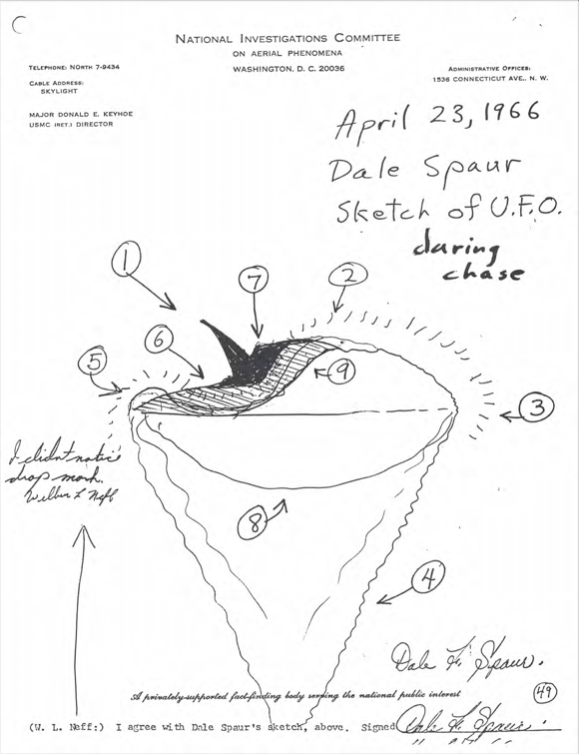
Instead, those dark roads became the opening scene for what is widely regarded as one of the most discussed law-enforcement UAP pursuits in the United States, and one of the most enduring arguments in the Project Blue Book era. What happened that night is fairly stable at the core and messy at the edges. The core is this: Deputies Dale F. Spaur and Wilbur “Barney” Neff reported seeing a brilliant object, described as bright and oblong, and then pursued it east for a long distance, ultimately reaching Pennsylvania. The mess begins where UAP cases always get complicated: how far away was it, how high was it, what exactly did it do, and what does it mean when an official explanation doesn’t feel like it matches the lived experience of the people who were there.
This account is built to be readable first, without sliding into certainty the evidence cannot support. It leans on first-hand witness testimony where it’s available through documented case summaries, and on official record streams where they exist. It also treats controversy as part of the historical record rather than an inconvenience to edit away. That is important here because the Portage County chase isn’t only about a light in the sky. It’s also about how institutions handle public-facing anomalies, and how witnesses absorb the consequences when the story becomes bigger than they are.
What is firmly known
Project Blue Book case documentation, as preserved and presented in widely consulted archives, places the incident on April 17, 1966. The object was first reported in the Ravenna–Mantua area of Ohio. Spaur and Neff pursued it eastward and the pursuit continued into Pennsylvania, ending near Conway, for roughly eighty miles of travel. Those elements appear directly in the case-file summaries circulated from the Blue Book record stream and reproduced in archival collections.
The same case-file summaries include descriptive language that has become inseparable from this event: the object was reported as very bright, with a silvery radiance, and described as oblong. At points, the report notes an estimate that it was roughly 500 feet over the pursuing vehicle.
Those details do not settle the case. Nighttime distance estimation is famously difficult, and an estimate in a narrative summary is not the same thing as a measurement. But they do establish why the chase never fit neatly into the “glanced at a light” box. The record describes prolonged attention, extended tracking, and an experience that the officers believed was dynamic and close enough to be alarming.
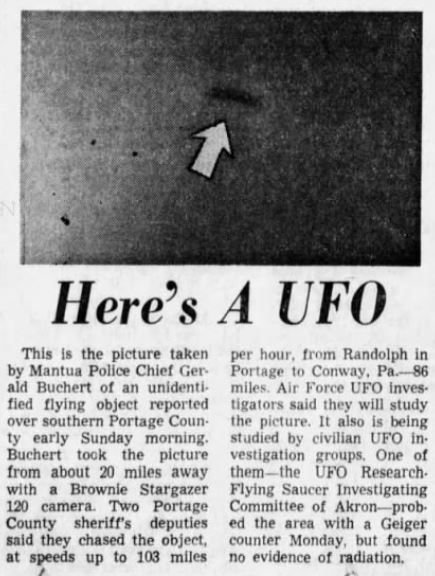
Also firmly known is that Blue Book reached an official conclusion. In the Project 10073 record as presented through the Blue Book-associated documentation stream, the “probable cause” is framed as a satellite pass, followed by the planet Venus after the satellite was no longer observed. The same record stream attributes the photographic results associated with Chief Gerald Buchert to film/processing problems, described as defects due to old or fogged film and poor handling.
The chase therefore has two parallel “knowns” that define its long afterlife: the officers’ pursuit narrative and the official satellite/Venus closure narrative. The tension between those two tracks is the reason this case is still discussed.
How it unfolded, in human terms
If you’ve never been in a moving night pursuit, it can be hard to understand why officers would commit so much time to something in the sky. But the chase becomes easier to grasp when you imagine how it probably felt from inside the cruiser.
You see a bright object ahead, low enough that it doesn’t behave like a normal starfield reference. You change speed and it still seems to be there. You take a turn and it stays in the same general sector of sky. You accelerate, partly to keep sightline, partly because you feel you’re losing it, and it remains visible. Your radio traffic increases. You tell dispatch what you think you’re seeing. At some point, the question shifts from “What is it?” to “Why is it still there?”
That lived feeling is exactly what makes this case hard to reduce to an astronomical explanation in the eyes of many readers. It is not that Venus is irrelevant. Venus is relevant to many UAP reports, and any careful analysis must keep that on the table. The difficulty is that the pursuit narrative implies motion relationships the witnesses experienced as interactive, whether or not those relationships were objectively real.
Later journalistic reconstruction of the case history, including accounts presented in Cleveland Scene, emphasizes that the officers believed the object remained trackable for long stretches and did not behave like a fixed background light to them in the moment. That is not the same as proving it was physically pacing them, but it is an important distinction. It describes experience, not physics.
This is also where other officers enter the broader memory of the event. Multiple accounts describe additional law enforcement attention as the chase moved east, which is broadly consistent with the general sense of escalation implied by the case narrative, even if the most stable public summaries focus primarily on Spaur and Neff. It is safer to say the event is widely reported as involving more than one set of law-enforcement eyes during its course, while treating the exact roster and sequence as variable across sources unless a specific claim is anchored to a specific document.
The Buchert photograph and why it never settled anything
Chief Gerald Buchert’s attempt to photograph the object should have been a turning point, the kind of artifact people crave in UAP cases. Instead, it became another argument.
The official Blue Book record stream, as presented in the Project 10073 record, attributes the photographic results to technical flaws: old or fogged film and poor handling, producing processing defects. That conclusion has been repeated for decades because it is simple and administratively convenient. If the photo is flawed, the photo cannot support an extraordinary claim.
But in practice, the photo’s weakness didn’t reduce interest. It amplified it, because it invited a familiar split: those inclined toward prosaic explanations viewed the photo as another example of why UAP evidence is unreliable; those inclined toward anomalous interpretations viewed the photo as a sideshow that does not address the underlying testimony and pursuit.
Later reporting preserves the cultural reality that the photograph became part of the conflict between local perception and official framing, not a clean solution. In a way, the photo became symbolic: the public wanted clarity, the official record offered dismissal, and the witnesses were left standing in the gap between the two.
The official satellite/Venus conclusion, framed correctly
Blue Book’s official position is not a rumor. It is in the record stream. It should be treated as the official conclusion, not as “the truth,” and not as something we can casually wave away.
The Project 10073 record describes a probable cause sequence beginning with a satellite pass and then shifting attention to Venus. From a purely astronomical standpoint, both elements are plausible stimuli. Satellites can be visible as moving points of light. Venus can appear remarkably bright, especially pre-dawn, and atmospheric conditions can make it shimmer or seem to pulse.
That said, plausibility is not the same as demonstrated match. The central question critics raise is whether those stimuli adequately explain the sustained pursuit narrative and the reported impressions of proximity and dynamic behavior found in the case-file summary language.
This is where careful writing matters. It is fair to say: Blue Book closed the case with a satellite/Venus explanation. It is not fair to imply that this closure settled the matter in a way that all competent observers must accept. Even Blue Book’s own historical record shows that administrative closure does not always equal full resolution, given the acknowledged number of cases left officially “Unidentified.”
The National Archives, which holds the declassified Blue Book files, states that Blue Book collected 12,618 reports and that 701 remained “Unidentified,” and confirms the records are declassified and available for research. This is crucial context: the official system itself left an admitted residue. The Portage County chase sits in the cultural space where official closure meets public and witness dissatisfaction.
Why “Venus” became inflammatory locally
A bright planet explanation can be technically reasonable and socially explosive at the same time. The difference is tone and context.
When an official explanation says, in effect, “you chased Venus,” it can land as more than an astronomical correction. It can land as a professional insult. Spaur and Neff were not casual stargazers. They were on-duty officers, engaged in a pursuit they felt justified. For the community, especially in the climate of the 1960s UAP debate, the “Venus” conclusion could feel like the Air Force was not simply explaining, but dismissing.
The UFOScans presentation includes a pointed excerpt of local criticism associated with correspondence from Portage County Judge Robert E. Cook to a congressman, calling the Venus conclusion ridiculous and arguing that it damaged Air Force prestige in the community. The letter’s existence and sentiment do not prove the object was anomalous. But it does document a real social reaction: the explanation did not restore confidence, it worsened tension.
That is part of the case’s historical importance. The phenomenon includes not only what was seen, but what was said afterward, and how the “settled answer” failed to settle anything.
Hynek, Powers, and a reported fracture in the advisory orbit
Because this case sits in 1966, it inevitably intersects with the public credibility crisis around Blue Book. J. Allen Hynek’s name often comes up in that wider story.
UAPedia’s profile of Hynek frames him as the scientific consultant who became increasingly dissatisfied with shallow or overly convenient explanations, particularly as public scrutiny intensified in the mid-1960s. That background matters because it explains why people look for “Hynek’s view” even when he was not the public author of every Blue Book conclusion.
A key detail that must be handled carefully is the claim that Hynek was not consulted before the public release of the evaluation, and that his assistant, William Powers, disagreed with the evaluation. That point appears in Cleveland Scene’s reporting and should be treated as a reported claim from later journalistic reconstruction rather than as independently verified fact from a primary document excerpt in the Blue Book file itself. Framed that way, it becomes a meaningful historical note about perceived internal disagreement, without pretending it is more certain than the sourcing supports.
This matters because it touches a recurring UAP pattern: internal complexity flattened into a single public narrative. Even if an official conclusion is defensible, the manner in which it is communicated can create a second controversy that outlives the first.
About those “extra specifics” and why they’re tricky
Some versions of the Portage County story include vivid additions: precise speed ranges, exact altitude figures repeated as if instrument-measured, or suggestions that radio communications were monitored or anticipated. The problem with these additions is not that they are impossible. The problem is that they are not consistently present in the most stable public backbone sources for this case, and they can drift toward mythology if presented as established fact.
The Blue Book case-file summaries reproduced in major archives provide key descriptive elements like brightness, oblong form, and the approximate “about 500 feet” claim. The Project 10073 record provides the official satellite/Venus conclusion and the photographic defect attribution. Those are the load-bearing facts for publication.
When numerical details appear in some secondary presentations, it is best to treat them as estimates reported in certain later accounts rather than as primary-file certainty, unless a primary document is cited with those exact figures. For publication discipline, the strongest approach is to keep the emphasis on what is stable: that the pursuit was prolonged, that it was treated seriously by the primary witnesses, and that the official closure disagreed with the experiential report.
Similarly, “radio monitoring implications” belong in the realm of witness interpretation or later researcher hypothesis unless a primary source explicitly records a claim that the object demonstrably responded to radio communications. Without that, it is better to describe the psychological experience: some witnesses in extended pursuits have expressed the feeling of being “anticipated,” but that feeling is not, by itself, evidence of monitoring.
This is not about deflating the case. It is about keeping the case strong by not hanging it on details that do not have stable sourcing.
Portage County as a case study in institutional closure
One of the most useful ways to understand the Portage County chase is to treat it as a case study in how a system can behave under public pressure.
Blue Book had institutional incentives. It needed to document reports. It needed to avoid public panic. It needed to protect credibility. And it needed to close cases in a way that fit within available explanatory templates. Sometimes, those templates were correct. Sometimes, they were convenient. And sometimes, they were correct in part while still failing to account for everything witnesses experienced.
The National Archives’ description of Blue Book’s scale and the fact that hundreds of cases remained “Unidentified” is a reminder that Blue Book was not a magical solver. It was an administrative and investigative program with limitations.
That context makes Portage County particularly valuable. It provides an example where the official explanation exists clearly, the witnesses’ disagreement is part of the historical record, and the public consequences are visible in later reporting.
The human cost, as part of the evidence environment
UAP stories often get flattened into one-liners. “A deputy chased a flying saucer.” “Police mistook Venus.” Those one-liners remove the second half of what makes the case instructive: the social aftermath.
Later reporting emphasizes that Spaur, especially, faced ridicule and professional repercussions in ways that had lasting personal impact. Any single outlet’s narrative choices should be read carefully, but the broader theme aligns with a well-established pattern in UAP witness history: stigma can be severe, particularly when the witness is public-facing and the event becomes a joke in popular culture.
That stigma matters to evaluation in two ways.
First, it affects reporting behavior. If officers believe a report will harm them, they are less likely to document future events with clarity. That reduces data quality and makes later investigation harder.
Second, it affects motive analysis. In ordinary credibility assessment, we ask whether a witness benefits from claiming something unusual. In Portage County, the record of ridicule suggests that at least one key witness did not benefit socially. That does not prove the witness is correct about what the object was. But it strengthens the claim that the witness was sincere about what they believed they saw.
Publications and the shape of the record
This case’s “paper trail” comes from several directions.
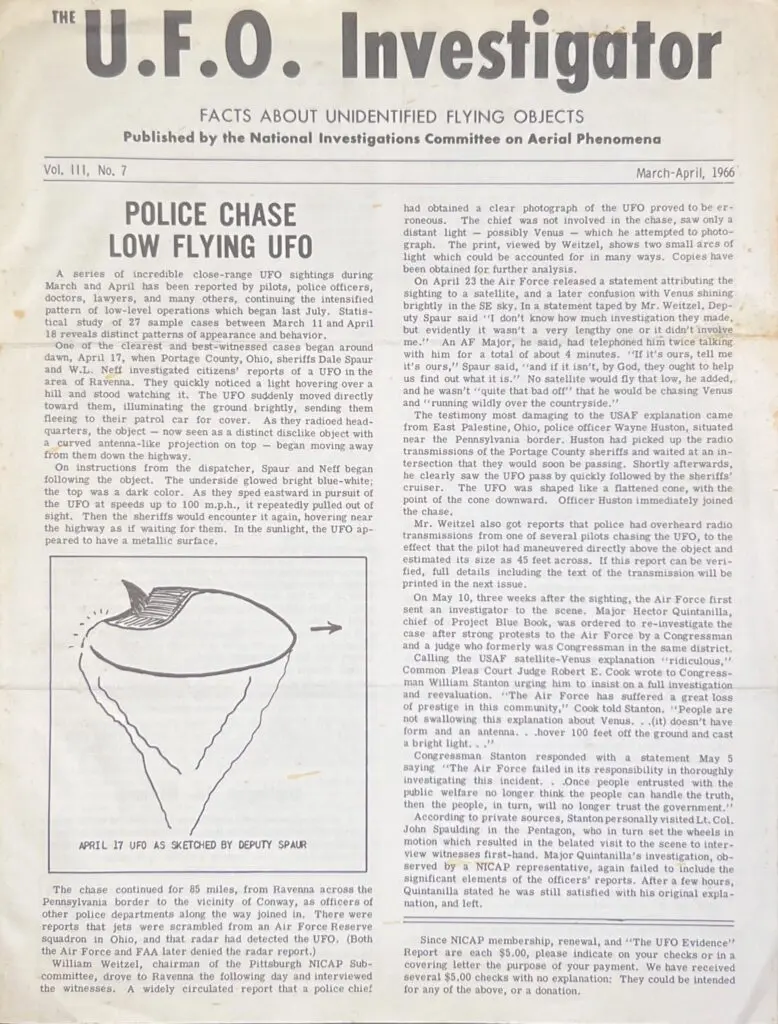
The archival direction, where the Blue Book file summaries and related documentation are preserved and presented, is represented well by the compilation made accessible through The Black Vault. The record-stream direction, where the official conclusion and photographic evaluation are repeated in a structured report entry, is represented by the Project 10073 record as presented by UFOScans. The institutional overview direction, which establishes the declassified status of Blue Book and gives context for what the program did and did not resolve, is represented by the National Archives’ Blue Book overview.
And then there is journalism. Cleveland Scene’s pieces are valuable as later journalistic reconstructions that connect the documentary backbone to interviews, local memory, and the witness aftermath, including claims about disagreement around how the evaluation was communicated.
A final note on Coral Lorenzen (1966): Lorenzen’s book remains valuable as a period publication reflecting how civilian researchers in the 1960s framed the event and similar patterns. However, many modern readers access it through scans or re-hosted reproductions. When that happens, it should be understood as an archival reproduction of a historical secondary source, not as a primary official record. For a publication-grade entry, it is best used as historical context and interpretation rather than as the foundation for precise technical claims unless the quoted passage is directly traceable to the original edition.
Implications: what the chase suggests without overstating
If Blue Book’s satellite/Venus conclusion is correct in the main, the Portage County chase still has serious implications. It would mean that in certain conditions, a combination of visible satellites, a brilliant planet, night driving, and stress can produce an experience so compelling that trained officers engage in a prolonged pursuit. That would argue for better astronomical training in law enforcement and more cautious pursuit decisions when the stimulus is not clearly a roadway threat.
If the officers’ perception of a low, structured object reflects an external reality beyond astronomical stimuli, the implications widen. It suggests that something unknown was capable of operating in a way that provoked pursuit, maintained visibility over distance, and resisted identification. That would have implications for airspace monitoring, public safety, and the adequacy of mid-century investigative frameworks.
Either way, Portage County is a reminder that “official explanation” and “public resolution” are different categories. Blue Book could close a file. It could not always close an argument.
Speculation Labels
Evidence
On April 17, 1966, Deputies Dale F. Spaur and Wilbur “Barney” Neff reported observing a bright object near the Ravenna–Mantua area of Ohio and pursuing it eastward into Pennsylvania, with case-file summaries stating it was followed to Conway, Pennsylvania for about eighty miles. The same summaries describe the object as bright, with an oblong shape, and include an approximate estimate of about 500 feet above the pursuing vehicle.
The official Project 10073 record stream attributes the probable cause to a satellite pass followed by Venus, and attributes the photographic results linked to Chief Buchert to processing defects associated with old or fogged film and poor handling.
Project Blue Book records are declassified and available through the National Archives, which states that the Air Force investigated 12,618 sightings and that 701 remained “Unidentified.”
Witness Interpretation
The pursuing officers interpreted the object as a discrete, trackable phenomenon that did not behave like a fixed point of light to them during the pursuit, an interpretation preserved in later journalistic reconstruction and interviews.
Researcher Opinion
Some researchers and commentators regard the satellite/Venus closure as administratively tidy but not fully responsive to the pursuit narrative and the descriptive language in the case summary, while others see it as an example of how perception can be shaped by stress and night-sky conditions in moving-vehicle contexts.
Hypothesis
One hypothesis consistent with the official record is that observers initially saw a satellite pass and then fixated on Venus, with motion perception shaped by pursuit dynamics and changing sightlines. Another hypothesis is that at least part of the event involved a genuinely unidentified UAP not accounted for by the astronomical explanation, with later official closure reflecting a preference for conventional attribution where possible under public pressure.
Claims Taxonomy
Disputed. The case rests on credible law-enforcement testimony and sustained duration, but it lacks decisive publicly available multi-sensor confirmation, and it remains in direct tension with Blue Book’s official satellite/Venus conclusion.
Relevant links
References
National Archives and Records Administration. (2024, June 25). Project BLUE BOOK: Unidentified flying objects. National Archives. https://www.archives.gov/research/military/air-force/ufos
Renner, J. (2004, March 31). Strangers in the night. Cleveland Scene. https://www.clevescene.com/news/strangers-in-the-night-1485939/
Renner, J. (2016, April 14; updated 2025, June 22). 50 years ago, a small town Ohio policeman chased a flying saucer into Pennsylvania… and it ruined his life. Cleveland Scene. https://www.clevescene.com/news/50-years-ago-a-small-town-ohio-policeman-chased-a-flying-saucer-into-pennsylvania-and-it-ruined-his-life-4877356/
The Black Vault. (n.d.). Project Blue Book: Ravenna, Mantua, Ohio, April 17, 1966. https://www.theblackvault.com/documentarchive/project-blue-book-ravenna-mantua-ohio-april-17-1966/
UAPedia. (n.d.). J. Allen Hynek: The scientist who made the study of UAP possible. https://uapedia.ai/wiki/j-allen-hynek-the-scientist-who-made-the-study-of-uap-possible/
UFOScans. (n.d.). Project 10073 record: UAP sighting 17 April 1966, Ravenna, Mantua, Ohio. https://www.ufoscans.com/1966-04-7104469-ravenna-mantua-ohio/
SEO keywords
Portage County Chase, Portage County UAP, 1966 UAP chase, Dale Spaur, Wilbur Neff, Barney Neff, Gerald Buchert, Ravenna Ohio UAP, Mantua Ohio UAP, Conway Pennsylvania UAP, Project Blue Book Ravenna Mantua, Project 10073 record, satellite Venus explanation, law enforcement UAP encounter, Blue Book case files, Hynek Blue Book consultant, Ohio police UAP pursuit, 1966 UAP wave