
There’s a kind of desert quiet that feels ordinary until something punctures it. A distant engine, a sudden flash, a column of dust moving against the wind. Then the silence returns, but it returns changed, as if the landscape is holding its breath.
The Kingman case has always lived inside that second silence. Not because it is a classic “light in the sky” story, but because it is remembered as an alleged response. A perimeter. Controlled movement. Specialists flown in. Statements recorded. An oath. A brief look at something that was not supposed to exist in public memory.
And yet, if you want to treat Kingman responsibly, you have to hold two truths in your hands at once. The first is that the core retrieval narrative is unusually specific for its era and arrives in documentary form through a signed affidavit. The second is that the narrative is still mediated through publication, still dependent on testimony, and still faces substantial counter-claims, including reported local non-confirmation and a reported denial by Dr. Ed Doll, the very person the witness says initiated the assignment. (nicap.org)
This is why Kingman is best understood as colliding evidence streams rather than a solved puzzle. It is a case about how stories survive in the seams between secrecy culture, memory, research networks, and the limits of what can be independently corroborated decades later.
The calendar: why May 19 keeps appearing, and why May 21 matters more
If you have read about Kingman even casually, you have probably seen “May 19, 1953” attached to it. That date is real, fixed, and official. It is the date of the “HARRY” shot during Operation Upshot–Knothole, a 32 kiloton nuclear test at the Nevada Test Site. The Nuclear Weapon Archive lists “HARRY” as May 19, 1953 with a yield of 32 kt. (nuclearweaponarchive.org)
That nuclear clock is one reason Kingman remains magnetized to the broader theme of UAP proximity to nuclear infrastructure. But the key point is simple: the “HARRY” shot date is not the core “Kingman retrieval” date in the primary civilian research summaries.
In the most commonly cited retrieval narrative, May 20 functions as a lead-in day and May 21, 1953 is the day the witness says he was taken to the crash site near Kingman. The NICAP-hosted summary, which preserves the case as a historical file, frames the incident as a 1953 Arizona crash investigation whose details Fowler surfaced through a witness affidavit and later publication. (nicap.org)
So May 19 should be treated as contextual, not substitutive. It gives you the setting. May 21 gives you the alleged event.
That distinction does more than tidy up a timeline. It prevents the case from being unintentionally warped into a single symbolic date. Kingman sits near the nuclear calendar, but it is not identical to it.
How Kingman enters the record: Fowler, NICAP, and an affidavit
The Kingman story became durable because it did not arrive as a one-off rumor drifting through a bar. It entered the modern UAP research ecosystem through established civilian channels.
NICAP’s case summary notes that Raymond E. Fowler first broke the details publicly in 1973, and that the story was reportedly known to NICAP investigator Richard Hall by 1964. It also states that Fowler said his information came from engineer “Fritz Werner,” later identified as Arthur G. Stancil, and that this witness signed a legal affidavit describing the investigation of a crashed unknown object. (nicap.org)
A few practical implications follow from those facts.
First, the case is not purely retrospective folklore. It has a paper artifact attached to it, and it circulated among researchers who understood the reputational cost of promoting easily falsified claims. Second, it still remains mediated by researchers rather than anchored to contemporaneous public documentation such as official incident reports, flight manifests, or photographs.
That mediation matters. It means we are reading an account preserved through a chain of trust, not a chain of custody.
The name issue: Stancil vs. Stansel and what can be responsibly said
The witness name creates a subtle but important credibility pressure point. NICAP uses “Arthur G. Stancil” as the identity behind the pseudonym “Fritz Werner.” (nicap.org) A separate counter-source associated with MUFON’s Project Aquarius materials and the Bill Moore files refers instead to “Arthur G. Stansel,” and discusses investigation and skepticism surrounding the case. (projectaquarius.mufon.com)
These two surnames might reflect transcription variance, deliberate obfuscation, or genuinely conflicting identification. Because the case already involves a pseudonym and identity protection, it is not appropriate to harmonize the names as if they are certainly the same without additional documentation.
The cleanest editorial handling is to label this directly as an unresolved identity discrepancy across primary and secondary sources. In practice, that means treating “Fritz Werner” as the stable identifier for the affidavit narrative, while noting that published attributions differ on the underlying surname. That is not sensational. It is simply honest about what the record actually shows.
The core narrative: a controlled trip to a lit perimeter
Most people expect the dramatic center of Kingman to be a “disc in the sand.” But the more consequential claim is procedural.
In the story as preserved in NICAP’s summary and in the wider Fowler-associated recounting, the witness describes being pulled from work associated with the nuclear test environment and routed through controlled nodes. The sequence includes reporting to Indian Springs Air Force Base, traveling by military aircraft to Phoenix, and then being transported by bus with blacked-out windows for hours, preventing passengers from identifying the route or destination. (nicap.org)
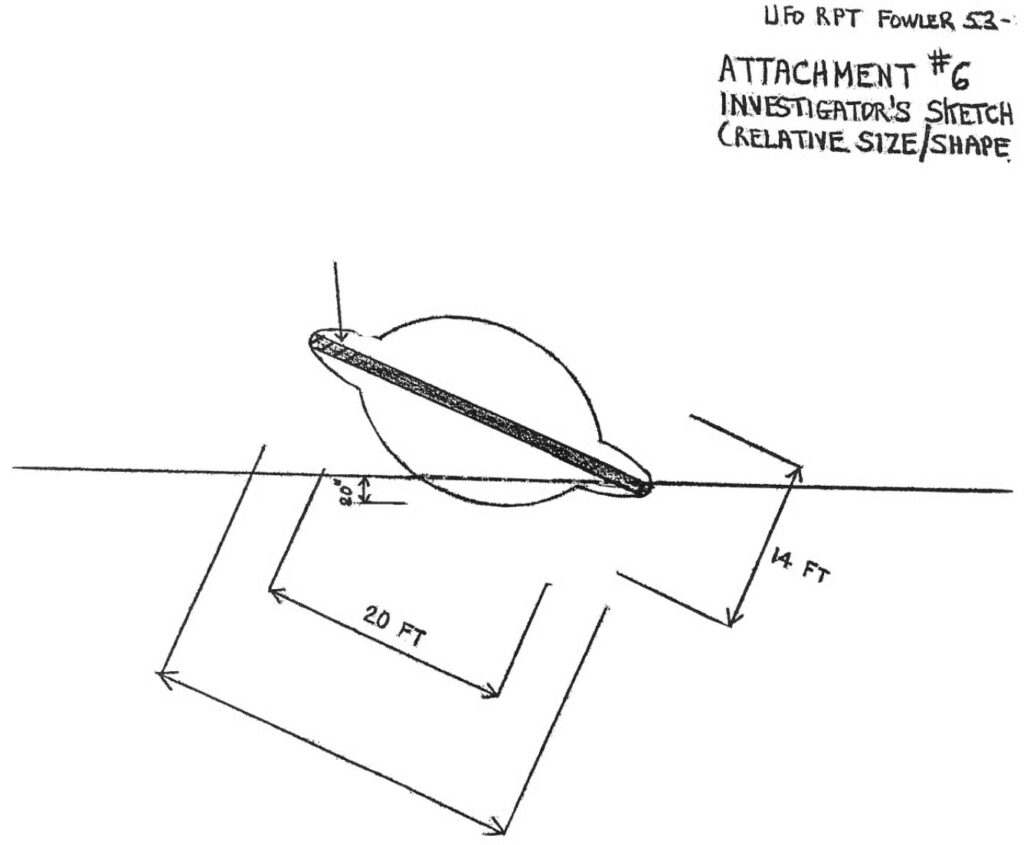
At the destination, the scene is described as intensely illuminated and guarded. Specialists are escorted in turn to perform narrow tasks. The witness describes a disc-shaped object, embedded in sand, with features he considered nonstandard. A tent near the craft is said to have contained the remains of a small occupant, which the witness claimed to have glimpsed under guard. Afterward, participants were reportedly interviewed, recorded, and required to take an oath of secrecy. (nicap.org)
These details are often presented as inherently convincing because they “sound like” compartmented operations. It is better, and more accurate, to say something narrower: the logistics are internally coherent with the way compartmented operations can function, especially in the early Cold War, but they remain testimonial rather than independently verified.
That distinction keeps the case grounded. It also helps explain why Kingman divides readers so sharply. People tend to confuse “plausible handling” with “confirmed event.”
Kingman has the first. It does not yet have the second.
The broader setting: the Southwest in the Upshot–Knothole era
Even if you set the retrieval claim aside for a moment, May 1953 is a period of enormous military-scientific activity in the American Southwest. Operation Upshot–Knothole ran multiple shots across the spring, and the “HARRY” shot in particular became historically salient for fallout concerns and the scale of participation. (nuclearweaponarchive.org)
This context matters for Kingman in two ways that pull against each other.
On one hand, the presence of large-scale, security-heavy operations makes the witnesses describing transport and secrecy measures more believable as a type of behavior that existed, because it did. The U.S. was already moving personnel, contractors, scientists, and military through restricted zones under tight rules.
On the other hand, that same context creates an alternative explanation for the diary-like “special job” motif that sometimes gets attached to Kingman. A person working in that environment could be tasked with classified work unrelated to UAP, and later interpret it differently through memory, later conversations, or exposure to the developing crash-retrieval narrative genre.
Kingman sits in a setting that makes both interpretations possible. That is part of its enduring uncertainty.
Publication mediation: what we have, and what we do not have
Kingman’s documentation is often described as “strong” because it includes an affidavit and a named researcher chain. It is better to describe it as “structured,” because structure can be built from testimony alone.
What we have in the public civilian record is a described affidavit, a consistent narrative spine repeated by reputable research intermediaries, and a case summary preserved through NICAP. (nicap.org)
What we do not have publicly is the sort of independent, contemporaneous corroboration that would change the case category overnight. There is no publicly accessible incident report that explicitly confirms a UAP crash. There is no official photograph that can be traced through a documented chain of custody. There are no publicly available orders or flight manifests that clearly place a team on a retrieval mission at Kingman on May 21, 1953.
This is why Kingman’s affidavit should be treated with seriousness but not with automatic elevation to proof. A sworn affidavit is a documentary object, but the claims inside it remain testimonial.
That line matters because it protects the reader from mistaking form for verification.
The controverters: local non-confirmation and the Doll denial
A case like Kingman should not be written as if skeptics merely “disagree.” It should be written as if the opposing record has weight, because it does.
The MUFON Project Aquarius / Bill Moore file is a key counter-source because it reports attempts to verify the incident through local channels and through contact with Dr. Ed Doll. According to that document, Moore pursued the “Werner” incident and interviewed people in Kingman connected to media and law enforcement, and those individuals claimed they had never heard of such an event and found it unlikely that a major military presence could have occurred without leaving social traces. (projectaquarius.mufon.com)
Local non-confirmation is not a silver bullet. A well-contained operation can leave fewer footprints than ordinary people expect, especially in remote areas. But it is a real pressure test. In 1953, Kingman was not a metropolis where major activity could vanish into urban noise. If there was an intense recovery operation that required vehicles, guards, equipment, and possibly lodging, it is reasonable to expect some local awareness.
Then comes the most serious counterpoint: Dr. Ed Doll. The witness account hinges on Doll, because Doll is the alleged initiating authority figure who calls and assigns the “special job.” The MUFON/Moore document reports that Doll denied knowing of any crashed-UAP incident and suggested he would have been aware if such a thing had occurred. (projectaquarius.mufon.com)
In a balanced evaluation, Doll’s reported denial must carry heavy weight. It does not automatically disprove Kingman, but it forces the case into a narrower corridor of plausibility. If the event happened, either Doll truly did not know, or did not remember, or chose to deny, or the call was misattributed by the witness, or the witness fabricated the connection. Each of those possibilities has different implications for how we should treat the rest of the story.
The honest conclusion is that the Doll issue is one of Kingman’s biggest unresolved weaknesses.
The Wright-Patterson echo claim: why it should be handled lightly
Some retellings of Kingman include an additional element: alleged accounts that bodies were delivered to Wright-Patterson Air Force Base, sometimes described as packed in dry ice.
NICAP’s summary mentions this as part of the broader Kingman narrative stream, attributed to claimed witnesses who did not make their identities public. (nicap.org)
This kind of “echo claim” is common in retrieval lore. It can be meaningful as a pattern marker, but it is low evidentiary weight unless it can be anchored to named testimony, documented chain-of-custody, or independent records. In Kingman’s case, the Wright-Patterson element should be treated explicitly as uncorroborated secondary testimony and should not be allowed to “upgrade” the core claim by association.
Put plainly, it is an add-on in the public record, not the foundation.
Modern official review: what AARO actually says, and what it cannot settle alone
Kingman is often dragged into modern debates about “official confirmation,” so it is important to cite modern official posture accurately.
In 2024, the All-domain Anomaly Resolution Office (AARO), under the U.S. Department of Defense, published Volume I of its Historical Record Report. The report states that AARO found no evidence that any U.S. government investigation confirmed that any sighting of a UAP represented extraterrestrial technology. (media.defense.gov)
That is the official statement and it should be treated as a relevant data point.
It is also not a universal solvent. The report is a statement about what was found in the record sets AARO accessed and what it could substantiate through those sources. It does not, on its own, eliminate the possibility that some claims exist outside those accessible archives, nor does it validate them.
So in practical terms, AARO’s report does not “solve” Kingman. It describes the present official documentary landscape and remains compatible with both skepticism and continued inquiry.
Why Kingman still matters, even as disputed
If you are looking for a single verdict, Kingman is a frustrating case. But frustration is not the same as insignificance.
Kingman matters because it describes governance behavior under anomaly conditions. If the core claim were even partially accurate, it would imply a mature rapid-response doctrine in the early 1950s, including perimeter security, compartmented technical assessment, recorded debriefs, and secrecy enforcement. (nicap.org)
That would have implications for how we interpret later claims about material exploitation programs, contractor involvement, and biological evidence handling. It would also sharpen the ethical questions. If an occupant was recovered, even deceased, what obligations were recognized, if any? What medical protocols applied? Were there attempts at autopsy, containment, preservation? Those questions are ethically heavy, and Kingman is one of the earliest cases that forces them into the open.
If the core claim is not accurate, Kingman still matters because it shows how retrieval narratives can be built in a way that feels operationally plausible, travels through reputable research channels, and persists for decades without collapsing. It becomes a cautionary lesson about secrecy culture, memory, and the way story structures can harden into “known facts” inside a community even when independent corroboration remains absent.
Either way, Kingman is instructive. It is not just about what happened in the desert. It is about how we know what we know.
Claims taxonomy
Disputed
The Kingman alleged retrieval is supported by a testimonial record preserved in affidavit form and circulated through established civilian research channels, but it faces substantial counterevidence including an unresolved identity discrepancy across primary and secondary sources (Stancil vs. Stansel), reported local non-confirmation, and a reported denial by Dr. Ed Doll, the alleged initiating figure. Secondary “echo” claims such as Wright-Patterson body transfer stories remain uncorroborated and have low evidentiary weight. (nicap.org)
Speculation labels
Hypothesis
The proximity between the Upshot–Knothole “HARRY” test (May 19, 1953) and the alleged Kingman retrieval (May 21, 1953) may indicate that heightened defense readiness and anomaly sensitivity during nuclear test operations increased the likelihood that unusual events were detected and escalated into secure handling channels. This is a pattern-based hypothesis and not a Kingman-specific confirmation. (nuclearweaponarchive.org)
Witness interpretation
Descriptions of the craft’s geometry, materials, and the occupant’s appearance are interpretive and filtered through claimed brief observation under guard, later recollection, and the witness’s own technical and cultural frame. (nicap.org)
Researcher opinion
Fowler’s approach suggests he judged the witness credible enough to preserve through an affidavit and controlled disclosure, while Moore’s counter-investigation, as described in the MUFON document, argues the story lacks local confirmation and is undermined by Doll’s denial. Both positions are mediated through publication rather than resolved by independent records. (projectaquarius.mufon.com)
References
All-domain Anomaly Resolution Office. (2024). Report on the historical record of U.S. government involvement with unidentified anomalous phenomena (UAP) (Volume I). U.S. Department of Defense. https://media.defense.gov/2024/Mar/08/2003409233/-1/-1/0/DOPSR-2024-0263-AARO-HISTORICAL-RECORD-REPORT-VOLUME-1-2024.PDF
Booth, B. J. (n.d.). UFO crash in Arizona, 1953 (NICAP-hosted PDF). National Investigations Committee on Aerial Phenomena (NICAP) archive. https://www.nicap.org/reports2/530520kingman_arizona.pdf
Moore, W. (n.d.). MAC–ARTHUR–GENL–D (MUFON Project Aquarius / Bill Moore file collection document; discussion of Kingman account and counter-investigation). https://projectaquarius.mufon.com/wp-content/uploads/pcg-bill-moore-files-collection/MAC-ARTHUR-GENL-D.pdf
Nuclear Weapon Archive. (n.d.). Operation Upshot–Knothole. https://www.nuclearweaponarchive.org/Usa/Tests/Upshotk.html
SEO keywords
Kingman AZ UAP 1953; Kingman Arizona alleged crash retrieval May 21 1953; Upshot Knothole Harry May 19 1953; Fritz Werner affidavit; Arthur G. Stancil vs Stansel unresolved identity discrepancy; Raymond Fowler Kingman case; NICAP Kingman Arizona 1953; Wright-Patterson dry ice bodies uncorroborated; Dr. Ed Doll denial Kingman; AARO historical record report UAP crash retrieval claims; flying saucer era retrieval narratives; UAP and nuclear testing Southwest