
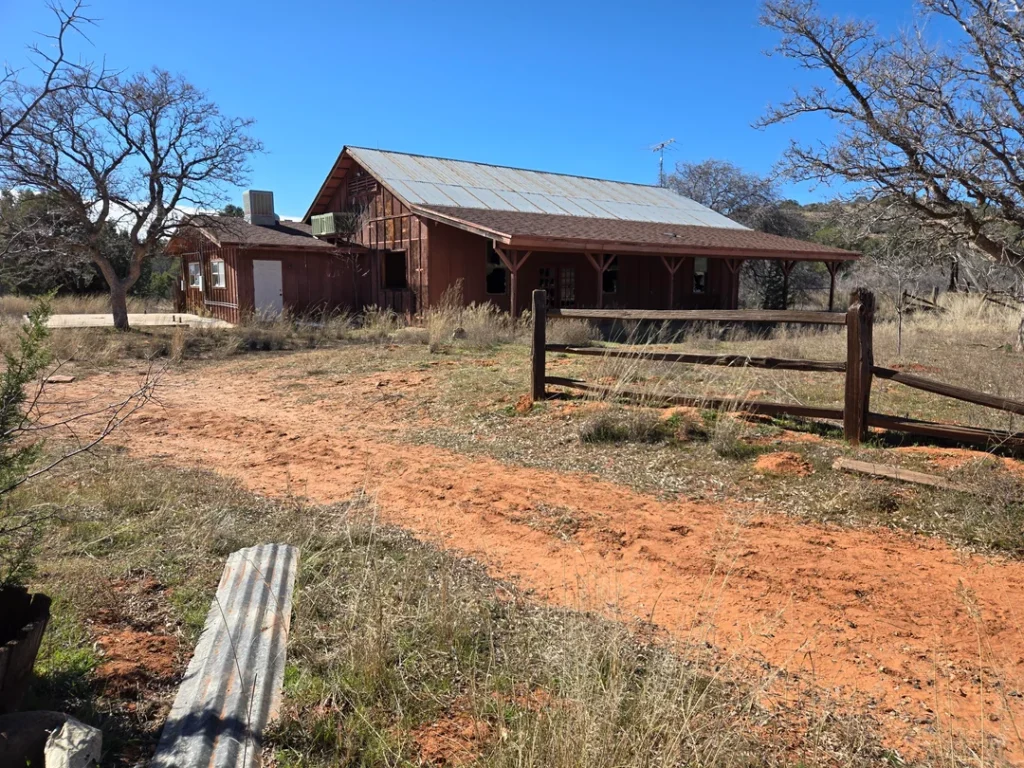
Bradshaw Ranch sits in one of those Sedona “in-between” zones where the map is straightforward but the stories are anything but. It is a real, physical ranch site west of town, with an old adobe house, a derelict newer structure, and the kind of dramatic red-rock backdrop that makes even ordinary headlights look theatrical at night. It is also one of the most frequently cited “high-strangeness” locations in the Sedona region, with decades of testimony describing lights, “orbs,” entities, missing time, and alleged portal-like effects.
The hard part, and the reason this place keeps coming up in UAP circles, is that Bradshaw Ranch is both more mundane and more complicated than the folklore suggests. On paper, it is federal land and, today, part of a long-term climate research program run through Northern Arizona University’s Southwest Experimental Garden Array (SEGA). In the story-world, it is a pressure point: a place where people insist the boundary between “ordinary” and “anomalous” runs thin.
This explainer separates what’s documented from what’s testified to, then looks at the friction line between them, because that’s where Bradshaw Ranch actually lives.
What this place is, in plain terms
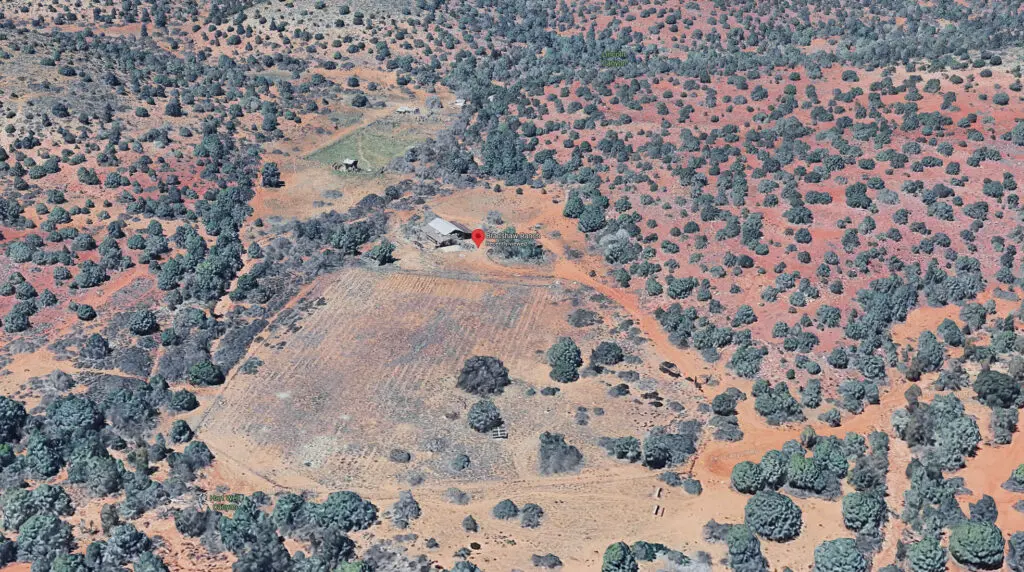
Start with geography, because it anchors everything else. SEGA describes Bradshaw Ranch as sitting in pinyon-juniper habitat beneath red rock cliffs, at the junction of Hartwell Canyon and Loy Canyon, west of Sedona. It notes the ranch was originally homesteaded in 1920, and that an adobe house from that period still stands. SEGA adds that this adobe structure is believed by some to be the oldest surviving structure in Sedona, a phrasing that matters because it signals a locally held belief rather than a formally proven historic designation. (sega.nau.edu)
Local reporting gives even more “pin on the map” detail. A 2023 Sedona Red Rock News piece places the 90-acre ranch about 12 miles west of Sedona, roughly 1.5 miles west of the Palatki Heritage Site, and between Hartwell Canyon wash and Loy Canyon wash. (Sedona Red Rock News)
So yes, it’s remote enough to feel secluded. But it’s not some mythical “nowhere.” It’s a specific parcel in a heavily visited region with a long paper trail.
A note on sources, because it changes how you read everything
For Bradshaw Ranch, “source quality” is not an academic aside. It is the whole game.
When we say something like “Bob Bradshaw bought the ranch in 1960,” we can point to SEGA’s site description and local newspaper reporting. Those are institutional or journalistic sources describing public-facing history. (sega.nau.edu)
When we say “people report portals,” we are usually talking about witness testimony that has been published and circulated, most notably in Merging Dimensions. That is a real publication with verifiable bibliographic records, but the extraordinary claims inside it are not automatically “verified” by the fact that the book exists. Google Books’ listing shows how the book describes its own content, including its claim of extensive photography, but that is still the authors’ framing. (Google Books)
And when we reference modern tour narratives, such as the Jezebel first-person piece about a night-vision outing with Bradshaw Ranch in the distance, we are very explicitly in the realm of cultural reporting and personal experience. It can be valuable, but it is not a controlled study and it does not “prove” anything about the ranch. (Jezebel)
With that in mind, here’s the story.
The ranch’s documented history, before the “high strangeness” label stuck
SEGA’s account of the ranch’s human history reads like the Sedona region in miniature: homestead era to tourism era to research era. After noting the 1920 homestead and the surviving adobe, SEGA says Bob Bradshaw purchased the ranch in 1960. It describes a “heyday” that included horseback riding, dinner and dancing, a petting zoo, cattle drives, a museum, a gift store, and historic wagon rides. (sega.nau.edu)
This is also the period that feeds the ranch’s visual mystique. SEGA says the ranch landscape was a key location for movie, TV, and commercial production in the 1960s and 1970s. (sega.nau.edu)
Sedona Red Rock News corroborates the broad shape of that story and adds specificity: it calls Bob Bradshaw a Hollywood stuntman, says he purchased the property in 1960, and reports that the ranch was used as a location for five Western movies, two television series, and numerous commercials. (Sedona Red Rock News)
If you ever wonder why Bradshaw Ranch “feels like a set,” it’s because it literally was one.
The land-transfer controversy that keeps resurfacing
A major point of confusion around Bradshaw Ranch is ownership and the way ownership is narrated in UAP-adjacent media. Some tellings suggest the land was seized. The most grounded public reporting points in a different direction.
Sedona Red Rock News lays out a chain of transactions: it reports that Bob Bradshaw sold the land to his Jeep tour company in 1998, that Gamma Investors LLC acquired the ranch around 2000, and that it was sold in May 2001 to the Trust for Public Land and then sold about a month later to the U.S. Forest Service for $3.15 million. (Sedona Red Rock News)
In other words, the best local reporting describes purchases and sales, not a forced taking.
SEGA’s site summary uses a slightly different milestone marker, stating that in May 2003 the ranch “became another parcel of federal Forest Service land.” That can coexist with the Red Rock News chain, because “ownership,” “transfer,” and “administrative integration” milestones can differ depending on which date a source treats as definitive. The key point is that both sources converge on the outcome: the ranch is now federal land, and today’s on-site activity is dominated by permitted research, not private residence. (sega.nau.edu)
The research era: SEGA, permits, fences, and an inconvenient fact for the folklore
Here is the detail that changes how you should imagine Bradshaw Ranch in 2026: parts of it are instrumented, fenced, and used for long-term climate-change biology.
SEGA states it has a special use permit with the National Forest Service for up to 20 years to conduct long-term climate change research on up to 22 acres at the site. It describes a fenced enclosure around an old pasture/field, a 900-foot well feeding irrigation, and power systems supporting instrumentation. (sega.nau.edu)
A U.S. Forest Service project summary in the Coconino National Forest archive aligns with that, describing authorization for a research permit to develop research gardens on up to 22 acres at what used to be the Bradshaw Ranch, with treatments studying plant responses under climate change. The same page shows a decision signed date in 2015 and lists the project as completed in the planning sense, meaning permitted and implemented. (fs.usda.gov)
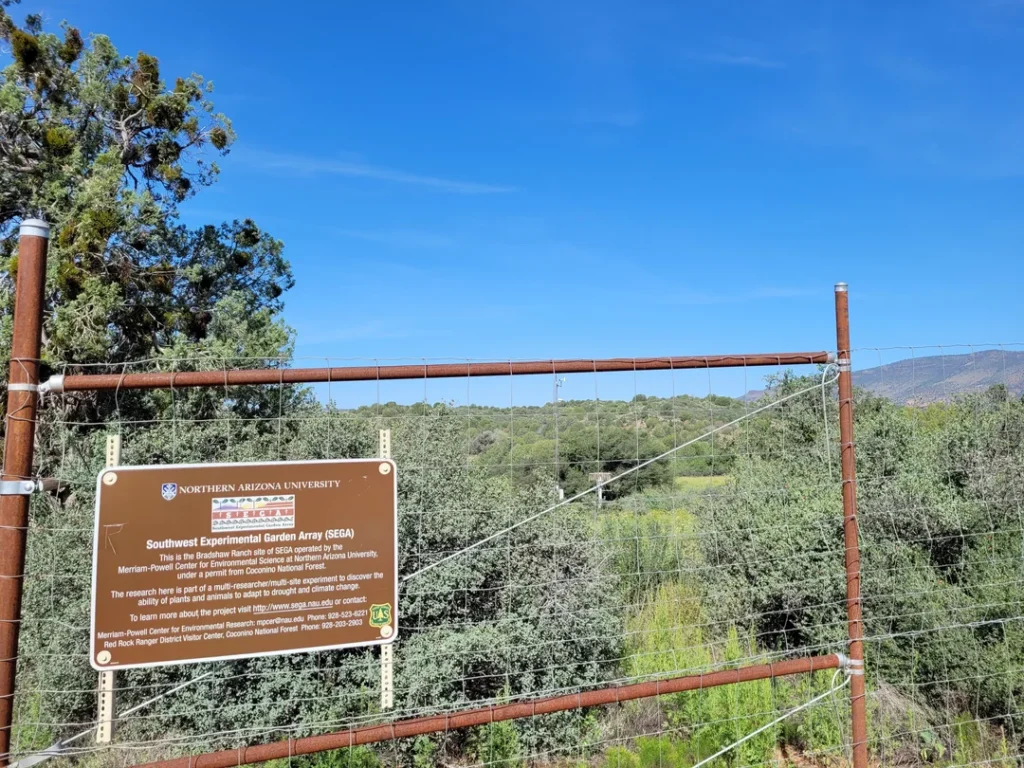
Sedona Red Rock News adds that the SEGA research examines how genotypes of cottonwoods and piñon pines respond to climate change, and it describes the site as fenced with a camera, solar panels, and a generator among other equipment. (Sedona Red Rock News)
Now for the inconvenient part, if you prefer your hotspots unambiguously “hot.” The same Red Rock News reporting states that none of NAU’s SEGA team scientists have seen paranormal anomalies at Bradshaw Ranch and that they are unaware of rumors about secret military bases or tunnels. (Sedona Red Rock News)
This doesn’t “debunk” witness testimony from other eras or other visitors. But it does establish an important data point: a group of scientists working there over multiple years, with infrastructure and repeat access, reports no anomalous experiences in their work context.
The core publication: Merging Dimensions and why titles matter
If Bradshaw Ranch has a canonical text, it’s Merging Dimensions.
Google Books lists the 1995 edition as Merging Dimensions: The Opening Portals of Sedona, authored by Tom Dongo and Linda Bradshaw, published by Light Technology Publishing, 203 pages, with ISBN 0962274844 / 9780962274848. The listing describes the book as beginning with strange events in 1992 and claims “over 100 actual photographs” of unusual phenomena. (Google Books)
Google Books also lists a later edition, Merging Dimensions: The Incredible Saga of the Bradshaw Ranch, published by Light Technology Publishing in 2020, 256 pages, with ISBN 1622338154 / 9781622338153. Its “about” text again frames the story as beginning in 1992 and foregrounds photographs and vivid incident narratives. (books.google.ch)
Why belabor bibliographic details? Because the title discrepancy is part of the Bradshaw Ranch confusion. Local reporting sometimes references the “Incredible Saga” title when discussing a 1995 book. That’s best understood as a referencing mismatch between editions and circulating title memories, rather than evidence of multiple unrelated books. The simplest, best-supported reading is that Merging Dimensions exists as a 1995 edition with “Opening Portals of Sedona” in the title record and a 2020 edition with “Incredible Saga of the Bradshaw Ranch” in the title record. (Google Books)
What witnesses say happens at Bradshaw Ranch
So what do the primary narrators actually claim?
Even without reproducing pages, the table of contents for the 1995 edition, visible through Google Books metadata, hints at the categories of experiences described: “Mysterious Lights,” “Photographing the Paranormal,” “Missing,” “The Portals in Sedona,” and “The Men in Black are Back,” among others. This is not written as a single incident report. It’s structured as a catalog of repeated anomaly types. (Google Books)
The 2020 edition’s description continues that tone, explicitly framing the work as a selection of the “most vivid” cases and implying ongoing experiences beyond what’s printed. (books.google.ch)
Separately, Light Technology Publishing’s author page for Linda Ball (Bradshaw) functions as promotional copy, but it is still useful as a concise statement of the narrative she associates with the ranch: “orbs of light,” frightening energies, “Grays,” “beautiful beings,” “portals,” and “extraterrestrial craft,” all tied to her years living there. (lighttechnology.com)
If you’re looking for why Bradshaw Ranch lands in the “high-strangeness” bucket rather than just “lights in the sky,” this is why. The testimony is not only about aerial objects. It’s about entities, perception effects, and place-based encounters.
Case study 1: The “catalog of phenomena” approach in Merging Dimensions
Many UAP case summaries focus on a single night: a single object, a single witness, a single flight path. Bradshaw Ranch is usually presented differently, because Merging Dimensions frames the ranch as a generator of recurring categories of events rather than a one-off “sighting.”
That approach has strengths and weaknesses.
The strength is that repeated-pattern testimony can be meaningful. When a witness says, in effect, “this happened many times, in variations,” it invites pattern analysis instead of anecdote-chasing. The contents and descriptions associated with the book suggest repeated experiences involving lights, invisibility themes, missing time themes, and claimed portal-like effects. (Google Books)
The weakness is that a catalog model is harder to independently verify. It’s not one timestamp you can cross-check against radar logs, astronomical data, or flight trackers. It’s an ongoing story-world. That doesn’t make it false, but it does mean that the evidentiary burden shifts toward things like: preserved original media, chain-of-custody for photographs, contemporaneous notes, independent corroborating witnesses, and, ideally, repeatable on-site measurements by unaffiliated teams.
Publicly accessible sources in this case mostly demonstrate that the narrative was published and widely circulated, not that it has been independently instrument-validated.
That’s why, for Bradshaw Ranch, responsible reporting keeps two thoughts in your head at the same time: witness testimony is real testimony, and extraordinary mechanisms are not established by publication alone.
Case study 2: “Beyond Skinwalker Ranch,” radiation claims, and the replication gap
Bradshaw Ranch’s modern media life got a major boost from the History Channel series “Beyond Skinwalker Ranch.” Sedona Red Rock News reports that the show’s logline included claims of dangerous radiation levels and a temperature anomaly while investigating Bradshaw Ranch, framed in the network’s “unidentified anomalous phenomena” language. (Sedona Red Rock News)
The same local reporting also documents a central methodological issue: it states that producers claimed a drone revealed a 50-foot underground “anomaly” and tunnels, but that those findings were not confirmed by different methods and that raw data was not made available for independent review. (Sedona Red Rock News)
If you want to understand why people argue past each other about Bradshaw Ranch, this is a big reason. Shows like this often deploy real instruments, but the audience typically receives edited narrative conclusions rather than the full datasets required for scientific dispute resolution.
It’s also notable that the show’s storyline leans into themes that already existed in local rumor streams: secret tunnels, hidden infrastructure, unusual signals. Red Rock News reports that a wide set of long-circulating stories exist around the Sedona area, including claims about tunnels, sudden lights, and portal-like effects. (Sedona Red Rock News)
So the show is not introducing the mythology as much as it is plugging into an existing myth-field and giving it a new production sheen.
Case study 3: A modern tour narrative and the “infrared-only” problem
In 2025, Jezebel published a first-person account of a night outing in the Sedona area that looked toward Bradshaw Ranch from a distance. The author describes being on a hill roughly 14 miles outside Sedona with Bradshaw Ranch about a mile away “in the distance,” using night vision goggles and observing lights that were not visible to the naked eye. (Jezebel)
Two points make this worth mentioning, even with all the caution labels attached.
First, it shows how Bradshaw Ranch functions culturally now: as a reference point on the horizon, a named locus of expectation, a place you look toward when you’re trying to see something anomalous. (Jezebel)
Second, it highlights a recurring modern wrinkle in UAP reports: sensor-dependent anomalies, where something registers in infrared or night-vision but not in normal viewing conditions. The Jezebel account is not a controlled experiment, and the author explicitly expresses uncertainty, but it documents how contemporary witnesses experience these events and how quickly interpretations proliferate, including a later claim by a tour guide of elevated Geiger counter readings at a spot associated with a light. (Jezebel)
For our purposes, it’s a cultural and phenomenological datapoint, not a validation of radiation or portals at Bradshaw Ranch.
Why Bradshaw Ranch stays “alive” as a hotspot
If NAU researchers report no anomalies, why does Bradshaw Ranch remain so sticky in UAP culture?
One answer is Sedona itself. The region is saturated with “special place” narratives, including vortex lore and decades of strange-lights storytelling. Red Rock News explicitly notes that a broad set of rumors and legends about lights, military activity, and portal-like effects have circulated in and around Sedona for years. (Sedona Red Rock News)
Another answer is the ranch’s physical layout. It sits in dramatic terrain with complex sight lines and limited ambient light. That doesn’t explain away every claim, but it does explain why the setting is so productive for experiences that feel significant. Place matters, psychologically and socially, even before we get into any exotic mechanism.
A third answer is that the primary witness narrative is not just “I saw something.” It’s “this place produced a long sequence of experiences.” That kind of story recruits readers into a relationship with the location. It invites pilgrimage, filming, late-night stakeouts, and, sometimes, trespass. Red Rock News notes that online creators sometimes trespass on the property while alleging paranormal activity. (Sedona Red Rock News)
Once that loop begins, Bradshaw Ranch becomes a feedback system: story draws attention, attention generates new experiences, new experiences refresh the story.
What Bradshaw Ranch implies for UAP research, if you take it seriously
A serious approach to Bradshaw Ranch doesn’t mean uncritical belief, and it also doesn’t mean reflexive dismissal. It means recognizing what kind of case it is.
It is a place-based case with layered narratives: homestead history, film-set history, published witness testimony, modern reality-TV claims, and a parallel track of long-term ecological research happening on the same land. (sega.nau.edu)
That combination suggests a practical implication: if anyone wanted to move Bradshaw Ranch from “fascinating testimony” toward “strongly evidenced anomaly,” the pathway is not another dramatic retelling. It’s transparent, repeatable measurement, ideally paired with disciplined documentation of witness reports.
The irony is that the site already has some of the infrastructure culture you’d want for long-term monitoring, because SEGA operates environmental sensing and site systems there for climate research. (sega.nau.edu)
That doesn’t mean SEGA is studying anomalies, and it shouldn’t be misrepresented as doing so. It simply means Bradshaw Ranch is one of the rare “hotspot” locations where the land is already being treated as something you revisit, instrument, and track over years rather than nights.
If you believe, as many serious UAP researchers do, that the phenomenon clusters around certain places, then Bradshaw Ranch is a case where the cultural story and the land-use reality collide in a way that could, in principle, be studied without relying on secrecy or one-off expeditions.
Claims taxonomy
Verified
Bradshaw Ranch exists where described; it was homesteaded in 1920; Bob Bradshaw purchased it in 1960; and parts of the site are now used under a Forest Service-authorized research framework for long-term climate-related studies through NAU/SEGA. (sega.nau.edu)
Probable
There is a long-running, well-documented body of witness narrative and published material claiming unusual lights and related experiences associated with the ranch beginning in 1992, including the existence of the Merging Dimensions publications as enduring artifacts. (Google Books)
Disputed
Claims of portals, entity encounters, missing time, dangerous radiation, and underground tunnels at or beneath the ranch remain unresolved in publicly available documentation, with media claims often lacking released raw data for independent review and with NAU-affiliated researchers reporting no anomalous experiences in their work at the site. (Sedona Red Rock News)
Misidentification
The claim that the property was taken via eminent domain is not supported by the specific transaction chain reported in local coverage describing purchases and sales culminating in Forest Service ownership. (Sedona Red Rock News)
Speculation labels
Hypothesis
Bradshaw Ranch may be an example of a “place effect,” where repeated witness reports cluster around a geographic node for reasons that could include environmental variables, cultural expectation, and (if the strongest claims are true) a localized anomalous mechanism that does not reliably present on demand.
Witness Interpretation
In the Merging Dimensions narrative and related promotional descriptions, witnesses interpret recurring lights and encounters through frameworks that include entities, portals, and otherworldly craft. Those interpretations are part of the testimony itself and help explain why the ranch is remembered as more than a “lights in the sky” location. (Google Books)
Researcher Opinion
The most constructive research posture for Bradshaw Ranch is to treat it as a layered case: keep the verified land and program history clean, treat published witness accounts as testimony rather than proof, and require replicable data before upgrading any extraordinary claim beyond “reported.”
References
Dongo, T., & Bradshaw, L. (1995). Merging Dimensions: The Opening Portals of Sedona. Light Technology Publishing. (ISBN 0962274844). (Google Books)
Dongo, T., & Bradshaw, L. (2020). Merging Dimensions: The Incredible Saga of the Bradshaw Ranch. Light Technology Publishing. (ISBN 1622338154). (books.google.ch)
Light Technology Publishing. (n.d.). Ball (Bradshaw), Linda [Author page]. (lighttechnology.com)
Sedona Red Rock News. (2023, June 4). History Channel show hunts UFOs, paranormal outside Sedona. (Sedona Red Rock News)
Sedona Red Rock News. (2023, August 25). NAU’s Southwest Experimental Garden Array at Bradshaw Ranch tracks climate change adapation. (Sedona Red Rock News)
U.S. Forest Service, Coconino National Forest. (2016, April 29). Bradshaw Ranch Climate Change Experimental Garden Array Research Permit (Project Summary #46546). (fs.usda.gov)
Weindling, J. (2025, August 29). The Most Surprising Part of Our Sedona UFO Tour Was What We Couldn’t See. Jezebel. (Jezebel)
SEO keywords
Bradshaw Ranch Sedona, Bradshaw Ranch UAP, Sedona UAP hotspot, Secret Mountain UAP, Loy Canyon lights, Hartwell Canyon anomalies, Merging Dimensions Tom Dongo, Linda Bradshaw Ball, SEGA Bradshaw Ranch, Northern Arizona University SEGA, Beyond Skinwalker Ranch Bradshaw Ranch, Sedona orbs, Sedona portals, missing time Sedona, Coconino National Forest Bradshaw Ranch