
For more than five decades, Bill Chalker has occupied one of the most demanding positions in Australian UAP research. He listens seriously to people who describe impossible encounters, but he also asks whether archives, timelines, soil samples, biological material, radar records, police observations, or independent witnesses can make those experiences testable.
That balance has made his work both influential and controversial.
Chalker is best known as a historian of Australian UAP cases, an investigator of reported contact experiences, and a researcher who has attempted to place alleged physical evidence under laboratory examination. His investigations have taken him from Australian Defence records and witness interviews to arranging laboratory examination of alleged biological material.
The results have not produced a simple conclusion.
Some cases strengthened under investigation. Others collapsed. Some generated intriguing evidence but not enough to establish an extraordinary origin. Still others became trapped behind inaccessible witness statements, incomplete laboratory documentation, or archival records that could not be located.
That is why Chalker matters. His career is not merely a collection of strange Australian stories. It is a long-running experiment in how testimony, physical evidence, official records, and speculation should be separated without treating any one of them as automatically decisive.
The week the files came out of the sacks
Before searchable databases and digitised archives, researching Australian UAP history depended on persistence, formal correspondence, telephone calls, and the willingness of officials to open restricted files.
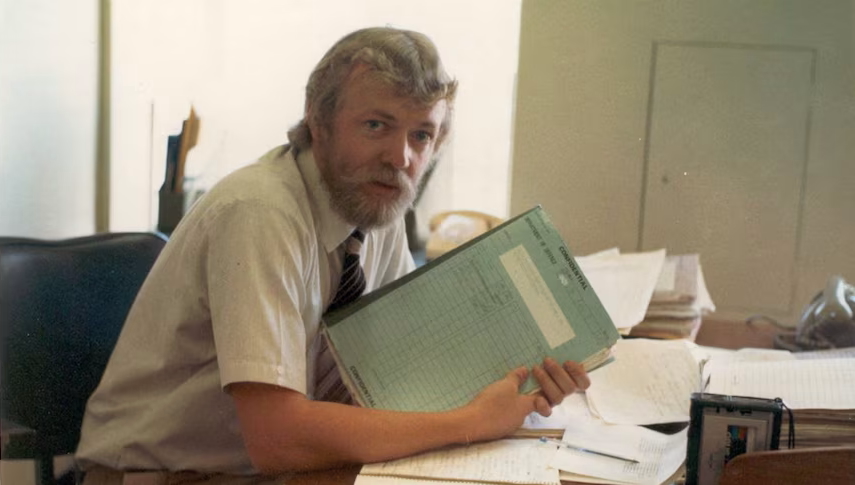
In January 1982, Chalker entered the Russell Offices in Canberra after spending about a year seeking access to Royal Australian Air Force records. At the time, he was working as a chemist in food science. According to an ABC News account published in 2024, Chalker was among the early civilian researchers granted direct access to the files.
The records did not arrive in carefully labelled archival boxes. Chalker recalled that two postal sacks containing documents were brought into the room. Officials then discovered that some of the material had not been formally declassified. The files were removed temporarily, stamped, and returned for inspection.
Chalker spent about a week examining the collection and recording cases he considered significant.
The episode has become one of the defining stories of his career. A civilian investigator with a scientific background found himself surrounded by records that had been collected for security and administrative purposes but had rarely been examined as a connected history of unexplained aerial reports.
The scene also reveals an important distinction. Access to a government file does not prove the extraordinary interpretation of the event described inside it. It proves that the report existed, that an agency received it, and that officials considered it worthy of documentation.
That may sound limited, but it is often historically decisive. Without archival access, later researchers may not know that a radar report, pilot statement, internal disagreement, or intelligence assessment ever existed.
ABC News describes Chalker as one of the first civilians to receive this level of access. The available public record does not establish that he was the first civilian researcher to examine Australian Defence UAP files, so that stronger claim should be avoided. ABC News: How Bill Chalker became one of the first civilians to access the RAAF’s UAP files
A chemist enters the mystery
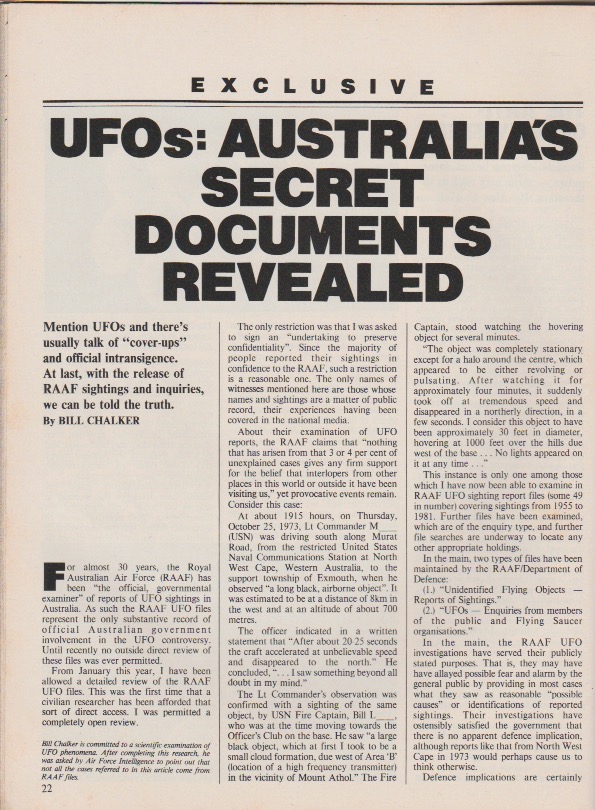
Chalker studied chemistry and mathematics at the University of New England and later worked as a chemist in food science. His publisher and the Center for UFO Studies describe this scientific background.
His involvement in organised UAP research began around 1969, when he became associated with the Sydney-based UAP Investigation Centre. He also developed links with the Aerial Phenomena Research Organization, an American civilian group that investigated reports internationally.
The combination of chemistry, mathematics, archives, and witness investigation shaped his later method. He did not approach the subject solely as a cultural historian. He was interested in whether reports produced measurable traces and whether those traces could survive ordinary explanations.
Chalker has also described a personal sighting that occurred on 15 September 1972 while he was a student at the University of New England.
According to his retrospective account, he noticed two students watching the evening sky and turned to see a metallic, egg-shaped object moving horizontally. He estimated that it remained visible for about 15 seconds. The object appeared silent and was eventually obscured by university buildings.
Chalker moved through the buildings in an attempt to regain sight of it, but the object was gone.
The incident is a documented self-report rather than an independently verified case. No photograph, instrument record, or publicly available statement from the other apparent observers was located in the sources reviewed for this article. Chalker has acknowledged uncertainty in his estimates of size and distance, which is important because those variables strongly influence any reconstruction of speed or scale.
The sighting nevertheless appears to have reinforced his interest in UAP investigation. It also placed him in the position experienced by many witnesses: convinced that he had seen something unusual, but unable to produce the kind of evidence that would settle its identity.
Around the same period, newspapers were reporting a recurring silvery light near Taree. Chalker has written that he reviewed the observational details and identified the object as Venus.
This identification, like the personal sighting, is supported primarily by Chalker’s own account. It should therefore remain attributed to him rather than treated as an independently reconstructed case.
The pairing is revealing. Chalker did not regard every unexplained report as evidence of a non-human vehicle. He was willing to identify a celestial object when the evidence appeared to support that conclusion, while leaving another observation unresolved. Center for UFO Studies: Bill Chalker biography
What forensic UAP research should require
Chalker has often described his preferred approach as forensic. In practical terms, that means beginning with the reported event and testing what can be tested.
A witness statement establishes what a person says happened. Its strength depends on when the account was recorded, whether the questioning was neutral, whether witnesses were interviewed separately, whether their descriptions converged before information was shared, and whether external evidence supports the time, place, and sequence.
A sincere witness can still misinterpret an event. Human memory is reconstructive, and confidence is not identical to accuracy. At the same time, inconsistency does not automatically mean fabrication. Stress, shock, sleep disruption, and the passage of time can alter how experiences are narrated.
Physical evidence introduces a second level of difficulty.
A sample must be documented before collection. Investigators need sterile equipment, labelled containers, environmental controls, clear custody records, and enough material for independent testing. Laboratories should ideally be blinded to the extraordinary claim. Raw data and analytical methods should be released wherever possible.
Without those safeguards, an unusual result may still be interesting, but its origin becomes difficult to establish.
Chalker’s work repeatedly demonstrates this problem. His investigations are strongest when testimony, archives, and physical traces converge. They become more uncertain when an unusual laboratory result is asked to support a conclusion that the testing itself did not establish.
Kelly Cahill and the investigation that disappeared
The reported 1993 Kelly Cahill encounter is one of the most important Australian contact cases and one of the clearest examples of how promising evidence can become inaccessible.
Cahill reported that on 7 August 1993, while travelling with her husband near Melbourne’s south-eastern outskirts, they observed an intensely illuminated object near a paddock. She later described missing time, unusual bodily marks, and memories of tall, dark figures.
Some of the more detailed elements of the experience emerged during hypnosis.
Cahill also recalled another vehicle near the scene and believed that additional people had witnessed aspects of the event. If confirmed through independent, separately recorded interviews, those witnesses could have transformed the case from a primarily personal experience into a multiple-witness investigation.
Chalker was among the first researchers Cahill contacted. Because he was based in New South Wales and the incident occurred in Victoria, he referred the fieldwork to John Auchettl and Phenomena Research Australia, commonly known as PRA.
PRA later reported that other witnesses had been located and that similarities existed between their accounts and Cahill’s. A comprehensive report of approximately 300 pages was discussed publicly, but it was not located in the public sources reviewed for this article.
The additional witnesses also did not make complete interviews available for independent assessment in the sources reviewed.
Public knowledge of their accounts therefore comes primarily through second-hand summaries supplied by investigators rather than through complete, independently inspectable testimony.
That distinction matters. Investigators may genuinely have interviewed corroborating witnesses. They may also have had legitimate privacy, psychological, or medical reasons for withholding personal information. Yet without anonymised transcripts, original recordings, interview dates, maps, and a clear chronology, outside researchers cannot determine whether the accounts were independent or whether details were introduced through discussion.
Chalker later described the case as a major lost opportunity. He has said that he saw indications that a substantial investigation had occurred, but he criticised the failure to publish the underlying material. He continued to regard Cahill as credible while expressing regret that he had transferred responsibility for the investigation.
Credibility, however, is not the same as verification.
It is verified that Cahill made the report, contacted Chalker, and became the subject of a PRA investigation. It is also verified that the anticipated report did not enter the publicly accessible record reviewed for this article.
The alleged independent corroboration remains disputed because the primary interviews are unavailable for public assessment.
Hypnosis adds another complication. It may facilitate narration and increase a subject’s confidence in remembered material, but research has shown that it can also increase suggestibility, false recollection, and confidence in inaccurate memories. Details emerging under hypnosis should therefore be treated as testimony requiring independent corroboration, not as a reliable recovery of an objective recording.
None of this shows that Cahill fabricated her experience. It means that the available evidence cannot establish its cause.
The most valuable missing material is not another interpretation of her account. It is the original interview archive, including audio recordings, contemporaneous notes, witness timelines, medical documentation released with consent, site photographs, and the unreleased PRA report.
ABC News: The Kelly Cahill case and the missing investigation
Peter Khoury and the hair that changed the argument
The Peter Khoury case became Chalker’s best-known attempt to move experiencer research from testimony into the laboratory.
Khoury reported an intrusive encounter at his Sydney home on 23 July 1992. He said that he awoke to find two unusual, human-looking female figures near him. He described the encounter as physical, disturbing, and unwanted.
After the figures disappeared, Khoury reported finding strands of pale hair entangled around his body.
The alleged sample became the focus of Chalker’s 2005 book, Hair of the Alien: DNA and Other Forensic Evidence for Alien Abductions.
The case differed from many contact reports because it involved recoverable biological material. Chalker and researchers associated with the Anomaly Physical Evidence Group arranged microscopic and genetic testing.
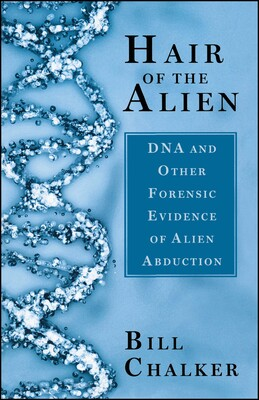
According to Chalker’s published account, testing was interpreted as showing human mitochondrial DNA associated with uncommon maternal lineages. He also discussed what he regarded as unusual ancestry patterns and a possible genetic variation involving the CCR5 gene.
These details must be attributed carefully.
The publicly accessible record reviewed for this article does not include a complete peer-reviewed case report containing all raw sequence data, electropherograms, control results, chain-of-custody documentation, analyst notes, and independent replication. The lineage descriptions and possible CCR5 findings are therefore reported interpretations from Chalker’s published account, not independently established conclusions.
The most important scientific point is that the DNA described publicly was human.
Mitochondrial DNA is often used in hair analysis because many copies can remain in a hair shaft even when nuclear DNA is absent or degraded. It can indicate maternal lineage, but it generally cannot identify a unique individual. Maternal relatives share mtDNA profiles, and unrelated people can share the same sequence.
Hair analysis is also particularly vulnerable to contamination.
A peer-reviewed study published in Forensic Science International found that biological material adhering to a hair can be co-amplified during testing. Contaminating saliva or blood cells may produce ambiguous sequencing results unless suitable decontamination procedures are used.
This becomes especially important when different portions of a sample are reported to have produced different genetic signals.
CCR5-Δ32 is a documented human allele. In homozygous individuals, it can confer substantial resistance to infection by CCR5-tropic HIV-1. It does not provide universal resistance to viruses, and its presence would not indicate a non-human donor.
The responsible conclusion is therefore narrower than the most dramatic interpretation.
Chalker’s published account reports that a hair sample attributed to Khoury’s experience was submitted for microscopic and genetic examination through his research network. According to Chalker, the results appeared unusual in relation to the witness’s description and expected ancestry. The publicly described DNA was human. No result independently demonstrated a non-human, hybrid, or genetically engineered origin.
Rarity is not alienness.
A rare human sequence remains human unless additional evidence establishes otherwise. Mixed or unusual results may arise from ordinary ancestry, contamination, multiple contributors, degraded low-template DNA, handling problems, analytical artefacts, or interpretive error.
Chalker proposed that the apparent mismatch between the witness’s description and the reported genetic findings might point toward genetic engineering or hybridisation. That proposition is a researcher hypothesis rather than a laboratory conclusion.
For the case to support a non-human origin, investigators would need a documented chain of custody, validated decontamination methods, complete raw data, independent testing of the remaining sample, and replication by multiple accredited laboratories. The laboratories should ideally receive blinded specimens so that analysts do not know which sample carries the extraordinary claim.
No independently replicated, peer-reviewed demonstration of non-human genetics was located in the public sources reviewed for this article.
This does not make the sample irrelevant. It remains one of the few alleged contact artefacts to have generated sustained biological testing claims. The case also provides a practical lesson for future investigations: collection and custody procedures are not administrative details. They determine what conclusions can later be defended.
Simon & Schuster: Hair of the Alien
Forensic Science International: Hair-shaft decontamination and mtDNA sequencing
National Institute of Justice: Basics of DNA evidence analysis
PubMed: CCR5-Δ32 and HIV-1 resistance
Gundiah: the case Chalker would not defend
The reported 2001 Gundiah incident shows a different side of Chalker’s investigative work.
The case began with a claim that Amy Rylance had been taken from a rural Queensland property by a beam of light during the night of 4 October 2001.
The story spread quickly. Chalker joined Diane Harrison of the Australian UAP Research Network in examining the property, consulting reported police observations, and reconstructing the movements of the people involved.
Investigators approached the location as a potential crime scene rather than assuming that an anomalous encounter had occurred.
Several apparently dramatic traces weakened under examination.
A damaged window screen could plausibly have been torn by a dog, which investigators observed jumping against it. A supposedly affected plant showed deterioration compatible with heat stress, and a comparison plant of the same species reportedly displayed similar damage.
More serious difficulties developed. The principal participants became unavailable for follow-up interviews. Investigators were unable to obtain samples from reported bodily marks. Police and civilian investigators reportedly identified inconsistencies between the physical circumstances and the public narrative.
Chalker later reported that information obtained through family connections supported the conclusion that the event had been fabricated. Contemporary newspaper reporting also described local police as considering the case a hoax.
The complete police file, full interviews, and any direct documented confession were not located in the public sources reviewed for this article.
For that reason, UAPedia should not present the hoax conclusion as independently verified beyond dispute.
Chalker and other investigators ultimately classified the Gundiah episode as a probable hoax. Publicly available evidence, including ordinary explanations for alleged traces, reported inconsistencies, participant withdrawal, and later claims of an admission, substantially weakens the original account.
The case demonstrates that disproving alleged evidence is not a failure of investigation.
A dog-damaged screen, heat-stressed vegetation, and contradictory circumstances are productive findings. They prevent ordinary traces from being promoted as evidence of an extraordinary event.
The Turner paper and Australia’s official record
Chalker’s archival work also helped draw attention to an unusual Australian intelligence document dated 27 May 1971.
The paper, titled “Scientific and Intelligence Aspects of the UFO Problem,” was signed by O. H. Turner, an official commonly referred to in later UAP literature as Harry Turner. He was identified in the document as head of the Joint Intelligence Organisation’s Nuclear Branch.
The document criticised the limited scientific attention given to Australian reports and questioned the adequacy of some conventional identifications. Turner argued that the subject might be better handled by an organisation capable of sustained scientific and intelligence analysis.
The paper is important because it demonstrates that a technically trained intelligence official regarded the existing investigative process as inadequate.
It does not prove that Turner’s interpretation was correct, nor does it establish a settled Australian government conclusion that UAP represented extraterrestrial vehicles.
An internal assessment records the judgement of its author and the concerns circulating within an institution at a particular time. It does not automatically become the official position of every agency or official who later encountered it.
The 1971 Joint Intelligence Organisation paper should also be distinguished from earlier assessments attributed to Turner in later media accounts. Chalker has stated that Turner’s earlier work interpreted a residual group of reports as evidence of extraterrestrial craft. That interpretation remains Chalker’s description of Turner’s assessment unless the complete earlier documentation is examined directly.
National Archives of Australia: Series A13693, control symbol 3092/2/000, item 30030606
Secondary access copy of the Turner paper
The Sea Fury radar-visual encounter
One of the most significant Australian cases preserved in official archives occurred on 31 August 1954.
Royal Australian Navy pilot Lieutenant J. A. O’Farrell was flying a Hawker Sea Fury when he reported two bright objects apparently pacing his aircraft. Ground personnel at Nowra confirmed unknown radar contacts.
The objects were reported to depart at high speed, and the National Archives of Australia states that their identity remains unresolved.
This is stronger than a solitary visual report because it combines observation by a military pilot with apparent ground radar confirmation.
Even so, “unresolved” is not an origin.
Without the complete radar parameters, calibration history, meteorological information, operator notes, and operational context, later investigators cannot confidently calculate the objects’ performance or eliminate every possible source of error.
The case demonstrates why official documentation matters while also showing its limits. The archival record confirms that an unusual radar-visual event was reported and investigated. It does not identify what produced it.
National Archives of Australia: Flying saucers, fact or fiction?
Why the RAAF stopped investigating reports
The Royal Australian Air Force ceased routine investigation of civilian UAP reports in 1994.
According to the National Archives of Australia, approximately 3 per cent of reports remained unexplained, but the unresolved remainder was considered to present little or no security threat.
That decision reflected an operational judgement.
A defence organisation can decide that a phenomenon does not justify continued allocation of personnel and resources. That does not mean the unresolved cases have been scientifically explained.
Security relevance and scientific significance are different questions. A report may remain unidentified without appearing hostile. It may also be scientifically interesting without falling within the practical mission of a military agency.
Chalker’s work repeatedly returns to this gap. When official organisations stop collecting reports, civilian researchers inherit both the mystery and the problems of inconsistent data.
The missing North West Cape material
During his 1982 review, Chalker searched for documentation concerning a reported October 1973 incident at the North West Cape communications facility.
He did not find the material in the files he was shown.
Chalker later concluded that the file had been removed because of the event’s sensitivity. ABC News reported this as his interpretation of the missing material.
The absence is significant, but it does not establish the reason.
A document may be missing because it was misfiled, transferred, separately classified, retained by another agency, lost, or excluded from the collection provided to the researcher. Deliberate removal is one possibility, but the absence alone cannot identify who removed it or why.
The most accurate formulation is that Chalker searched for the North West Cape case, did not find it in the available files, and interpreted its absence as evidence that it had been removed.
That interpretation remains disputed.
Publications that built an Australian UAP history
Chalker’s influence extends beyond individual cases.
His 1996 book, The Oz Files: The Australian UFO Story, assembled Australian reports into a broad historical narrative. The National Library of Australia catalogues the volume as a 239-page work containing illustrations, a map, bibliography, and index.
The book helped give Australian cases a sustained place in a literature that had often been dominated by events from the United States and Europe.
His 2005 book, Hair of the Alien, concentrated on biological and forensic claims arising from contact experiences. Its most important contribution may not be the hybrid interpretation it advanced, but the insistence that alleged contact material should be examined scientifically rather than treated only as narrative.
Chalker was also among the country contributors to UFOs and Government: A Historical Inquiry, published in 2012. The publisher presents the book as a work by Michael Swords and Robert Powell with Chalker and several other national contributors. Chalker’s involvement reflected his long engagement with Australian government records.
Chalker has also listed UFO History Keys: Examining the UFO Controversy from a Historical Perspective among his publications. Its exact publication details require confirmation through a library catalogue, ISBN record, or publisher listing before being treated as fully verified bibliographic information.
The controversies that define the legacy
The central controversies surrounding Chalker’s work are methodological rather than personal.
The Khoury case raises the problem of inferential distance. The reported genetic results may be unusual, but moving from uncommon human sequences to a genetically engineered or hybrid being requires evidence that the published testing did not provide.
The Cahill case raises the problem of inaccessible corroboration. Chalker may have strong reasons for believing Cahill and may have seen information unavailable to the public, but confidence held by an investigator cannot replace primary evidence.
The North West Cape question raises the problem of interpreting absence. A missing record may be important, but its absence cannot establish the mechanism by which it became unavailable.
The Gundiah case raises a different challenge. Researchers must be willing to reject an extraordinary account when its physical traces fail and its narrative becomes inconsistent.
Chalker’s record contains examples of all four problems.
This is what makes his career more instructive than a simple debate over whether he is a believer or a sceptic. He has defended witnesses, proposed ambitious hypotheses, identified ordinary explanations, criticised secrecy within civilian research, and rejected cases he believed had been fabricated.
Some of his evidentiary bridges hold. Others remain unfinished.
Why Bill Chalker still matters
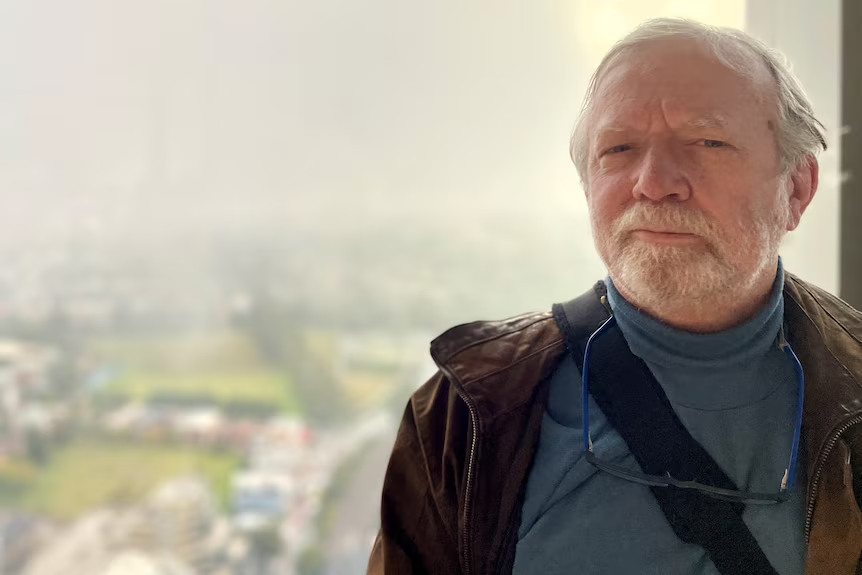
Chalker’s impact can be understood through three principles.
The first is that experiencers should be heard without ridicule. A person can describe missing time, bodily effects, perceived entities, or overwhelming fear without automatically being treated as dishonest or irrational.
Respectful listening is not the same as accepting every interpretation.
The second principle is that testimony should begin an investigation rather than end it.
A reported mark should be photographed and examined. A time discrepancy should be compared with calls, receipts, vehicle records, and independent witnesses. A biological sample should enter a controlled forensic process. A government reference should lead to the underlying document.
The third principle is that negative findings are valuable.
Venus, heat damage, contamination, memory distortion, or inconsistent witness accounts do not undermine UAP research. They improve it by removing weak material from the case record.
Chalker’s work also demonstrates the need for durable research institutions.
Private archives can disappear. Samples can degrade. Witness consent can be lost. Investigative groups can fracture. Major reports can remain unpublished. Researchers may die before their records are catalogued.
The next generation of experiencer research will require secure archives, ethical consent procedures, standardised interviews, trained sample collection, accredited laboratories, and public release of anonymised evidence wherever privacy allows.
Chalker has not solved the contact phenomenon. His work has shown why solving it is so difficult.
Implications
Experiencer research should operate simultaneously as witness support, historical documentation, and forensic inquiry.
None of those roles can replace the others.
A purely psychological approach risks defining an apparently external anomaly as an internal event before the surrounding environment has been investigated.
A purely literal approach risks converting the witness’s interpretation into fact.
A purely laboratory approach may analyse an object while losing the chronology and human context that gave the object significance.
The strongest model preserves the original account, investigates external circumstances, assesses reported medical effects through appropriate professionals, and separates hypotheses from evidence until multiple lines of data converge.
For biological samples, the Khoury case suggests a clear protocol. Investigators should photograph the sample in place, use sterile equipment, gather environmental and human controls, document every transfer, divide the material among independent laboratories, blind analysts to the claim, preserve raw data, and retain enough material for replication.
For testimony, the Cahill case offers a parallel lesson. Witnesses should be interviewed separately and as soon as possible. Original audio should be retained. Investigators should distinguish spontaneous recollection from prompted material. Hypnosis-derived details should be clearly identified and should not be treated as independently recovered facts.
For physical traces, Gundiah supplies a final rule: investigators must actively search for information capable of falsifying the extraordinary claim.
A proposition that cannot be challenged is not a forensic hypothesis.
Claims Taxonomy
Verified
Bill Chalker has been involved in Australian UAP research since the late 1960s and has published major works on Australian cases and alleged contact evidence.
He studied chemistry and mathematics at the University of New England and later worked as a chemist in food science.
He spent approximately one week examining Australian Defence UAP files at the Russell Offices in January 1982.
Kelly Cahill reported a 1993 encounter, contacted Chalker, and became the subject of an investigation by Phenomena Research Australia.
The anticipated comprehensive PRA report did not enter the publicly accessible record reviewed for this article.
Chalker’s published account reports that a hair sample attributed to Peter Khoury’s reported 1992 experience was submitted for microscopic and genetic examination through his research network.
The genetic findings described publicly by Chalker were human and did not independently demonstrate a non-human donor.
Chalker and Diane Harrison investigated the Gundiah claims and reported ordinary explanations for some of the alleged physical traces.
The 1971 O. H. Turner paper exists and records criticism of the Australian investigative process.
The National Archives confirms the unresolved 1954 Sea Fury radar-visual report and the RAAF’s decision to cease routine civilian UAP investigation in 1994.
Probable
It is probable that Chalker’s archival work increased public awareness of Australian UAP records and helped consolidate material that had previously been scattered across official files, local reports, and private collections. This is an editorial assessment of his historical impact rather than a measurable preservation claim.
Assuming Chalker’s description of the laboratory work is accurate, it is probable that the Khoury sample produced human mtDNA results that investigators regarded as unusual.
It is probable that Kelly Cahill underwent a powerful and personally consequential experience, although its cause remains unresolved.
The Gundiah episode was probably fabricated, based on the available trace explanations, reported inconsistencies, participant withdrawal, and the conclusions reached by Chalker and other investigators.
Disputed
The interpretation of the Cahill event as a physical encounter with non-human beings is disputed because the primary corroborating interviews and full investigative report remain unavailable for public assessment.
The origin of the Khoury hair is disputed. The reported human genetic profile does not establish who deposited the hair or how it reached the reported location.
The claim that the Khoury genetic findings indicate hybridisation, engineering, or non-human ancestry is disputed and unsupported by independent replication located in the sources reviewed.
Chalker’s interpretation that the North West Cape record was deliberately removed is disputed. The absence of the expected file is reported, but the reason for its absence is not established.
The origin of Chalker’s 1972 sighting remains disputed. The account is a documented self-report without an independent technical record located in the sources reviewed.
Legend
No central biographical claim about Bill Chalker is classified as Legend.
Traditional narratives that have been compared with Chalker’s biological-intervention ideas should be treated as cultural or religious accounts within their own contexts. They do not independently verify genetic engineering or non-human contact.
Misidentification
According to Chalker’s retrospective account, he identified the widely reported Taree silvery light as Venus.
In the Gundiah investigation, damage to a window screen was plausibly attributed to a dog, while plant deterioration was consistent with heat stress.
These findings reclassified alleged evidence without necessarily resolving every statement made by the witnesses.
Hoax
Chalker, participating investigators, and reported police commentary ultimately treated the Gundiah episode as a probable hoax. The available evidence substantially weakens the original account, but the complete police records, full interviews, and a direct published confession were not located in the public sources reviewed. The classification should therefore remain attributed rather than presented as independently verified beyond dispute.
Speculation Labels
Witness Interpretation
Chalker’s 1972 description of a silent, metallic, egg-shaped object is his interpretation of a brief personal sighting.
Kelly Cahill’s descriptions of an illuminated object, missing time, and dark figures are witness interpretations of a reported experience. Some details emerged under hypnosis and require particular caution.
Peter Khoury’s identification of the figures he reported as non-human is also a witness interpretation.
These accounts may be sincere and significant without establishing the objective cause of the events.
Researcher Opinion
Chalker’s continuing belief in the credibility of Cahill’s account is a researcher opinion informed by his contact with her and by information he says he reviewed.
His conclusion that North West Cape documentation had been deliberately removed is a researcher opinion based on the absence of the expected material.
His interpretation of the Khoury hair as potentially connected to an engineered or hybrid being is also a researcher opinion that extends beyond the publicly documented laboratory findings.
Hypothesis
The proposal that the Khoury sample originated from a genetically engineered, hybrid, or non-human being is a hypothesis.
The broader suggestion that contact reports, unusual human genetic lineages, and cultural traditions may be connected through a programme of biological intervention is also a hypothesis.
A competing hypothesis is that the hair was ordinary human material affected by uncommon ancestry, contamination, multiple contributors, sample handling, or technical limitations.
Neither explanation has been conclusively demonstrated.
References
Australian Broadcasting Corporation. (2020, September 26). “Holy grail” or epic hoax? Australian Kelly Cahill’s UFO abduction story still stirs passions. https://www.abc.net.au/news/2020-09-26/ufo-abduction-book-kelly-cahill-encounter-eumemmering-australia/12661498
Australian Broadcasting Corporation. (2024, December 7). How Bill Chalker became one of the first civilians to access the RAAF’s UFO files. https://www.abc.net.au/news/2024-12-07/accessing-australia-secret-ufo-files/104673082
Center for UFO Studies. (n.d.). Bill Chalker. https://cufos.org/about-us/cufos-board-consultants-and-friends/bill-chalker/
Chalker, B. (1996). The Oz files: The Australian UFO story. Duffy & Snellgrove. https://catalogue.nla.gov.au/catalog/1138942
Chalker, B. (2005). Hair of the alien: DNA and other forensic evidence for alien abductions. Paraview Pocket Books. https://archive.org/details/hairofaliendnaot00bill
Chalker, B. (2012, July). Peter Khoury and the “Hair of the Alien,” 20 years on. The Oz Files. https://theozfiles.blogspot.com/2012/07/peter-khoury-and-hair-of-alien-20-years.html
Chalker, B. (2021, May). Experiencing UAP “hotzones”: Mount Butler, Tyringham and the “Skinwalker” beat. The Oz Files. https://theozfiles.blogspot.com/2021/05/experiencing-ufouap-hotzones-mount.html
Chalker, B. (2024, July). The 2001 Gundiah Queensland UAP “abduction” of Amy Rylance. The Oz Files. https://theozfiles.blogspot.com/2024/07/the-2001-gundiah-queensland-ufo.html
Dean, M., Carrington, M., Winkler, C., Huttley, G. A., Smith, M. W., Allikmets, R., Goedert, J. J., Buchbinder, S. P., Vittinghoff, E., Gomperts, E., Donfield, S., Vlahov, D., Kaslow, R., Saah, A., Rinaldo, C., Detels, R., & O’Brien, S. J. (1996). Genetic restriction of HIV-1 infection and progression to AIDS by a deletion allele of the CKR5 structural gene. Science, 273(5283), 1856–1862. https://pubmed.ncbi.nlm.nih.gov/8791590/
Jehaes, E., Gilissen, A., Cassiman, J.-J., & Decorte, R. (1998). Evaluation of a decontamination protocol for hair shafts before mtDNA sequencing. Forensic Science International, 94(1–2), 65–71. https://doi.org/10.1016/S0379-0738(98)00052-8
Kihlstrom, J. F. (1997). Hypnosis, memory and amnesia. Philosophical Transactions of the Royal Society B: Biological Sciences, 352, 1727–1732. https://pubmed.ncbi.nlm.nih.gov/9415925/
National Archives of Australia. (1971). Scientific and intelligence aspects of the UFO problem. Series A13693, control symbol 3092/2/000, item 30030606. https://recordsearch.naa.gov.au/SearchNRetrieve/Interface/ViewImage.aspx?B=30030606
National Archives of Australia. (2018, February 28). Flying saucers: Fact or fiction? https://www.naa.gov.au/blog/flying-saucers-fact-or-fiction
National Institute of Justice. (2012, August 8). DNA evidence: Basics of analyzing. https://nij.ojp.gov/topics/articles/dna-evidence-basics-analyzing
Simon & Schuster Australia. (n.d.). Bill Chalker. https://www.simonandschuster.com.au/authors/Bill-Chalker/22509695
Swords, M. D., & Powell, R., with Svahn, C., Ballester Olmos, V.-J., Chalker, B., Greenwood, B., Thieme, R., Aldrich, J., and Purcell, S. (2012). UFOs and government: A historical inquiry. Anomalist Books. https://www.anomalistbooks.com/book.cfm?id=64
Turner, O. H. (1971, May 27). Scientific and intelligence aspects of the UFO problem. Joint Intelligence Organisation minute paper, National Archives of Australia, series A13693, control symbol 3092/2/000, item 30030606.
SEO keywords
Bill Chalker, Australian UAP investigator, Bill Chalker biography, Australian UAP history, Kelly Cahill encounter, Peter Khoury hair sample, Hair of the Alien, human mtDNA UAP evidence, Gundiah incident, Amy Rylance case, Australian experiencer research, contact experience investigation, RAAF UAP files, O. H. Turner report, Harry Turner UAP, Australian UAP archives, Anomaly Physical Evidence Group, UAP Investigation Centre, mitochondrial DNA hair evidence, forensic UAP investigation, experiencer testimony, UAP physical evidence, hypnosis and contact memories, The Oz Files, North West Cape UAP, Sea Fury radar encounter, UAP evidence standards, CCR5-Δ32, UAP biological evidence