
The first time most people hear the phrase “non-human intelligence” (NHI), it lands with a thud. It sounds like something from a classified briefing or a hard sci-fi paperback. It also feels different from “aliens.” “Aliens” is cultural. “NHI” is administrative.
And that detail matters, because governments do not usually “recognize” world-shifting realities with fireworks and a podium. They do it with vocabulary, process, and paperwork. A term appears in a definition. A reporting pipeline is funded. A records collection is mandated. A hearing transcript preserves sworn language that can never quite be put back in the bottle.
If you are looking for a single cinematic moment when a state confirms NHI as fact, you will be disappointed. If, instead, you want to understand how recognition actually happens in modern bureaucracies, then NHI is a masterclass in slow disclosure: the kind that moves through legislation, archival rules, institutional reshuffles, and public testimony, while officials still insist nothing has been proven.
This article is about that “quiet pivot.” Not a victory lap, not a dismissal. A map of what governments have done and said, how they define NHI when they do, what they appear to be protecting, and what this implies about intent, uncertainty, and the limits of official knowledge.
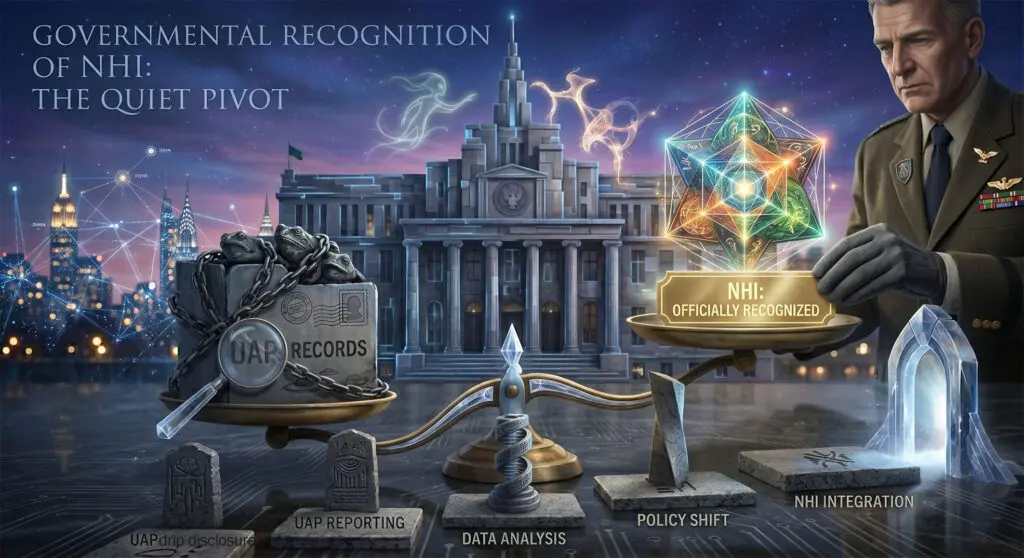
NHI as a government word, not a pop culture word
“Non-human intelligence” is deliberately broad. It is not “extraterrestrial.” It is not even “biological.” It is a category designed to hold open a door that governments do not want to close prematurely.
A striking example comes from proposed U.S. disclosure legislation language that defined NHI as “any sentient intelligent non-human lifeform regardless of nature or ultimate origin” that may be presumed responsible for UAP or that the federal government has become aware of. (Senate Democratic Leadership)
That phrasing is almost clinical, and it reads like a lawyer and an analyst built it together. “Regardless of nature or ultimate origin” is the tell. It anticipates multiple explanatory families: not only spacefaring visitors, but also something terrestrial, trans-dimensional, unknown, or simply not yet conceptualized in ordinary categories.
Even more consequential than a proposed definition is what was written into federal records practice. U.S. National Archives guidance, tied to statutory requirements, states that the UAP Records Collection will include records relating to “unidentified anomalous phenomena, technologies of unknown origin, and non-human intelligence,” including equivalent subjects by other names. (National Archives)
That sentence is one of the most underappreciated markers of governmental recognition. It is not a speech. It is a records mandate. It is the state saying: whatever this is, it is real enough as a subject that agencies must search for it, digitize it, and transfer it for public disclosure under an established process. (National Archives)
To be clear, that does not mean “the government confirms NHI exists.” It means the government has elevated NHI from a cultural idea to an administrative category, one important enough to shape recordkeeping obligations across agencies.
That is how recognition starts.
The modern pivot did not begin with NHI, it began with UAP
Before NHI entered mainstream political speech, “UAP” did the groundwork. A new label allowed governments to talk about anomalies without inheriting decades of stigma attached to “UFO.” The term also widened the frame beyond “craft” and into “phenomena,” including things that might not be objects in any straightforward sense.
The U.S. Department of Defense’s decision to formally release three U.S. Navy videos in April 2020 is often treated as a media moment, but it is better understood as a boundary-setting moment. The statement emphasized two things at once: the footage was real and unclassified, and the phenomena remained “unidentified.” (U.S. Department of War)
That matters because it quietly redefined what an “official” position could be. The old reflex was to debunk, mock, or bury. The new posture was: this is authentic military imagery; it does not reveal sensitive capabilities; the label “unidentified” is still appropriate. (U.S. Department of War)
In other words: the state began to tolerate public ambiguity.
And once governments tolerate ambiguity, they have to manage it. That is where offices, reports, and archives come in.
Institutional recognition: when governments build offices for the unknown
One of the clearest signals of recognition is institutionalization. Governments rarely create durable structures for things they consider purely imaginary.
In the U.S., the All-domain Anomaly Resolution Office (AARO) describes itself as leading government efforts on UAP using a “rigorous scientific framework” and “data-driven approach.” (AARO) The language is skeptical in tone, but structurally it is an admission: UAP is a category that warrants sustained analysis across domains.
AARO’s 2025 mission brief adds another detail that tends to get overlooked. It explicitly states that AARO accepts reports of UAP-related government programs or activities from current or former government employees, service members, or contractor personnel with direct knowledge, and that these reports inform its congressionally directed historical record report. (AARO)
That is important because it shows the pipeline is not only about sightings. It is also about allegations of programs, custody, and institutional behavior. In other words: governments are not only tracking anomalous events, they are tracking claims about what their own systems have done with anomalous material.
At the same time, AARO’s mission brief claims only a very small percentage of reports show anomalous signatures and that most reported detections have ordinary characteristics, while noting data limitations. (AARO) This tension is central to the entire modern era: the machinery is real, the insistence that it is mostly explainable is also real, and the residue of high-quality cases continues to drive public and congressional pressure.
Archival recognition: when governments mandate the hunt for NHI records
If institutional recognition is building an office, archival recognition is more disruptive: it forces multiple agencies to search for, organize, and transfer records they might prefer to keep scattered.
In the United States, National Archives guidance explains that the 2024 National Defense Authorization Act required NARA to establish a UAP Records Collection and required agencies to review, identify, and organize each UAP record for disclosure and transfer. (National Archives)
Critically, NARA’s guidance describes the collection’s scope using the triad: UAP, technologies of unknown origin, and non-human intelligence. (National Archives) That is not a casual phrase. “Technologies of unknown origin” and “non-human intelligence” are conceptual bombs placed inside bureaucratic procedure. Even if many records ultimately relate to mundane events, the mandate forces agencies to treat NHI-related materials, if they exist under any naming convention, as something that must be identified and processed.
NARA later announced it released new UAP records transferred from ODNI, the Office of the Secretary of Defense, the FAA, and the Nuclear Regulatory Commission, adding them to the collection on an ongoing basis. (National Archives) The existence of a rolling release mechanism is another quiet recognition: this is no longer a one-off curiosity. It is now an archival program.
NARA even created a dedicated record group for the UAP Records Collection and lists contributing agencies and catalog identifiers as materials arrive. (National Archives)
This is what recognition looks like when it is expressed through governance rather than proclamation: a system designed to surface and adjudicate what is already inside the state, including what the state may not have understood how to name.
Reports as recognition: what official studies say, and what they avoid saying
Official studies often read cautious, even deflationary, but the very act of publication is part of recognition. Three documents are particularly useful for seeing the shape of governmental thinking.
ODNI’s threat frame: “we have a dataset, but we don’t have answers”
The ODNI “Preliminary Assessment” (June 25, 2021) is frequently summarized, but its deeper importance is procedural. It was produced in response to a formal request, framed as an overview for policymakers, and it describes the challenge of characterizing potential threats posed by UAP while building processes and policies for future encounters.
Read that again: “if and when they encounter UAP.” This is not the language of fantasy. It is the language of operational expectation.
It also makes clear the dataset was limited, largely based on government reporting from November 2004 to March 2021, and acknowledges continuing collection and analysis.
AARO’s historical record report: “we investigated off-world technology under intelligent control”
AARO’s “Historical Record Report, Volume I” is controversial for its conclusions, but it contains one sentence that matters enormously for the story of governmental recognition.
It states that since 1945 the U.S. government funded and supported UAP investigations to determine whether UAP represented flight safety risk, technological leaps by competitor nations, or “evidence of off-world technology under intelligent control.” (U.S. Department of War)
Whatever you think of AARO’s later judgments, that line is a historical confession: the “intelligent control” hypothesis, which is essentially an NHI-shaped possibility, has been an explicit governmental investigative aim for decades. (U.S. Department of War)
AARO also states it reviewed official investigatory efforts since 1945, researched classified and unclassified archives, conducted interviews, and partnered with oversight officials for controlled and special access programs. (U.S. Department of War) That is another form of recognition: the government treated UAP not only as sightings, but as something that might intersect with deeply classified programs.
DoD/ODNI annual reporting: statistics as recognition
The Fiscal Year 2024 consolidated annual report notes it is provided in response to a legal requirement and that it covers UAP reports from May 1, 2023 to June 1, 2024, reporting that AARO received 757 UAP reports during that period. (U.S. Department of War)
Even if one believes most of these reports are misidentifications or sensor artifacts, the reporting pipeline itself represents normalization: UAP is now a bureaucratic category that generates routine statistical output.
NASA’s entry: recognition by scientific posture
NASA’s 2023 independent study team report describes UAP study as a scientific opportunity that demands rigorous, evidence-based approaches and calls for improved data acquisition and a systematic reporting framework while reducing stigma.
NASA’s UAP program page clarifies the scope: the study focused on what data exists, how to collect future data, and how NASA can contribute scientifically, rather than trying to prove any specific origin claim. (NASA Science)
NASA’s involvement is recognition of a different type. It says: even if the origin is unknown, the phenomenon is legitimate enough to deserve method.
Recognition through testimony: when pilots describe the impossible in plain language
Governmental recognition of NHI is not only a top-down story. It is also a bottom-up story, driven by witnesses who were trained to observe and who describe things that do not fit the expected inventory of human aerospace.
The 2023 House Oversight hearing is now part of the official record, but its most powerful contribution is not the headlines. It is the calm, matter-of-fact tone of first-hand accounts.
Ryan Graves, a former Navy F/A-18 pilot, told Congress he witnessed “advanced UAP on multiple sensor systems firsthand” and framed them as both national security and aviation safety problems. (House Oversight Committee) He emphasized that these sightings were not rare, describing repeated observations over years and the persistent absence of answers. (House Oversight Committee)
David Fravor’s written statement on the 2004 USS Nimitz “Tic Tac” encounter is similarly direct. He describes a white, Tic Tac-shaped object with no visible rotors or control surfaces, moving abruptly over disturbed water. He recounts that when he maneuvered to intercept, the object accelerated and disappeared, and then was reported by radar at their CAP point roughly 60 miles away.
This is the human core of governmental recognition: sworn testimony that describes performance outside the familiar envelope, delivered without theatricality.
Do these testimonies prove NHI? No. They do something else: they force the state to take seriously the possibility that unknown intelligence might be operating in restricted training ranges, interacting with military assets, and leaving traces across sensors.
That is why the language shifts from “what was that?” to “who or what is responsible?”
Case studies: how specific incidents push governments toward NHI-shaped language
When governments begin to speak in NHI-adjacent terms, it is rarely because of one report. It is because of clusters of “high-friction” cases that refuse to die, often because they combine credible witnesses, multiple sensors, and official documentation.
The Tic Tac as a template for “intelligent control” questions
The Nimitz case, as described by Fravor, is not merely “unidentified.” It is behaviorally provocative: abrupt movement, apparent acceleration, rapid relocation, and a context of repeated contacts. That is exactly the kind of case that makes “intent” relevant, because it reads less like atmospheric noise and more like a system operating with awareness of human aircraft.
Even the DoD’s 2020 statement on the Navy videos reinforces the administrative reality: footage tied to November 2004 and January 2015 encounters was authentic, remained “unidentified,” and related to incursions in military airspace. (U.S. Department of War)
The Roosevelt-era encounters and the safety problem
Graves’ testimony is valuable not only because he says he witnessed advanced UAP, but because he anchors the story in a pattern: regular encounters, reporting stigma, and the consequences of treating anomalies as taboo. (House Oversight Committee)
When governments start seeing UAP as a safety issue, they can no longer dismiss it as an eccentric belief. Safety is quantifiable. Safety generates policy. Safety generates paperwork. And paperwork is where recognition accumulates.
The “program allegations” layer: when NHI becomes a governance problem
Alongside sightings is a second layer: allegations of hidden retrieval, analysis, or exploitation programs. Regardless of whether any particular allegation is true, the existence of a formal intake channel for government personnel reporting UAP-related programs, and the repeated congressional emphasis on transparency and whistleblower protections, shows the state is taking the allegations seriously enough to manage them. (AARO)
Congressional task forces have explicitly framed public trust and whistleblower protection as part of the UAP transparency problem. (House Oversight Committee) This is not a scientific claim, but it is recognition of institutional tension: lawmakers believe relevant information exists inside government systems and is not flowing properly.
International recognition: when “NHI” is not the word, but the structure is the same
Not every government uses “NHI,” but many have built UAP-facing structures that do the same work: collecting reports, investigating, publishing results, and normalizing the topic.
France’s GEIPAN, housed under the French space agency CNES, describes its mission as collecting, analyzing, investigating, publishing, and archiving UAP sightings and providing information and data to the public. (Geipan)
Canada’s Office of the Chief Science Advisor launched the Sky Canada Project to review how public UAP reports are managed and to recommend improvements. (ISED Canada) Canada’s Q&A is explicit about boundaries: the project was not intended to prove or deny extraterrestrial life, and it focused on reporting processes rather than adjudicating specific sightings. (ISED Canada)
The United Kingdom’s “Project Condign” similarly frames the issue as defense intelligence triage: whether there is evidence of threat, and whether any military technologies of interest might be involved. (Internet Archive)
What these have in common is structural recognition. Even when officials avoid NHI language, they build systems that treat the unknown as real enough to manage.
Controversies: recognition in a fog of denial, distrust, and competing narratives
No honest account of governmental recognition can pretend the story is clean.
AARO’s historical report has been widely covered as concluding there is no verified evidence of extraterrestrial technology and that many popular claims map onto misidentification and other drivers. (Reuters) That conclusion is itself a source of controversy because, for many observers and witnesses, it does not resolve the best cases. It also does not fully reconcile with the intensity of congressional language that led to archival mandates involving “technologies of unknown origin” and “non-human intelligence.” (National Archives)
This is where recognition becomes paradoxical. A government can say, publicly, “we have found no proof,” while simultaneously building mechanisms that presume the category (NHI) might be relevant enough to define, archive, and regulate. (National Archives)
There is also a credibility gap problem: witnesses describe extraordinary performance under oath, while official summaries often emphasize mundane explanations and data limitations. (House Oversight Committee) Both can be true at the same time. Most reports can be explainable while a small residue remains not merely unexplained but behaviorally suggestive.
The deeper controversy is not simply “are UAP real?” It is “who gets to decide what counts as evidence, and what is withheld from the public record?” That question is now explicitly political. (House Oversight Committee)
What “intent” means in the governmental frame
Here is where we have to be careful. “Intent” can be a trap. People hear it and leap to motives, agendas, threats, or salvation. Governments, when they approach intent, usually do it more narrowly: does observed behavior imply control, pattern, responsiveness, or strategic interest?
AARO’s own historical framing makes this explicit by referencing “off-world technology under intelligent control” as a hypothesis that investigations were designed to test. (U.S. Department of War) “Intelligent control” is, functionally, intent-adjacent language. It is not saying “we know who.” It is saying “we are asking whether something purposeful is happening.”
Witness testimony also pushes the intent question, even when witnesses do not use that word. When Fravor describes an object aligning with his aircraft and then accelerating away, what is being implied is not simply unknown physics, but interaction. Interaction is where intent becomes relevant.
And this is precisely why “NHI” is a useful governmental term. It allows the system to ask intent-like questions without committing to a specific origin story.
Speculation Labels
Hypothesis
If the NHI category exists in records mandates because governments have encountered consistent patterns of behavior that resemble responsiveness, then recognition is not primarily about “belief,” it is about risk management. In that frame, the state does not need certainty to act. It only needs repeated anomalies in sensitive contexts, plus enough credible reporting to justify process. (National Archives)
Witness Interpretation
Graves’ language, describing “advanced UAP” and framing them as a persistent safety problem, reflects a pilot’s interpretation of capability relative to known platforms and training expectations. (House Oversight Committee) Fravor’s account similarly interprets sudden acceleration and relocation as extraordinary performance. These interpretations are grounded in experience, but they are not the same as a laboratory conclusion about origin.
Researcher Opinion
The most productive way to think about governmental recognition of NHI is not as a binary “confirmed or not,” but as an accumulation of administrative commitments. When you see NHI language in definitions, archives, and statutory frameworks, you are watching a government prepare for the possibility space of intelligence it cannot yet name. That preparation can coexist with official skepticism and debunking culture, but it still changes the landscape. (National Archives)
Implications
What changes once NHI becomes a category the state must manage?
Once NHI is an administrative category, several consequences follow even if no definitive proof is released tomorrow.
First, science gains a foothold. NASA’s insistence on rigorous data, standardized reporting, and stigma reduction is not an “answer,” but it is an opening: it legitimizes the method.
Second, governance shifts from denial to adjudication. The National Archives UAP Records Collection is not a promise of revelation, but it is an infrastructure that can surface patterns and contradictions over time. (National Archives)
Third, intent becomes a policy question rather than a campfire story. If objects or phenomena operate in sensitive airspace and appear to respond to assets, intent becomes relevant to rules of engagement, air safety, and classification. Graves’ framing of national security and aviation safety is a preview of that world. (House Oversight Committee)
Finally, public trust becomes central. Congressional hearing wrap-ups emphasizing transparency and whistleblower protection show that recognition is not only about phenomena. It is also about the state’s credibility and the public’s willingness to accept uncertainty without stigma. (House Oversight Committee)
Claims taxonomy
Verified
The U.S. National Archives guidance for the UAP Records Collection explicitly includes records relating to “non-human intelligence” and “technologies of unknown origin,” establishing NHI as an official archival subject category regardless of ultimate conclusions. (National Archives)
The U.S. Department of Defense formally authorized release of three Navy videos and stated the phenomena in them remain “unidentified,” while framing them as military airspace incursions. (U.S. Department of War)
AARO’s Historical Record Report states that U.S. government UAP investigations since 1945 aimed, in part, to determine whether UAP could be “evidence of off-world technology under intelligent control,” demonstrating that an intelligence-shaped hypothesis has long existed inside official investigative aims. (U.S. Department of War)
Probable
Credible military witnesses have provided consistent first-hand accounts of UAP demonstrating unusual performance characteristics and operational persistence, creating a strong basis for treating a subset of cases as genuinely anomalous even when origin is undetermined. (House Oversight Committee)
Disputed
Claims that governments possess retrieved craft, “non-human biologics,” or ongoing reverse-engineering programs remain unresolved in the public record, with intense testimony and political pressure on one side and official reports disputing or downgrading such claims on the other. (AARO)
Misidentification
Many UAP reports appear attributable to ordinary objects, sensor artifacts, or environmental effects, as repeatedly emphasized in official analytic summaries, even though this does not resolve the best cases. (AARO)
References
All-domain Anomaly Resolution Office. (2024). Report on the Historical Record of U.S. Government Involvement with Unidentified Anomalous Phenomena (UAP), Volume I. U.S. Department of Defense. (U.S. Department of War)
All-domain Anomaly Resolution Office. (2025). AARO Mission Brief (2025). (AARO)
Department of Defense. (2020, April 27). Statement by the Department of Defense on the Release of Historical Navy Videos. (U.S. Department of War)
Director of National Intelligence. (2021, June 25). Preliminary Assessment: Unidentified Aerial Phenomena.
National Aeronautics and Space Administration. (2023). UAP Independent Study Team Final Report.
National Archives and Records Administration. (2024). Guidance to Federal Agencies on Unidentified Anomalous Phenomena Records Collection. (National Archives)
National Archives and Records Administration. (2025, April 24). National Archives Releases UAP Records (Press release). (National Archives)
National Archives and Records Administration. (2026). Record Group 615: Unidentified Anomalous Phenomena Records Collection. (National Archives)
Office of the Director of National Intelligence & Department of Defense. (2024). Fiscal Year 2024 Consolidated Annual Report on Unidentified Anomalous Phenomena. (U.S. Department of War)
Office national d’études spatiales (CNES). (2025). GEIPAN: A body to investigate unidentified aerospace phenomena. (CNES)
GEIPAN (CNES). (n.d.). What is GEIPAN? (Geipan)
Office of the Chief Science Advisor of Canada. (2025). Sky Canada Project. Government of Canada. (ISED Canada)
Office of the Chief Science Advisor of Canada. (2025). Questions and Answers about the Sky Canada Project. Government of Canada. (ISED Canada)
U.S. House Committee on Oversight and Government Reform. (2025). Hearing wrap-up: Government Must Be More Transparent About UAPs. (House Oversight Committee)
U.S. House Committee on Oversight and Government Reform. (2023). Ryan Graves Testimony (House Oversight). (House Oversight Committee)
U.S. House Committee on Oversight and Government Reform. (2023). David Fravor Statement for House Oversight Committee.
Ministry of Defence (UK). (2000). Project Condign: Unidentified Aerial Phenomena in the UK Air Defence Region. (Internet Archive)
Project Blue Book (USAF / Battelle). (1955). Special Report No. 14: Analysis of Reports of Unidentified Aerial Objects. (Academia)
Representative Eric Burlison. (2025, August 29). Rep. Burlison Introduces UAP Disclosure Act of 2025 as Amendment to NDAA (Press release). (Representative Burlison)
Yang, A. (2024). The UAP Disclosure Act. NYU Journal of Legislation & Public Policy. (nyujlpp.org)
SEO keywords
governmental recognition of NHI, non-human intelligence definition, UAP records collection NARA, technologies of unknown origin, AARO historical record report, ODNI UAP report 2021, FY2024 UAP annual report, NASA UAP independent study team 2023, Ryan Graves testimony UAP, David Fravor Tic Tac encounter, GEIPAN CNES UAP, Sky Canada Project UAP, UAP disclosure act, UAP transparency and whistleblower protection, NHI intent analysis, UAP, NHI