
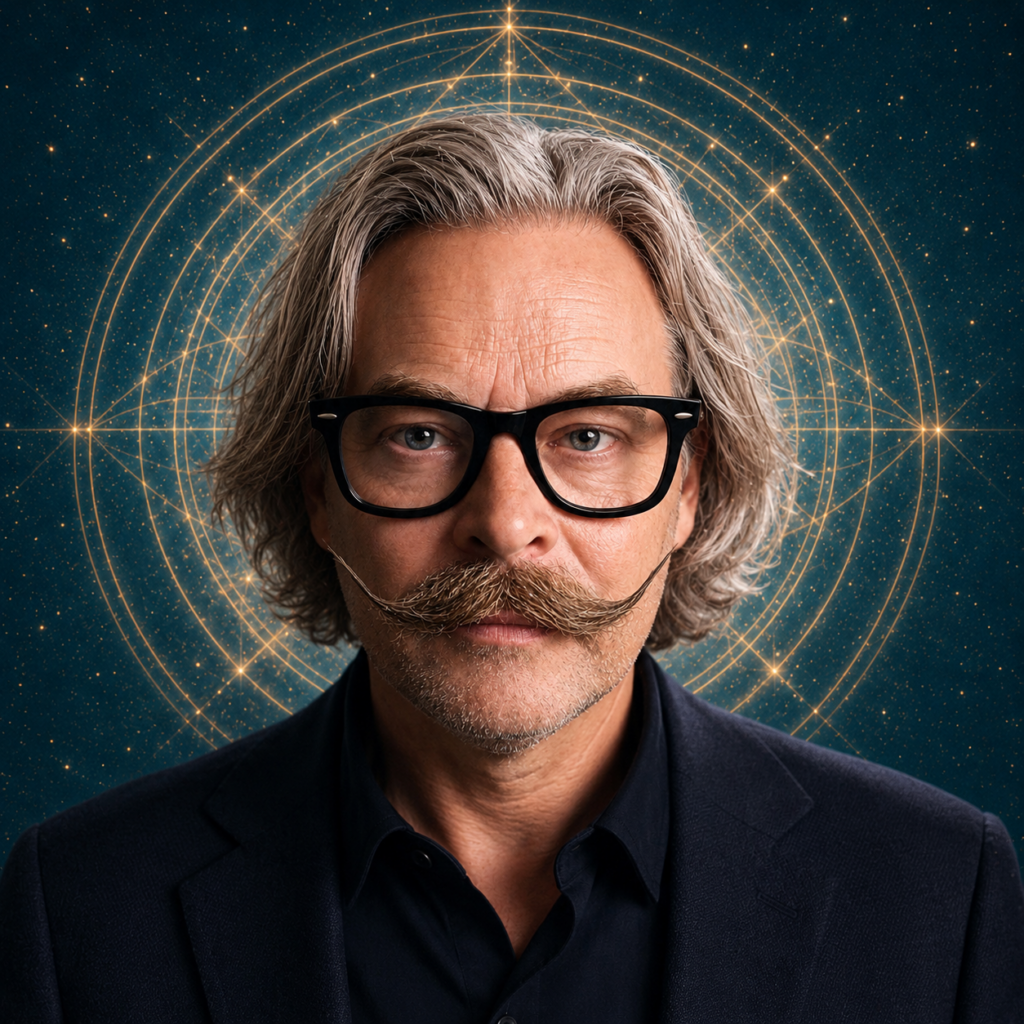
A witness who became an interpreter
Richard Monck is a British Fortean writer, researcher and first-person UAP experiencer whose work brings together anomalous testimony, consciousness studies, folklore, esotericism and popular culture. His relevance to the contemporary UAP field does not rest on a government position, scientific appointment or single evidentially conclusive investigation. It rests on a particular form of synthesis: he treats unusual human experiences as serious material for inquiry while resisting pressure to convert them immediately into proof of extraterrestrial visitation, spiritual revelation or psychological error.
By October 2026, Monck’s documented public roles included contributing to UAPedia, helping to organise UAPCon, publishing the essay series Cartography of Weird, appearing on experiencer panels and podcasts, and participating in camera and field work connected with Fortean investigations. His media material describes him as a writer and researcher who connects lived encounters with folklore, consciousness, popular culture and the Western esoteric tradition while keeping their interpretation open.
The public record reviewed for this biography does not establish a conventional academic career or formal programme of scientific research. Monck’s authority is instead experiential, literary and synthetic. He is best understood as a witness who became an interpreter, concerned not only with what an unusual object might have been, but with what an unresolved encounter does to the person who reports it.
That emphasis places him within a current of UAP thought associated with Jacques Vallée, John Keel, Patrick Harpur, Joshua Cutchin and Jeffrey J. Kripal. Monck did not originate their principal frameworks. His contribution lies in adapting them into a personal method that combines autobiography, cultural criticism, field observation, humour and sustained attention to uncertainty.
Billingham, Nicolas and the instability of memory
Monck places his early childhood in Billingham, Teesside, around 1970. In his published account, an unseen companion named Nicolas had become a regular feature of family life by the time Monck was three. His parents sometimes laid an additional place at the dinner table, and one remembered incident involved Monck becoming distressed when a passenger occupied the apparently empty bus seat in which he believed Nicolas was sitting.
Monck also recalls that his maternal grandmother, whom he called Nana, greeted Nicolas during his visits with the same matter-of-fact courtesy she extended to other members of the family. Nicolas disappeared from the story when Monck was approximately four. These memories are recounted in his UAPedia essay, The Cartography of High Strangeness.
This material belongs to retrospective family history rather than independently verifiable evidence. It establishes what Monck remembers and what he reports being told about his early childhood. It does not establish whether Nicolas was imaginative play, an unusual perception, a reconstructed family narrative or an encounter with an externally existing presence.
The distinction is central to Monck’s later work. He does not present Nicolas as a demonstrated entity. Instead, he treats the experience as an early example of a recurring ambiguity in which something may feel entirely real to the experiencer while remaining unavailable to everyone else. That tension between private certainty and absent corroboration subsequently became one of the organising problems of his writing.
Only in adulthood did Monck place Nicolas alongside his later UAP sighting and near-death-like episode. This retrospective construction produced the idea of a personal curriculum of high strangeness. It is an interpretive model rather than an established causal sequence, and Monck’s essays acknowledge that much of the meaning arrived long after the original events.
The disc behind the cloud
The defining UAP event in Monck’s account occurred in spring 1980, when he was approximately nine and a half and attending Fatfield School in Washington, Tyne and Wear. He remembers looking upwards and seeing a grey-metallic, disc-shaped object partly concealed by a cloud.
His later description includes a domed upper section, a ring of porthole-like features, a skirted lower hull and three spherical protrusions beneath it. The cloud appeared to obscure part of the object, giving Monck the impression that it possessed depth and occupied physical space.
Monck recalls trying to direct another pupil’s attention towards the object. In his account, the pupil said that she could not see what he was describing. He has written that this response affected him at least as profoundly as the sighting because it raised an immediate question about whether his own observation could be trusted. The experience remained largely unspoken for many years.
No photograph, instrumental record, contemporaneous written report or independently produced witness statement is presented in the public sources reviewed for this biography. The event therefore remains a detailed retrospective testimony. Its persistence and influence on Monck’s later intellectual development are documented, but its external cause remains unresolved.
Several interpretations remain possible. Monck may have observed an externally existing structured object that the other pupil failed to notice. Perception, memory and later cultural knowledge may have shaped the description. The discrepancy between the two children’s reported observations could also reflect differences in attention, position or interpretation. The available record does not permit a decisive choice among these possibilities.
The sighting eventually became the anchor of Monck’s public identity as an experiencer, but it did not lead him to a fixed explanation of UAP. Its continuing force lies partly in the tension among the apparently physical appearance of the object, the absence of shared observation and the later growth of a wider autobiographical pattern.
General’s Wood and the Row Pit history
During later research into the area, Monck associated the direction of his sighting with General’s Wood and land formerly occupied by Harraton Colliery’s Row Pit. Historical records confirm that a major explosion occurred at Row Pit on 30 June 1817, killing 38 men and boys.
The Durham Mining Museum, the Northern Mine Research Society and the Tyne & Wear Historic Environment Record all identify the Row Pit site and the 1817 disaster. The historical record also distinguishes this event from the separate Nova Scotia Pit incident of 2 July 1817, in which eight people died from choke damp.
The mining disaster is an independently documented historical fact. A connection between that tragedy and Monck’s 1980 sighting is not. Monck’s juxtaposition of the two belongs to his interpretation of place, memory and historical trauma. It reflects an interest in whether locations can acquire symbolic or experiential significance, but it does not demonstrate that the UAP event was caused, attracted or shaped by the history beneath the landscape.
This distinction matters because the emotional force of a historical discovery can easily be mistaken for evidence of causation. Monck’s writing is strongest when it preserves the resonance without upgrading it into proof. In his account, the Row Pit history changes the meaning of the landscape. It does not identify the object.
An unconventional intellectual education
The public sources reviewed for this biography contain little information about Monck’s formal education or career outside his work on anomalous subjects. His documented intellectual formation was largely self-directed and unfolded through counterculture, religion, music, altered states and esoteric study.
At fourteen, Monck recalls being given a television recording of Woodstock by his mother. During his later teens and twenties he studied ceremonial magic, including the work of Aleister Crowley and later practitioners. The rave movement and psychedelic experience supplied another form of boundary testing, while a brief period of charismatic Christianity coincided with the Toronto Blessing reaching churches near Sunderland.
Monck later interpreted these apparently separate engagements as different attempts to approach the same question: whether particular disciplines, rituals or altered states can make the perceived boundary between ordinary and extraordinary experience more permeable. This development is described most fully in his essay The Spiral, Not the Circle.
William S. Burroughs, Brion Gysin and Robert Anton Wilson supplied models of reality as editable, unstable and partly constructed through language and expectation. Monck has described them not as casual literary interests but as orientation points. He also corresponded with countercultural writer Brian Barritt, whose work connected psychedelic culture, occult thought and alternative models of consciousness.
The later arrival of Vallée, Cutchin and Kripal gave Monck a vocabulary for integrating his own experiences. Vallée’s comparative work suggested that UAP encounters should not be reduced to visits by machines from another planet. Cutchin’s writing connected childhood companions, anomalous encounters, folklore and near-death experiences. Kripal’s scholarship treated extraordinary events and the consciousness perceiving them as difficult to separate completely.
Harpur and Keel added further layers. Harpur’s daimonic model offered a way of discussing figures that appear to occupy the boundary between subjective and objective reality. Keel’s work encouraged attention to clusters of high-strangeness events, unstable presentation and the transformative consequences of encounters.
Monck adopted these ideas as interpretive tools rather than established explanations. His synthesis remains indebted to earlier writers, but its autobiographical structure, cultural range and British Fortean humour give it a recognisable voice of its own.
The loving dark of 2012
A second pivotal event occurred in 2012. Monck reports that he was under the influence of LSD while watching the film Gentlemen Broncos when he began laughing and choking on a Jaffa Cake. A friend noticed that he had turned blue and intervened.
Monck remembers entering a condition of darkness that felt peaceful, warm and complete rather than empty or frightening. He later referred to it as a loving dark or loving nothingness and compared it with descriptions of the Pleroma in Gnostic thought.
Monck has described the episode as near-death-like and, at times, as reaching the threshold of a near-death experience without developing into the familiar sequence of tunnel, light or encounter. The public record does not include clinical observations, medical measurements or a precise duration. Choking, probable oxygen deprivation and psychedelic intoxication were all present, making it impossible to isolate a single cause from the available testimony.
The importance of the event lies in its reported aftermath. Monck describes a gradual movement from vegetarianism towards veganism and a change in how he understood his obligations towards other living beings. He did not emerge with a detailed doctrine or claim of privileged knowledge. Instead, he interpreted the experience primarily through its ethical effect.
The 2012 episode became an inward counterpart to the apparently outward 1980 sighting. One was object-like and visually structured; the other was formless and interior. Monck’s later work asks whether these experiences belong to separate categories or whether they might represent different expressions of a deeper process involving consciousness, perception and crisis.
In the first-party essay The Same Waiting Room, Monck extends this comparison to DMT experiences and contact narratives. He places accounts recorded in psychedelic research beside descriptions from modern encounter literature and asks whether they display a shared experiential architecture.
Monck does not treat resemblance as proof that the experiences have one cause. His argument is framed as a comparative hypothesis, with neurochemical, psychological, cultural and potentially external factors all remaining open. The essay is therefore most useful as a proposal for further investigation rather than a settled explanatory model.
From private inquiry to field participation
For much of Monck’s life, his investigation appears to have remained personal and largely private. The visible public phase began much more recently and included participation in fieldwork beyond the immediate UAP subject.
A Centre for Fortean Zoology report documents Monck’s involvement in a study day at Maidencombe, Devon, on 30 June 2024. The activity concerned reports of unusually large footprints near woodland on the coast path. The report names Monck among those who explored the area, installed trail cameras and used electromagnetic-field meters and compasses while looking for anomalies.
The activity is documented in Man Beasts (BHM), published in Animals & Men, issue 76, pages 30 to 35. The report establishes that field activity occurred and that particular instruments were deployed. It does not establish that an unknown animal produced the original impressions.
Indeed, the published discussion records a possible ordinary explanation involving a footprint elongated by sliding in mud. Participation in the investigation therefore does not imply endorsement of every claim surrounding it. The episode is valuable because it demonstrates Monck’s willingness to join practical field investigations while preserving uncertainty about the result.
Monck also worked on the Dartmoor instalments of the independent production Summit View Studios: Legend Seekers. UAPCon’s promotional biography describes him as Director of Photography, while IMDbPro records a cameraman credit. Preserving both descriptions is more accurate than silently selecting the more elevated title.
His media material additionally recounts an investigation involving a group that claimed telepathic contact with beings called the Xanue and used a home-built device described as a portal. That account is presently documented through Monck’s own media presentation and interviews rather than independent experimental records.
Its biographical relevance lies in his willingness to enter unusual belief environments and examine their social dynamics, language, humour and ritual behaviour without automatically accepting their explanatory claims. This is closer to participant observation than laboratory research. It can preserve context and interpersonal detail that disappear from purely evidential summaries, but it cannot substitute for controlled conditions, independent replication or documented chain of custody.
Monck’s field identity is therefore most accurately described as Fortean and observational rather than experimental. He is concerned with what people report, how they construct meaning, and how an investigator can remain present without either dismissing or absorbing the belief system under examination.
Cartography of Weird
Monck’s principal independent writing project, Cartography of Weird, emerged publicly in 2026. On 30 August he described the project in 35 Doors as having produced 35 essays in five months.
The series ranges across UAP testimony, near-death experiences, psychedelics, ritual, folklore, artificial intelligence, religion, media, disclosure narratives and the economics of anomalous culture. Its breadth reflects Monck’s conviction that categories conventionally used to separate these subjects may obscure meaningful continuities.
The title expresses his preferred method. A cartography does not claim to own or fully explain the territory. It marks routes, concentrations, uncertainties and areas in which ordinary categories seem inadequate. Monck’s recurring images of maps, spirals, doors, masks, thresholds and waiting rooms allow him to compare experiences without insisting that they share a proven cause.
In The Spiral, Not the Circle, he argues that a life shaped by anomalous experience does not proceed towards a single explanatory resolution. It repeatedly returns to similar questions from altered positions. Nicolas, the Fatfield sighting and the 2012 episode become points on a spiral whose meaning changes as new reading and experience accumulate.
A related concept is the hidden curriculum of high strangeness. Monck proposes that recurring encounters may educate the experiencer, not by transmitting a clear doctrine, but by changing attention, ethics, identity and tolerance for ambiguity. This is the researcher’s opinion. It may describe a genuine process of psychological and cultural integration, but it does not demonstrate that an external intelligence designed or delivered the sequence.
His more speculative writing develops an interface hypothesis. In this model, forms reported during encounters may function as translations or masks constructed at the boundary between an unknown phenomenon and human perception. Familiar entity types would not necessarily represent literal anatomy. They might instead be culturally and psychologically legible presentations, shaped in part by the witnessing consciousness.
The idea is developed through essays including The Oldest Joke. It draws on earlier work by Vallée, Keel, Harpur, Jung and others. Monck’s contribution is not the invention of the idea that anomalous phenomena interact with cultural expectation. It is his attempt to place the witnessing consciousness inside the mechanism of presentation.
The model is conceptually productive, but its flexibility is also a limitation. A theory able to interpret almost any reported form as an interface may struggle to make precise predictions capable of disproving it. Monck’s writing is therefore strongest when the interface remains a question rather than a universal answer.
UAPedia, UAPCon and public conversation
Monck’s association with UAPedia gave his autobiographical and theoretical work an editorial home. UAPedia published The Cartography of High Strangeness as an experiencer narrative and identifies him as a writer and researcher working across UAP, Forteana and consciousness.
The platform’s editorial standard is particularly relevant to his work because it treats credible testimony as evidentiary input while requiring witness interpretation to remain distinct from independently verifiable fact. The current operative standard is UAPedia Editorial Standards: Navigating the Mystery, version 1.3, last updated on 12 August 2026.
At UAPCon 2 on 3 May 2026, Monck joined Holly Anne Wood and Meredith Spearman for the panel The Experiencer Dimension: Meaning and Conclusions. The programme framed the discussion around the effects of unusual encounters on perception, identity, meaning and worldview. It also emphasised the boundary between observation and interpretation, a distinction that closely matches Monck’s own approach.
A subsequent New Realities programme on 16 May 2026 presented the UAPedia-sponsored UAPCon discussion to a wider audience. The BBS Radio programme page identifies Meredith Spearman, Holly Anne Wood and Richard Monck as participants.
Monck also appeared on episode 363 of Tommy Cullum’s Let’s Get Freaky, published on 23 March 2026, and episode 391 of Pursuit of the Paranormal, published on 13 October 2026. These conversations covered his childhood sighting, the 2012 episode, consciousness, folklore and his developing model of high strangeness.
His media kit records a further ALIEN8UK appearance on 19 October 2026 and identifies him as both a UAPedia contributor and UAPCon organiser. It also records additional media conversations and an appearance awaiting publication as of 20 October 2026. These details originate partly in Monck’s own professional material and should be understood as first-party information where no independent programme record is available.
Monck’s print record remains modest but has begun to extend beyond his own platforms. FATE Magazine’s public contents page confirms that issue 743 included Blake Collier’s article Experiencers React to Disclosure Day. Monck’s media kit states that his quoted contribution appears on pages 89 and 90, where he comments on the contrast between cinematic resolution and the unresolved effects of anomalous experience.
The FATE Magazine contents page confirms the article and author. The narrower page-level attribution presently rests on Monck’s media kit rather than the publicly accessible publisher page.
Method, contribution and limits
Monck’s distinctive contribution is methodological rather than evidentially conclusive. He begins with the fact that a person reports an experience, separates that fact from the meaning later assigned to it, and then examines how memory, folklore, landscape, media and altered states shape the account’s continuing life.
The result is less a physical theory of UAP than an account of their epistemic and transformative aftermath. This method gives unusual experiences room to be described without requiring immediate belief or dismissal. It also allows Monck to preserve contradiction.
The object may have appeared physical, yet another person reportedly did not see it. The 2012 experience may have carried spiritual meaning, yet it occurred during choking and psychedelic intoxication. A historical site may resonate powerfully with a later encounter without proving a causal relationship.
That posture follows UAPedia’s commitment to distinguish evidence from interpretation, accept testimony as data and maintain confidence only where warranted. Biographical articles are exempt from the site’s mandatory Claims Taxonomy and formal Speculation Labels, although careful epistemic framing remains appropriate.
The method’s principal risk is pattern inflation. Human lives contain coincidences, repeated symbols, cultural influences and emotionally charged memories. Selecting particular events and arranging them into a spiral can create meaningful coherence without establishing that the events were externally connected.
Retrospective testimony is also vulnerable to reconstruction, while psychedelic and crisis experiences introduce further interpretive variables. Monck often acknowledges these difficulties, but acknowledgement does not eliminate them.
The public sources used for this biography consist mainly of first-person essays, interviews, event programmes, press material, production credits and reports of field participation. They do not form a peer-reviewed scientific research programme or an independently instrumented investigation of the 1980 sighting.
His authority should therefore be understood accurately. It is experiential, literary and comparative. His work can preserve testimony, expose neglected questions, illuminate the culture surrounding UAP and offer models for understanding personal transformation. It does not independently demonstrate the origin, mechanism or intelligence behind anomalous phenomena.
An emerging and provisional legacy
As of 22 October 2026, Monck’s public legacy remains in formation. His main body of published writing is recent, and his influence is presently demonstrated through essays, event organisation, interviews, collaborative work and participation in Fortean investigations rather than through academic citation or a long-established archival programme.
Claims that he has transformed the wider field would therefore be premature. What he has demonstrably contributed is a coherent first-person model of intellectual development after anomalous experience. His writing shows how a childhood sighting can remain active across decades without producing certainty, and how later reading, altered states and fieldwork can repeatedly reorganise its meaning.
He also represents a strand of contemporary UAP inquiry that treats consciousness, folklore and cultural context as necessary parts of the record. This does not require abandoning physical evidence. It requires recognising that an encounter has more than one evidential layer: the reported event, the witness’s perception, the interpretation imposed upon it and the consequences that follow.
Monck’s central metaphor offers a useful standard for judging the work. A map can preserve routes taken by witnesses, show where accounts cluster and identify places where the ground disappears beneath speculation. It need not pretend that every symbol marks an independently verified territory.
His work offers no final verdict on Nicolas, the disc behind the cloud or the loving darkness of 2012. Its value lies in documenting how those experiences were remembered, connected and turned into questions. For Monck, the mystery is not simply an object waiting to be named. It is a continuing encounter between event, witness and interpretation.
References
Centre for Fortean Zoology. (2024). Man Beasts (BHM). Animals & Men, 77, 30–36. https://cdnc.heyzine.com/files/uploaded/f9e0fe79928705357a0ed5b147dd318730efb941.pdf
Durham Mining Museum. (n.d.). Colliery disaster 1817: Harraton, Row Pit. https://w.dmm.org.uk/names/n1817-01.htm
FATE Magazine. (2026, September 11). FATE Magazine issue #743 is here! https://www.fatemag.com/post/fate-magazine-issue-743-where-is-it-1
IMDbPro. (2025). Legend Seekers: Full cast and crew. https://pro.imdb.com/title/tt37513593/
Monck, R. (2026). The Cartography of High Strangeness. UAPedia. https://uapedia.ai/wiki/the-cartography-of-high-strangeness/
Monck, R. (2026, June 3). The Oldest Joke: What the Trickster knows about the phenomenon. Cartography of Weird. https://cartographyofweird.substack.com/p/the-oldest-joke
Monck, R. (2026, August 30). 35 Doors: A Cut-Up. Cartography of Weird. https://cartographyofweird.substack.com/p/35-doors
Monck, R. (2026, September 13). The Spiral, Not the Circle: Notes toward a personal cartography of the Hero’s Journey. Cartography of Weird. https://cartographyofweird.substack.com/p/the-spiral-not-the-circle
Monck, R. (2026, September 28). The Same Waiting Room: On Rick Strassman, Whitley Strieber, and a possible shared architecture of contact. Cartography of Weird. https://cartographyofweird.substack.com/p/the-same-waiting-room
Monck, R. (2026, October 20). Richard Monck media kit [Press kit].
New Realities with Alan Steinfeld. (2026, May 16). New Realities, May 16, 2026 [Podcast episode]. https://bbsradio.com/podcast/new-realities-may-16-2026
Northern Mine Research Society. (n.d.). Harraton Colliery Row Pit explosion, Harraton, 1817. https://nmrs.org.uk/mines-map/accidents-disasters/durham/harraton-colliery-row-pit-explosion-harraton-1817/
Pursuit of the Paranormal. (2026, October 13). The Cartography of High Strangeness: UAP, consciousness and the paranormal, Richard Monck [Podcast episode]. https://pursuitoftheparanormal.co.uk/episode/the-cartography-of-high-strangeness-ufos-consciousness-the-paranormal-richard-monck/
Tommy Cullum’s Let’s Get Freaky. (2026, March 23). Episode 363 featuring Richard Monck [Podcast episode]. https://goodpods.com/podcasts/tommy-cullums-lets-get-freaky-222678/connecting-the-dots-richard-monck-on-ufos-ndes-cryptids-and-high-stran-108621390
Tyne & Wear Historic Environment Record. (n.d.). HER 3024: Harraton Colliery, Row Pit. https://twsitelines.info/SMR/3024
UAPCon. (2026, May 3). UAPCon 2: UAP, consciousness and human experience. https://uapcon.com/
UAPedia. (2026, August 12). UAPedia editorial standards: Navigating the mystery (Version 1.3). https://uapedia.ai/wiki/uapedia-editorial-standard-navigating-the-mystery/
SEO keywords
Richard Monck, UAP experiencer, UAP researcher, Fortean writer, UAPedia, UAPCon, Cartography of Weird, high strangeness, consciousness and UAP, Fatfield School UAP sighting, Washington Tyne and Wear UAP, near-death experience and UAP, folklore and UAP, experiencer testimony, British UAP research, anomalous phenomena, Centre for Fortean Zoology, General’s Wood, Harraton Row Pit, DMT and UAP, interface hypothesis.