
From sacred spheres and wartime lights to instrumented hotspots, government videos, and encounters that feel personal, the orbs ask a harder question than what they are: when do lights become a presence?
By Eduardo Mace
I write about orbs from an uncomfortable but necessary position. I am not only an editor examining a category of UAP reports. I am a serial experiencer. I have encountered and documented multiple orbs, one of them at less than an arm’s length.
At that distance, an orb is no longer a category on a screen. It occupies a larger portion of the world. My testimony does not make me an authority on every light in the sky, and it does not turn every circular photograph into evidence. It does establish why I refuse to let a camera artifact become a universal answer. A camera can create an image. It cannot retroactively create the directly observed event that led a witness to raise the camera.
So let me begin with two conclusions that belong together: orbs are almost certainly not just one thing, and a genuine mystery remains after ordinary explanations are removed.
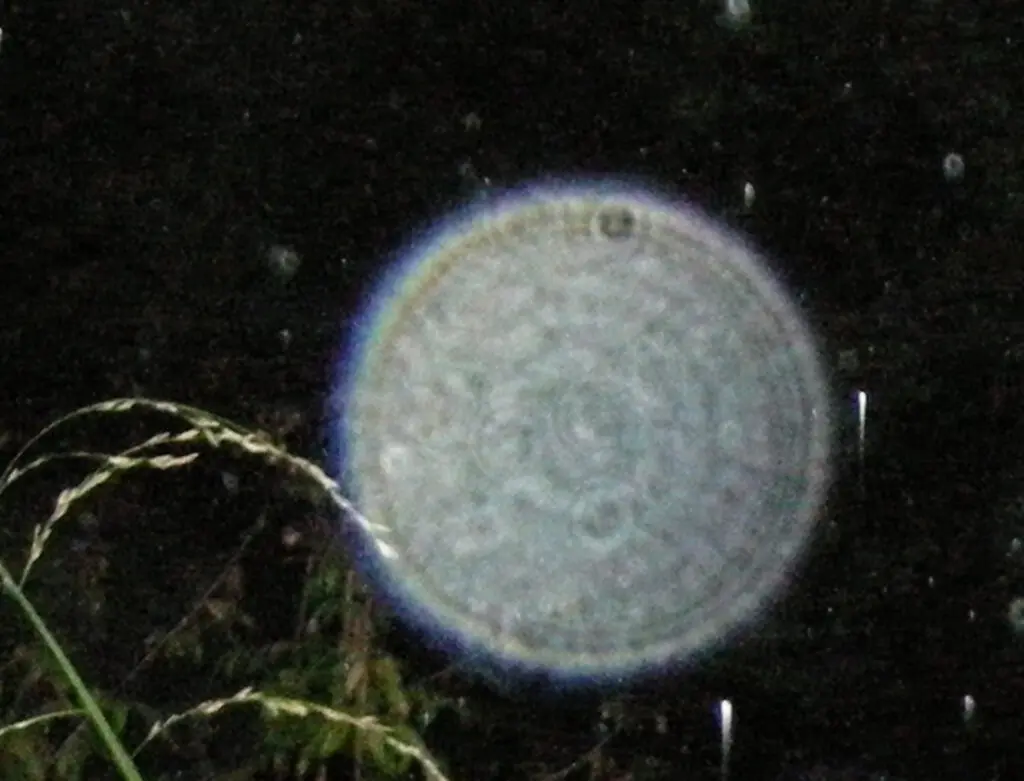
It is my interpretation that these Orb manifestations, whatever they are, are also our greatest chance to begin to understand and reconcile some common-ground knowledge of UAP. It might not be the entire phenomenon, but as we shall see, it can be captured repeatedly and interacted with, which would allow us the necessary opportunity for learning. Maybe this is a way to start the study of some of the non-human intelligence behind the phenomenon.
Let’s start with what the term means to us: “Orb” is a description of appearance. It is not an ontology. A circle in a flash photograph, a distant satellite flare, a rare electrical phenomenon, a metallic sphere on an infrared display, and a luminous presence that seems to respond to a witness may all be called an orb. Similar appearance does not establish a common cause. Yet plural causes do not mean the entire subject is unreal. Proving that dust causes one class of orb does not explain a luminous sphere seen directly at close range, shared by multiple witnesses, recorded continuously on video, or registered across independent sensors.
Two opposite errors have trapped the subject for decades. One side treats every circular image as a spirit or craft. The other explains a camera artifact and assumes the entire category has vanished. Both confuse a label with a solution. The serious path is more demanding and more exciting: remove the artifacts, identify the ordinary lights, preserve the residual cases, and improve the experiments until the categories separate themselves.
Four histories hiding inside one word
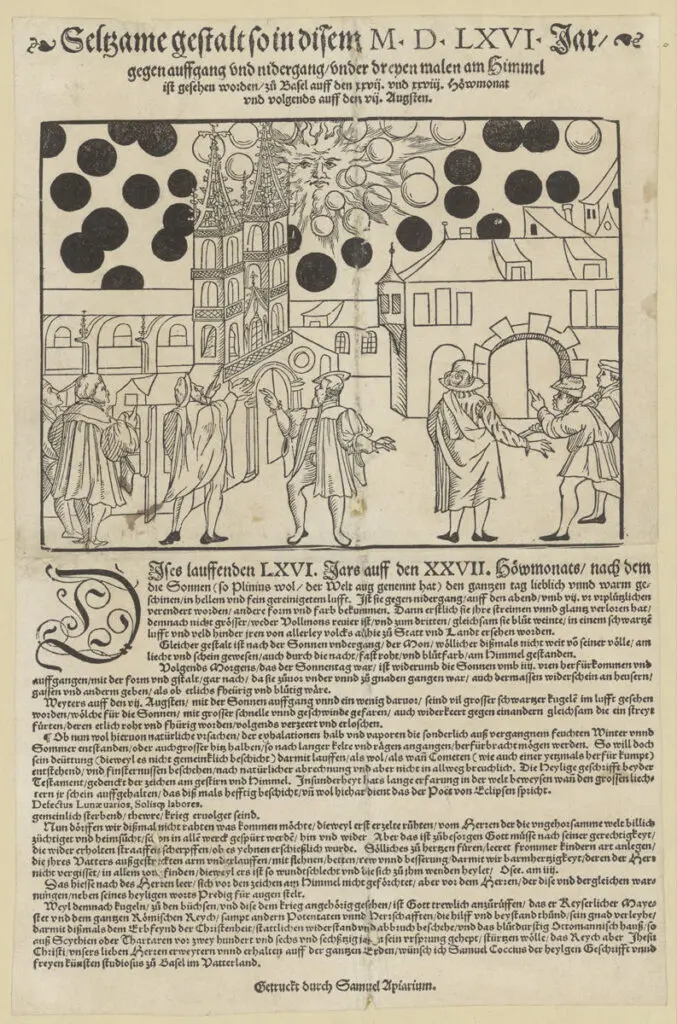
The English word orb is ancient. Long before digital cameras, it meant a sphere, celestial body, eye, or emblem of power. Anomalous-orb history is harder to date because older witnesses used terms such as globe, ball, star, fire, sun, and light. Calling a sixteenth-century woodcut an “orb sighting” may identify a pattern, or merely translate an old report into modern language.
Consider the broadsheets from Nuremberg in 1561 and Basel in 1566. The surviving, catalogued prints describe or depict balls, rods, crosses, crescents, and, in Basel, black spheres. They also belong to a print culture that interpreted unusual skies as moral and religious signs. The woodcuts are not photographs, and their creators were not necessarily direct witnesses. UAPedia’s detailed treatment treats the documents as verified and the cause as disputed.
In 1808, Swedish naturalist Erik Acharius investigated reports from Biskopsberga of a dimmed red Sun and enormous numbers of “balls, or spherical bodies” moving for more than two hours. Some reportedly slowed, linked in chains, or descended, with one witness describing a delicate iridescent film that vanished. Acharius compared accounts and proposed windborne vegetable material while admitting what it did not explain. That balance feels strikingly modern. See Sweden’s Sun-Spheres Report.
Religious history supplies a different lineage. Edward Healy Thompson’s 1873 biography of the Catholic mystic Anna Maria Taigi describes her reported vision of a “luminous orb, or sun” over many years. It functioned in the story as an instrument of spiritual sight, not as an aerial vehicle. This example alone disproves the claim that Edgar Cayce or J. Z. Knight was the first person to mention a paranormal orb in a book.
Cayce’s relevant material is earlier than Knight’s, but it still does not establish priority. A 1933 Cayce reading interprets another person’s vision of a bright sphere in terms of inner enlightenment. It was a reading transcript, not originally a book passage, and it was not a discussion of modern photographic orbs. Knight’s clearest dated material about photographing orbs appears in a Ramtha workshop held on March 21, 2003. The revised 2004 edition of Ramtha: The White Book includes “orbs” in its index, although Steenhuisen-Siemonsma found that the indexed passages themselves describe glimmering or brilliant lights rather than using the term. Claims that the teaching began in the early 1980s remain retrospective and unverified.
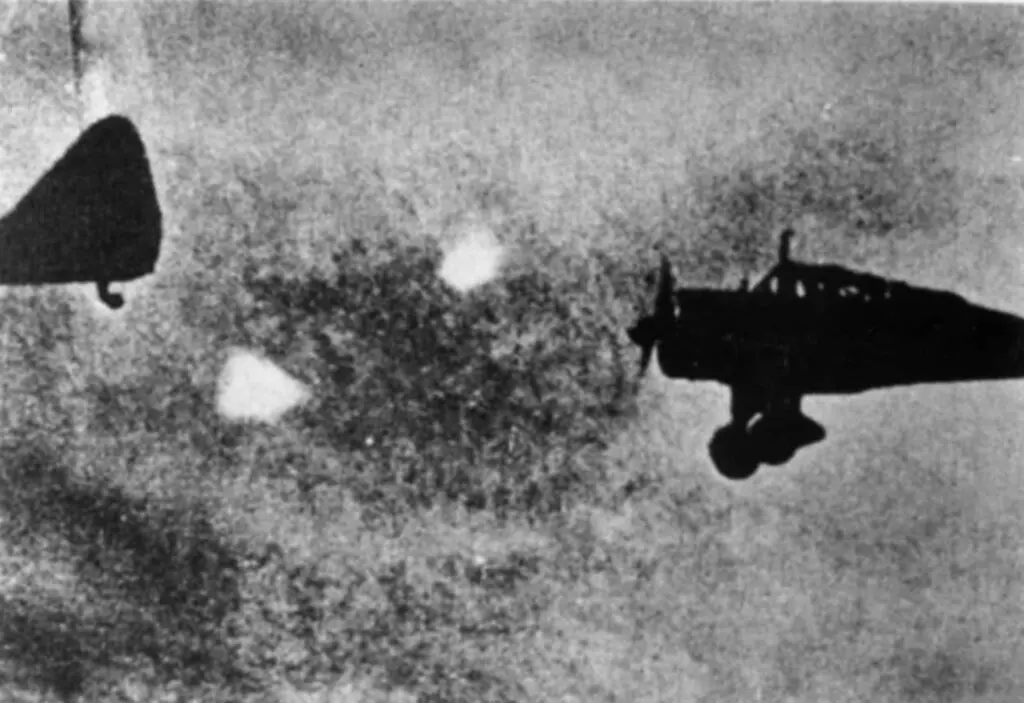
The modern UAP lineage developed in parallel. Jacques Vallée wrote of luminous balls and spheres in Anatomy of a Phenomenon in 1965. Wartime aircrews had already reported lights that paced aircraft, later remembered under the nickname “foo fighters.” The historical records vary enormously in quality, but the recurring motif is older than the word’s present fashion: a compact light that hovers, follows, approaches, retreats, or appears to observe. UAPedia examines that thread in From WWII Foo Fighters to Vietnam War Spheres, although any claim of systematic surveillance should remain a hypothesis rather than a settled conclusion.
Then came the digital camera. Near-lens dust, droplets, fibers, and insects could return the flash as soft, patterned discs that felt charged with meaning when they appeared over a grave, sacred site, family gathering, or reportedly haunted room.
The modern paranormal-photography use of orb appears to have spread in the 1990s. Dave Oester later claimed he coined it in 1994, but the attribution is disputed. British investigators initially called similar forms “lightballs” in 1998. Linda Moulton Howe used “light orbs” in Mysterious Lights and Crop Circles in 2000. Hall and Pickering’s Beyond Photography appeared in 2006, followed by Heinemann and Ledwith’s influential The Orb Project in 2007. The publisher states that Ledwith encountered the idea through Ramtha’s teachings, which helps explain why Knight is sometimes credited with origin even though the dated record does not support that claim.
The photographic boom did something culturally important. It placed an apparent mystery in millions of ordinary hands. But it also fused two categories that should never have been merged: orbs discovered only after a photograph was taken, and luminous objects consciously observed in the environment.
The camera explained many orbs and it also opened a window
The evidence for ordinary photographic orbs is strong. Optical experiments have repeatedly produced them with airborne particles, droplets, insects, defocus, and flash geometry. Schwartz and Creath demonstrated conventional mechanisms in controlled photography. Dave Wood systematically tested flash operation, depth of field, and flash-to-lens geometry. Steven Parsons used a stereo digital camera with two lenses and synchronized exposures. The orb forms appeared on only one side, as near-lens particles should. Steenhuisen-Siemonsma’s review describes thousands of such stereo pairs and no corresponding distant orb.
This is not a hostile finding. It is the first filter. Every reliable explanation removes noise and protects the cases that deserve closer study. Bright point sources enlarged by digital zoom can become pulsing discs. Autofocus can make a planet appear to breathe. Stabilization can make a stationary source wander. Insects can become rods or streaks at slow shutter speeds, especially under infrared illumination. Near-lens particles can glow in an active night-vision system.
But this familiar account has too often swallowed the history of the affirmative photographic research, especially the work of experimental physicist Klaus Heinemann and theologian Míceál Ledwith in The Orb Project.
Their starting point was technically important. Silicon CCD sensors retain some response beyond the range of human vision into the near-infrared, beginning around 700 nanometers. A hot-mirror, also called an IR-cut filter, suppresses that response, but the strength and design of the filter varied among early cameras, and some night-vision systems allowed it to be moved aside. Heinemann worked principally with a 3.34-megapixel Pentax Optio 330 and an 8-megapixel Nikon Coolpix 8800, both CCD cameras. The authors even recommended checking a camera’s infrared sensitivity with a television remote. A camera could therefore record incoming radiation that the photographer did not consciously see. That fact does not prove an invisible entity. It does make “I did not see it with my eyes” an insufficient reason to say that nothing reached the sensor.
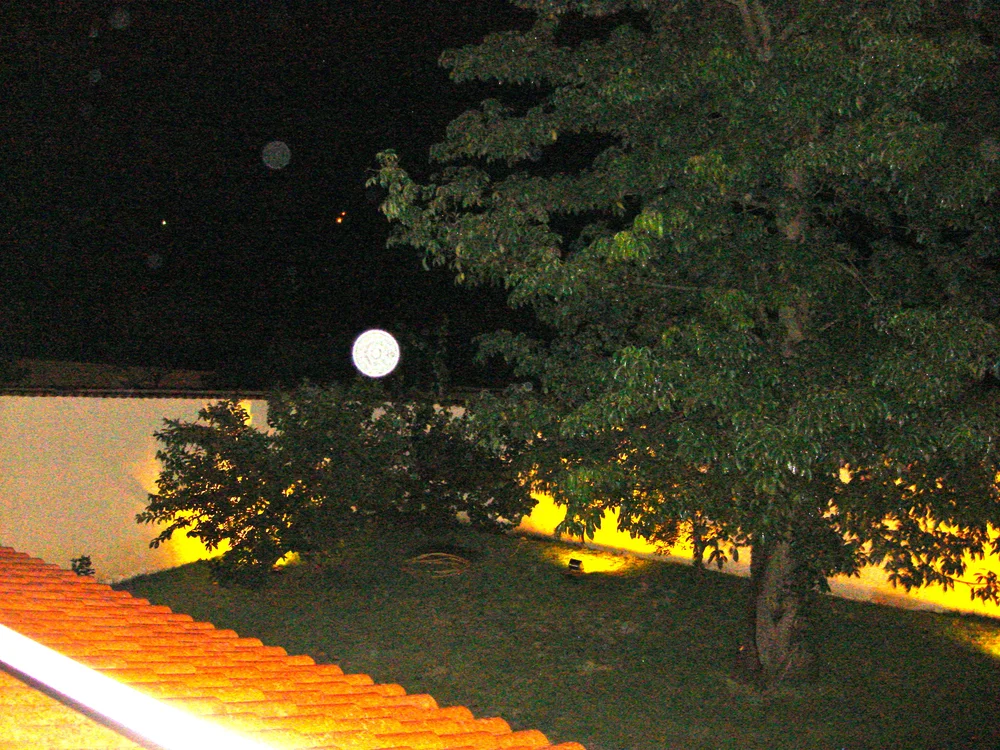
Heinemann and Ledwith did more than publish a stray disc from a single flash photograph. Ledwith reported taking roughly 100,000 photographs over five or six years beginning in 2002, from which 58 were selected for the book. Heinemann stated that, apart from identified exceptions, the evidence section used photographs he took or events he personally witnessed. The published plates include single and multiple forms that the photographers said were not visible at the moment of exposure. They explicitly considered dust, pollen, moisture, lens contamination, flare, bokeh, straps, and shutter effects, and Heinemann acknowledged possible ordinary causes in some of his own images.
The reported tests included rapid sequences, camera rotation, different camera models, reversing camera and flash roles, apparent partial occlusion by foreground objects, and paired cameras exposed by a common flash. They also presented images from other photographers as corroborating material. Whether one accepts their spiritual interpretation or not, this was an attempt to construct an experimental problem, not simply a gallery of belief.
The skeptical objections still matter. The paired cameras were not identical, and a particle inside the small “orb zone” of one lens is expected to appear in one side-by-side camera but not the other. That result alone does not demonstrate selective intelligence. Infrared sensitivity also makes cameras more responsive to insects and reflective particles. Apparent occlusion can sometimes be produced by contrast, exposure, or image-processing effects. Most importantly, The Orb Project is a trade book that presents selected photographs and conclusions rather than a preregistered experiment with the full image corpus, matched controls, environmental particle counts, calibrated stereo geometry, blind classification, raw-file access, and independent replication.
Those limitations define the strength of the claim. They do not justify pretending the work never happened. The correct conclusion is not that Heinemann proved spirits, nor that a generic dust demonstration has explained every residual photograph he and Ledwith presented. It is that their selected images remain a disputed body of evidence. When ordinary interference has been reasonably tested and no explanation has been demonstrated for a particular file, the honest label is unexplained. That label preserves a question. It does not answer it.
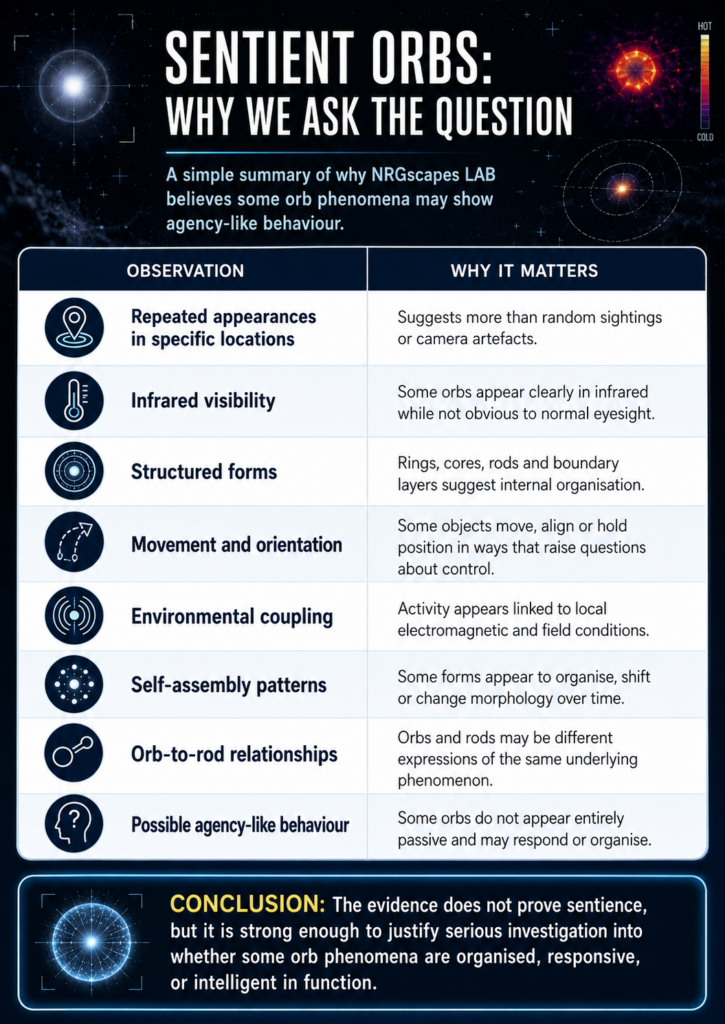
A 2024 NRGscapes Lab report belongs in the same developing conversation. Its authors recorded recurring infrared forms at Karijini National Park in Western Australia and classified them as orbs, rods, or animals. A single 30-frame-per-second camera could not establish range, physical size, extreme velocity, or nonhuman control, and the report lacks synchronized visible-light and stereo controls capable of fully excluding insects and near-lens backscatter. The imagery should be retained as exploratory data, with its stronger interpretations marked disputed. Its limits are a design brief for the next experiment, not a reason to abandon the site.
A 2022 Ukrainian astronomy preprint offers another lesson about range. Fast daytime cameras in Kyiv and Vinarivka recorded small luminous and dark transients, but extraordinary sizes and velocities were inferred from contested color and contrast assumptions. Critics challenged the pixel scale, calibration, timing, atmospheric model, unknown reflectivity, and uncertainty analysis. The detections are real as image data. Their extreme physical interpretation, and even their classification as three-dimensional spheres, is not established.
We therefore need three evidentiary lanes. The first contains camera-generated artifacts, where optics or processing creates the apparent orb. The second contains residual image detections, where controls and provenance make an ordinary artifact possible but not demonstrated. The third contains directly observed, continuously recorded, multiwitness, or multisensor luminous objects. Demonstrating the first lane does not erase the second or third. It tells us how to reach them.
When the light is actually there
The case becomes more interesting when people see the phenomenon before recording it, when multiple witnesses agree on its position and movement, or when independent instruments register related data.
Hessdalen Valley in Norway remains the most important example of a recurring luminous UAP location. Residents reported an intense wave beginning in 1981, sometimes with as many as 20 observations in a week. The 1984 field campaign logged 53 reports that investigators classified as the Hessdalen phenomenon, while also sorting out a much larger set of known lights. Some reported lights remained stationary, changed direction, flickered, or persisted long enough to be observed and photographed. Spectral and radar work over subsequent decades has encouraged plasma and combustion hypotheses, but no single explanation has closed the full record. The scientific value of Hessdalen is not that every light is exotic. It is that recurrence allows prospective measurement. See Hessdalen Valley: Norway’s Most Studied UAP Lights.
John and Gerald Tedesco have carried that prospective principle into a mobile observatory. Their published 2024 paper, Eye on the Sky, reports a ten-month overnight study on coastal Long Island using two versions of their Nightcrawler laboratory. The platform combined visible, near-infrared, short-wave infrared, and long-wave thermal imaging with horizontally and vertically oriented X-band radar, radio-frequency and electromagnetic monitoring, acoustic and ultrasonic sensors, radiation instruments, weather data, astronomy software, marine-traffic checks, and aircraft-transponder data. The team removed IR-cut filters from part of its fixed camera array, extending the same invisible-band question raised by Heinemann into a much broader instrument suite.
The Tedescos report recurring luminous spheroids, seen mainly in infrared and SWIR and sometimes in visible light, along with intermittent radar returns and electromagnetic or acoustic outliers during some observing periods. Their paper includes ordinary identifications, including an airliner and Venus, which is important evidence that the filters were actively used. It also reports tentative diameters of roughly 1.5 to 3 meters and occasions on which the objects seemed organized or interactive.
Those last claims need further work. Size estimates depend on coincident range data, and the published paper does not provide a complete, time-synchronized archive linking each camera, radar, RF, acoustic, and environmental record event by event. It does not include a full false-positive table, blinded outside analysis, or raw-data repository. We should therefore distinguish the achievement from the interpretation. The Nightcrawler program does not yet prove intelligence, transmedium travel, or a common origin for every spheroid. It does establish a serious multi-instrument residual that cannot be dismissed as mishandled flash photography.
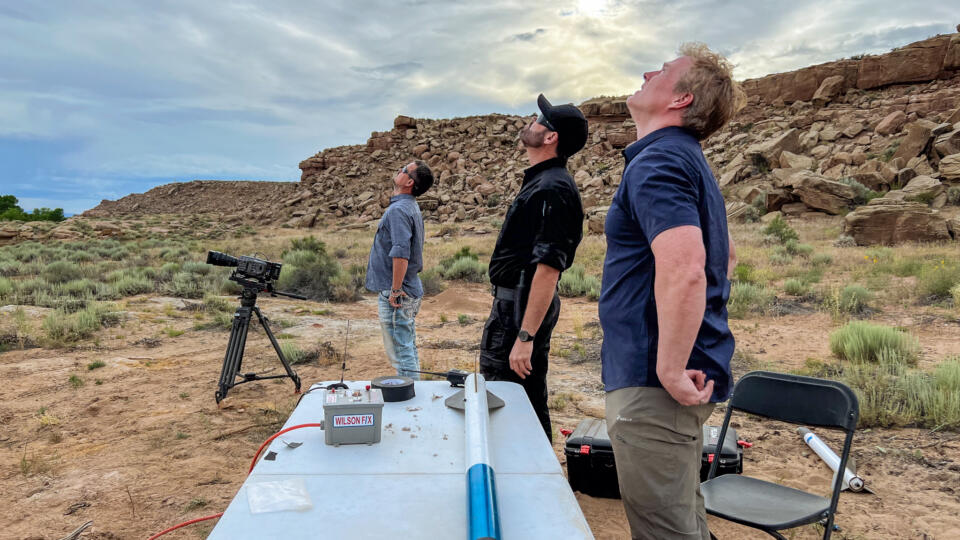
Skinwalker Ranch occupies a similar frontier, with one extra complication: much of the public evidence reaches us through television. Under owner Brandon Fugal and principal investigator Erik Bard, the ranch has operated fixed and mobile visible-light, infrared, night-vision, and thermal cameras, aircraft-transponder receivers, weather and RF monitoring, and magnetic, infrasonic, and seismic sensors. The History program has shown orb-like targets captured during planned experiments, including a helicopter-mounted GoPro sequence in which a bright light appeared to vanish at the Mesa and a similar light appeared seconds later on roughly the same plane. A separate experiment recorded an orb-like target ascending near a laser beam.
These are prospective captures at an instrumented site, not circles noticed after an uncontrolled flash photograph. That distinction matters. So do the limits. “Through the Mesa” and “responding to the laser” remain interpretations because the public record lacks native files, synchronized second viewpoints, calibrated range, and independently reanalyzable telemetry. Recent participation by established Doppler-on-Wheels radar researchers Joshua Wurman and Karen Kosiba is encouraging because it brings mature mobile-radar expertise into the investigation. Publicly released material has not yet established a synchronized radar-optical lock on an orb. Skinwalker should be treated as a rich field-research lead whose next decisive contribution will be open data and independent replication, not as either a punchline or a proven portal.
Modern government data add scale but not automatic certainty. In its FY2025 consolidated report, AARO states that among reports containing usable visual descriptions, spheroidal objects accounted for 40 percent and lights for 33 percent. Those categories overlap in ordinary conversation but are separate in AARO’s chart. More importantly, shape is not evidence of anomaly.
The 2026 PURSUE releases contain a linked northeastern series spanning four years. “Triangle Orbs”, recorded in November 2021, began as one bright light and appeared to resolve into several lights rotating relative to one another. “Red Orb Rotation”, from March 2022, shows two red luminous sources reported to have hovered while the lower one slowly changed position around the upper. In each file, the FBI assessed the reporter as highly credible.
The most sustained recording in that regional series is “Orbs Over the Pond”. In October 2024, a witness reported a plasma-like sphere hovering above a pond for roughly 45 minutes, intermittently changing shape and luminosity and at times appearing to separate into smaller points. A lower luminous point hovered near the water and, in the witness’s judgment, did not behave like a reflection. The government states that the iPhone video was analyzed and authenticated, with no alteration beyond privacy cropping, and that the witness was highly credible. Authentication establishes the integrity of the released file. It does not identify the light.
Then, in July 2025 at roughly nine o’clock in the evening, two witnesses in the same broader region reported an intense red sphere hovering about 25 feet above their backyard and below the tree line. They described a brilliant red exterior and a white, sun-like center. A second similar light appeared above the first. The pair reportedly rose, moved silently in formation, and seemed to merge, or draw too close to distinguish, while departing. One witness recorded 49 seconds on an iPhone after the objects had moved above the trees. The FBI documented their statements and assessed the reporters as credible. The recording and summary were released as “Northeastern Orb Sighting”.
What does that official record verify? It verifies that two people reported the event, that the FBI documented their accounts, that a video exists, and that the agency found the reporters credible. It does not verify the estimated one-meter size, prove that two objects physically merged, identify a plasma, or establish nonhuman origin. Credibility is not infallibility, and government custody is not a scientific conclusion. But the case is stronger than an anonymous clip because it preserves witnesses, sequence, location context, and a documented reporting chain.
A separate August 2026 PURSUE release adds a military case. Six contemporaneous clips, DOW-UAP-PR117 through PR122, are cell-phone recordings of an infrared sensor display aboard a U.S. Special Operations Forces AC-130J over the Gulf of Oman. An accompanying intelligence report describes roughly four-foot “cold orbs.” AARO explicitly cautions that the clips are secondary screen captures, not native sensor data, and that screen filming can add blur and flicker. Its descriptions are informational, not analytical determinations. The case verifies that trained personnel reported an infrared event and preserved contemporaneous recordings. The public files do not independently establish diameter, speed, temperature, or origin.
Taken together, the PURSUE material does not prove that every round light shares a cause. It does establish that “orb” is not confined to paranormal flash photography. The archive now contains recurring citizen video, multi-witness close-range testimony, military infrared reports, and files whose custodians still classify the underlying events as unresolved. There is a genuine mystery here, even if the word unresolved must continue to mean exactly what it says.
The Buga Sphere: an object in search of a chain of evidence
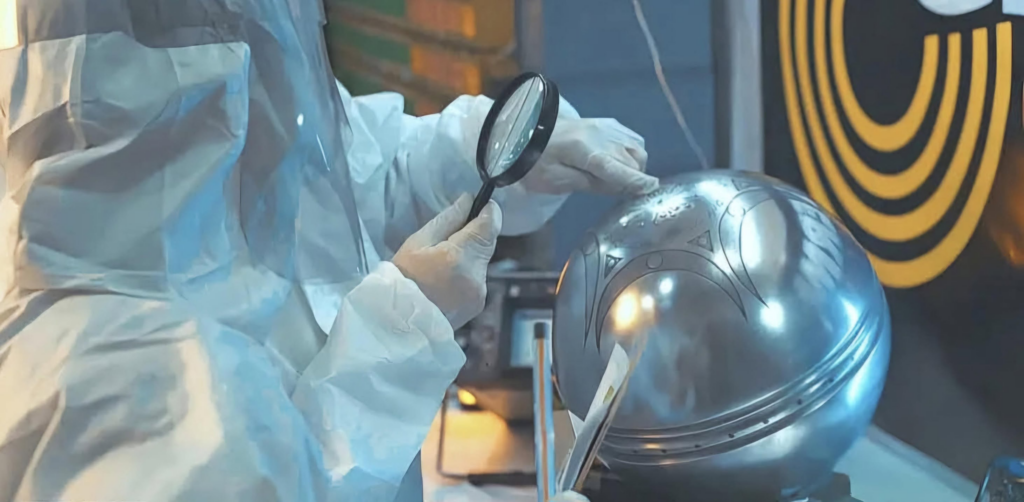
The Buga Sphere moved the discussion from an image in the air to an alleged piece of hardware. In March 2025, José Arias reported finding a metallic sphere near Buga, Colombia, after a companion recorded it in flight. Arias passed it to his cousin, David Vélez, who retained it for roughly two months before the object entered Jaime Maussan’s research and media network and was transported to Mexico.
The promoted claims are dramatic. The sphere has been described as initially weighing about two kilograms, lacking visible welds, bearing engraved symbols, and containing concentric layers, internal sphere-like structures, fibers, and a central component. Later claims included changing weight, electromagnetic effects, and an ancient radiocarbon date for resin associated with the object.
The public evidence does not presently sustain those stronger conclusions. Accounts disagree about whether imaging showed nine or eighteen internal spheres. No complete raw CT dataset, calibrated weighing record, accredited materials report, controlled electromagnetic log, or peer-reviewed analysis has been released. Widely repeated claims of an official university validation have not been matched by an institutional report. The object passed through private hands before testing, and the advertised dating report contained serious inconsistencies concerning the client and sample description. The fibers and polymers described in media reports are also compatible with terrestrial manufacture.
This does not mean the object should be ignored. It means that its physical existence and its claimed aerial history must be tested separately. A seamless-looking shell can be manufactured by several terrestrial processes, while “no visible welds” is not equivalent to “no method of assembly.” The decisive program would place the object under neutral custody, publish full-resolution CT and microscopy files, map every sampling location, repeat mass and field measurements under blinded controls, examine tool marks and adhesives, and distribute samples to independent laboratories.
For now, there is no demonstrated link between the Buga object and the spheres recorded by U.S. military sensors beyond morphology. Patrick Jackson, whose network hypothesis is often mentioned in the same conversation, has himself publicly called the Buga Sphere fake. It should therefore not be presented as corroboration of his model.
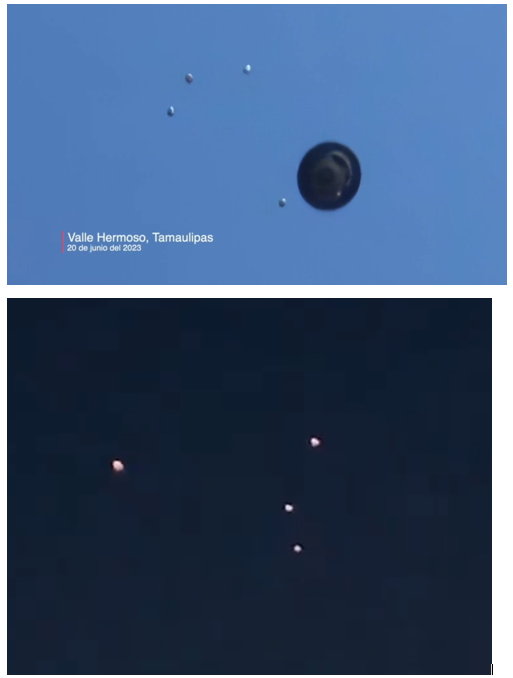
Patrick Jackson’s sphere-network hypothesis
Jackson is an information-technology and reverse-engineering specialist who developed his model in the independently published 2020 book Quantum Paranormal and The Sphere Network published in 2025. He proposes that recurring spheres form a layered, nonhuman monitoring and defense architecture rather than a collection of unrelated craft.
In his model, high-altitude Type 1 spheres operate in groups, often triangular or V-shaped, to locate, track, and sometimes intercept targets. Type 2 spheres work lower in the atmosphere as communication relays. Small Type 3 spheres operate near terrain or inside buildings, creating a local data mesh. Jackson extends the model into paranormal research by proposing that some poltergeist-like effects are protective or diversionary responses produced when low-level nodes transmit energy or data.
The hypothesis, detailed in his new book The Sphere Network, is powerful as a systems narrative because it offers roles, hierarchy, communication paths, and intent. It also creates predictions. If the network exists, recurring formations should survive calibrated triangulation; the same size and altitude classes should recur across independent datasets; relay appearances should precede or accompany high-altitude formations; and optical events should correlate in time with specific radio, microwave, magnetic, thermal, or radiation signatures.
Those tests have not yet been met publicly. Jackson’s evidence base consists largely of selected photographs, videos, historical comparisons, and his interpretation of repeated geometry. There is no peer-reviewed event catalog with blind classification, measured baselines, released multisensor files, false-positive rates, or independent replication. Triangles are also easy to find in crowded skies, and three unresolved points do not by themselves demonstrate trilateration, communication, or interception.
I do not dismiss the model because it is ambitious. I ask it to become more scientific. Jackson’s hypothesis could be tested through synchronized stations separated by known baselines, continuous all-sky imaging, radar and radio monitoring, pre-registered geometric criteria, and predictions recorded before an event. If one sphere class reliably signals the appearance or movement of another, the network should reveal temporal and spatial relationships that chance, satellites, aircraft, balloons, and selection bias cannot reproduce.
This hard-object branch broadens the orb question without dissolving its categories. A luminous orb might be an atmospheric event, an energetic envelope, or an interface. A metallic sphere might be a balloon, drone, probe, vehicle, or sensor node. The same technology could conceivably appear reflective in daylight and luminous when active, but that remains a hypothesis. The work ahead is to discover whether we are seeing one system in different states or several unrelated phenomena wearing the same geometry.
Chris Bledsoe and the relational orb
No modern experiencer has done more to place orbs at the intersection of UAP, spirituality, healing, and official interest than Chris Bledsoe.
In his 2023 memoir UFO of God, Bledsoe recounts a crisis near North Carolina’s Cape Fear River in January 2007. He says he walked away from his companions, prayed for help, encountered luminous phenomena and beings, experienced missing time, and returned believing that a chronic illness had been healed. Other members of the group reported frightening phenomena that night. Bledsoe describes continuing appearances of lights around his family, visits by researchers and people with government or space-program backgrounds, and a later encounter with a feminine figure he calls the Lady.
Bledsoe’s interpretation is emphatically relational. The lights are not merely machines crossing airspace. In his account they participate in a moral and spiritual drama centered on compassion, healing, warning, and a transformation in human consciousness. He understands them as benevolent, although the original encounter included fear and profound disruption, and he has also cautioned that no one really knows their identity.
This is where language must do careful work.
Evidence: Bledsoe has published a detailed first-person account and a large, continuing archive of photographs and videos. Relatives, visitors, public skywatch participants, and third-party production crews have reported seeing and recording lights with him in North Carolina and at other locations. This recurrence is his case’s strongest evidentiary feature. It shows that the narrative did not end with one memory from 2007 and creates opportunities for prospective testing.
Witness interpretation: Bledsoe attributes healing, guidance, and spiritual intent to the phenomenon and identifies the Lady through a religious and divine-feminine frame. Publicly available medical records or an independent clinician’s assessment do not establish the claimed healing.
Researcher opinion: The sustained interest of credentialed visitors makes the case culturally and investigatively significant. Third-party television investigations have added low-light, thermal, and even EEG observations, but edited programs are not the same as a blind, independently replicated experiment. A light visible in one low-light camera and absent from a thermal imager can be important, but the result also depends on range, field of view, sensitivity, and synchronization. None of this proves that an agency validated Bledsoe’s ontology, healing claims, or every light in his videos.
Hypothesis: If a subset of orb phenomena is intelligent, Bledsoe’s case suggests that the light may function as an interface, a perceptible form through which a more complex agency manages distance, emotion, and attention.
That last proposition is not established. It is, however, more faithful to Bledsoe’s narrative than reducing the lights to vehicles. Some individual clips may prove to have different origins, and each one must be screened on its own merits. The cumulative record still matters. Repeated appearances with other observers are a legitimate research target, especially when the next session can be monitored in advance. The case belongs in any serious history because it shows what happens when the orb ceases to be a sighting and becomes a relationship. UAPedia’s full case review, Chris Bledsoe and the Living Sky, explores the testimony, imagery, official interest, spiritual interpretation, and points of dispute in greater depth.
An experiencer can be honest and mistaken about a particular light. A meaningful event can include both an external anomaly and later interpretation. A conventional photograph can become part of an authentic healing journey. Psychological or spiritual consequence does not prove physical origin, but neither does an optical explanation erase the consequence.
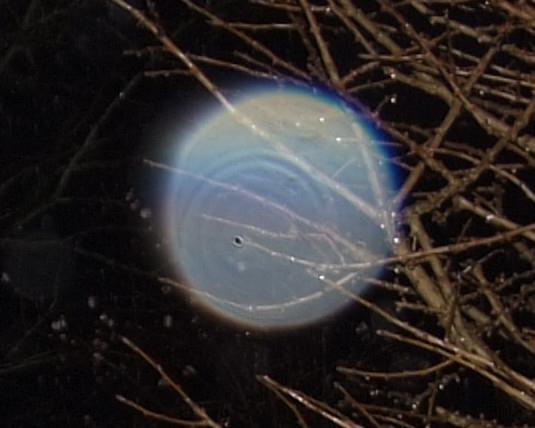
This may be the single most important lesson from Mara Steenhuisen-Siemonsma’s 2022 doctoral research. Her ethnography interviewed 20 orb experiencers, excluded one limited contribution from the findings, and consulted eight additional specialists. It was not a physics experiment and did not prove that photographed orbs are conscious beings. It documented how people move through what she calls “Seeing the Light,” “Being in the Light,” and “Being the Light.” An unexpected image or visual event can become perceived interaction, then a transformed identity and purpose.
Participants interpreted orbs as deceased loved ones, angels, nature beings, protective companions, star beings, teachers, or manifestations of consciousness. They described comfort in bereavement, healing, guidance, ecological warning, and positive life change. The small, self-selecting, predominantly older Western sample cannot tell us how common these experiences are. It does show that the question of intent arises from lived patterns, not only from internet speculation.
Here we need a principle I call convergence without equivalence. Heinemann’s selected CCD photographs, Bledsoe’s recurring lights, the Tedesco Brothers’ multispectral spheroids, Skinwalker Ranch’s experiment-associated targets, the PURSUE videos, and other close encounters do not automatically document one phenomenon. Their capture mechanisms, contexts, and their evidentiary strengths differ. Collectively, however, they defeat the claim that the entire orb subject begins and ends with dust or camera artifacts. What converges is not yet an identity. It is a research question that has survived several kinds of observation.
What could orbs be?
The strongest model is not one answer but a layered ecology. At least seven explanatory families deserve a place at the table.
1. Optical and computational images
Dust, droplets, pollen, insects, defocus, lens flare, bokeh, sensor blooming, digital zoom, stabilization, sharpening, and compression can all produce round or apparently structured images. This category explains a large and repeatedly demonstrated class of photographic orbs, especially those noticed only after flash photography. It also explains why color and internal pattern cannot be read as a reliable code without raw data and optical controls. It does not, by itself, explain every controlled residual image, directly witnessed luminous sphere, continuous video sequence, or multisensor event.
2. Familiar objects and lights
Balloons, aircraft, drones, lanterns, planets, stars, rocket launches, reentry debris, and satellites can look spherical when unresolved. Distance strips away structure. A bright source becomes a point, and the camera renders that point as a disc. AARO’s success in identifying satellite flares shows how a new analytic tool can make an old mystery disappear without accusing the witness of dishonesty.
3. Rare atmospheric electricity
Ball lightning is real, even if its mechanisms remain debated. In 2012, researchers accidentally recorded the optical spectrum of a luminous event following a cloud-to-ground lightning strike, publishing the result in Physical Review Letters in 2014. Soil elements appeared in the spectrum throughout its brief lifetime. Ball lightning can therefore account for some luminous spheres near thunderstorms or electrical activity. It is not a universal solvent. An explanation should match the weather, duration, motion, recurrence, and energy behavior of the actual case.
4. Plasmas and dusty plasmoids
Natural plasma models have long been proposed for Hessdalen and other persistent lights. In 2026, atmospheric chemist John Birks offered a more specific hypothesis: meteor-derived iron, nickel, and magnetic oxide nanoparticles could assemble into weakly confined dusty plasmoids. Oxidation could provide heat and buoyancy, while triboelectric discharges could produce light, flicker, color, splitting, and merging without intelligence.
The idea is valuable because it makes testable predictions. A genuine example should show the predicted spectrum, infrared heat, magnetic or electric disturbance, motion broadly compatible with wind and convection, and perhaps meteoritic residues. But the paper remains under review. Its 508 selected cases came from subjective screening of public reports, with most reports labeled as lanterns reassigned to the orb category. There was no direct sampling, calibrated range, or spectroscopy. An author correction also reduced a key meteor-frequency calculation by an enormous factor and acknowledged that the paper does not explain how enough dust would concentrate and flocculate in the lower atmosphere. The model is intriguing, not confirmed.
5. Physical devices, probes, or vehicles
A sphere is structurally simple, orientation-independent, and compatible with a probe designed to observe from any direction. Reports of metallic spheres, formation flight, pacing, station-keeping, and apparently controlled acceleration motivate a technological hypothesis. The weakness is that a luminous image may reveal the shape of an emission or sensor response, not the shape of the source. Even when a sphere is physically present, behavior that looks controlled does not identify its builder.
6. Organisms or self-organizing life-like systems
Some researchers have proposed living plasmas or atmospheric organisms. The attraction is understandable. Orbs are sometimes described as clustering, zig-zagging, dividing, avoiding, or approaching. But those verbs can smuggle agency into ambiguous motion. Convection, electromagnetic forces, focus changes, and observer movement can imitate life. A biological claim would require evidence of metabolism, reproduction, homeostasis, information processing, or a material body, none of which is established by scientific evidence.
7. Consciousness-mediated or spiritual presences
Experiencers frequently report that orbs arrive after prayer, grief, meditation, invitation, or a request for confirmation. Some report repeated companion lights, telepathic impressions, healing, or synchronized personal meaning. These patterns are central to Bledsoe’s account and Steenhuisen-Siemonsma’s interviews. They should be documented as experience data.
They do not yet tell us whether the source is an external intelligence, an altered mode of perception, a mind-matter interaction, a culturally shaped interpretation, or some combination. The most generative version of this hypothesis treats consciousness as a variable to test, not a word that ends the investigation. UAPedia’s Orbs and the Mind develops protocols for doing that carefully.
These families can coexist. A single witness may photograph dust during a night when a real distant light is also present. A natural plasma may become spiritually meaningful. An intelligent source might use a luminous sheath, a projected image, or an atmospheric process as camouflage or interface. A mixed ecology is less satisfying than one grand answer, but it is far more consistent with the evidence.
What is their intent?
Intent is the most important question and the easiest one to answer too quickly.
Movement is not motive. A light that approaches a person may be drifting, following wind, responding to camera movement, or deliberately closing distance. A light that appears during prayer may be an extraordinary response, a coincidence made salient by emotion, or an event noticed because attention has narrowed toward the sky. Before inferring intent, we need to establish agency.
Several experiencers have moved beyond asking whether every orb is real. Some may be artifacts, and some are genuine events. The unresolved question is which cases contain an external phenomenon, which of those show contingent behavior, and whether any behavior rises to communication. That is a far more useful inquiry than forcing every report into belief or denial.
I propose a five-level agency ladder:
- Persistence: The phenomenon remains present long enough to observe, but no response is demonstrated.
- Structured behavior: It changes speed, direction, formation, brightness, or altitude in ways that appear organized.
- Contingent response: It changes in a time-linked and specific way after an observer’s action or signal.
- Repeat relationship: Comparable responses recur across sessions with the same person, place, or protocol.
- Information transfer: The interaction conveys novel, specific information that can be independently checked.
Even though some move all the way to step five, most orb reports never move beyond the first two levels. That does not make them unimportant. It means claims of communication should be proportional to the evidence. A strong interaction case should rule out cueing, selective memory, multiple unreported attempts, flight paths, atmospheric phenomena, drones, and camera movement. Ideally, a protocol should be preregistered, independently observed, time-synchronized, and replicated.
If agency is eventually demonstrated for a subset, several intentions remain possible.
Hypothesis, observation: The orb is a probe or remote sensor. Pacing aircraft, lingering near people, or appearing at strategic sites can resemble surveillance. This is a plausible behavioral reading, not proof of an observing party.
Witness interpretation, invitation: Many experiencers describe the phenomenon as encouraging attention, curiosity, or a widening of worldview rather than delivering conventional sentences. The “message” may be the encounter itself.
Witness interpretation, healing and protection: Bledsoe and participants in Steenhuisen-Siemonsma’s research describe comfort, healing, warning, and companionship. These outcomes are real as reports and sometimes life-changing. Their causal source remains unverified.
Hypothesis, warning or transformation: Environmental concern and an approaching change in human consciousness recur in experiencer narratives. The pattern deserves comparative study, but shared culture can also spread shared themes.
Researcher opinion, interface: The orb may not be the agent at all. It may be the visible boundary of something normally outside human perception, a low-information form selected because it can be seen without revealing the source. In this model, light is a user interface rather than a vehicle.
Hypothesis, deception or manipulation: Benevolence should not be assumed simply because an experience feels beautiful. Human history contains powerful experiences that inspire both compassion and certainty. Any purported intelligence should be judged by consistency, verifiable information, respect for autonomy, and long-term effects, not by spectacle alone.
Evidence, no intent: In many cases there is no agent. Dust has no message. A satellite flare has no interest in the witness. Ball lightning does not visit to teach us, even if seeing it changes a life.
My own position is cautiously optimistic. Across the experiencer literature, positive transformation, compassion, connection, and reduced fear appear often enough that I will not dismiss them. Yet hope is strongest when it does not require certainty. If a genuine intelligence is present, rigorous observation will not insult it. If the phenomenon invites human maturity, then discernment may be part of the invitation.
A research program worthy of the mystery
We already know how to improve the evidence.
For every future orb event, investigators should preserve the original file and metadata, record exact time and location, note the viewing direction and angular size, capture the wider scene before zooming, and document weather, lightning, aircraft, satellites, launches, celestial objects, and local light sources. The ideal optical array would pair a normal IR-cut camera with a matched full-spectrum or near-infrared camera, then add synchronized cameras on a measured baseline, SWIR, calibrated thermal imaging, and a wide-field context view. Forward particle illumination or a dedicated near-lens monitor can reveal dust, droplets, and insects without assuming them. Spectrometers can distinguish reflected light, thermal emission, electrical discharge, fluorescence, and chemical lines. Radar, lidar, magnetometers, electric-field meters, RF monitoring, infrasound, and weather instruments add independent channels.
The most important instrument may be transparency. Positive events, control runs, failed interaction attempts, calibration files, and complete time-synchronized data should be released together. The next generation of Heinemann, Tedesco, Skinwalker, Hessdalen, and experiencer-led research will advance fastest when independent analysts can test the same file without first accepting the investigator’s interpretation.
Interaction claims need equal care. A witness can choose among randomly generated prompts hidden from the camera operator, while the sky and all attempts are recorded continuously. Success criteria should be written in advance. Repetition matters more than one dramatic coincidence. Failed trials must be counted. Independent teams should be able to test the same protocol without requiring allegiance to a belief system.
Experiencer research also needs humanity. People should not have to choose between being believed uncritically and being treated as broken. Interviews can document sequence, emotional state, health context, prior expectations, other witnesses, and later effects without forcing an ontological verdict. Medical or psychological support should be offered when experiences are frightening, disruptive, or destabilizing. Care is not debunking.
Finally, all reports should be sorted before they are compared:
- Image-only photographic orbs, where no one saw a source at the time.
- Directly observed luminous spheres, including multi-witness events.
- Sensor-defined spheroidal targets, where “shape” may depend on resolution and processing.
- Relational or experiential orbs, where apparent interaction, meaning, or transformation is central.
That simple separation would resolve much of the argument. It would also reveal which residue truly deserves the word anomalous.
The light and the lesson
Orbs have traveled through our history as celestial symbols, divine signs, strange aerial bodies, camera artifacts, instrument detections, companions, warnings, and promises. We have repeatedly made the mistake of asking which single story owns them.
None does.
Some orbs are dust. That sentence is true, useful, and radically incomplete. Some are distant technology or familiar lights stripped of detail. Some may be rare self-organizing atmospheric events. Some selected photographs remain unexplained after the investigators’ controls, even though their extraordinary interpretation is disputed. Some luminous objects have been seen directly, recorded in sequence, witnessed by more than one person, or reported through military and scientific instruments. A small, difficult class may even involve a relationship between consciousness and the environment that our present methods are only beginning to approach.
We should therefore say it without embarrassment: there is a genuine orb mystery. The mystery is not every floating circle on a screen. It is the residue that survives optical analysis, contextual identification, witness comparison, and increasingly sophisticated instrumentation.
As an experiencer, I know that this phenomenon is real as part of the nature of reality. Science does not need to certify that the experiences affected me. It can help determine what was physically present, how it behaved, and whether others can observe the same pattern. I still need better evidence before I know more about who caused it, or what it intended. That boundary is not a retreat from mystery. It is how we learn to meet mystery without surrendering either wonder or judgment.
If some of these lights are looking back, the most intelligent response is neither worship nor ridicule. It is attention, compassion, measurement, and the courage to let the answer be plural.
Note on the metallic spheres
Although the metallic spheres are clearly linked to luminous orb activities, they are in a different category, possessing more “engineered” appearances and behaviours.
Claims Taxonomy
Verified
- Optical backscatter, defocus, flash geometry, and near-lens particles can produce circular photographic “orbs.” Controlled and stereo-photography experiments establish a large ordinary image-only class.
- Heinemann and Ledwith published a selected body of CCD photographs, described near-infrared response and common artifacts, and reported sequential, rotation, paired-camera, and apparent-occlusion tests. This verifies the research record, not their interpretation of invisible spiritual agency.
- Rare natural ball-lightning events exist. At least one event associated with a lightning strike has been recorded spectroscopically.
- Recurring unusual lights have been reported and instrumented in Hessdalen Valley since the early 1980s, although the archive contains both conventional and unresolved events.
- John and Gerald Tedesco published a ten-month Long Island field study using multispectral cameras, two-axis X-band radar, RF, acoustic, radiation, weather, astronomy, marine-traffic, and aircraft checks. The paper documents their methods and reported detections, while its strongest physical interpretations await released synchronized data and independent analysis.
- AARO’s FY2025 report states that spheroidal objects and lights were the two most commonly reported morphologies among cases with usable descriptions. The same report documents extensive resolutions involving satellite flares and other ordinary sources.
- PURSUE preserves four FBI-associated northeastern videos from 2021 through 2025. The FBI assessed the reporters as credible or highly credible, and the government authenticated the 2024 pond video as unaltered apart from privacy cropping. This verifies the records and custody, not an exotic cause.
- PURSUE Release 05 contains six contemporaneous secondary recordings of an AC-130J infrared display. The companion intelligence report uses the term “cold orbs,” while AARO cautions that the public clips are screen recordings rather than native sensor data.
- Chris Bledsoe has published a sustained experiencer narrative and a continuing photographic and video archive involving luminous phenomena, healing claims, and spiritual interpretation. Third parties have reported observing lights with him; institutional validation of his ontology is not established.
Probable
- The Tedesco Brothers’ claims involving estimated size, intelligence, interaction, and transmedium behavior remain probable pending event-level synchronized raw data and independent reanalysis.
- “Orb” describes several visually similar phenomena with different causes rather than one unified class.
- A large share of distant sky luminous-orb reports can be attributed to satellites, aircraft, balloons, drones, lanterns, celestial objects, reentry events, and camera effects when adequate contextual data are available.
- A group spanning selected controlled photographs, directly observed lights, recurring videos, and multisensor reports remains genuinely unresolved because available data do not support confident attribution.
Disputed
- The extreme distances, sizes, and velocities inferred for targets in the 2022 Ukrainian preprint are disputed because they depend on contested colorimetric and geometric assumptions. The paper does not establish that its luminous detections were three-dimensional spheres.
- The 2026 meteor-derived dusty-plasmoid model is testable but unconfirmed, remains under review, and has required a major numerical correction.
- The NRGscapes infrared “orbs” and “rods” have not been shown to exclude insects, particulates, defocus, or motion smear. Claims of size, extreme speed, investigation, or nonhuman control exceed the reported method.
- Heinemann and Ledwith’s interpretation of selected photographs as intelligent spiritual manifestations remains disputed. Their book does not provide the complete corpus, identical calibrated cameras, environmental particle counts, blind classification, or independent replication needed to establish that conclusion.
- Skinwalker Ranch has produced experiment-associated optical targets and instrument returns, but claims that lights passed through terrain, responded intelligently, or disclosed a portal are not established by the edited public record.
- Claims that some orbs are conscious beings, technologies, biological entities, spiritual messengers, or agents of healing remain unverified and case-dependent.
- Apparent response, merging, formation behavior, and witness-specific recurrence may suggest agency, but these features require controlled replication before intent can be inferred.
Legend
- Ancient and early modern stories of sacred globes, celestial armies, and portentous spheres are culturally and historically important. When later authors identify them as the same phenomenon as modern UAP or photographic orbs, that continuity is interpretive rather than established.
Misidentification
- Demonstrated cases include near-lens dust and moisture, insects, defocused stars and planets, balloons, drones, lanterns, aircraft lights, rocket or reentry events, and satellite flares. Misidentification describes an error of attribution, not dishonesty.
Speculation Labels (Summary)
Evidence: Records, images, sensor detections, optical experiments, documented witness statements, publication history, and measurable outcomes.
Witness Interpretation: Personal meanings attributed to orbs, including deceased loved ones, angels, star beings, healing, protection, warning, and spiritual transformation.
Researcher Opinion: Analytical models such as the orb as interface, the value of relational case comparison, and the need to treat morphology separately from ontology.
Hypothesis: Dusty plasmoids, technological probes, atmospheric organisms, consciousness-mediated manifestation, information-bearing interaction, observation, warning, healing, deception, or other purposeful activity.
Suggested UAPedia Crosslinks
- Orbs and the Mind: A Careful Guide to “Interactive” UAP
- Chris Bledsoe and the Living Sky
- Hessdalen Valley: Norway’s Most Studied UAP Lights
- Nuremberg 1561, Basel 1566: Europe’s Orb UAPs
- Sweden’s Sun-Spheres Report: Biskopsberga 1808
- From WWII Foo Fighters to Vietnam War Spheres
- Non-Human Consciousness and UAP Interaction
- Global High-Strangeness Hotspots
- Environmental and Atmospheric Phenomena Catalog
References
Acharius, E. (1816). Account of an extraordinary meteoric phenomenon (J. C. Hauff, Trans.). The North-American Review, 3, 320–322. JSTOR record
All-domain Anomaly Resolution Office. (2026). Fiscal year 2025 consolidated annual report on unidentified anomalous phenomena. U.S. Department of War. Official report
All-domain Anomaly Resolution Office. (2026). UAP report documents and imagery releases. U.S. Department of War. Official records page
Banias, M. J. (2020, January 30). Inside Skinwalker Ranch, a paranormal hotbed of UFO research. Vice. Field report
Birks, J. W. (2026). UAP orbs: Magnetically confined dusty plasmoids produced by meteors [Preprint]. EGUsphere. https://doi.org/10.5194/egusphere-2026-2921
Birks, J. W. (2026, July 13). Correction to Eq. 2 and Table 2 [Author comment]. EGUsphere. https://doi.org/10.5194/egusphere-2026-2921-AC1
Bledsoe, C. (2023). UFO of God: The extraordinary true story of Chris Bledsoe. UFO of God. Google Books record
Cen, J., Yuan, P., & Xue, S. (2014). Observation of the optical and spectral characteristics of ball lightning. Physical Review Letters, 112(3), 035001. https://doi.org/10.1103/PhysRevLett.112.035001
Defense Visual Information Distribution Service. (2026, June 12). FBI-UAP-PR001, “Triangle Orbs,” 2021 [Video]. Official video and case summary
Defense Visual Information Distribution Service. (2026, June 12). FBI-UAP-PR002, “Red Orb Rotation,” 2022 [Video]. Official video and case summary
Defense Visual Information Distribution Service. (2026, June 12). FBI-UAP-PR003, “Orbs Over the Pond,” 2024 [Video]. Official video and case summary
Defense Visual Information Distribution Service. (2026, June 12). FBI-UAP-PR004, “Northeastern Orb Sighting,” 2025 [Video]. Official video and case summary
Defense Visual Information Distribution Service. (2026, August 7). DOW-UAP-PR117, unresolved UAP report, Gulf of Oman, 2021 [Video]. Official video and methodological caution
Edgar Cayce Foundation. (n.d.). Readings 262-33 through 262-61 [Archival collection, including reading 262-40]. ArchiveSpace record
Federal Bureau of Investigation. (2026, February). FBI-UAP-D009: FD-302-67, Northeastern orb sighting [Interview summary]. In U.S. Department of War, PURSUE Release 03. Official PDF
Hall, K., & Pickering, J. (2006). Beyond photography: Encounters with orbs, angels and light-forms. 6th Books.
Heinemann, K., & Ledwith, M. (2007). The orb project. Atria Books/Beyond Words. Publisher record
History. (n.d.). 7 of the most mind-bending moments on Skinwalker Ranch. The Secret of Skinwalker Ranch. Program summary
Howe, L. M. (2000). Mysterious lights and crop circles. Paper Chase Press.
Knight, J. Z., & Ramtha. (2004). Ramtha: The white book (Rev. and expanded ed.). JZK Publishing. WorldCat record
Loeb, A. (2022). “Down to Earth” limits on unidentified aerial phenomena in Ukraine: Comment on arXiv:2208.11215 [Preprint]. arXiv. https://doi.org/10.48550/arXiv.2210.01972
Morgan, A. D., & Tyson, B. (2024). Unidentified anomalous phenomena (UAP): Orb and rod object form and location centric abundance (NRGscapes Lab Research Paper Publication No. 001). NRGscapes Lab. https://doi.org/10.13140/RG.2.2.33897.51046
NASA. (2023). UAP independent study report. NASA Science
Parsons, S. T. (2014). Orbs, some definitive evidence that they are not paranormal. Paranthropology: Journal of Anthropological Approaches to the Paranormal, 5(2), 44–49. Journal archive
Ramtha’s School of Enlightenment. (2003, March 21). Participatory universe: Legacy series [Audio recording]. Official catalog
Schwartz, G. E., & Creath, K. (2005). Anomalous orbic “spirit” photographs? A conventional optical explanation. Journal of Scientific Exploration, 19(3), 343–358. ResearchGate record
Steenhuisen, M. (2020). Orbs: A preliminary search in the RERC archives. Journal for the Study of Religious Experience, 6(1), 24–44. Journal article
Steenhuisen, M. (2022). Orbs and spiritual experiences: In an orbital shape of mind. Culture and Cosmos, 26(1), 109–129. https://doi.org/10.46472/CC.0126.0211
Steenhuisen-Siemonsma, M. J. (2022). Orbs in the skyscape: An exploration of spiritual experiences with anomalous light phenomena [Doctoral dissertation, University of Wales Trinity Saint David]. ProQuest Dissertations & Theses Global. ProQuest record
Strand, E. P. (1984). Project Hessdalen 1984: Final technical report. Project Hessdalen. Project archive
Tedesco, J. J., & Tedesco, G. T. (2024). Eye on the sky: A UAP research and field study off New York’s Long Island coast. Open Journal of Applied Sciences, 14(8), 2267–2295. https://doi.org/10.4236/ojapps.2024.148152
Thompson, E. H. (Ed.). (1873). The life of the Venerable Anna Maria Taigi, the Roman matron. Fr. Pustet. Internet Archive scan
Vallée, J. (1965). Anatomy of a phenomenon. Henry Regnery Company. Internet Archive scan
Veles, O. A. (2022, September 18). Critical review of Zhilyaev et al., “Unidentified aerial phenomena I: Observations of events” [Technical review, in Ukrainian]. Main Astronomical Observatory, National Academy of Sciences of Ukraine. Institutional PDF
Wood, D. (2012). The Orb Zone: Accounts of experimentation into the natural causes of “orbs.” Journal of the Society for Psychical Research, 76(906), 17–31. Journal abstract
Zhilyaev, B. E., Petukhov, V. N., & Reshetnyk, V. M. (2022). Unidentified aerial phenomena I: Observations of events [Preprint]. arXiv. https://doi.org/10.48550/arXiv.2208.11215
SEO Keywords
orbs UAP, UAP orbs, luminous spheres, orb sightings, orb history, photographic orbs, spiritual orbs, Klaus Heinemann orbs, The Orb Project, near-infrared orb photography, CCD orb photography, IR-cut filter, hot-mirror filter, Chris Bledsoe orbs, UFO of God, Tedesco Brothers, Nightcrawler UAP research, Eye on the Sky, Skinwalker Ranch orbs, Hessdalen lights, ball lightning orbs, plasma UAP, dusty plasmoid hypothesis, AARO sphere reports, PURSUE orb files, Orbs Over the Pond, Northeastern Orb Sighting 2025, cold orbs, interactive UAP, consciousness and UAP, orb intent, orb beings, spherical UAP, light-based UAP, orb misidentification, UAP experiencer, UAPedia orbs