
On a cool Friday night in September 1952, Flatwoods was the kind of West Virginia town that didn’t expect history to come looking for it. A few kids tossed a football around on a school playground, the hills rose dark and familiar behind them, and the world beyond Braxton County felt very far away.
Then the sky cracked open with light.
What happened next lasted minutes, but it has lived for decades: a brilliant object streaking overhead, a climb up a dark hillside with a borrowed flashlight, a choking mist that felt wrong in the lungs, and a figure at the edge of the beam with eyes that reflected like hot coals. Depending on who you ask, Flatwoods hosted a rare, messy collision between astronomy and something stranger, or it hosted a near-perfect recipe for misperception: a fireball, a startled animal, a beacon light, and a group of witnesses primed by adrenaline.
Flatwoods matters because it is not “just” a light in the sky, and it is not “just” a monster story. It is an early Cold War UAP encounter that spilled across categories: aerial anomaly, close-range confrontation, physical aftereffects, media amplification, and official attention that seemed to arrive and vanish like the thing the kids thought they saw drop behind the ridge. That hybrid quality is exactly why the case continues to polarize researchers and why it remains useful as a case study in how UAP events can behave like narratives that refuse to stay in their lane.
The first act: a fire in the sky
The core timeline begins with the schoolyard. Accounts agree that a group of young people were outside near the Flatwoods school when they saw a fiery object move across the night sky and appear to drop behind a nearby hill. In Joe Nickell’s later reconstruction (drawing on earlier sources and local interviews), the object “apparently” seemed to land on a hilltop near the Bailey Fisher farm.
This “landing” detail is a hinge point. A bright meteor, especially a large fireball, can produce an illusion of descent as it travels away from the observer’s line of sight and drops below a ridgeline. That does not make the witnesses foolish, it makes them human. One of the most consistent features of meteor misinterpretations is the sincerity with which people insist it “came down” nearby.
Later documentation associated with early Air Force-era tracking and indexing practices explicitly treats the Flatwoods aerial sighting as astronomical in nature. In a declassified list of early September 1952 sightings, “Flatwoods, West Virginia” appears with an evaluation of “Astro (METEOR).”
That is worth taking seriously, and also worth describing carefully. This kind of entry is best understood as an official-era index artifact: it shows how the event was categorized in a record system, and it signals that analysts felt confident about the sky stimulus. It does not, by itself, function as a full case narrative, a complete evidentiary audit, or a resolution of every claim connected to the hillside encounter.
And yet, if Flatwoods were only a meteor report, it would be a footnote. The case became legendary because the witnesses did not stop at the sky. They went to the hill.

The second act: the climb, the mist, the eyes
Here is where Flatwoods becomes Flatwoods.
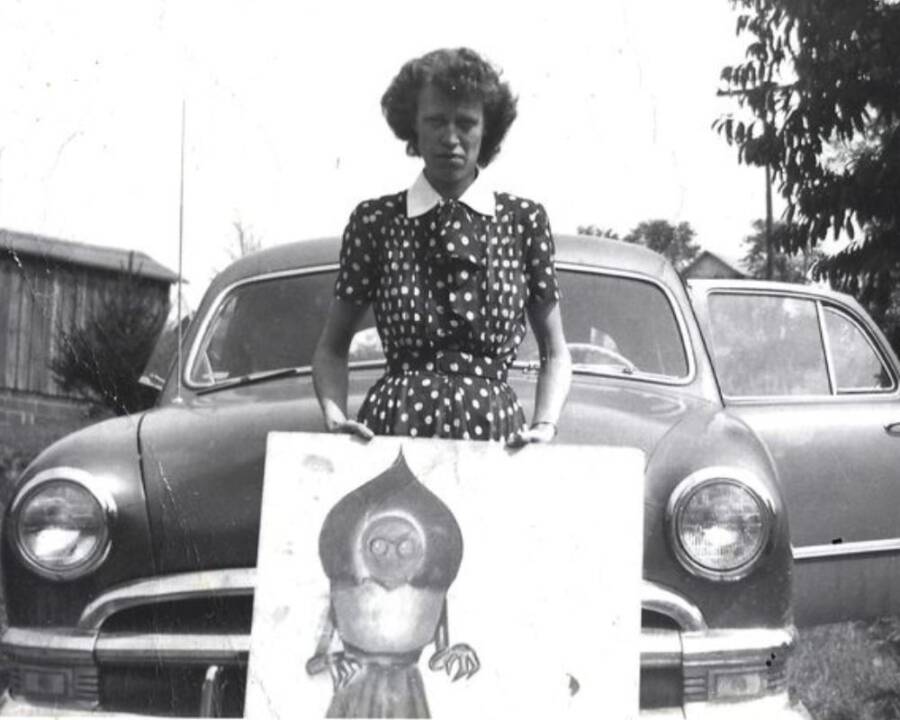
After seeing the object, the children ran to the home of Kathleen May, who is consistently described as a central adult witness in early retellings. Gray Barker’s early account (published in Fate in January 1953) frames her as initially skeptical until she saw an unusual glow, after which a party headed up the hill with a flashlight. Barker quotes May comparing what she saw to Frankenstein, a line that traveled fast because it translated terror into a pop-culture image anyone could grasp.
The cast of witnesses is fairly stable across early sources: Mrs. May; her sons (often given as Eddie and Fred/Freddie); older teens Gene Lemon and Neil Nunley; and younger boys Ronnie Shaver and Tommy Hyer. Ages vary slightly depending on source, which is common in press-driven cases, but the group composition remains recognizable.
Barker’s published excerpt emphasizes three sensory elements that become recurring motifs in later versions: a pulsing reddish light ahead, a mist that seemed like fog but smelled sharp and irritating, and then the sudden shock of an animate presence revealed by the flashlight.
A parallel early account, printed in the Civilian Saucer Investigation (CSI) Bulletin in Winter 1953, adds additional texture and escalates the physiological component. In that telling, Gene Lemon aimed the flashlight at what he assumed were the eyes of a raccoon on a limb. Instead, the beam “petrified” the group as an “enormous figure” appeared to “come to life,” accompanied by a reddish glow in the head region, a greenish glow through “cloth-like” lower parts, and a hissing release of dense mist that allegedly made several witnesses violently ill.
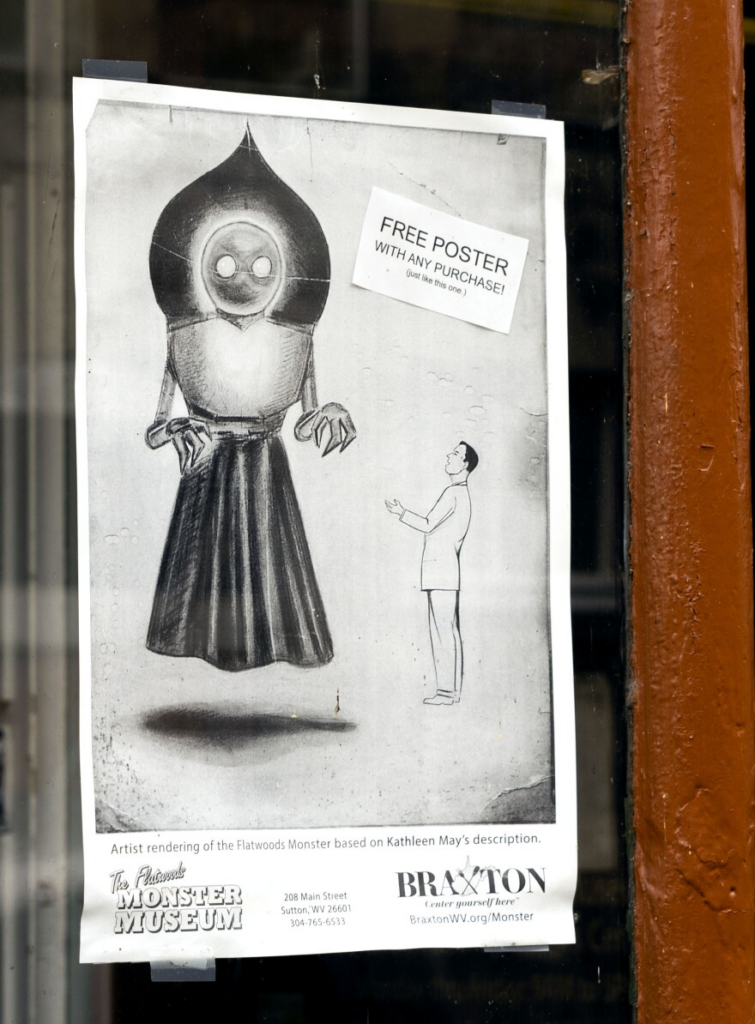
Nickell’s later summary, while skeptical of the extraordinary interpretation, preserves key descriptive elements that show up repeatedly in earlier sources: two shining “animal-like” eyes, a towering “man-like” figure with a round red “face” framed by a pointed hood-like shape, a hissing sound, a gliding motion toward the group, and a pungent mist noticed at the scene.
Whatever the ultimate explanation, it is difficult to overstate how quickly the encounter moves in human terms. A group of kids and one adult climb into darkness, see a red pulsing light through trees, smell something that makes their throats tighten, and then, for only a moment, a figure fills the flashlight beam. The brain does not file that under “interesting.” It files it under “survival.”
They ran.
The morning after: tracks, smells, and the machinery of a story
Flatwoods did not keep the experience private. Reports spread quickly enough that, according to multiple retellings, local authorities and press figures entered the chain almost immediately.
Nickell notes that locals, and later a sheriff and deputy, searched but reported finding nothing at the site, at least in the way one would expect from a conventional crash. That detail matters because it reveals a tension that will persist throughout Flatwoods commentary: witnesses describe a vivid close encounter; follow-up searches often describe an absence of unambiguous physical evidence.
Then come the “traces.”
The CSI Bulletin account asserts that A. Lee Stewart Jr. of the Braxton Democrat visited the hill and still smelled an odor, found “tracks” where something reportedly landed, and recovered an odd piece of black plastic-like material that did not burn when tested. It also claims that soil and vegetation samples were collected by Air Force officers.
Nickell preserves the “skid marks” tradition too, noting that Stewart discovered skid marks in roadside grass and an odd gummy deposit that were interpreted as evidence of a landed craft, while also documenting a local counter-claim that the marks and oily residue came from a vehicle, specifically Max Lockard’s pickup truck, driven up the hillside after the news spread.
This is one of the most instructive parts of Flatwoods as a case study. Not because it “debunks” anything, but because it demonstrates how quickly an environment can be overwritten by well-meaning human activity. Once the rumor is out, people go to look. Vehicles climb where they do not normally climb. Flashlights sweep. Boots crush grass. Curious locals create traces that later investigators inherit as “evidence.” The scene becomes contaminated in the plain, forensic sense.
And still, the story keeps its sharpest edge: the witnesses insist they saw a presence.
Early publications: how Flatwoods entered UAP history
Flatwoods is unusually well documented for a small-town 1952 case because it landed in the prime territory of early saucer-era publishing.
Barker’s Fate article is important less because it is definitive and more because it captures the moment when the case shifted from local shock to national lore. Barker describes traveling to Flatwoods and questioning the witnesses separately, concluding that while details had been colored by retellings, the accounts held together in “minor” variations.
The CSI Bulletin report, in turn, functions like a proto-investigative memo, claiming confirmation of Barker’s report and adding supplemental allegations: severe sickness, convulsions, swollen throats, and other aftereffects, alongside claims of odors, marks, and later observations that were interpreted as craft-related.
Whether one accepts every claim or not, the publication record shows something clear: Flatwoods immediately became contested terrain. Even in the early 1950s, the case was not a single narrative but a bundle of narratives moving at different speeds through different channels.
Official attention: what “the file” can and cannot tell us
Any honest Flatwoods analysis has to hold two ideas at once.
First, there is credible indication that the aerial component of the event aligned with a broader meteor-like phenomenon observed across multiple areas that night. Nickell cites commentary that a meteor of “considerable proportion” was visible across a wide region. And the Air Force-era indexing of the Flatwoods sighting as “Astro (METEOR)” is a real artifact of official categorization.
Second, government-era evaluations often focus on the part of an event that is easiest to categorize and easiest to close. A meteor closes a sky report neatly. It does not engage the messy human encounter on the hillside, the odors, the mist, the fear response, and the contradictions between witnesses who had only seconds to perceive something in poor light.
That gap between “the light in the sky” and “the experience on the ground” is not unique to Flatwoods. It is a recurring fault line in UAP history, and it is one reason modern researchers still return to early case files and ask what the paperwork was designed to accomplish.
For wider context on how Air Force-era record systems shaped what counted as “data,” UAPedia’s own backgrounder on Blue Book’s record structure and research limitations is worth reading alongside Flatwoods, precisely because it makes clear how case categorization can compress complexity into a checkbox.
The controversy engine: meteor, owl, beacon… and the parts that don’t fit
If you want to understand why Flatwoods never stops sparking debate, you have to see how neatly the skeptical model can be assembled, and then you have to notice what it leaves behind.
Nickell’s interpretation has become the best-known skeptical synthesis: a meteor explains the bright object; a pulsing red light could be attributable to a distant aircraft beacon (especially since earlier investigator Ivan Sanderson reportedly acknowledged multiple beacons visible from the hilltop); “landing traces” could be mundane vehicle marks; and the “monster” could be a barn owl perched on a limb, its large head and facial disc exaggerated by darkness, glare, and fear, and its scream matching the hissy, rasping sounds described.
As a model, it has strengths. It respects the reality of the meteor-like sky event. It uses known animal behavior and known human perception effects. It also accounts for why descriptions of the figure’s lower half are often vague, since many witnesses may have seen only the upper portion within the flashlight cone and foliage.
But Flatwoods is sticky because the witness experience includes more than sight.
The odor and mist appear early and often. Barker’s excerpt includes the pungent, irritating mist before the “reveal.” The CSI Bulletin expands this dramatically into claims of severe sickness and lingering throat issues. Nickell acknowledges a pungent mist and reports of nausea, even while disputing extraordinary conclusions.
So, what could that be?
A prosaic explanation might reach for natural fog, plant irritants, disturbed soil, or even psychosomatic effects amplified by panic. That is not an insult to witnesses. Panic is a physiological event. Hyperventilation can produce throat irritation, nausea, and a sense of choking. A steep climb at night, adrenaline, and the sudden fright of a lunging animal could plausibly produce real symptoms in multiple people.
At the same time, one frequently repeated medical detail needs careful framing. The CSI Bulletin reports that a doctor compared the symptoms to mustard gas. That comparison is part of the case’s early publication record, but it is not independently verified in publicly available medical documentation, and it should be treated as a reported claim rather than a confirmed clinical conclusion.
That distinction is critical. Flatwoods is full of these moments where the story can escalate beyond what documentation can cleanly support.
Why Flatwoods still matters in UAP studies
Even if you believe the meteor-and-owl model explains most components, Flatwoods remains valuable because it shows how UAP events can fuse with “entity” motifs in a single night. That fusion is not an after-the-fact embellishment invented decades later. The “monster” component is present in the earliest wave of reporting and publishing, not just in modern folklore retellings.
And if you do not accept the owl model as sufficient, Flatwoods becomes something else: an early, high-strangeness close encounter where witnesses describe a mechanical or suited figure, a defensive mist or exhaust, and physical aftereffects.
Stanton Friedman’s later reflections, written after meeting Kathleen May and revisiting the site with researcher Frank Feschino, push strongly in that direction. Friedman argues the figure was not well captured by later popular drawings and suggests details such as a more mechanical appearance and an “oily” substance, while also criticizing skeptical approaches for failing to engage witnesses directly.
Friedman’s stance is not a court transcript, and parts of his account depend on interviews and materials not embedded in the public primary-source chain. But it illustrates something sociologically important: Flatwoods functions as a litmus test. It reveals how much weight a researcher places on site context, on witness interviews, and on the possibility that an event can include both a conventional stimulus (a meteor) and a second, anomalous layer (a close encounter) in the same temporal window.
That layered possibility is uncomfortable because it prevents easy closure. It invites a “both/and” framework rather than an “either/or.”
In the broader saucer-era context, Flatwoods sits in the same year as the famous 1952 Washington, D.C. wave of sightings and radar-visual drama. The early 1950s were saturated with reports, and the cultural atmosphere mattered. People were primed, yes. But priming does not manufacture a shared sensory experience out of nothing. It shapes interpretation, not necessarily perception.
The Flatwoods effect: how memory, media, and place shape a case
Flatwoods is also a lesson in how a case becomes a legend without necessarily becoming false.
The “Flatwoods Monster” image most people know today, a tall figure with a spade-shaped hood and glowing eyes, is a cultural artifact. It is a synthesis of witness description, illustrator imagination, and media repetition. Even Friedman, arguing for an anomalous interpretation, suggests the popular depiction drifted away from what witnesses actually described.
Nickell, on the other hand, emphasizes how later accounts “garbled” details and how mythmaking accretes.
Both can be true at once. Cultural drift is real. But drift does not erase an originating event. The question is not whether the story evolved. It did. The question is what the initial witnesses experienced in that first, brief moment when the flashlight beam hit the shape behind the tree.
That is the irreducible core of Flatwoods: a few seconds of perception that drove a group of people to flee in terror, followed by a long afterlife of interpretation.
Implications: what Flatwoods teaches investigators now
Flatwoods, treated carefully, offers practical implications for UAP research methodology and for how we interpret early twentieth-century and mid-century cases as a continuous record.
It shows why investigators must separate “sky stimulus” from “ground encounter” without assuming one automatically explains the other. A meteor can be real and still not explain everything witnesses later report.
It demonstrates how fast a site becomes contaminated and why early documentation is priceless. The CSI Bulletin’s claims about odors, samples, and marks may be disputable, but they show what early investigators thought mattered: physical traces, physiological effects, and chain-of-custody questions, even if those standards were unevenly applied in practice.
It reminds us that witness testimony is not “data” in the sterile sense, but it is evidence in the human sense. Barker’s emphasis on interviewing witnesses separately is rudimentary by modern standards, but it reflects an instinct that remains valid: independent narratives matter.
Finally, Flatwoods is an early indicator of how UAP cases can bleed into what later researchers would call “high strangeness,” a domain where the phenomenon appears to produce not just aerial anomalies but theatrical, confrontational, and symbolically charged encounters at close range.
Claims taxonomy
Disputed
The Flatwoods incident contains a sky component compatible with a meteor and categorized that way in an Air Force-era index entry, but the close encounter component remains unresolved due to conflicting interpretations, inconsistent trace evidence, and heavy dependence on witness testimony under extreme conditions.
Speculation labels
Hypothesis
Flatwoods may represent a layered event in which a widely observed meteor created the initial trigger, while a separate, localized stimulus on the hillside, whether animal, beacon, or something anomalous, produced the “entity” perception and the reported physical effects. This hypothesis treats the meteor classification as compatible with, not automatically dismissive of, the close encounter component.
Witness interpretation
In early retellings, witnesses framed the aerial object as a “saucer” and the hillside figure as a monstrous, non-human presence capable of emitting mist or gas. The language of the era, “flying saucer,” “monster,” “worse than Frankenstein,” reflects how people reached for available cultural hooks to describe something that overwhelmed them in seconds.
Researcher opinion
Skeptical investigators argue the event is best explained through a meteor plus misidentification of a barn owl and other mundane factors, emphasizing perception limits and local explanations for traces and lights. Other researchers argue that witness fear, reported physical effects, and inconsistencies in the owl model warrant keeping an anomalous interpretation open, especially when later interviews suggest details not captured in early popular art.
References
Barker, G. (1953). The monster and the saucer (originally published January 1953). Fate Magazine. Retrieved from https://www.fatemag.com/post/the-monster-and-the-saucer
Civilian Saucer Investigation. (1953). More on the “Green Monster” (CSI Bulletin No. 2, Winter 1953). Retrieved from https://www.project1947.com/shg/csi/csiv1-2.html
Friedman, S. T. (2002, December 15; updated 2011; archived 2024). Flatwoods Monster UAP event (essay). The Black Vault. Retrieved from https://www.theblackvault.com/casefiles/flatwoods-monster-ufo-event/
Nickell, J. (2000). The Flatwoods UAP Monster (original title uses “UFO”). Skeptical Inquirer, 24(6). Retrieved from https://centerforinquiry.s3.amazonaws.com/wp-content/uploads/sites/29/2000/11/22164839/p15.pdf
NICAP. (n.d.). The 1952 sighting wave (chronology entry including Flatwoods). Retrieved from https://www.nicap.org/chronos/1952FIXED.htm
U.S. Air Force (declassified-era record, hosted by NICAP). (1952). 9–16 September 1952 sightings list (includes Flatwoods evaluation “Astro (METEOR)”). Retrieved from https://www.nicap.org/docs/520913allentown_docs.pdf
UAPedia. (n.d.). Project Blue Book Records & Data Archives. Retrieved from https://www.uapedia.ai/wiki/project-blue-book-records-data-archives/
UAPedia. (2026). Transient astronomical objects and the UAP flap of 1952. Retrieved from https://www.uapedia.ai/wiki/transient-astronomical-objects-and-the-uap-flap-of-1952/
UAPedia. (n.d.). The Socorro landing incident (1964). Retrieved from https://www.uapedia.ai/wiki/socorro-landing-incident-1964/
SEO keywords
Flatwoods Monster, Flatwoods incident 1952, Braxton County Monster, West Virginia UAP, 1952 UAP sightings, Project Blue Book Flatwoods, Air Force UAP records Flatwoods, meteor classification Flatwoods, Kathleen May witness, Gene Lemon, Neil Nunley, UAP close encounter, UAP entity encounter, UAP folklore origins, early Cold War UAP cases, Flatwoods meteor and monster