
On a quiet stretch of West Texas highway, the strangest part was not the light in the sky.
It was the silence.
You can picture the scene even if you have never been to the South Plains: flat land that makes the horizon feel close, farm roads that run like ruler lines, and small towns where “late night” means a gas station sign and a few porch lights holding the darkness at bay. In early November of 1957, drivers around Levelland found themselves rolling into something that didn’t just look unusual, it behaved unusual. Engines died. Headlights blinked out. Radios went dead. Then, as suddenly as it began, everything returned to normal, as if whatever had reached into the machinery had let go. (NICAP Levelland case file)
The Levelland incident has become one of the foundational UAP cases in the “vehicle interference” category, not because it offers a tidy answer, but because it refuses to cooperate with simple dismissal. The reports came in quickly, from different directions, from people who were not traveling together, who didn’t share a single vantage point, and who described a repeating pattern: a bright, low object near the roadway and an immediate, temporary failure of the vehicle’s electrical and ignition systems. Dr. J. Allen Hynek, who would later shape how the public thinks about “close encounters,” treated Levelland as a case where the coincidence argument starts to buckle. (NICAP Levelland case file)
A phone call that sounded like panic
The story, as we can reconstruct it from witness statements and contemporaneous reporting, starts like a lot of UAP cases start: someone calls the police and sounds shaken enough that the person answering has to decide, fast, whether it’s a crank, a drunk, or something real.
In Hynek’s widely circulated account (drawn from The UFO Experience and reproduced by NICAP), Levelland patrolman A. J. Fowler received the first of several similar calls around 11:00 p.m. on November 2, 1957. The caller was Pedro Saucedo, who said he and his companion Joe Salaz had been driving a truck four miles west of Levelland when a brilliantly lit, fast-approaching object swept close. Saucedo’s statement described a “big flame” that he initially mistook for lightning, followed by the detail that made Levelland famous: the object “put my truck motor out and lights.” (NICAP Levelland case file)
That’s already a lot to ask a small-town officer to take at face value. But Saucedo added two elements that show up again and again across the Levelland reports: a sense of heat and a sense of proximity. He said the object was close enough and intense enough that he “had to hit the ground,” and he estimated a long, “torpedo” form with bright coloration. (NICAP Levelland case file)
If this had been the only call, Levelland might have become a footnote, filed away with a shrug. Hynek himself admits that, standing alone, a single frightened witness is easy to discount. The problem is that the phone didn’t stop ringing. (NICAP Levelland case file)
When one stalled engine becomes a pattern
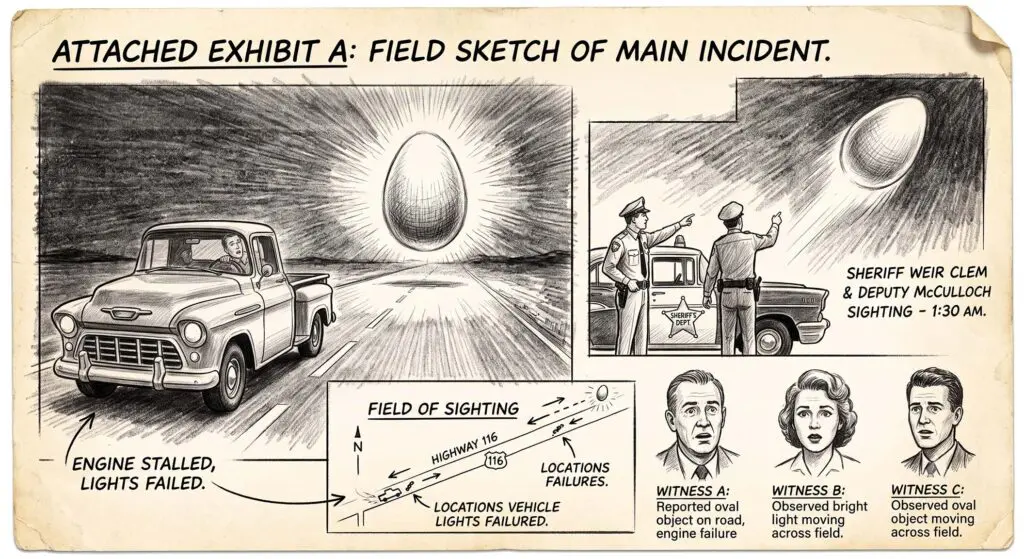
About an hour after Saucedo’s call, Fowler received another report, this time from a man in the Whitharral area. The description changed, but the structure of the event did not. The witness reported an egg-shaped, brilliantly illuminated object, low and close, “sitting in the middle of the road.” As he approached, his engine failed and his headlights went out. When he stepped out, the object rose, and as it climbed its light blinked out. Then the car started normally. (NICAP Levelland case file)
A short time later, another call came in from another Whitharral-area witness who also described a glowing object on the road, followed by the same sequence: engine stops, lights fail, object departs, the vehicle “heals itself.” (NICAP Levelland case file)
Hynek’s account goes further, pulling in a signed statement from Project Blue Book files: at 12:05 a.m., a 19-year-old Texas Tech freshman driving roughly nine miles east of Levelland reported his engine sputtering, an ammeter jump, the motor “cutting out,” and then the headlights dimming and going out. Only after stepping away from the hood did he notice an oval object ahead on the road, glowing bluish-green. He watched it for several minutes before it rose “almost straight up” and vanished “in a split instant,” after which the car operated normally again. (NICAP Levelland case file)
Then came more. At about 1:15 a.m., a truck driver from Waco, northeast of Levelland on what locals called the “Oklahoma Flat Road,” told Fowler his engine and headlights failed as he approached within about 200 feet of a brilliant, egg-shaped object that blinked “like a neon sign.” He reported a roar as it shot straight up and streaked away. (NICAP Levelland case file)
This is where the case stops feeling like a single odd event and starts feeling like a temporally grouped cluster: multiple similar episodes, separated by distance but packed into the same narrow window of night. Hynek reports that Fowler said fifteen calls came into the police station in direct reference to the UAP, and that callers were “very excited.” Hynek focuses on seven specific car-disablement episodes clustered into roughly two hours, and he uses the phrase “out of the statistical universe” for the odds that all of them are coincidence if they are truly independent reports. (NICAP Levelland case file)
Even if you don’t agree with Hynek’s phrasing, the underlying point lands: coincidences can happen. Repeating coincidences, with matching mechanics, in a tight time window, are much harder to wave away without doing the work.
Law enforcement sees it too, briefly
A question readers often ask about Levelland is simple and fair: if something was really out there, did anyone official actually see it?
Yes, but the official sightings are the kind that frustrate anyone hoping for a clean “gotcha” moment. They are brief, partly descriptive, and not paired with a perfectly documented instrument record. They still matter, because they show that the event wasn’t confined to a single civilian witness or a single dramatic storyteller.
Hynek reports that by around 1:30 a.m., Sheriff Weir Clem and Deputy Pat McCulloch were out on the roads, being updated by Fowler as they drove. On the Oklahoma Flat Road, the two men spotted an oval-shaped light, described as a “brilliant red sunset across the highway,” lighting up the pavement ahead of them for about two seconds. Patrolmen Lee Hargrove and Floyd Gavin were following behind, and Hargrove’s signed statement described a strange flash down the roadway, moving east to west, close to the ground. Constable Lloyd Ballen also reported a fast-moving flash. (NICAP Levelland case file)
Hynek adds another detail that makes Levelland unusually rich for a 1950s case: Fire Marshal Ray Jones, also searching for the object, said his headlights dimmed and his engine sputtered (but did not fully die) as he saw a streak of light north of the Oklahoma Flat. It’s a small detail, but it matters because it suggests “vehicle effects” were not always identical, even on the same night, and that we’re probably dealing with a range-dependent or intensity-dependent interaction rather than a simple on/off switch. (NICAP Levelland case file)
The official explanation arrives, and the sheriff pushes back
When something like this hits a community, the next phase is predictable: reporters call, rumours spread, and someone in authority tries to put a lid on it.
A United Press dispatch dated November 6, 1957 captures that moment in real time. It notes that an Air Defense Command representative from Colorado Springs was in Levelland trying to “get the facts,” and it quotes Sheriff Clem describing the representative as refusing to offer an explanation, saying he was there only to gather information. The dispatch also notes Reese Air Force Base in Lubbock as part of the official context for the visit. (NICAP United Press reprint)
So far, so professional: show up, interview witnesses, see what you can verify.
Then the public-facing conclusion hardened into a familiar shape. In a later local report preserved by the Portal to Texas History, the Levelland Daily Sun News describes an Air Force announcement framing the light as a “weather phenomenon” identified as “ball lightning,” and it reports the Air Force additionally calling it “St. Elmo’s fire” caused by stormy conditions. The same announcement, according to the paper, said an investigation found only three persons had seen the light, not “dozens” as originally reported. (Levelland Daily Sun News via Portal to Texas History)
This is where Sheriff Clem’s voice becomes one of the most valuable first-hand records we have, because he answers the official narrative directly, in his own words, inside his own time.
“It was definitely something,” Clem told a reporter by telephone. He added that he had seen weather phenomena before and did not accept that explanation. He also pushed back on the witness count, saying the “three persons” claim referred to those who saw it on the ground, while more people saw it in the air, and he included himself in that number. (Levelland Daily Sun News via Portal to Texas History)
The article carries another detail that tends to get lost in modern retellings: Clem said he was receiving letters about the sighting “from all over the United States” and even one from Italy, and that they were still coming in. That’s the social impact, right there, in a single line: a small farming town becoming an international address for the unknown. (Levelland Daily Sun News via Portal to Texas History)
Why “ball lightning” never really solved Levelland
It’s easy to mock the weather explanation now, decades later, but Levelland deserves something better than mockery. “Ball lightning” gets used as a catch-all label because it sits in the public imagination as a real, rare, luminous thing that appears around storms. If you are an investigator under pressure, it has an appeal: it sounds scientific, it fits the word “light,” and it lets you close the file quickly.
The problem is that Levelland isn’t just a light report. It’s a light-plus-effects report.
Hynek, who worked as a scientific consultant to Air Force UAP studies and later became one of the most influential voices urging serious inquiry, admitted something important about Levelland. He wrote that he “hastily concurred” in a “ball lightning” evaluation based on information that an electrical storm had been in progress, but later concluded that was not the case. He noted that observers reported overcast and mist but no lightning, and he pointed out that there is no well-documented evidence demonstrating consistent, repeatable vehicle shutdown as an established property of ball lightning. (NICAP Levelland case file)
In other words, one of the central scientific figures associated with official-era UAP evaluation is telling you, in plain language, that the quick explanation was too quick.
Researcher M. Rullán, looking at Levelland as part of the broader 1957 “Southwest wave,” lays out the problem with even more detail. He reports that Blue Book’s conclusions for the Levelland cluster leaned heavily on “ball lightning” and “unreliable reporting,” and he summarizes Blue Book’s pattern of attributing several vehicle-interference cases to unreliable witnesses, imagination, lightning, meteors, and ball lightning. (Rullán CUFOS paper)
Rullán then makes two points that matter for anyone trying to do honest evaluation.
First, the “social contagion” idea (people embellishing after hearing earlier reports) can possibly account for some reports, especially later single-witness ones, but it struggles to explain a whole set of vehicle-interference cases, including multiple-witness reports and reports close in time to the triggering events. (Rullán CUFOS paper)
Second, the ball lightning hypothesis has its own limitations, not as an insult to atmospheric science, but as a matter of evidence. Rullán notes there is no strong, well-documented evidence linking ball lightning to consistent vehicle shutdown, and he notes that many observers did not report stormy weather. He also observes that ball lightning researchers do not typically list Levelland among canonical cases in their databases, which is a subtle but important signal: specialists in that phenomenon do not appear to be claiming Levelland as “explained.” (Rullán CUFOS paper)
So what Levelland leaves us with is not “weather versus aliens,” but a more serious, more stubborn question: what kind of phenomenon can produce a bright, low, structured-seeming presence near roadways and correlate with temporary, localized vehicle electrical and ignition failures?
Blue Book, pressure, and what “official” really means
To talk responsibly about the “official investigation,” we have to be clear about what Project Blue Book was, and what it was not.
According to a U.S. Air Force fact sheet on Blue Book, the program’s stated objectives were to determine whether UAP posed a threat to national security and whether they suggested scientific or technological information worth studying, while attempting to identify and explain reports wherever possible. (USAF Project Blue Book fact sheet)
That sounds straightforward, but in practice Blue Book lived inside a public-relations environment. Hynek’s Levelland narrative includes a telling note: he states that Blue Book came under “severe pressure,” and he references a memo dated December 4, 1957 in which Captain Gregory complained that the Assistant Secretary of Defense requested an immediate preliminary analysis for the press despite limited data. Hynek also reports that the on-site investigation may have been as thin as a single day of driving excursions and questioning, and that a reporter identified the investigator as an Air Force sergeant. (NICAP Levelland case file)
You don’t have to romanticize Hynek or demonize Blue Book to see what’s happening here. A small town reports something dramatic. The press amplifies it. Washington wants an answer. The system produces one.
That does not make the answer correct.
It does, however, explain why Levelland became a long-running point of friction. It’s a case where the need to conclude appears to have outrun the ability to conclude, and the people who were actually there, including the sheriff, noticed.
McDonald’s “physical effects” argument, straight from testimony
If Hynek represents the “inside-out” critique (a scientific adviser questioning the speed and quality of the official call), atmospheric scientist Dr. James E. McDonald represents the “outside-in” critique: a scientist arguing that the best UAP cases show physical effects that demand more rigorous study.
In a 1968 exchange reproduced by NICAP from McDonald’s testimony before the House Committee on Science & Astronautics, McDonald uses Levelland as his go-to example of vehicle interference. He states that “ten vehicles were stopped” independently within a short area and a two-hour period, and he emphasizes there was “no lightning or thunder storm, and only a trace of rain.” He frames this not as a victory speech for any one explanation, but as a sign that something deserves “much more attention” than it was getting. (NICAP McDonald testimony excerpt)
Even if you take issue with the exact number “ten” versus Hynek’s “seven disablements,” the heart of McDonald’s claim aligns with the record: multiple independent motorists reporting the same kind of mechanical failure in the presence of a luminous, low object. In legal terms, this is corroboration, not proof, and Levelland is strong enough as corroboration that it kept surfacing in serious discussions long after the headlines faded.
The skeptic’s pushback and the “traffic jam” question
No responsible case file lives in a vacuum, and Levelland has always had critics. One of the most common skeptical arguments is basically a common-sense traffic argument: if a UAP can stall engines, why didn’t it stall every engine in the area? Why no massive pileup?
Astronomer Donald H. Menzel, in The World of Flying Saucers, frames this as a key objection to car-stopping narratives, arguing in essence that widespread engine failure would produce dramatic traffic disruptions, and he points to mundane mechanisms like vapor lock as explanations for clusters of stalled cars during extreme weather. (Menzel & Boyd, Project Gutenberg text)
That critique has teeth, but it doesn’t end the conversation, especially not in Levelland’s specific geography.
The Levelland reports largely occur after late evening and into the early morning on rural roads, not in downtown traffic. The witnesses often describe a close approach to a specific object, sometimes “on the road ahead,” sometimes hovering low, with the failure localized to their vehicle and resolving immediately after the object departs. (NICAP Levelland case file)
In other words, the case itself implies a limited range of effect. You can still argue “coincidence” or “mechanical weakness,” but then you have to explain why multiple vehicles, in different locations, would fail in the same time window and then immediately return to normal in sync with the appearance and departure of a luminous object. Hynek’s point is not that coincidence is impossible. It’s that you don’t get to use coincidence as a substitute for analysis. (NICAP Levelland case file)
Levelland wasn’t alone: the 1957 Southwest vehicle-interference wave
One reason Levelland remains so important is that it wasn’t an isolated car-stall story floating in empty space. It sits at the front edge of a wider cluster.
Rullán reports that the 1957 Southwest wave contained a concentration of “vehicle interference” cases, and that the wave began on November 2, peaked November 3, and lasted about nine days. He also emphasizes that while nocturnal light cases were numerous, the vehicle-interference cases drew the most media attention because they were “richer in content” and harder to explain away. (Rullán CUFOS paper)
This broader context does two things.
It weakens the easy dismissal that Levelland is just one town’s overexcited rumor, because similar effect-pattern reports appear across a wider region and over multiple days. (Rullán CUFOS paper)
And it sharpens the real question, because now we’re not just asking “what did Levelland see,” we’re asking “what kind of phenomenon, natural or otherwise, could produce a regional pattern of luminous objects interacting with vehicles?” (Rullán CUFOS paper)
Even contemporary reporting hints at that wider pattern. The United Press dispatch that mentions the Levelland investigation also describes other “egg shaped” and “cigar shaped” objects across Texas, and includes another vehicle-effect report near San Antonio where a driver said an extremely bright object coincided with the failure of his car’s lights and engine. (NICAP United Press reprint)
Levelland is the headline case, but 1957 in the Southwest looks less like a single “incident” and more like a short-lived outbreak of closely related anomalies.
What we can responsibly say is supported by the record
Levelland rewards careful language. There is a lot here, but it is not everything.
We can say that multiple independent witnesses reported close-range encounters with a bright, low object on or near roadways in the Levelland area on the night of November 2–3, 1957, and that several of those witnesses reported temporary engine and headlight failure that resolved when the object departed. (NICAP Levelland case file)
We can say that law enforcement received numerous calls, that officers and local officials went into the field, and that Sheriff Weir Clem publicly disputed the Air Force’s weather explanation, insisting what he saw was not a routine phenomenon and objecting to downplayed witness counts. (NICAP Levelland case file; Levelland Daily Sun News via Portal to Texas History)
We can say that the official public-facing explanation, as reported locally, leaned on “ball lightning” and “St. Elmo’s fire,” and that it triggered immediate pushback from local authorities. (Levelland Daily Sun News via Portal to Texas History)
We can also say that later scientific voices who took the case seriously, including Hynek and McDonald, argued that the weather explanation did not match witness descriptions of conditions and did not engage the vehicle-stoppage element in a scientifically satisfying way. (NICAP Levelland case file; NICAP McDonald testimony excerpt)
What we cannot honestly claim is that Levelland provides hard sensor data, unambiguous photographs, recovered materials, or a single unified description of the object’s shape, color, sound, and behavior. Even in Hynek’s account, the descriptions vary: torpedo-like, egg-shaped, orange ball, bluish-green glow. That variability can mean multiple things, including multiple stimuli, perceptual distortion under stress, or a phenomenon that changes presentation. Rullán explicitly notes that heterogeneity is one reason single-cause explanations struggle. (Rullán CUFOS paper)
So Levelland lands in that category of cases that are strong in testimony, strong in pattern, and weak in instrumentation. It is compelling, not because it proves a conclusion, but because it builds a problem that keeps resisting clean reduction.
Implications: why Levelland still matters now
Levelland’s lasting value is that it forces UAP research to treat “secondary effects” as primary data.
A light in the sky can be misperceived. A light plus synchronized vehicle failure, reported repeatedly and independently, is harder to dismiss without doing engineering-level work. That is why Levelland keeps surfacing whenever researchers discuss electromagnetic interference, physical trace cases, and the gaps between witness narratives and institutional conclusions. (NICAP Levelland case file)
It also matters because it exposes a recurring historical pattern: when institutions are tasked with both investigating and reassuring, the incentive to conclude can outweigh the incentive to deeply test. Project Blue Book’s own public framing emphasizes identification and reassurance, alongside security and scientific aims. (USAF Project Blue Book fact sheet)
Modern researchers have better tools: distributed sensors, vehicle telemetry, ubiquitous cameras, and open-source weather and satellite data. But Levelland is a reminder that tools only matter if the culture of inquiry is willing to use them without prematurely labeling the answer.
Claims taxonomy
Probable
The Levelland 1957 cluster is supported by converging testimony from multiple independent witnesses, contemporaneous law-enforcement involvement, and documented public dispute over the official explanation. However, it lacks multi-sensor instrumentation and contains heterogeneous descriptions that prevent definitive identification. (NICAP Levelland case file; Levelland Daily Sun News via Portal to Texas History; Rullán CUFOS paper)
Speculation labels
Hypothesis
If the reports track a real external stimulus, Levelland is consistent with a localized field effect that temporarily disrupts ignition or electrical systems when a UAP is within a limited range, with rapid recovery once the field is removed. That would align with repeated “failure while present, recovery on departure” sequencing described across multiple witnesses. (NICAP Levelland case file)
Witness Interpretation
Several witnesses describe the object as “on the road” or “landing softly,” which could reflect literal ground proximity or could be a depth-perception artifact at night on flat terrain, where a bright source near the horizon can feel closer and lower than it is. Fear and surprise also compress time and distort size estimates, which may help explain why length estimates (125–200 feet) cluster at very large values. (NICAP Levelland case file)
Researcher Opinion
Levelland reads like a case that deserved rapid-response field protocols that did not exist in 1957: immediate weather verification, independent interviews before cross-contamination, vehicle inspections (battery, ignition, wiring), and triangulation of reported locations against any available radio logs. Hynek’s own regret about agreeing too quickly, and his description of thin on-site follow-up, suggests the case became an example of how not to investigate high-strangeness physical-effects reports. (NICAP Levelland case file)
References
Brewer, O. (1957, November 17). “Definitely Something” Lowmon tells reporter: “Weather phenomenon?” Clem vows what he saw sure wasn’t. The Levelland Daily Sun News (Levelland, TX). (Digitized by University of North Texas Libraries, The Portal to Texas History). https://texashistory.unt.edu/ark%3A/67531/metapth1122797/m1/1/ (Levelland Daily Sun News via Portal to Texas History)
Hynek, J. A. (1972). The UFO Experience: A Scientific Inquiry (excerpt reproduced by NICAP as “The Levelland, Texas, Sightings, November 2, 1957”). National Investigations Committee on Aerial Phenomena (NICAP). https://www.nicap.org/reports/571102levell_hynek.htm (NICAP Levelland case file)
McDonald, J. E. (1968, July 29). Testimony on physical effects associated with UAP sightings (excerpt reproduced by NICAP). National Investigations Committee on Aerial Phenomena (NICAP). https://www.nicap.org/outage_main.htm (NICAP McDonald testimony excerpt)
Menzel, D. H., & Boyd, L. G. (1963). The World of Flying Saucers (Project Gutenberg eBook). Project Gutenberg. https://www.gutenberg.org/ebooks/66639.txt.utf-8 (Menzel & Boyd, Project Gutenberg text)
Rullán, M. (2008). The 1957 Southwest UAP wave (vehicle interference cases and interpretive analysis). International UFO Reporter, 31(3). Center for UFO Studies (CUFOS) PDF archive. https://cufos.org/PDFs/pdfs/rullan.pdf (Rullán CUFOS paper)
United Press. (1957, November 6). Strange objects fly through Texas skies (wire story reproduced by NICAP). National Investigations Committee on Aerial Phenomena (NICAP). https://www.nicap.org/articles/571102midland_article.htm (NICAP United Press reprint)
U.S. Air Force. (1966, February 1). Project Blue Book (public fact sheet / overview). WHS/ESD FOIA Reading Room. https://www.esd.whs.mil/Portals/54/Documents/FOID/Reading%20Room/UFOsandUAPs/proj_b1.pdf (USAF Project Blue Book fact sheet)
UAPedia. (2025–2026). Project Blue Book Records & Data Archives. UAPedia. https://www.uapedia.ai/wiki/project-blue-book-records-data-archives/ (UAPedia: Project Blue Book Records)
UAPedia. (2025–2026). NICAP: The civilian UAP investigative group of the Cold War. UAPedia. https://www.uapedia.ai/wiki/nicap-the-civilian-uap-investigative-group/ (UAPedia: NICAP)
UAPedia. (2025–2026). The Condon Report (1968). UAPedia. https://uapedia.ai/wiki/the-condon-report-1968/ (UAPedia: Condon Report)
UAPedia. (2025–2026). The Control System Theory of UAP. UAPedia. https://www.uapedia.ai/wiki/the-control-system-theory-of-uap/ (UAPedia: Control System Theory)
SEO keywords
Levelland Texas UAP 1957; Levelland UAP incident; 1957 Texas UAP flap; vehicle interference UAP; car engine stall UAP; electromagnetic effects UAP; Project Blue Book Levelland; Weir Clem Levelland; J. Allen Hynek Levelland; James McDonald Levelland testimony; 1957 Southwest UAP wave; ball lightning explanation UAP; St. Elmo’s fire UAP controversy; NICAP Levelland case; close encounter physical effects.